

Cricket
Mastering the Death Overs: A Tactical Bowling & Fielding Plan
Equip your bowlers with a structured, high-pressure execution plan for the final overs, focusing on yorker accuracy, smart variations, and defensive field placements.

What you need
Cricket balls (match condition), Stumps, Target markers/cones, Measuring tape (optional, for marking zones)
1. Overview
The "death overs" (typically overs 16-20 in a T20 match or 41-50 in a One Day International) are the most critical phase of a limited-overs cricket match. Batters are looking to maximize scoring, meaning the margin for error for bowlers is incredibly small.
This set play provides a comprehensive blueprint for bowlers and captains to restrict scoring and take crucial wickets under extreme pressure. By combining disciplined yorker execution, strategic variations, and airtight field placements, coaches can give their teams a distinct advantage in tight finishes.
2. Setup
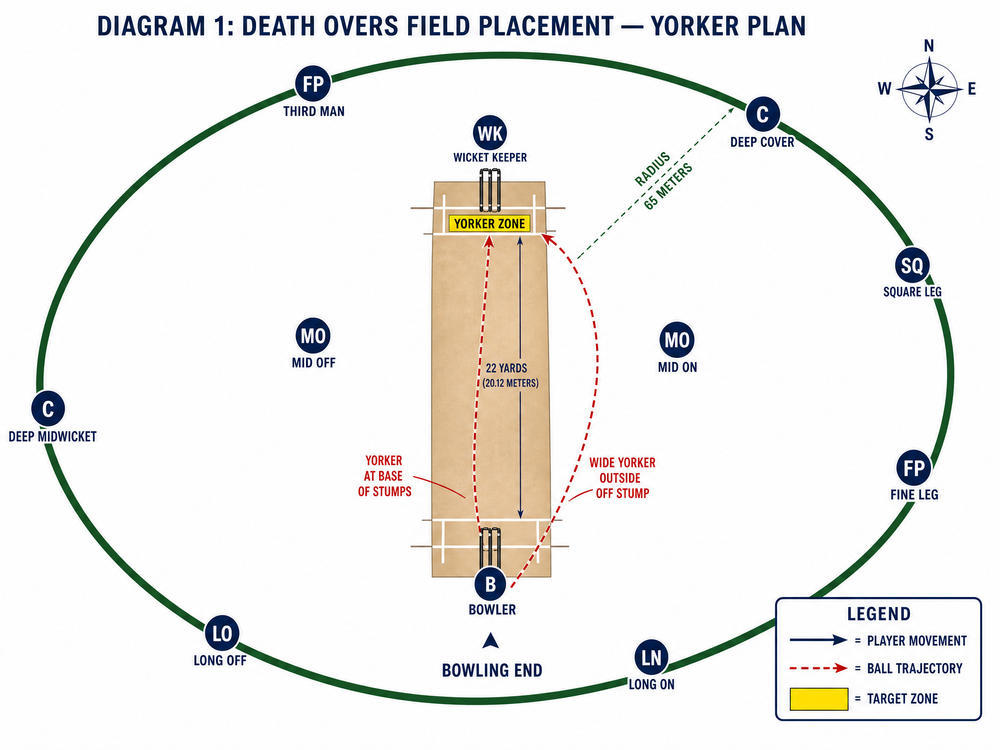
Equipment Needed
- Target cones or markers (for practice drills)
- Minimum of 6 cricket balls (preferably older balls to simulate match conditions)
- Stumps
Pitch & Field Setup
During practice, mark out specific target zones on the pitch using flat markers or cones. The primary focus is the "Yorker Zone" (base of the stumps) and the "Wide Yorker Zone" (outside the off-stump line).
For the field setup, you will need a captain who understands the angles and can communicate adjustments based on the bowler's intended delivery.
3. Step-by-Step Instructions
Phase 1: The Primary Plan (The Yorker)
The foundation of any death bowling plan is the ability to consistently bowl a yorker.
- Set the Field: Ensure your field is set to protect the boundaries straight down the ground (Long-On, Long-Off) and square on the leg side (Deep Midwicket, Deep Square Leg).
- Target Acquisition: The bowler must focus intently on the base of the stumps or the batter's toes.
- Execution: Bowl full and fast. The goal is to get the ball to land within 1 meter of the popping crease.

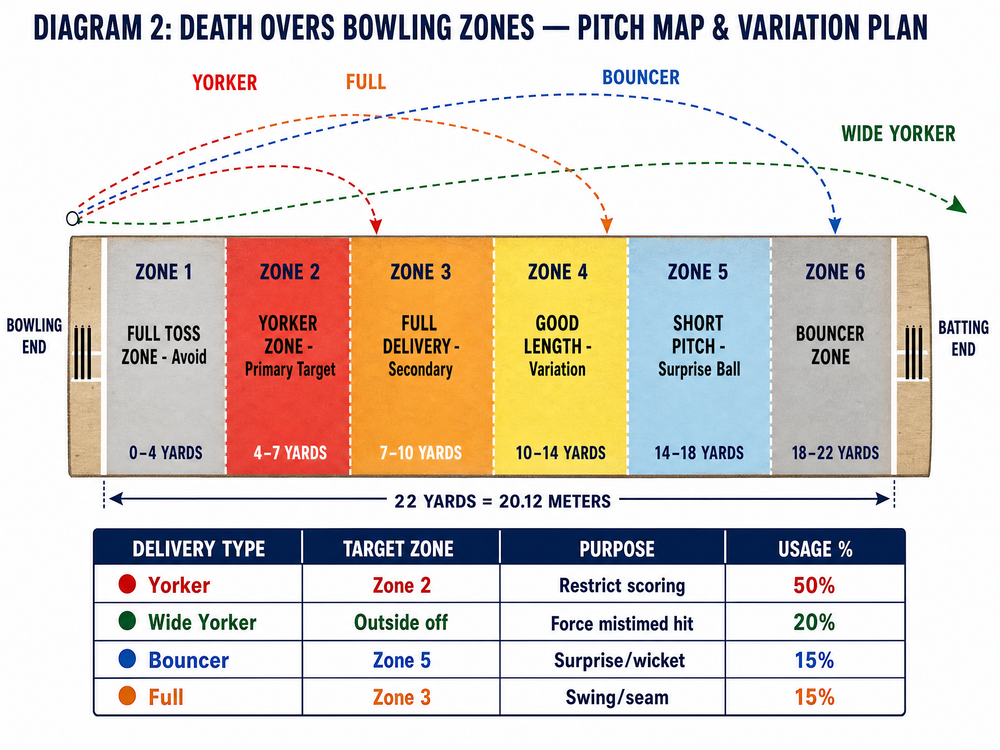
Phase 2: The Variation (Wide Yorker & Slower Ball)
Batters will eventually anticipate the straight yorker and adjust their stance (e.g., moving deep in the crease or shuffling across). The bowler must have variations ready.
- The Wide Yorker: If the batter is backing away to the leg side, push the ball wide outside the off-stump, near the return crease. Ensure the field reflects this (Sweeper Cover, Deep Point).
- The Slower Ball: Use an off-cutter, back-of-the-hand, or knuckleball. The key is arm speed—it must look identical to a fast delivery until the ball is released.
- The Bouncer: Use sparingly to push the batter back into their crease, making the subsequent yorker more effective.
Phase 3: Field Transitions
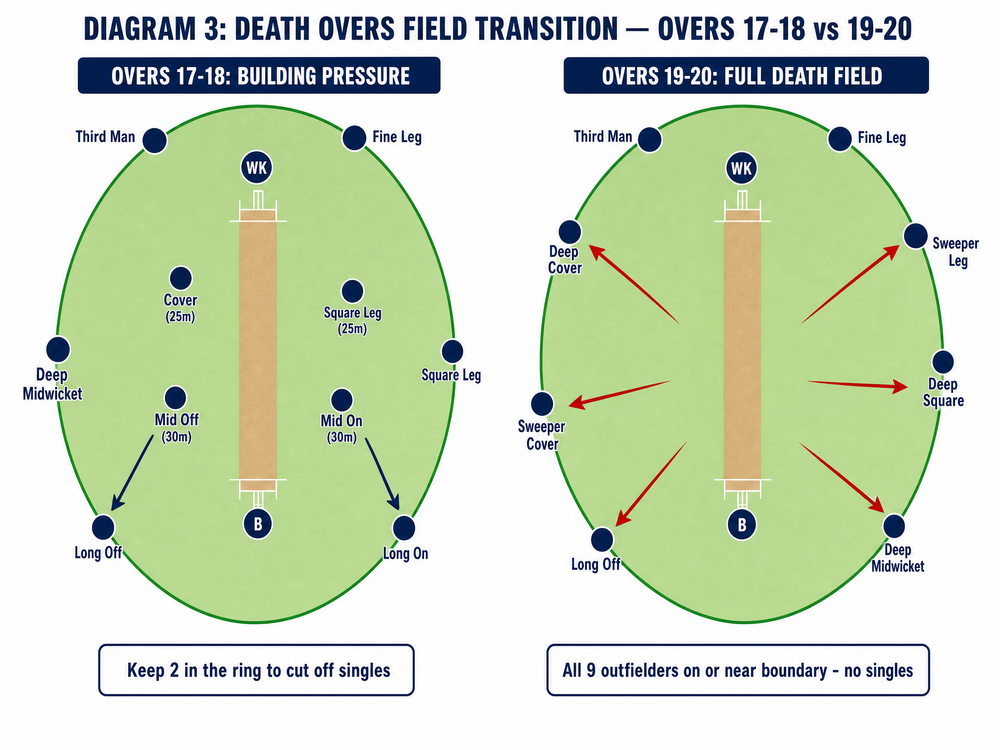
As the innings progresses toward the final over, the field must adapt to the increasing desperation of the batters.
- Overs 16-18: Keep two fielders inside the 30-yard circle in key catching or run-saving positions (e.g., backward point, short third man) to build pressure and force risks.
- Overs 19-20: Push maximum allowed fielders to the boundary. The priority shifts entirely to preventing boundaries. Conceding a single is a victory.
4. Key Coaching Points
- Clarity of Thought: The bowler must commit 100% to the chosen delivery. Hesitation leads to half-volleys or full tosses.
- Field Synergy: The bowler must bowl to the field set by the captain. A wide yorker with no deep cover is a recipe for disaster.
- Practice Under Pressure: Do not just practice yorkers in an empty net. Set scenarios (e.g., "10 runs needed off 6 balls") and have batters actively try to disrupt the bowler.
- Watch the Batter: Bowlers must be aware of the batter's movements just before delivery and be prepared to adjust their line slightly if the batter shuffles.
5. Common Mistakes
- Missing Length: Bowling a full toss or a half-volley instead of a yorker. This is often caused by releasing the ball too early or too late.
- Predictability: Bowling the same ball six times in a row. Even a good yorker can be hit if the batter knows it's coming.
- Ignoring the Field: Bowling on the pads when the field is set heavily on the off-side.
6. Variations & Progressions
- Target Practice: Place a shoe or a cone at the base of the stumps. Award points for hitting the target.
- The 'Call It' Drill: The coach calls out a delivery type (Yorker, Slower Ball, Bouncer) just as the bowler starts their run-up, forcing quick thinking and execution.
- Scenario Nets: Have the batting team need a specific number of runs off the final over, creating match-like pressure.
7. Age Adaptations
- Under 12s: Focus primarily on bowling straight and full. Introduce the concept of a yorker, but do not expect perfection. Variations are less important than consistency.
- Under 14s-16s: Introduce the slower ball and the wide yorker. Begin teaching the tactical relationship between field placements and bowling plans.
- Open/Seniors: Full implementation of the plan, including reading the batter's movements, complex field transitions, and executing under high-pressure scenarios.
