

Cricket
Defensive Field Setting for Spin: Choking the Runs
A practical defensive spin field plan that helps coaches protect boundary zones, choke strike rotation, and create pressure through connected bowling and fielding.

What you need
Cricket balls, Two sets of stumps and bails, 12-16 field-marker cones, Bibs or numbered vests, Stopwatch, Scorecard or whiteboard
1. Overview
A defensive spin field is not a passive field. It is a pressure field: the boundary riders remove the batter’s familiar release shots while the inner ring denies the low-risk single. Use it in a non-powerplay phase when you are defending a total, protecting one side of the oval, or slowing a batter who has begun to dominate pace. It is especially useful from overs 7–16 in T20 cricket or when the batting side needs a boundary every over.
The bowler and field must agree on one plan. Against a right-handed batter, off-spin works middle-and-off and turns in; leg-spin works just outside off and turns away. Make the batter hit against the turn, over a ring fielder, or into the longest part of the ground.
2. Setup
Use a regulation pitch where possible. MCC Law 6.1 defines the pitch as 22 yards (20.12 m) long and 10 ft (3.05 m) wide.[1] In limited-overs cricket, the restriction area is formed by two 30-yard (27.43 m) semicircles centred on the middle stumps and joined by parallel lines; use your local competition’s current playing conditions for the allowed number of boundary fielders.[2]
| Item | Coach setup standard |
|---|---|
| Players | 11: one bowler, one wicketkeeper, nine fielders |
| Equipment | Ball, two sets of stumps, 12–16 cones, bibs, stopwatch, and a scorecard or whiteboard |
| Ground markings | 22-yard pitch; visible boundary; 30-yard circle or cone approximation |
| Timing | Allow 90 seconds to build the field, 20 seconds to walk through the first ball, then bowl 3 blocks of 6 deliveries |
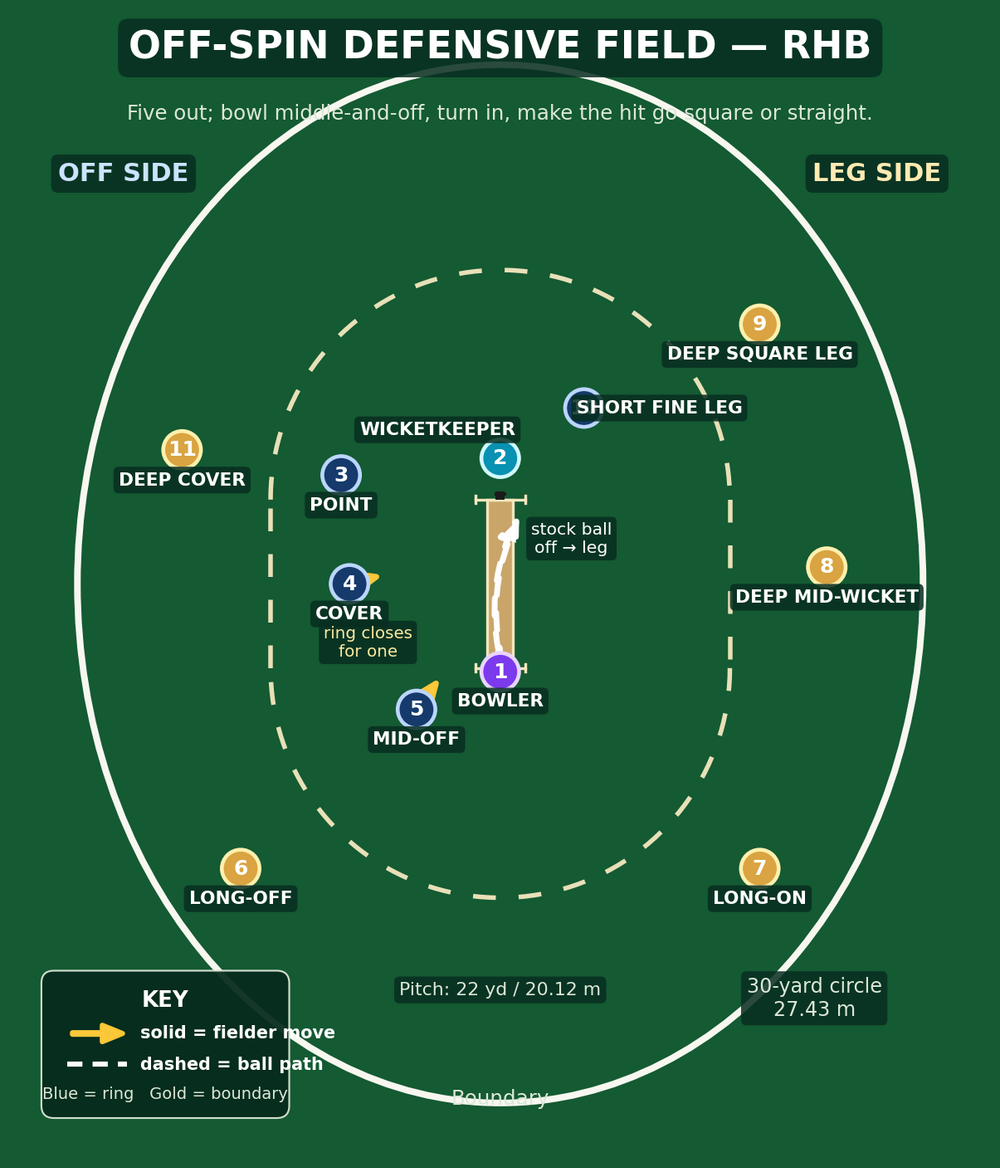
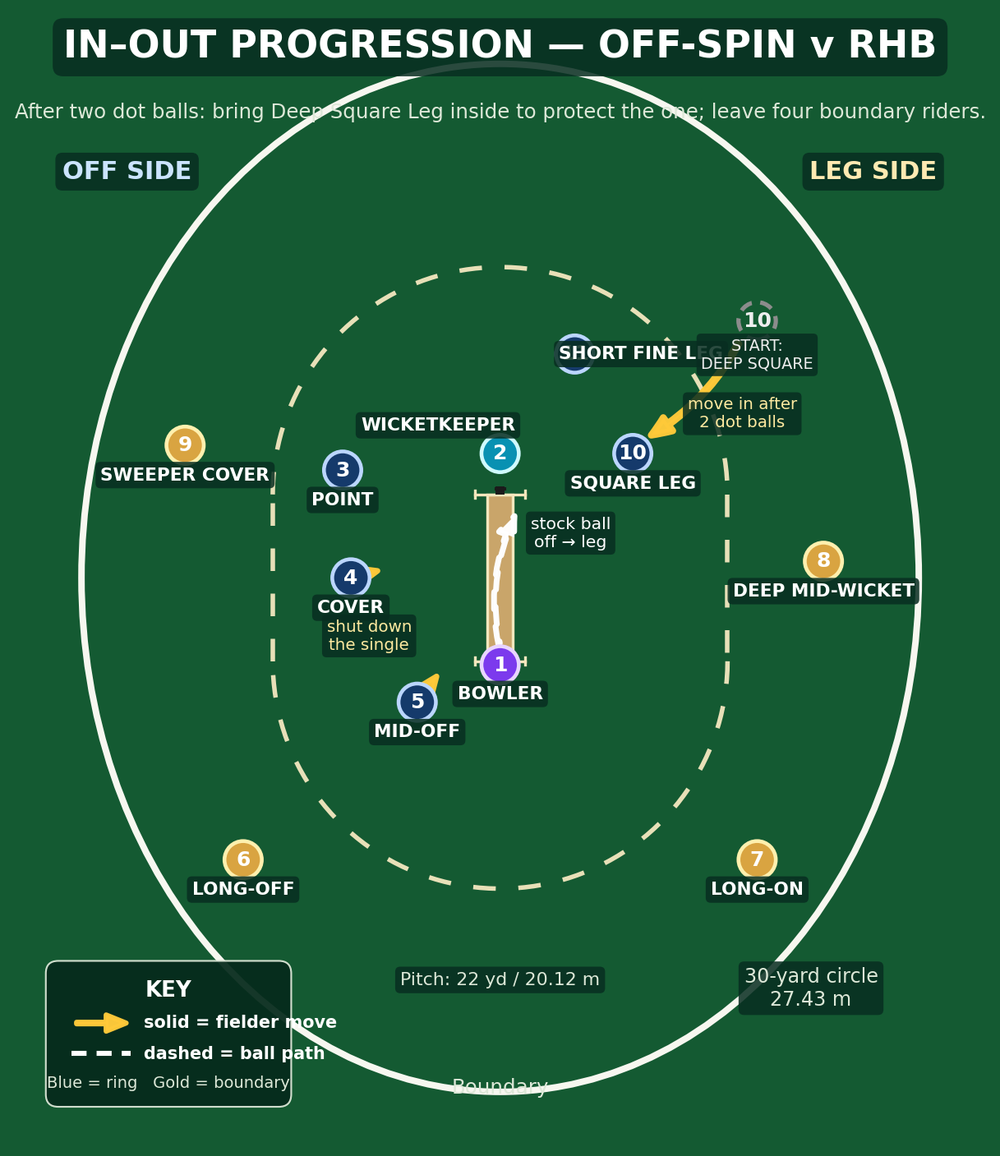
For the off-spin base field against an RHB, number players as shown in Diagram 1. The five gold-numbered boundary riders start on the rope. Point and Cover begin about 18–22 m from the striker; Mid-Off about 16–20 m; Short Fine Leg 10–12 m behind square. Move them only after a repeatable scoring pattern.
| No. | Position | Primary job |
|---|---|---|
| 1 | Bowler | Hit the planned line and length; finish ready to stop the straight push. |
| 2 | Wicketkeeper | Stand up where safe; read feet, call the plan, and prevent the easy bye. |
| 3 | Point | Cut off the square push and the late cut. |
| 4 | Cover | Attack the defensive push; make the batter earn the single. |
| 5 | Mid-Off | Close the straight single and protect the bowler’s follow-through. |
| 6 | Long-Off | Protect the inside-out lofted drive. |
| 7 | Long-On | Protect the straight slog or lofted on-drive. |
| 8 | Deep Mid-Wicket | Stop the slog sweep and mid-wicket hit. |
| 9 | Deep Square Leg | Stop the conventional sweep and sweep-pull. |
| 10 | Short Fine Leg | Cover the paddle, glance, and top edge behind square. |
| 11 | Deep Cover | Remove the lofted cover drive and back-foot punch. |
3. Step-by-Step Instructions
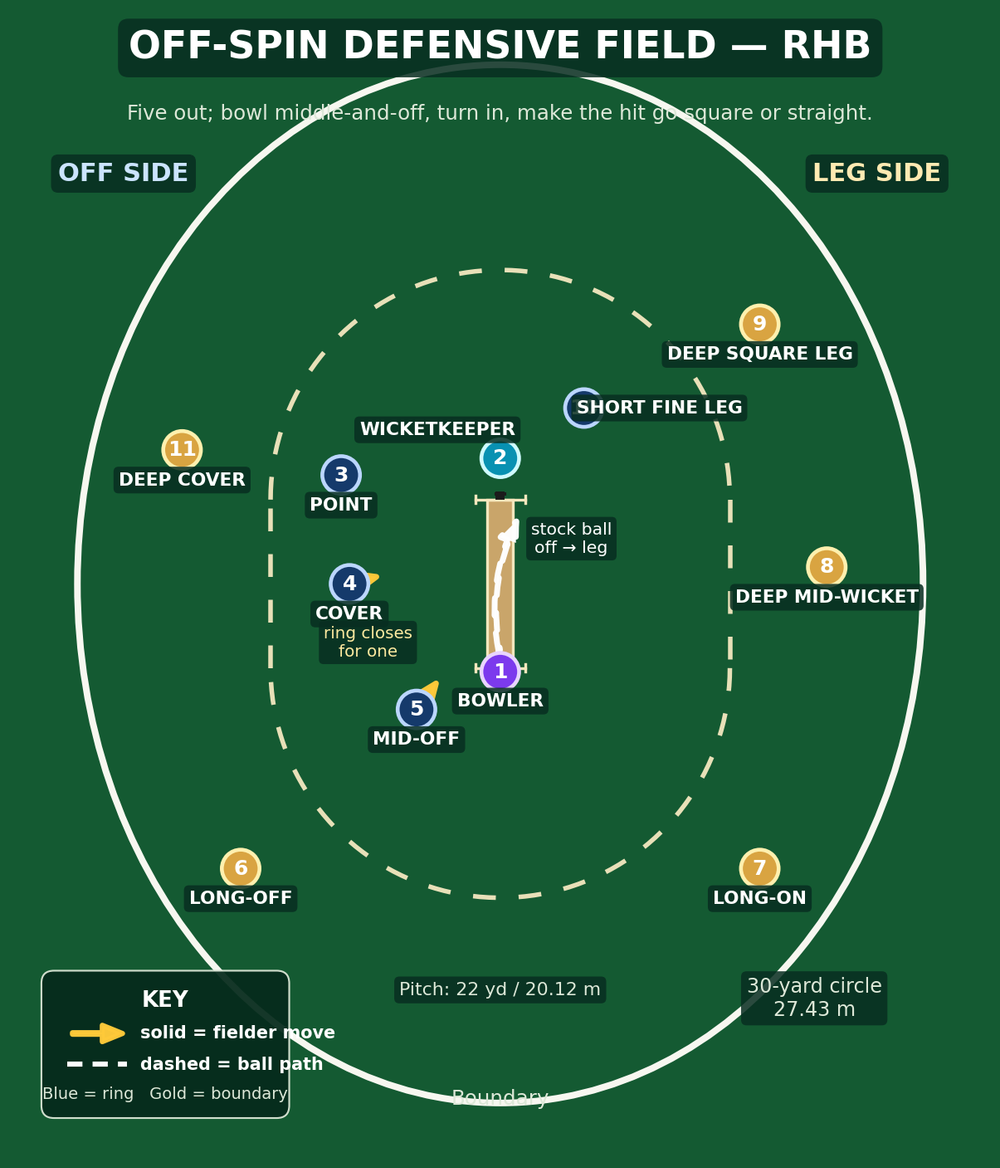

State the match problem. Tell the group: “We protect leg-side and straight boundaries; singles must be hard-run.” Set a clear target, such as four runs or fewer in the next over.
Build five-out from straight to square. Set Long-Off, Long-On, Deep Mid-Wicket, Deep Square Leg, and Deep Cover. From the keeper’s view, check that every rider’s first recovery step is toward the rope.
Close the inner ring. Bring Point and Cover one stride inside the circle if the batter rotates easily. Keep Mid-Off slightly closer to deny the straight push; Short Fine Leg stays low and watches the batter’s base.
Give the bowler a six-ball plan. Start with four stock off-breaks landing 4–6 m from the striker’s stumps, on middle-and-off. Add one quicker ball on the same line; add flight only with Long-On and Long-Off deep. Chase a wicket only after two dot balls.
Run the communication cycle. Five seconds before delivery, the keeper calls the plan: “Middle-and-off, no width; Cover in.” At release, every ring fielder takes one controlled step forward. On contact, the nearest fielder calls “mine,” and the next fielder becomes the backing-up player. Reset the field within 12 seconds of the ball becoming dead.
Review after each over. Ask: did the ball land as planned; did the field cover its zone; did the batter beat the plan or an error? Change one variable—line, length, or one fielder—at a time.
4. Leg-Spin Variation
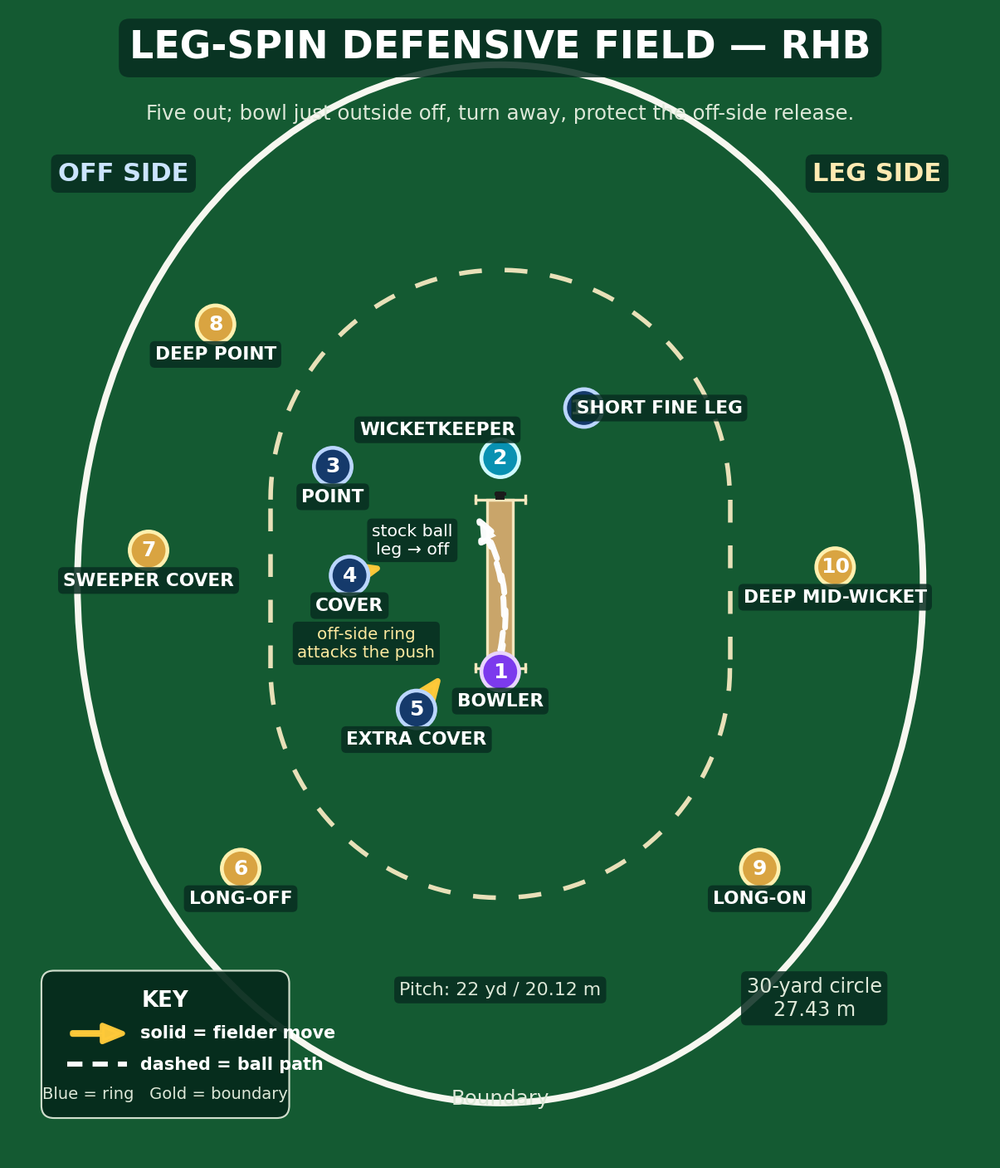
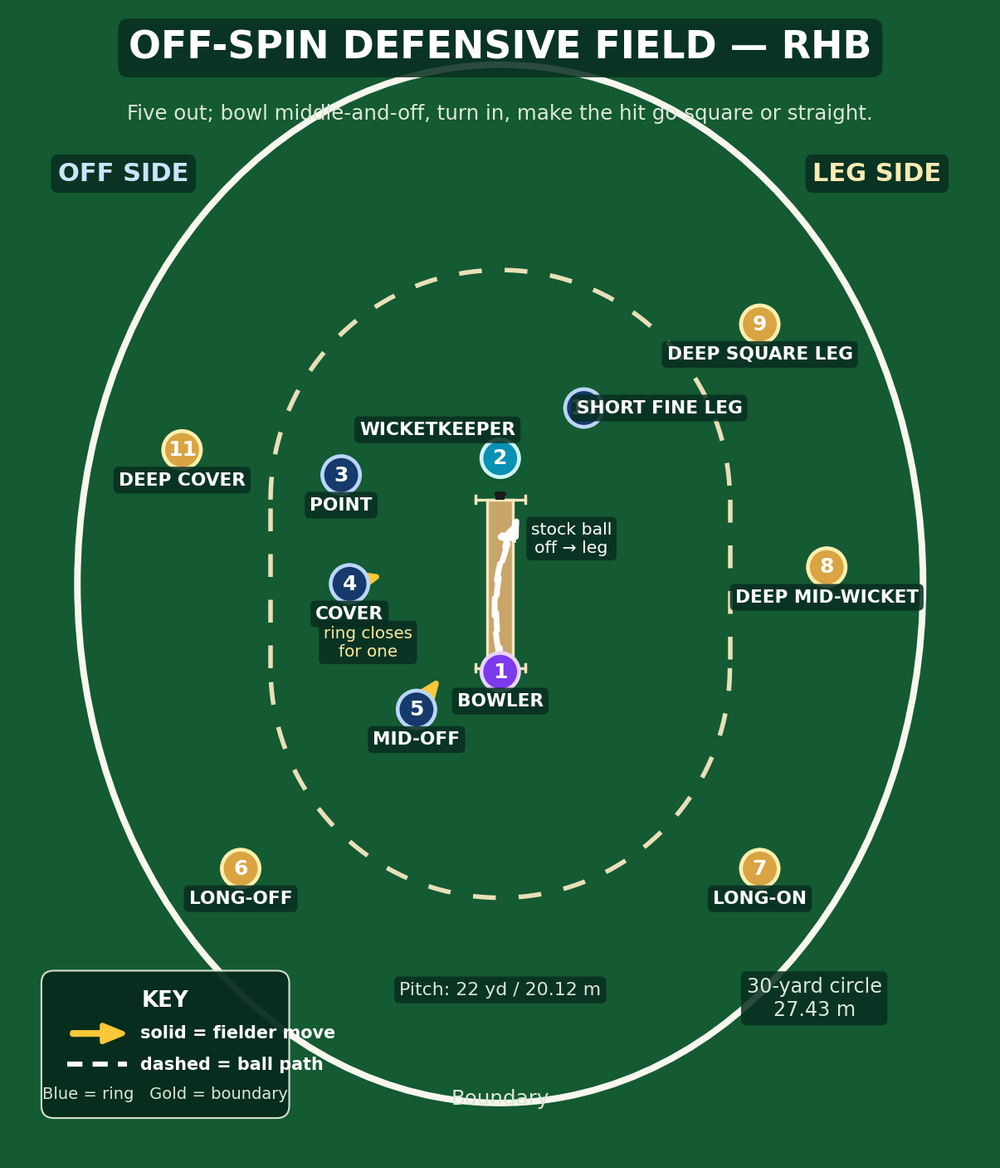
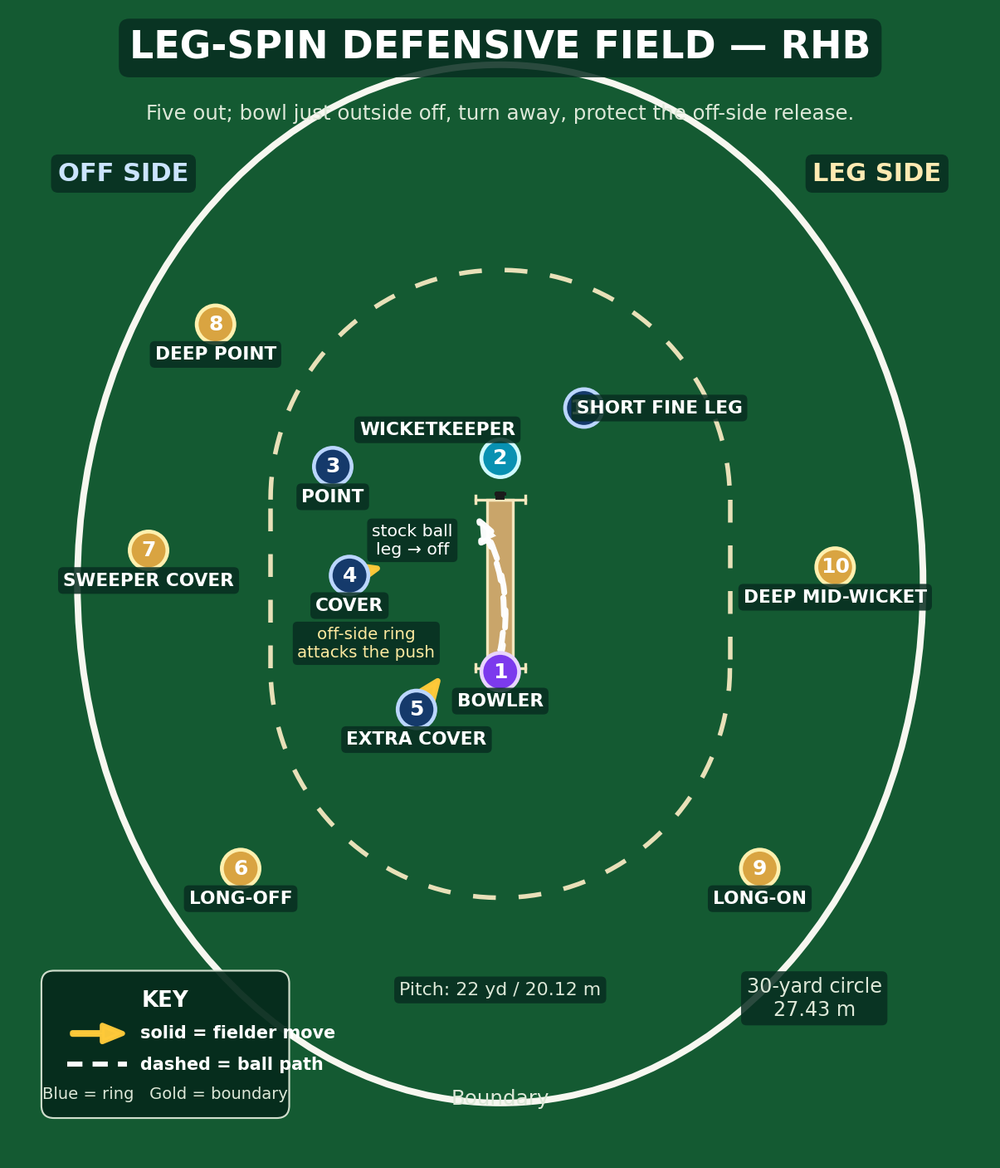
Leg-spin turns away toward the off side. Retain Long-Off and Long-On, but replace Deep Square Leg with Deep Point and use Sweeper Cover to remove the cut and square drive. Bowl just outside off so the batter must reach or hit against the spin. If a reverse sweep appears twice, move Deep Mid-Wicket to Deep Backward Point for the next ball.
5. Key Coaching Points
- Bowl to the field, not to the batter’s invitation. A defensive field cannot protect a half-volley outside off or a drag-down on leg stump. Make the bowler call their intended line before each delivery.
- Win the first five metres. Ring fielders start low and move forward at release. A fielder who waits for the ball allows the easy single that relieves the entire pressure plan.
- Keep the boundary riders connected. Each rider must know their adjacent backup. Long-On backs up Deep Mid-Wicket on the miss-hit; Long-Off backs up Deep Cover when the ball is driven square.
- Use the wicketkeeper as tactical lead. The keeper reads the batter’s feet, communicates the bowler’s line, and tells the captain when the batter has started to manufacture a new shot.
- Vary only after establishing the stock ball. The quicker ball, wider ball, and extra flight are useful only if the batter first respects the standard length.
6. Common Mistakes
| Mistake | Coach correction |
|---|---|
| Bowler drifts onto leg stump | Move the target cone to middle-and-off and require 4 of 6 balls to hit it before adding variations. |
| Boundary rider creeps 5–8 m in | Reset them on the rope; rehearse the first backward recovery step at the moment of contact. |
| Ring stands too deep | Bring Point, Cover, and Mid-Off in two strides and score a point for every single denied. |
| Whole field changes after one boundary | Keep the shape for two more balls unless the boundary came from a repeatable shot or obvious mismatch. |
| No backup on a misfield | Assign each pair before the over: Long-On/Deep Mid-Wicket, Long-Off/Deep Cover, Point/Cover. |
7. Variations & Progressions
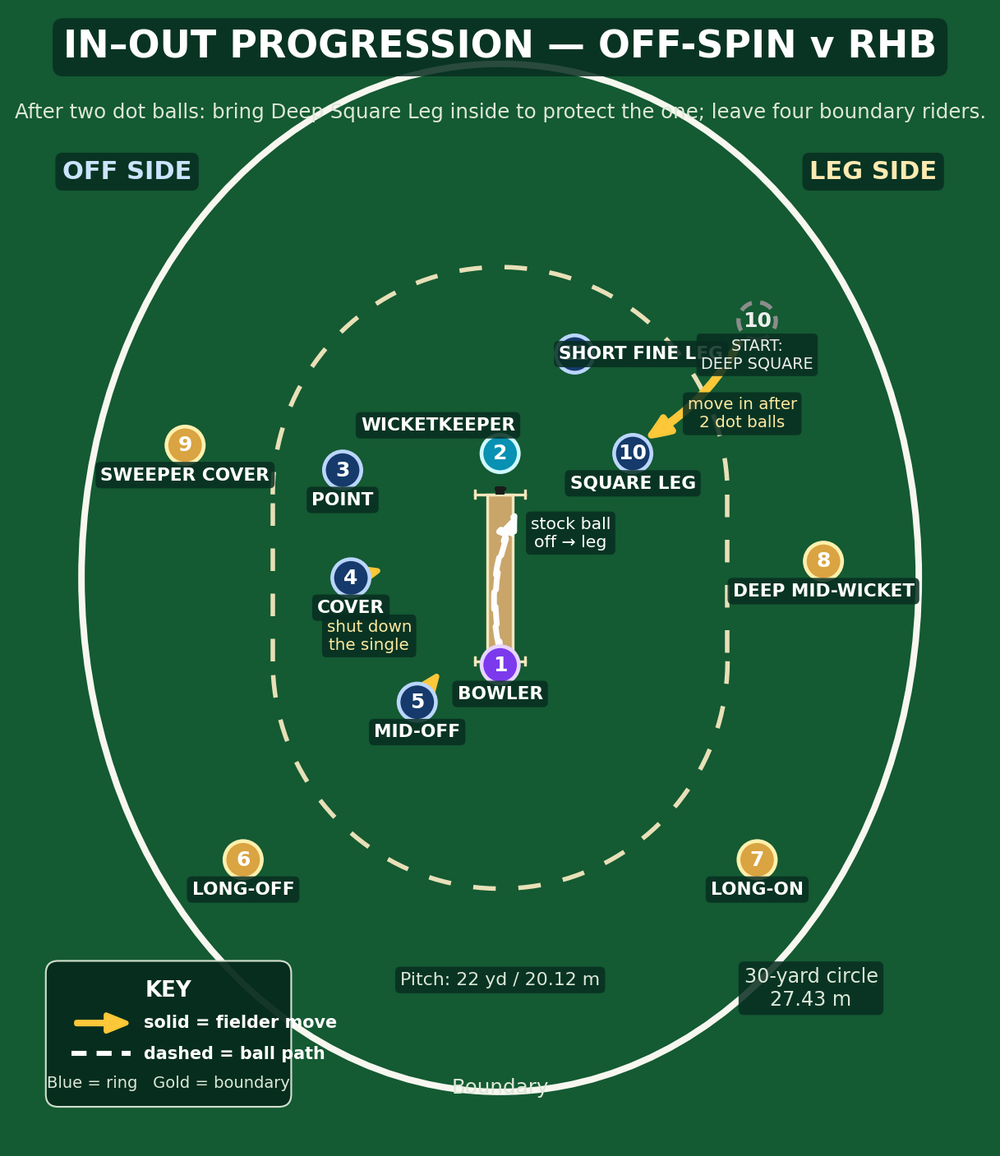
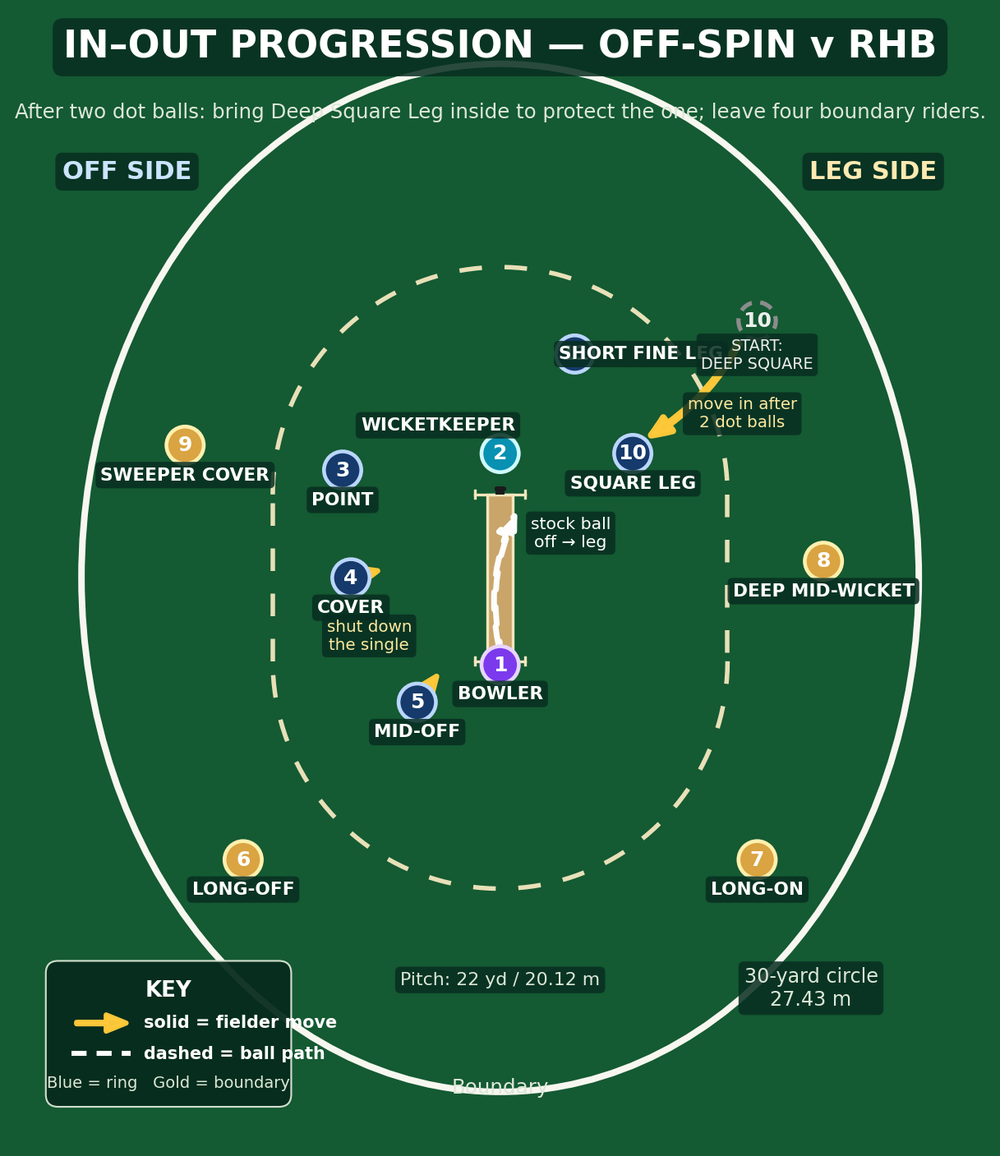
In–Out progression. After two dot balls, move Deep Square Leg into Square Leg, as shown in Diagram 3. You now have four boundary riders and five active ring fielders, asking the batter to clear a fielder rather than collect a simple single. Use this only where the competition restriction permits it and when the batter has not shown a dominant sweep.
Attacking–defensive hybrid. If the pitch is gripping, bring Deep Cover into Slip and keep five boundary riders elsewhere. The slip exists for the defensive prod or late edge; the boundary field still protects the release shot. Tell the bowler that this is a one-over trap, not a permanent field.
Left-handed batter mirror. Mirror the off-spin and leg-spin maps across the pitch. Before the next delivery, have each fielder point to their new zone and repeat the batting threat they are covering. This prevents vague, late movement during the bowler’s run-up.
8. Age Adaptations
For Under 8s, use a smaller ground, four ring fielders, and a “stop and throw to the keeper” objective; junior pitch lengths are set by the governing body.[1] For Under 10s, keep two boundary protectors and reward clean pickup-and-throw technique. For Under 12s and Under 14s, introduce the six-ball plan and two-dot-ball in–out move. For Under 16s and open-age teams, demand match-speed communication and evidence-based adjustments.
References
[1] Marylebone Cricket Club, Law 6: The Pitch
[2] International Cricket Council, Men’s T20I Match Clause 28: The Fielder
