

Cricket
Mastering the Middle Overs: Run Chase Strategy & Strike Rotation
Equip your batsmen with the tactical blueprint to navigate overs 15-40, focusing on risk-free strike rotation, gap exploitation, and calculated boundary hitting during a run chase.

What you need
Cricket balls (match condition), Stumps (both ends), Fielding markers or cones, Batting gear
1. Overview
The middle overs (typically overs 15-40 in a 50-over match, or 7-15 in a T20) often dictate the outcome of a run chase. Unlike the powerplay where fielding restrictions allow for aggressive boundary hitting, the middle overs require a nuanced, tactical approach. The primary goal of this set play strategy is to maintain the required run rate without losing clusters of wickets. This is achieved through aggressive running between the wickets, manipulating field placements, and executing low-risk boundary options.
Coaches must instill the mindset that 'dot balls are the enemy' during this phase. This resource provides a structured blueprint to help batsmen transition from powerplay aggression to middle-over consolidation, and finally, setup the launchpad for the death overs.
2. Setup
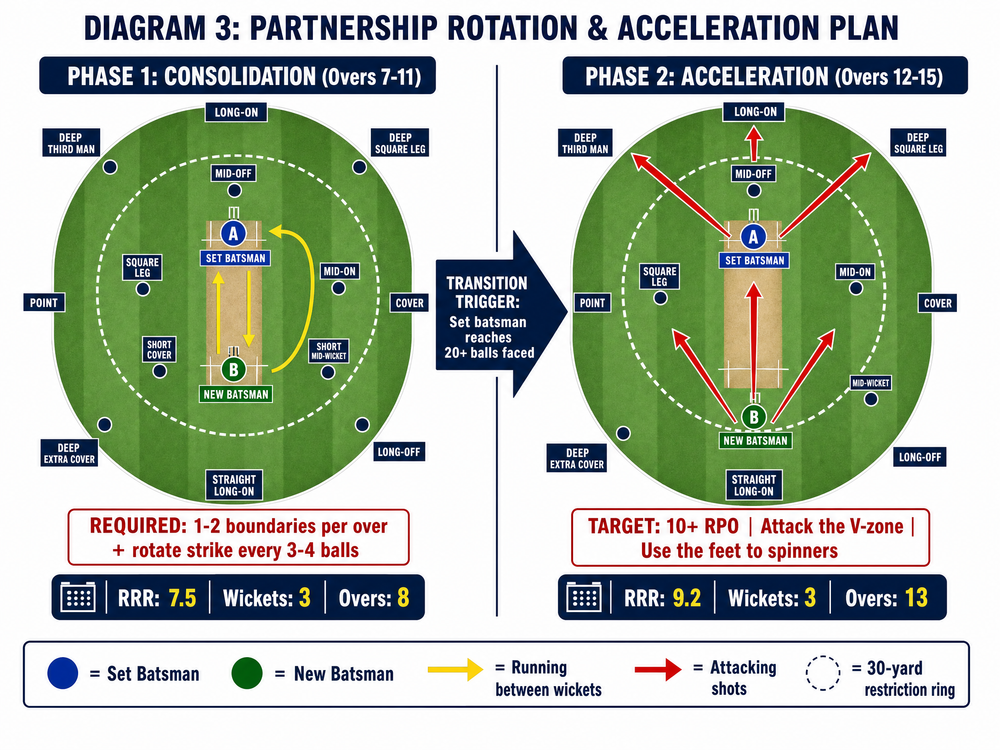
Equipment Needed:
- Standard cricket balls (match condition)
- Stumps (both ends)
- Fielding markers or cones (to simulate fielders and the 30-yard circle)
- Batting gear
Pitch & Field Setup:
Set up a standard 22-yard pitch on the center square. Place cones to clearly mark the 30-yard fielding restriction circle. Position your fielders (or use tall cones/flags if short on players) in a standard middle-overs defensive spread: typically 4 fielders inside the circle and 5 on the boundary. Ensure key boundary riders are placed at Long-on, Deep Mid-wicket, Deep Square Leg, Deep Cover, and Third Man.

3. Step-by-Step Instructions
Step 1: The Strike Rotation Drill (Consolidation)
- Begin with two batsmen at the crease. Set a target run rate of 5-6 runs per over.
- The bowler delivers a mix of lengths and lines, primarily focusing on a good length outside off stump.
- The batsmen must score at least one run off every ball by dropping the ball into the 'V' or tapping it square of the wicket.
- If a dot ball is bowled, the batsmen must sprint a penalty run (simulating pressure).
Step 2: Manipulating the Field (Gap Exploitation)
- The coach actively changes the field every 2 overs, forcing the batsmen to identify the new gaps.
- Batsmen must verbally communicate the field changes to each other before the over begins.
- Focus on hitting 'with the spin' or 'with the angle' to access the designated scoring zones.
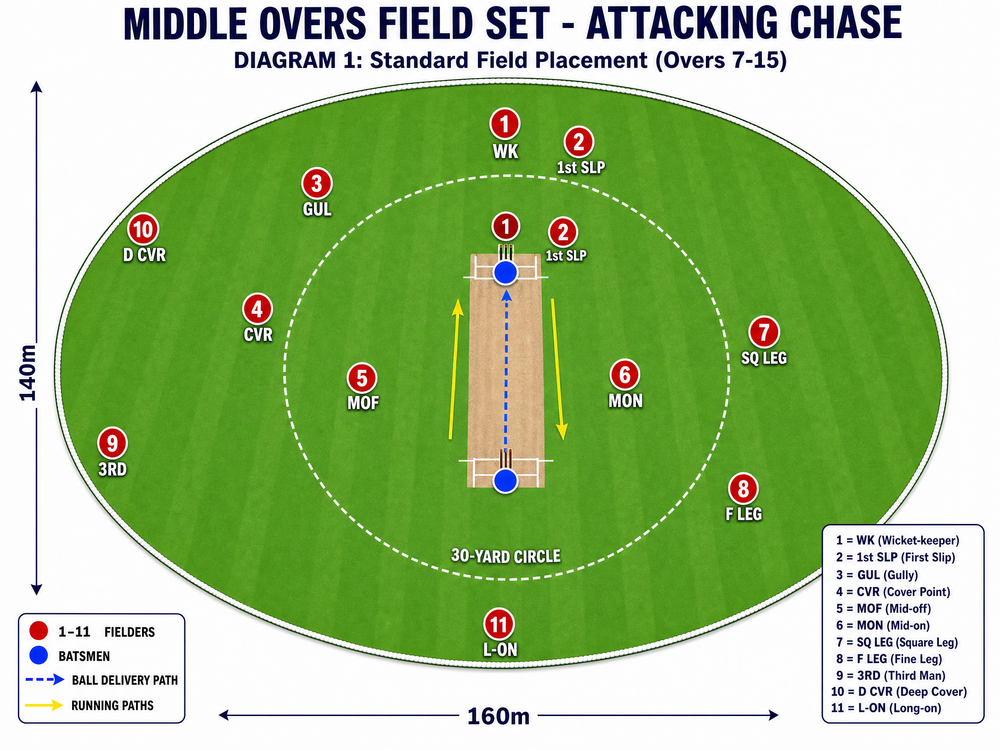
Step 3: The Boundary Release (Acceleration)
- Introduce a rule: Every 5th or 6th ball of the over MUST be hit for a boundary, regardless of the delivery.
- This simulates the pressure of needing to release the pressure valve when the run rate creeps up.
- Batsmen must use their feet to spinners or manufacture room against pace to access their strong zones.
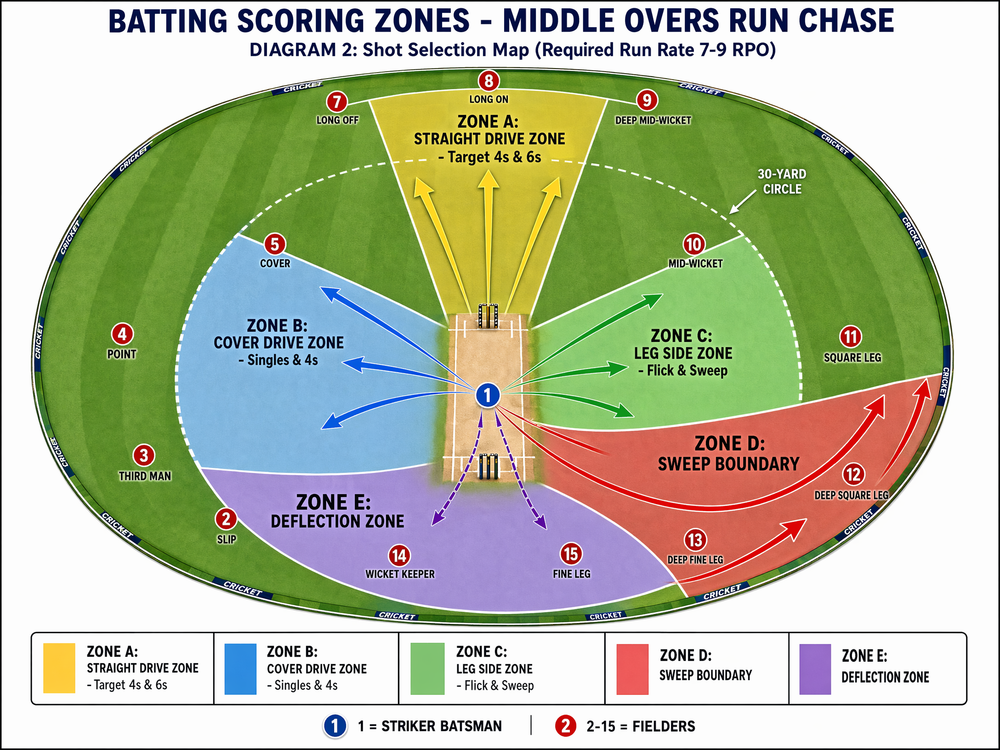
Step 4: Scenario Simulation
- Set a specific match scenario: e.g., 'Target is 120 runs off 20 overs, 4 wickets down'.
- Let the play run continuously. The coach should only intervene between overs to discuss decision-making and shot selection.
4. Key Coaching Points
- Communication is Paramount: Batsmen must talk constantly. 'Wait', 'Yes', 'No' must be loud and decisive. Non-strikers should back up aggressively.
- Play the Percentages: Encourage hitting the ball along the ground. Aerial shots should be calculated risks, targeting vacant boundary areas.
- Read the Field: Batsmen must scan the field before every delivery. If mid-off is up, the straight drive is an option; if deep point is back, look for the easy single.
- Soft Hands: When defending or deflecting, use soft hands to drop the ball at the feet and scamper for a quick single.
- Pacing the Innings: Teach batsmen to recognize when to consolidate (after a wicket falls) and when to attack (when a bowler is struggling with their length).
5. Common Mistakes
- Pre-meditation: Deciding on a shot before the ball is bowled, leading to poor execution if the length changes.
- Stagnation: Allowing dot balls to build up pressure, resulting in a rash, high-risk shot.
- Poor Calling: Hesitation or quiet calling leading to run-outs. The striker owns the call for shots in front of the wicket; the non-striker owns the call for shots behind.
- Ignoring the Match Situation: Playing aggressively when consolidation is needed, or batting too defensively when the run rate is climbing.
6. Variations & Progressions
- Progression 1: The Squeeze: Bring all fielders inside the circle for 3 overs to simulate immense pressure. Batsmen must find ways to pierce the infield.
- Progression 2: Spin Heavy: Bowl exclusively spin for a 5-over block. Focus on using the crease (sweeping, using feet) to manipulate the field.
- Variation 1: The 'No Boundary' Rule: For a 10-over block, boundaries count for zero runs. All runs must be scored via running between the wickets.
7. Age Adaptations
- Under 10s: Focus entirely on calling loudly and running hard. Introduce the concept of hitting into gaps rather than straight to fielders.
- Under 14s: Introduce field manipulation. Teach them to look for where the fielders aren't and to rotate the strike off the spinners.
- Open/Seniors: Full scenario simulation with dynamic field changes, complex bowling plans, and strict run-rate requirements. Focus heavily on the psychological aspect of pacing a chase.
