

Cricket
Mastering the Powerplay: Attacking Field Settings to Dominate the First 6 Overs
Learn how to deploy aggressive powerplay field settings to build early pressure, restrict scoring, and take crucial wickets in the first six overs.
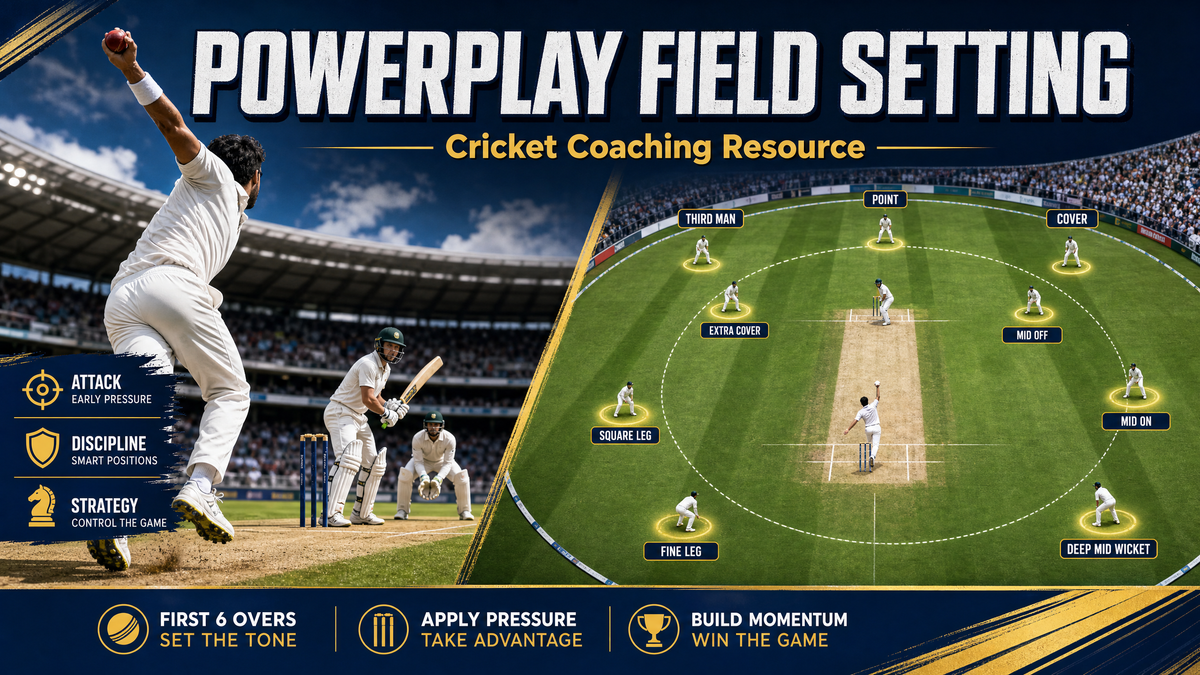
What you need
New Cricket Ball, Stumps and Bails, Marker Cones (for practice)
1. Overview
The Powerplay (typically the first 6 overs in T20s or 10 overs in ODIs) is a critical phase of the game that often dictates the momentum of the entire innings. During this period, fielding restrictions apply, allowing a maximum of only two fielders outside the 30-yard circle. This set play focuses on utilizing an attacking field setting to exploit the new ball, build early pressure, and create wicket-taking opportunities. Rather than purely defending the boundaries, this strategy encourages bowlers to pitch the ball up, seek movement, and challenge the batters' techniques while supported by a well-placed inner ring and slip cordon.
2. Setup
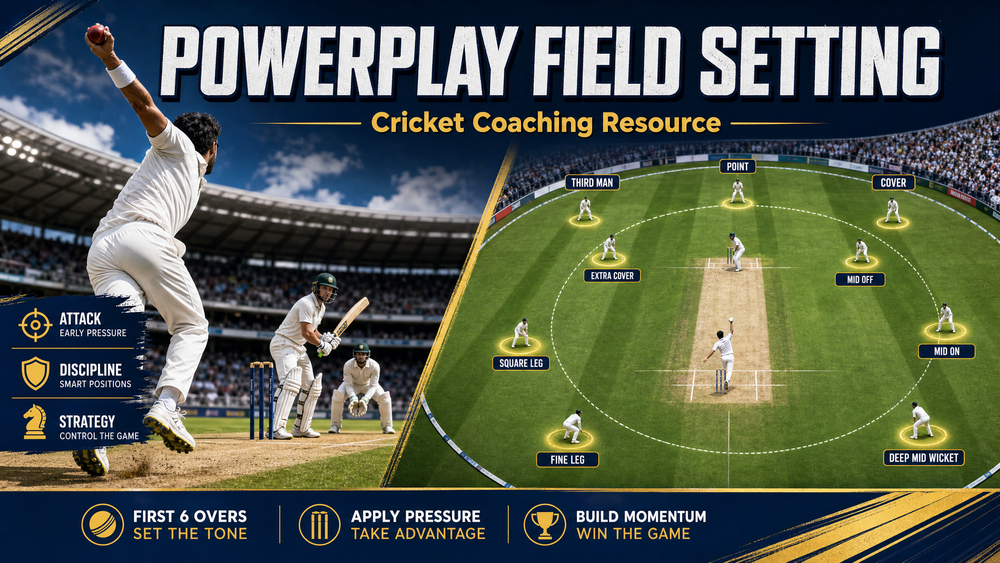
Equipment Needed:
- 1 New Cricket Ball (preferably one that swings)
- Full set of stumps and bails
- Marker cones (optional, to outline the 30-yard circle for practice sessions)
Pitch & Field Dimensions:
- Standard 22-yard pitch.
- 30-yard fielding restriction circle clearly defined.
- Standard oval boundary.
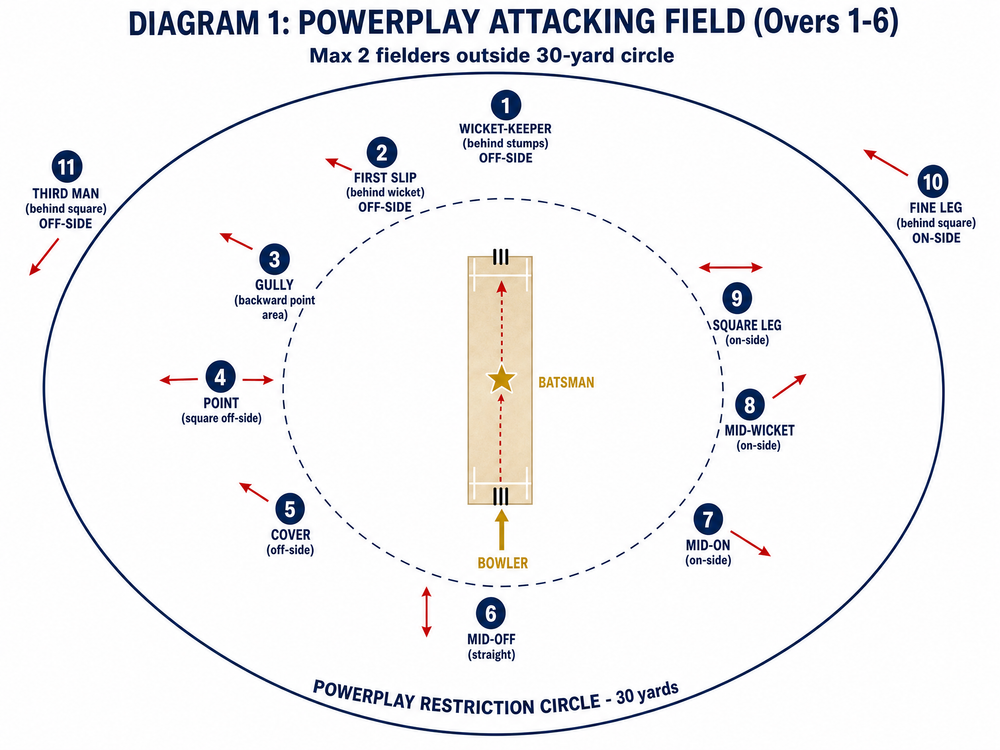
Player Positions (Standard Attacking Setup):
- Wicket-Keeper: Standing back for pace, ready for edges.
- First Slip: Positioned aggressively for the outside edge.
- Gully / Second Slip: Catching position behind square on the off-side.
- Point: Inside the circle, square on the off-side to cut off the cut shot.
- Cover: Inside the circle, cutting off the drive.
- Mid-Off: Inside the circle, relatively straight.
- Mid-On: Inside the circle, relatively straight.
- Mid-Wicket: Inside the circle, stopping the flick or pull.
- Square Leg: Inside the circle, square on the on-side.
- Third Man (Boundary): Protecting the edge down to the boundary.
- Fine Leg (Boundary): Protecting the stray delivery on the pads.
3. Step-by-Step Instructions
Step 1: Assess the Conditions and the Batter
Before the first ball is bowled, the captain and bowler must assess the pitch conditions (swing, seam, bounce) and the opening batter's strengths. Set the baseline field (as shown in Diagram 1) to challenge the off-stump line.
Step 2: Establish the Line and Length
The bowler must consistently hit a 'top of off-stump' line and a good length (roughly 6-8 meters from the batter). The field is set to support this specific delivery. Bowling too short or too wide will negate the field placement.
Step 3: The Slip Cordon Engagement
Ensure the Wicket-Keeper, First Slip, and Gully are perfectly spaced. They must be close enough to catch edges but far enough back to react to the pace of the new ball. Their primary role is to catch, not just stop runs.
Step 4: The Inner Ring Pressure
Fielders at Point, Cover, Mid-Off, Mid-On, and Mid-Wicket must be on their toes, walking in as the bowler runs up. Their goal is to cut off quick singles and force the batter to play high-risk aerial shots to clear the infield.
Step 5: Adjusting to the Batter's Movement
If the batter starts stepping out of the crease or moving across the stumps, the captain must make micro-adjustments. For example, moving Cover slightly squarer or bringing Mid-Off tighter to save the single.
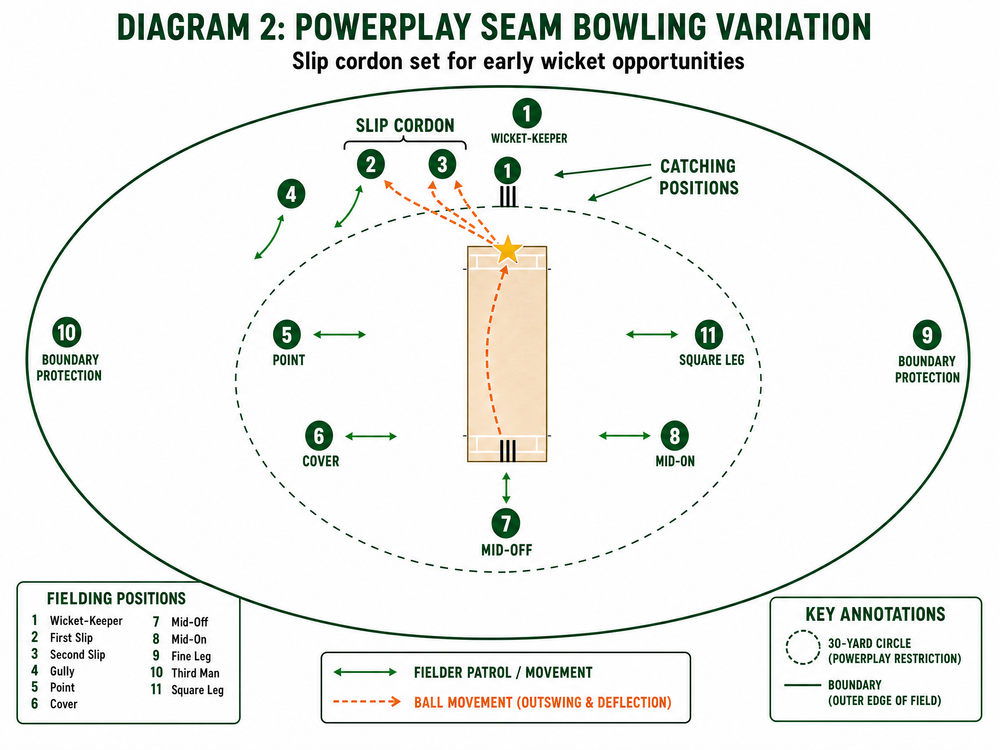
Step 6: The Seam Bowling Variation (Diagram 2)
If the ball is swinging significantly, deploy the Seam Bowling Variation. Add a Second Slip, moving the Gully slightly wider, and bring the boundary riders (Third Man/Fine Leg) squarer to protect against thick edges or leg-glances.
4. Key Coaching Points
- Discipline in Line and Length: The attacking field only works if the bowler bowls to it. A wide half-volley will easily pierce the inner ring. Bowlers must be disciplined to hit the top of off-stump.
- Active Fielding in the Ring: Inner ring fielders must 'walk in' with the bowler. A static fielder is easily beaten. Anticipation and dynamic movement are crucial to saving runs and creating run-out chances.
- Catching Posture: The slip cordon must maintain a low, athletic base, rising with the bounce of the ball. Soft hands and intense concentration are required for every delivery.
- Communication: The captain, bowler, and wicket-keeper must constantly communicate. If the plan isn't working after an over, be prepared to shift to a variation rather than waiting for the powerplay to end.
5. Common Mistakes
- Bowling to the Wrong Field: A bowler dropping short when the field is set for pitched-up swing bowling.
- Deep Fielders Too Deep: Boundary riders in the powerplay sometimes stand too far back, allowing easy twos. They should be on the rope but ready to attack the ball.
- Static Inner Ring: Fielders standing flat-footed, allowing batters to easily push for quick singles and rotate the strike.
- Over-Attacking: Keeping three slips when the ball isn't swinging and the batters are scoring freely through the covers.
6. Variations & Progressions
Variation 1: The Spin Trap (Diagram 3)
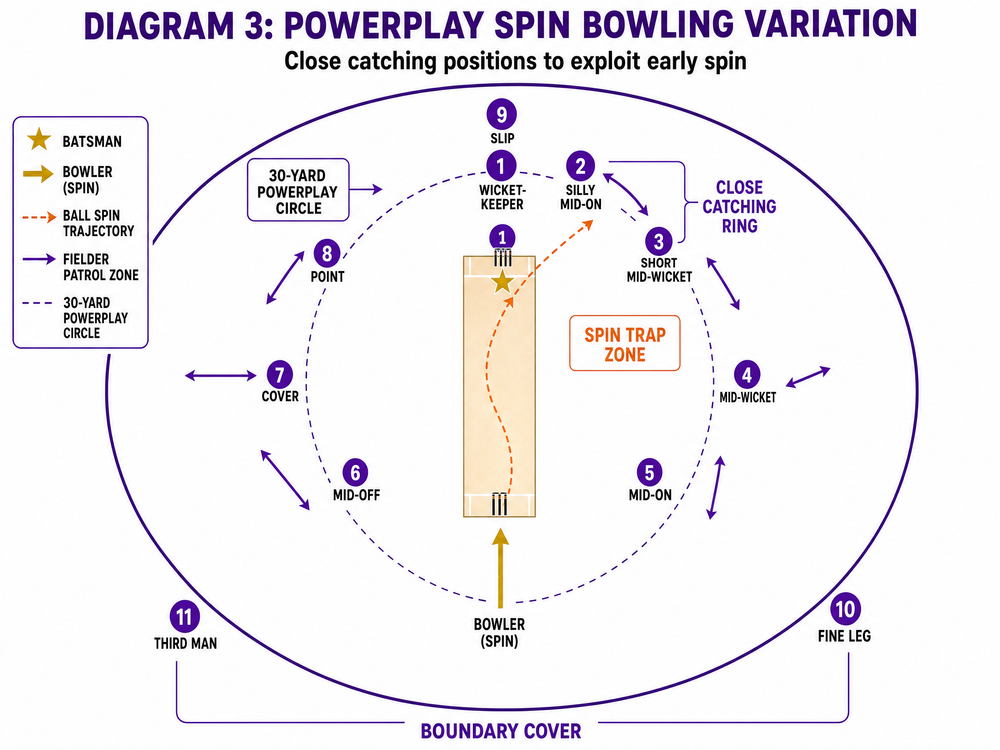
If introducing a spinner in the powerplay, change the dynamic. Bring the Wicket-Keeper up to the stumps. Introduce a Silly Mid-On or Short Mid-Wicket to create a 'Close Catching Ring' on the leg side, forcing the batter to play against the spin.
Variation 2: The Off-Side Squeeze
If the batter is strong on the leg side, pack the off-side. Move Mid-Wicket to Extra Cover and bowl a strict fifth-stump line, forcing the batter to reach for the ball and hit through the heavily populated off-side.
Progression 1: Target Practice
In training, set up the powerplay field and place target zones on the pitch. Award points to the bowler for hitting the zones and points to the batters for successfully piercing the infield.
7. Age Adaptations
- Under 10 / Under 12: Focus purely on bowling straight and basic fielding positions. Avoid close catching positions (like Silly Mid-On) for safety. Emphasize stopping the ball in the inner ring.
- Under 14 / Under 16: Introduce the concept of bowling to a field. Start using a slip fielder regularly and teach the inner ring how to walk in and cut off angles.
- Open / Seniors: Full implementation of tactical variations, dynamic field changes ball-by-ball, and advanced slip catching techniques.
