Powerplay Field-Setting Play: Attacking Off-Side Squeeze
A match-ready powerplay field plan that helps coaches build pressure outside off stump, protect two boundary channels, and rehearse every fielder’s movement on release.

Equipment Needed
Overview
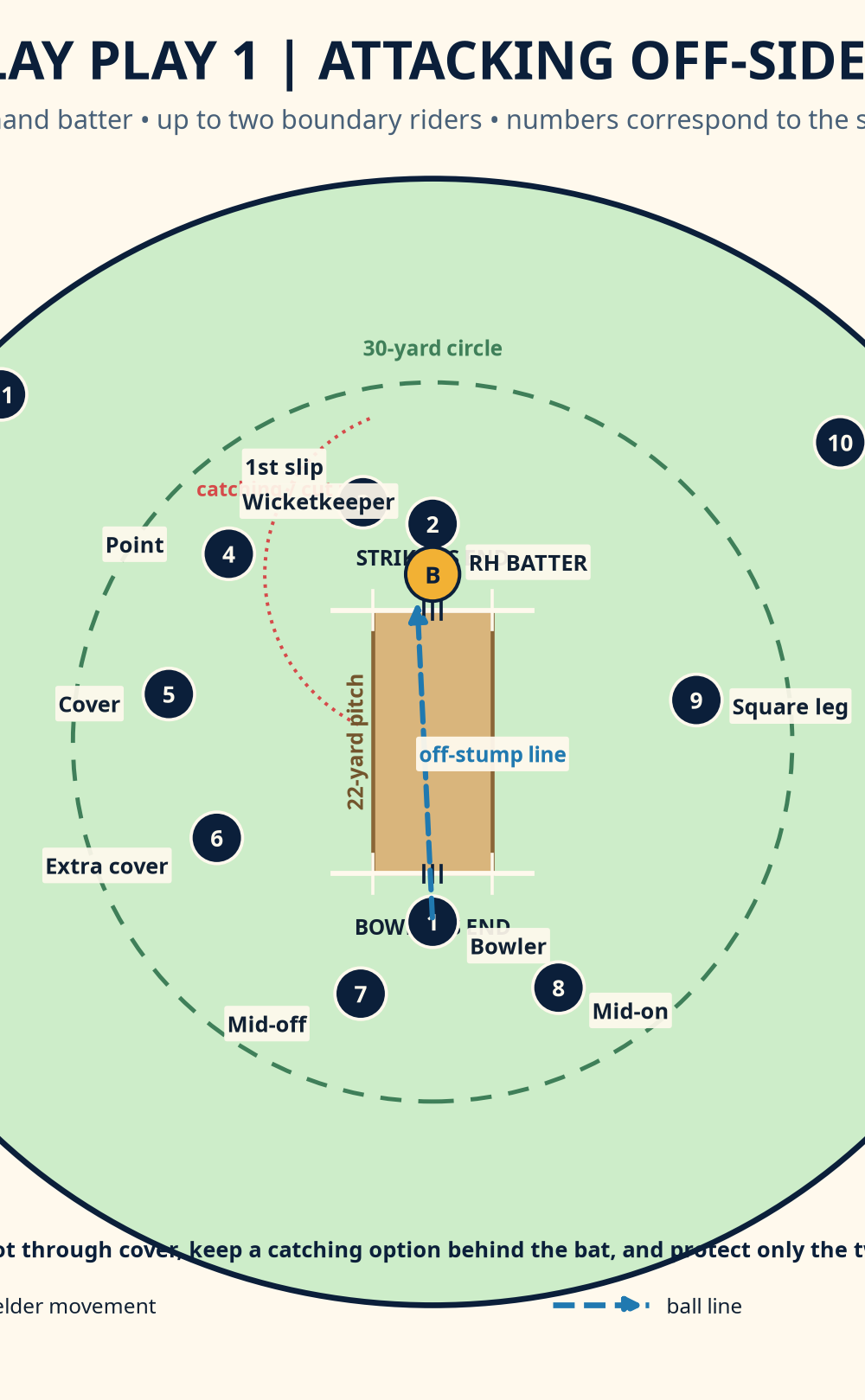
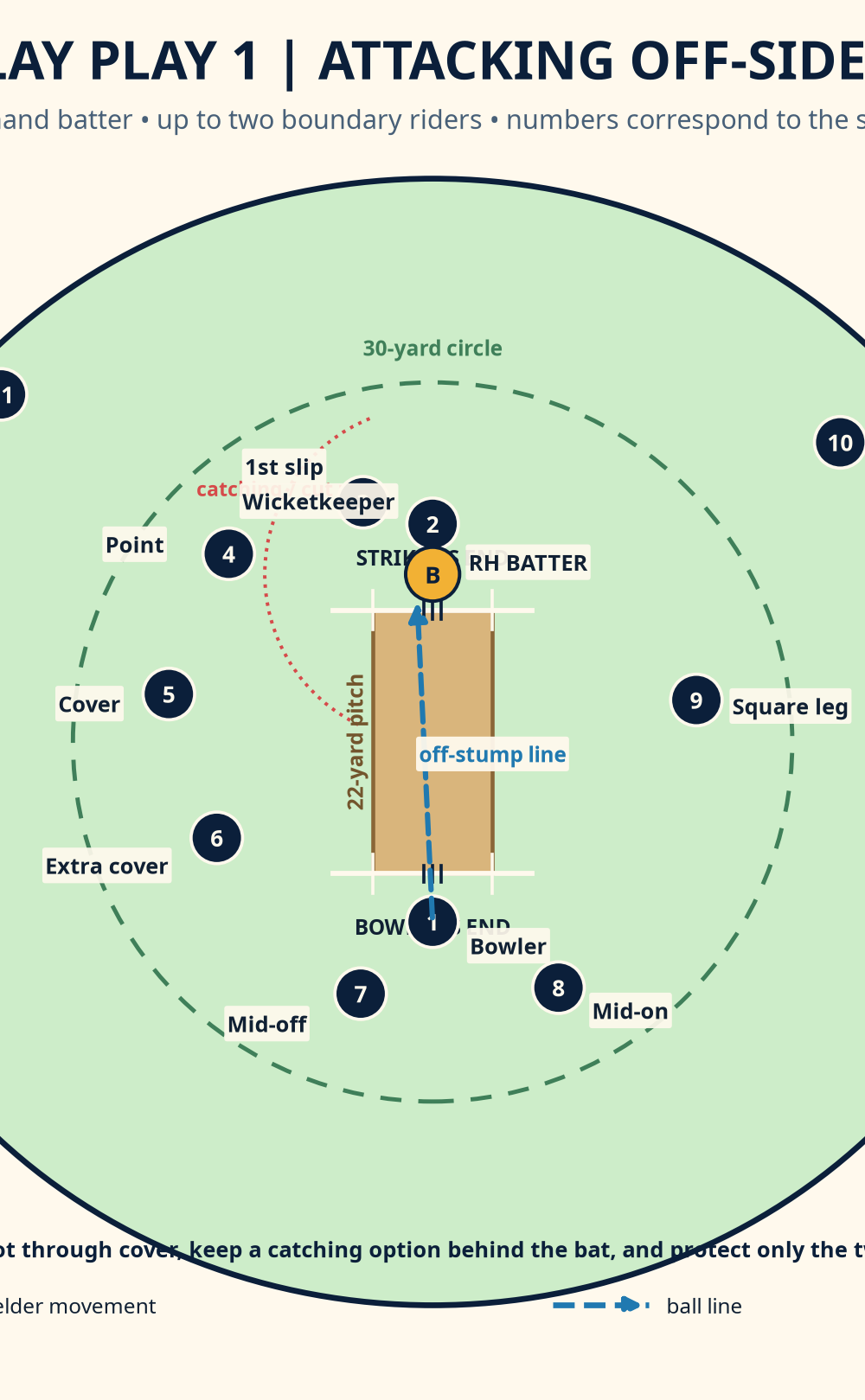
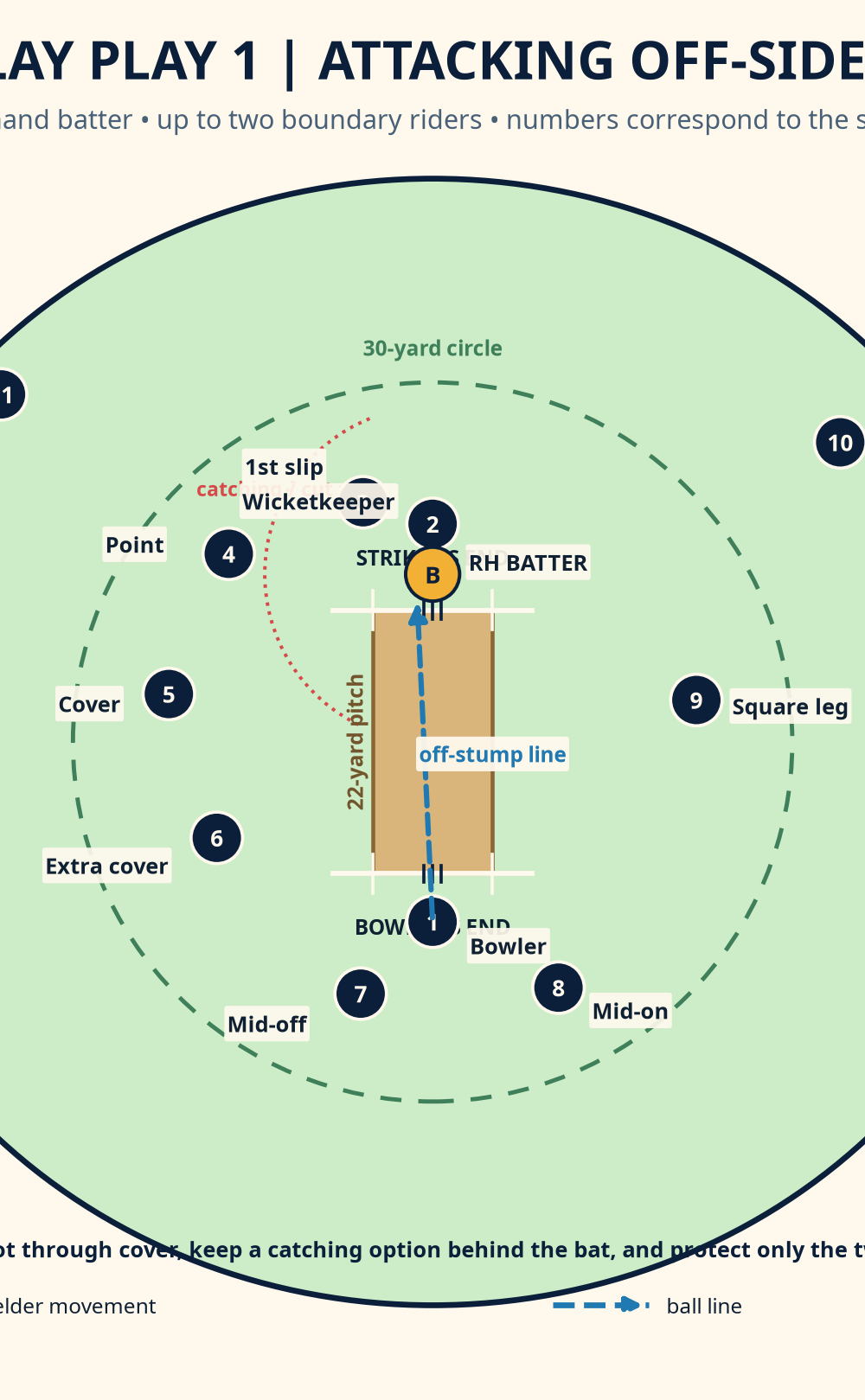
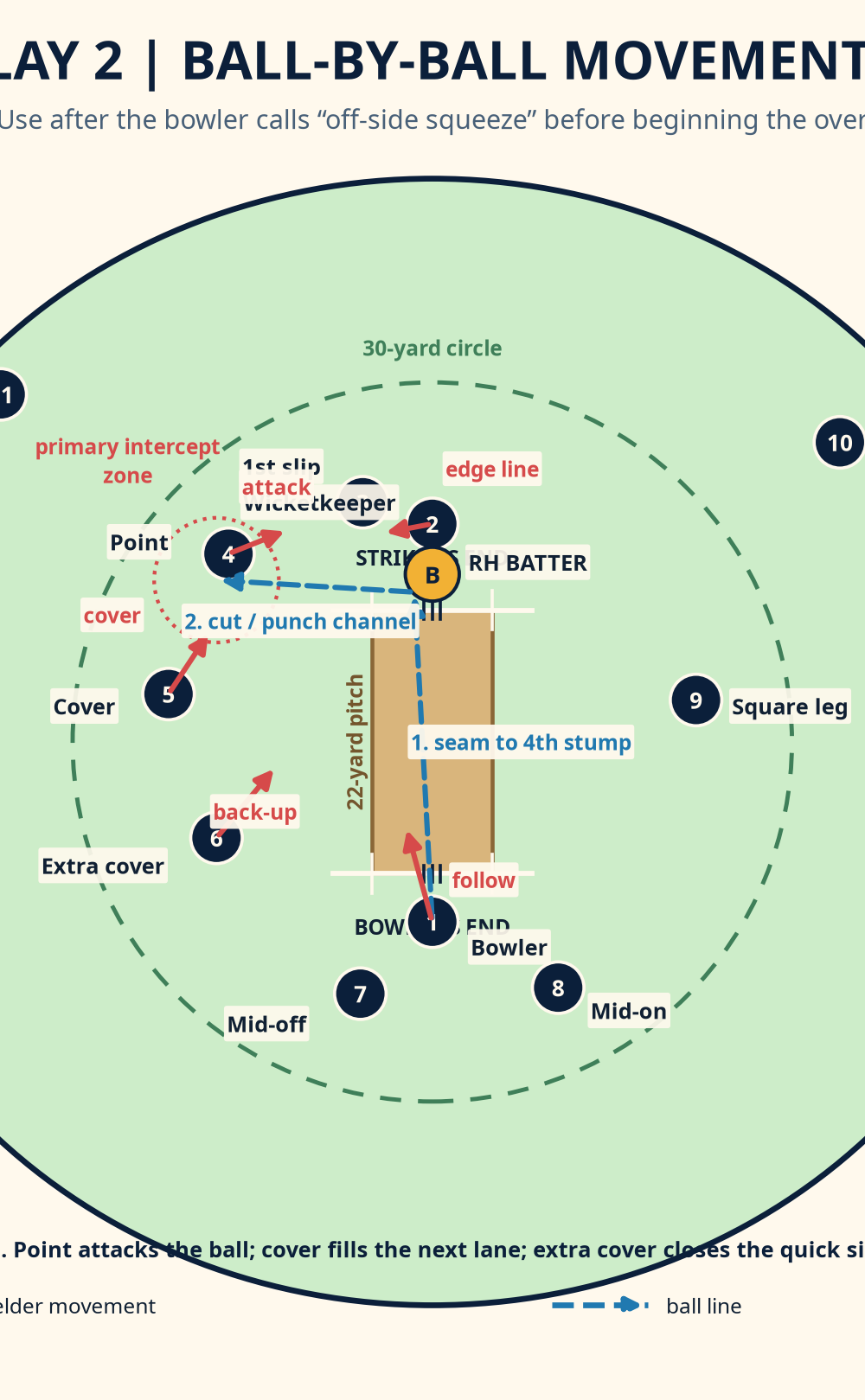
The Attacking Off-Side Squeeze is a repeatable powerplay field-setting play for a right-hand batter. Its job is to make one area of the ground feel crowded: the off-side in front of the wicket. The bowler attacks a disciplined fourth-stump to off-stump corridor, while point, cover and extra cover close the cut, punch and push. A wicketkeeper and first slip retain a genuine catch threat; third and fine leg are the only two boundary riders. The field asks the batter to either play through a packed ring or take on a higher-risk release shot.
Use it when your new-ball bowler can land a good length just outside off, the ball is carrying to the keeper, and the batter is looking to score square or through cover. It works in a standard T20 powerplay and in the first ten overs of a 50-over innings because the published ICC framework permits only two fielders outside the 30-yard restriction area at delivery in those phases.2 3 Treat the picture as a tactical template, not a substitute for local rules: junior and domestic competitions may set different restrictions.
Coach’s intent: Give the batter one apparent scoring option, then place your best hands and quickest movers where that option must travel.
Setup
Set the practice on a full, regulation 22-yard pitch, or scale it down proportionately for younger players. The standard pitch is 22 yards (20.12 m) long; keep the bowler’s run-up clear behind the bowler’s-end stumps.1 Mark a 30-yard circle from the middle-stump line at each end if your ground does not already have one. In international limited-overs conditions, the fielding restriction area is formed from 30-yard semi-circles joined by parallel lines.2
| Item | Coach setup standard |
|---|---|
| Players | 11 fielders, one right-hand batter, one non-striker and two batters rotating if possible |
| Equipment | Two sets of stumps, 20–30 flat markers, 6–12 balls, bibs, whistle and a scoring card |
| Area | Full oval preferred; use a marked 30-yard ring and place boundary cones at 55–70 m according to the venue |
| Timing | 12 minutes walk-through, 18 minutes controlled balls, 15 minutes live decision play |
Place 1 Bowler at the bowler’s end and 2 Wicketkeeper 3–5 m behind the striker’s stumps, adjusted to pace and bounce. Put 3 First slip approximately 6–8 m behind and 4–6 m outside the keeper’s line. Inside the ring, set 4 Point at 14–16 m square on the off side, 5 Cover at 18–22 m, 6 Extra cover at 18–22 m, 7 Mid-off at 18–22 m, 8 Mid-on at 18–22 m, and 9 Square leg at 18–22 m. Use 10 Fine leg and 11 Third as your two boundary riders, 5–8 m inside the rope so they can move forward rather than chase back.

Before the first ball, the captain confirms the code word “off-side squeeze”, the bowler confirms the intended line, and point confirms that they are the primary attacker. The rule for the whole unit is simple: everyone is still until release; then the ball moves and the ring moves with it.
Step-by-Step Instructions
Install the field at walking pace. Give each fielder a numbered cone and have them state both their name and job. Do not move on until the group can identify the two boundary riders and the catchers behind the bat without prompting.
Set the line-length contract. Ask the bowler for four deliveries on a good length, fourth stump to off stump. For a medium-pacer this is normally a landing point roughly 5–7 m before the striker’s popping crease; adjust for pace, surface and batter stride. The purpose is not to bowl a magic ball. It is to repeat a channel the field can defend.
Rehearse the release trigger. On the coach’s call, the bowler delivers at 60–70% effort. Point takes two sharp steps forward and slightly squarer to attack the cut; cover slides one lane toward point’s original channel; extra cover closes the quick single; the bowler follows 6–8 m down the pitch into the return line. The wicketkeeper and slip stay on the edge line rather than drifting with the ring.
Add the batter’s three likely responses. First, ask the batter to defend or push to cover. Second, ask for a late cut or square punch. Third, ask for a firm drive through cover. Rotate the ball deliberately for six balls so the fielders learn that the same starting picture creates different second actions.
Score the fielding outcome. Award the fielding unit two points for a catch or direct-hit run-out, one point for a clean stop that restricts the shot to one, and zero for a misfield, over-throw or boundary. The batting pair earns one point for a single, two for two runs and four for a boundary. Review after each six-ball set, not after every ball; this keeps the coaching sharp and the tempo honest.
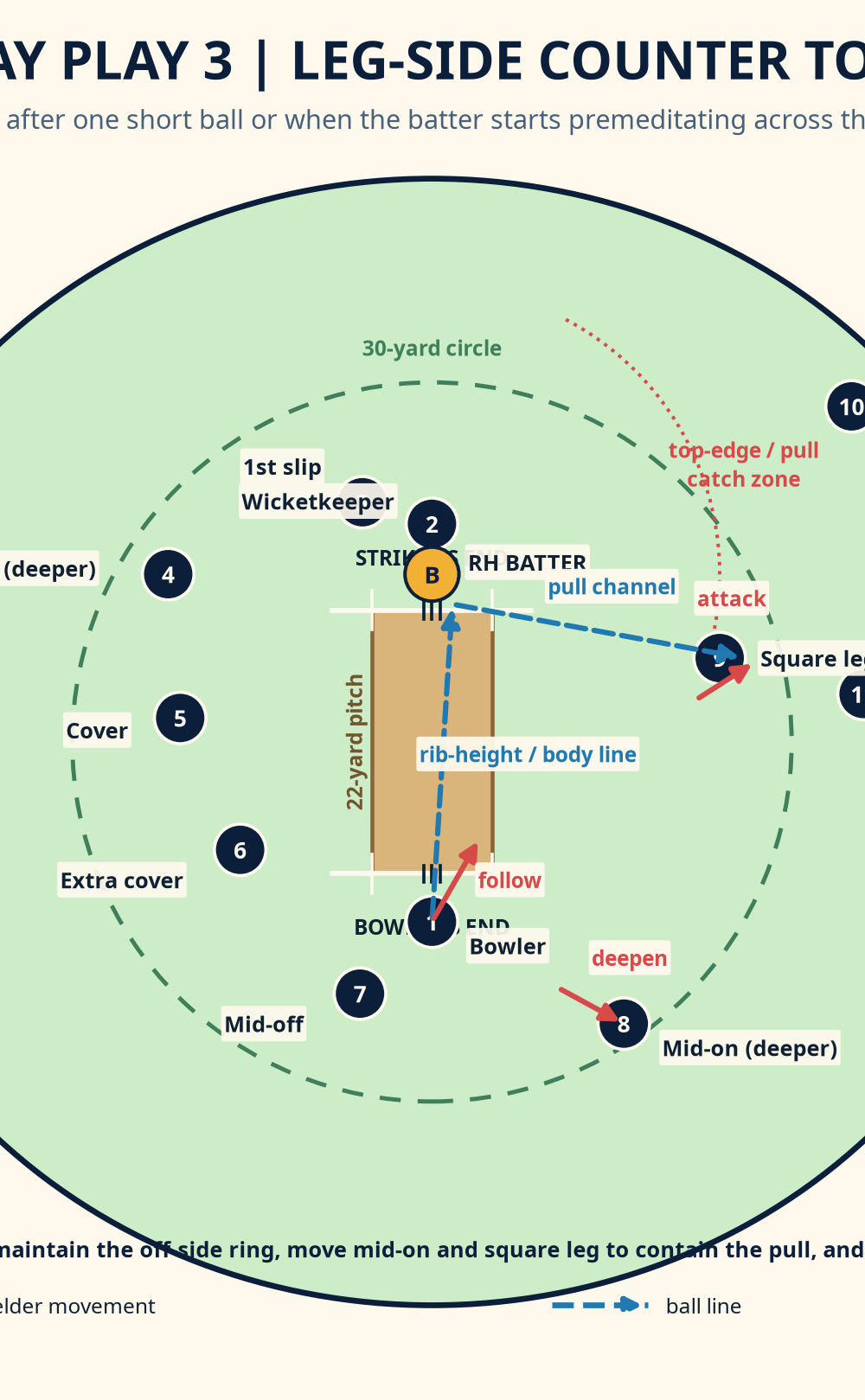
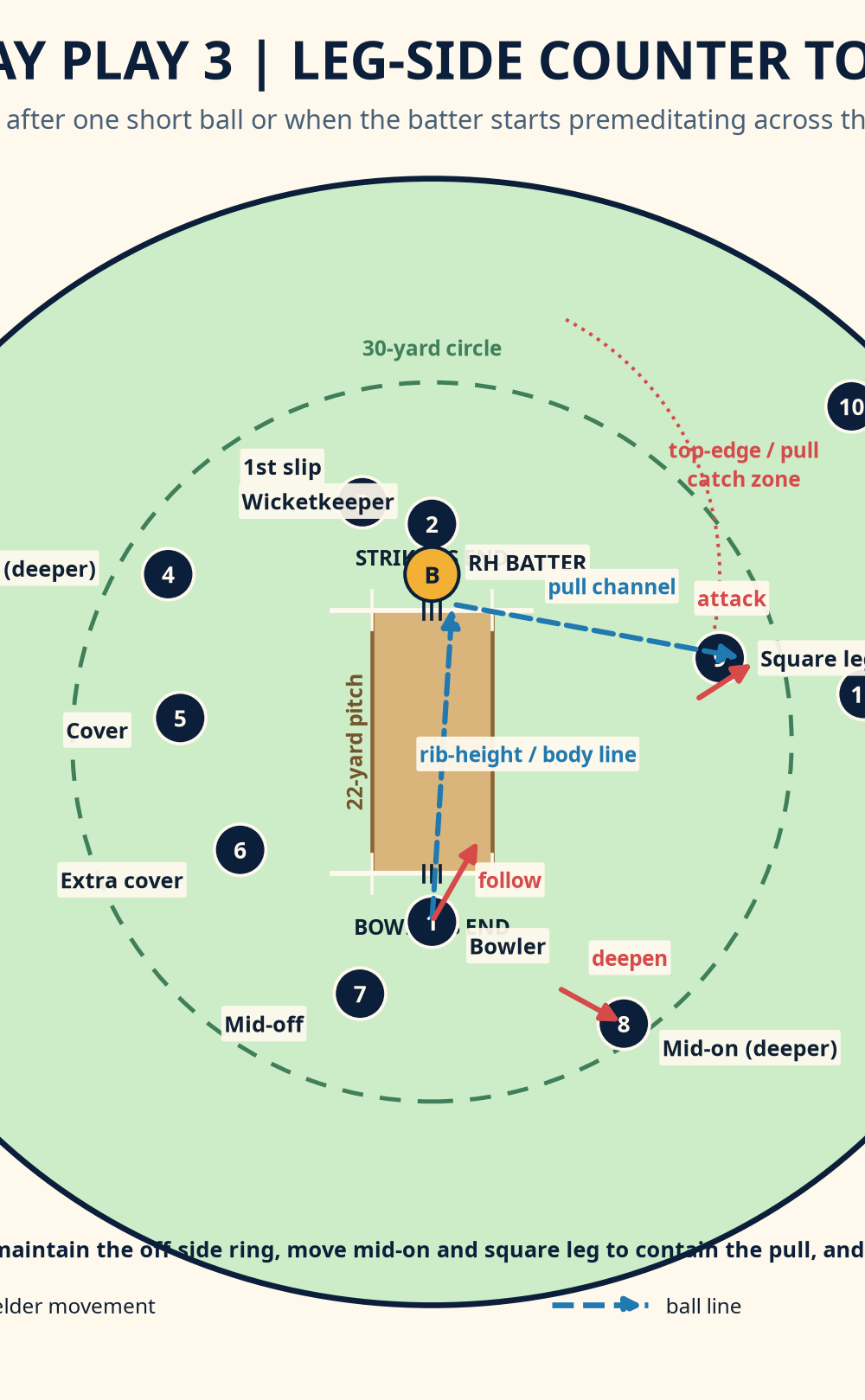
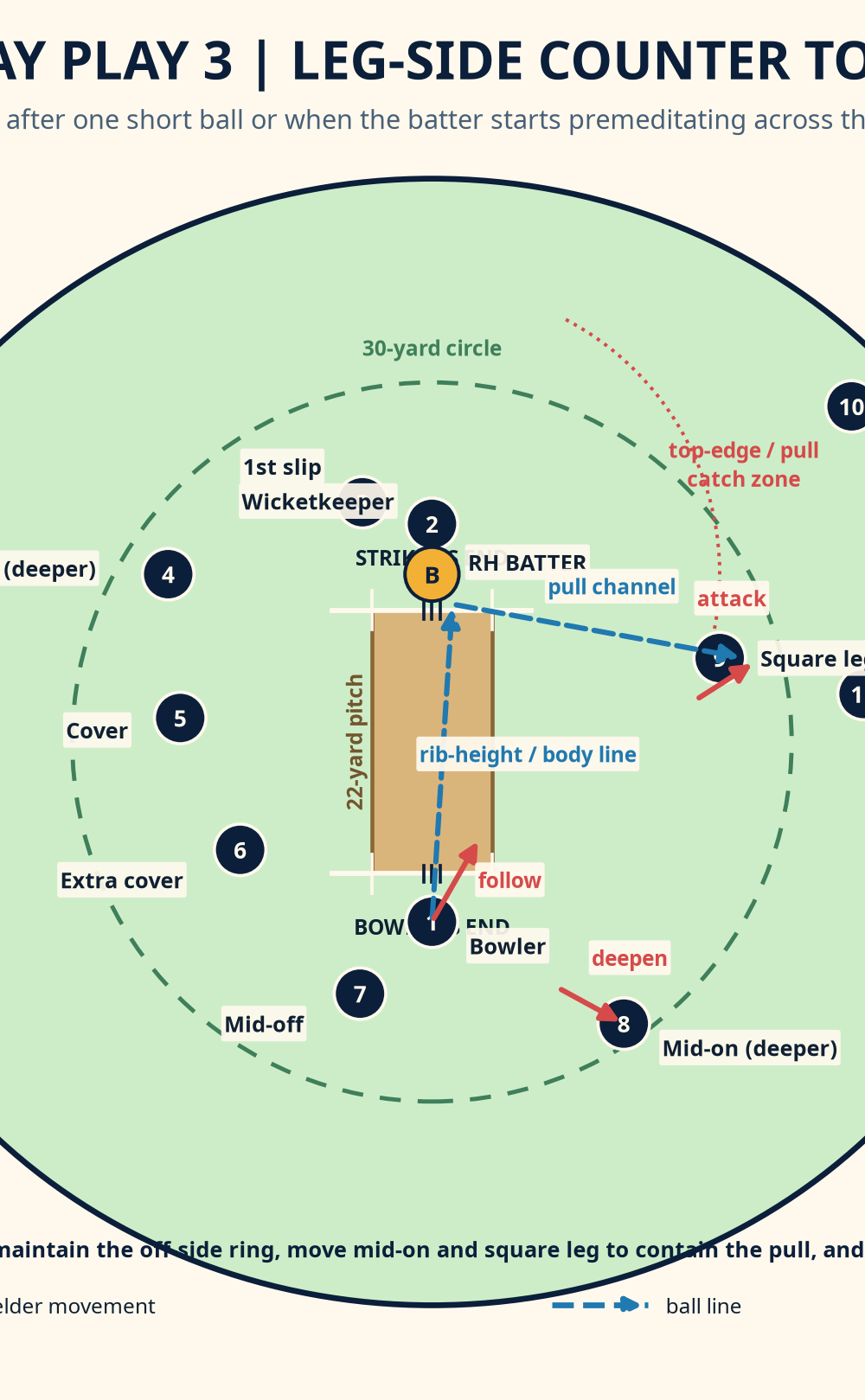
Call the counter only from evidence. If the batter premeditates a pull, moves across early, or the bowler misses short twice, use the call “pull counter” for the next two balls. Square leg attacks the pull lane, mid-on goes 4–6 m deeper, and deep square replaces third as the second boundary rider. Do not make the switch because of one fortunate boundary; make it because the batter has shown a repeatable intention.
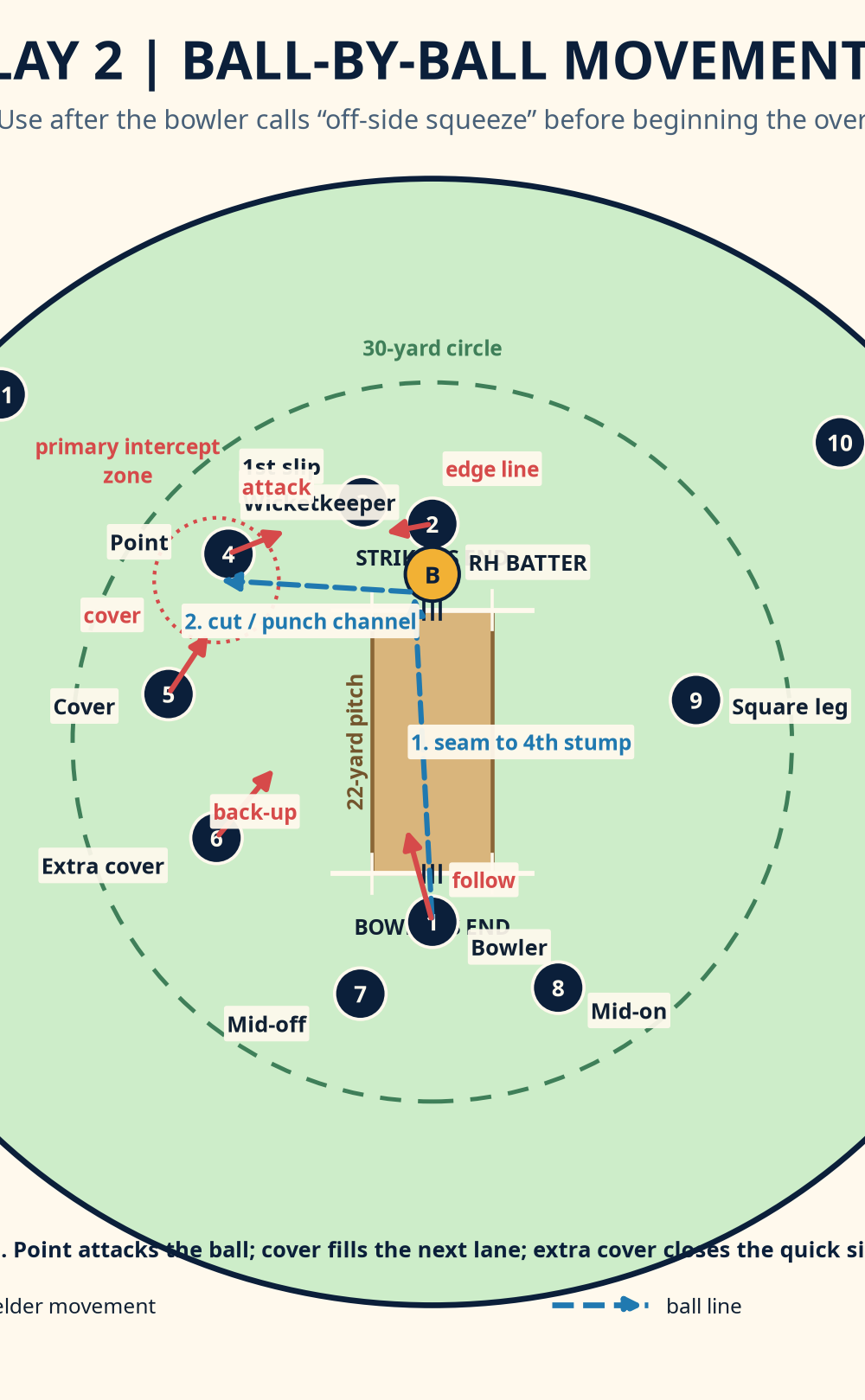
- Finish with live captaincy. Remove the coach’s calls. The captain sets the field in 30 seconds, gives one concise plan to the bowler, and may change one fielder between balls. After two overs, ask: Which shot did we invite? Where did the first mistake occur: line, starting position, movement, pick-up or throw?
Key Coaching Points
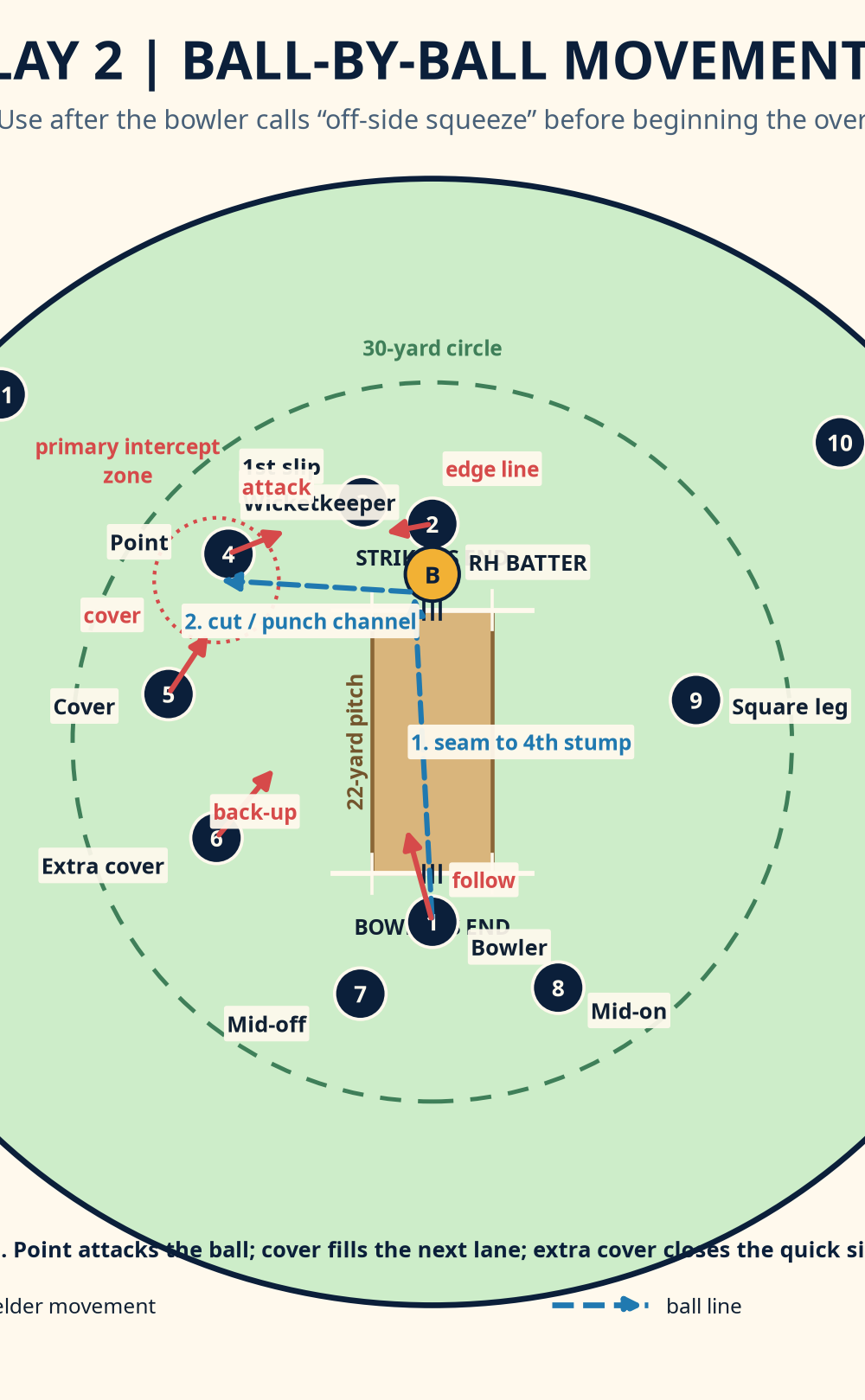
| Coaching point | What excellent looks like |
|---|---|
| Start position | Ring fielders are low, balanced and able to move on the release—not already leaning into the shot. |
| One clear message | The bowler, keeper and point can each describe the same line, length and primary scoring denial. |
| Movement timing | Point and cover move on release, not on the bowler’s approach; early movement gives the batter a visual cue. |
| Intercept, then throw | Fielders attack the ball on the correct angle, gather with two hands when possible, and throw to the keeper’s end only when the run is genuinely on. |
| Boundary-rider depth | Fine leg and third stand far enough in to cut off a two while retaining time to retreat for a top edge or late glide. |
| Captain’s composure | The captain changes the field from evidence and communicates the new role in a short, audible phrase. |
Common Mistakes
The usual error is a field that is ahead of the bowler: players pack the off side, but the ball is dragged onto leg stump or overpitched. Stop the set if three of six balls miss the agreed corridor. Point must move at release, not before it; cover closes the next lane rather than retreating for a boundary; and the bowler must finish ready to field a return or straight drive.
Variations & Progressions
Start simpler with eight fielders in a 22–25 m ring, one boundary rider and a sidearm feeder; freeze on contact so players name the stop and back-up. Progress to a scored 11-player contest in which the bowler is rewarded for four of six balls in the agreed corridor. For advanced players, run a two-over contest: the captain has a batter profile, one in-over positional change and a two-ball leg-side counter call.
Age Adaptations
| Age band | Adaptation |
|---|---|
| Under 8 | Use a shortened pitch, soft ball and six players. Teach ball-side, back-up and boundary roles. |
| Under 10 | Use an 18–20 yard pitch and 20–25 m ring. Add point, cover, mid-off and keeper; reward stops before throws. |
| Under 12 | Use a full or near-full pitch and 8–10 fielders. Add numbered roles, the release trigger and one boundary rider. |
| Under 14 to open age | Use the full plan, two riders where legal, live bowling and evidence-based captaincy. |
Keep every player protected: close catchers must be competent, ready and positioned for their skill level; young players should not be placed in high-risk close-catching positions against hard-ball pace. End the practice by praising the best collective decision, not simply the quickest fielder or the wicket-taking ball.
References