

Cricket
Mastering the Quick Single: Pressure Running & Calling Drill
Develop decisive calling, aggressive running, and split-second decision making under fielding pressure with this match-simulation drill.

What you need
Cricket Bats, Batting Pads & Gloves, Helmets, Cricket Balls (Leather or Incrediball), Stumps (2 sets), Marker Cones
1. Overview
Running between the wickets is often the difference between a good batting partnership and a match-winning one. This drill focuses on the mechanics of calling, the urgency of the first run, and the spatial awareness required to rotate the strike under pressure. By simulating in-game fielding scenarios, coaches can help batsmen develop the crucial 'Call-Commit-Go' mindset while simultaneously testing fielders' agility and throwing accuracy.
2. Setup
Pitch & Field:
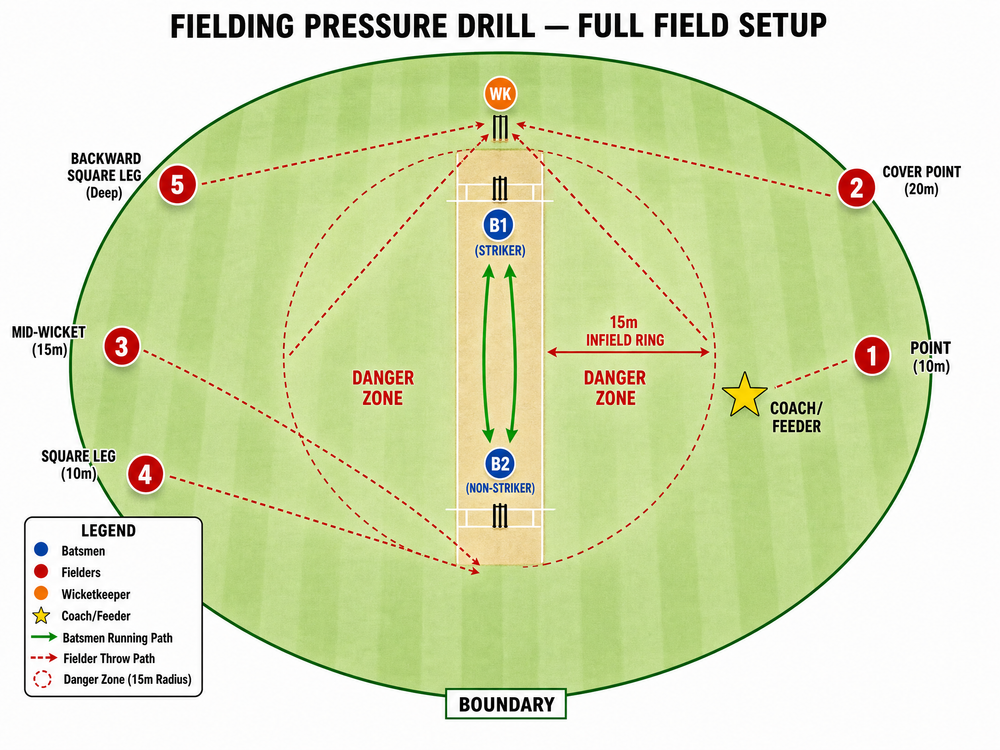
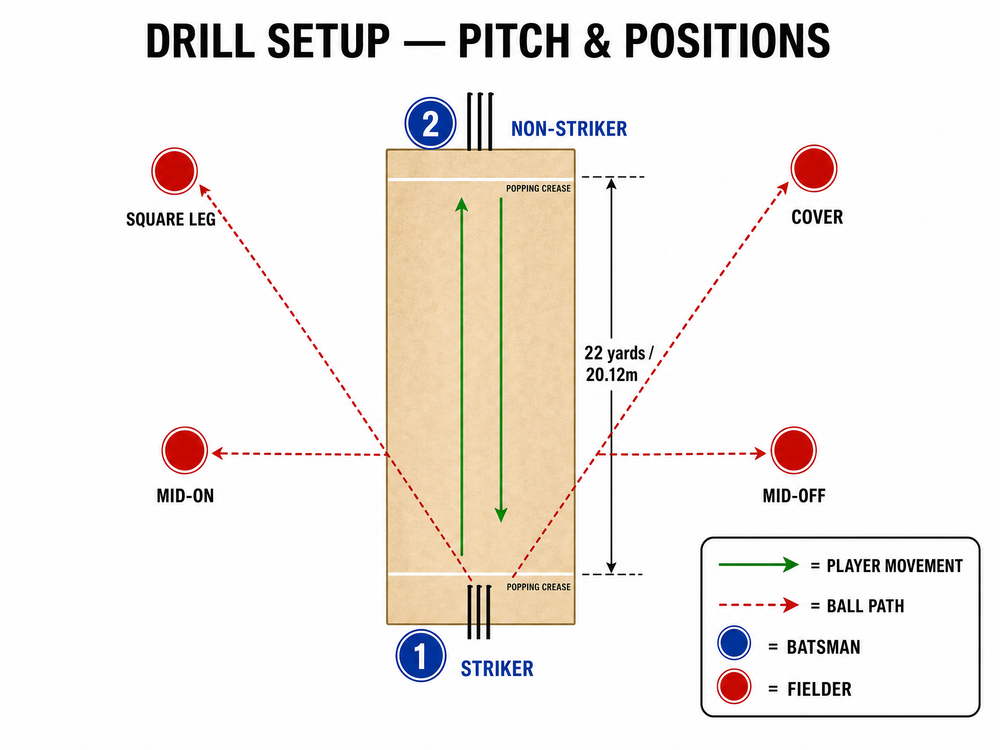
- Full 22-yard pitch (20.12m) with stumps at both ends.
- Mark popping creases clearly at each end.
- Establish a 15-metre 'Danger Zone' radius around the pitch for the infielders.
Player Positions:
- 2 Batsmen (Striker and Non-Striker) fully kitted with pads, gloves, and bats.
- 1 Wicketkeeper positioned behind the stumps at the bowler's end (or striker's end depending on the feed).
- 4-5 Fielders positioned inside the 15m ring (e.g., Point, Cover, Mid-On, Mid-Off, Square Leg).
- 1 Coach/Feeder positioned adjacent to the pitch to distribute the ball.

3. Step-by-Step Instructions
- The Feed: The coach/feeder rolls or throws the ball into various zones within the 15m ring, simulating a defensively pushed or tapped ball.
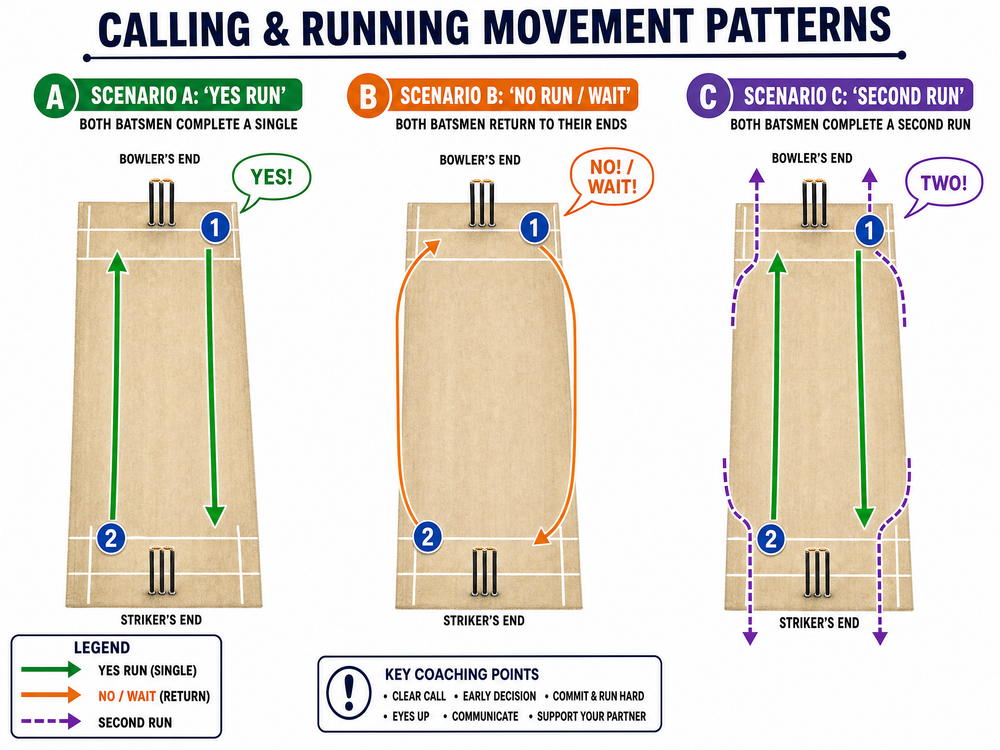
- The Call: The Striker (or Non-Striker, if the ball is behind square) must immediately assess the ball's pace and the fielder's position, then make a loud, clear call: 'YES', 'NO', or 'WAIT'.
- The Execution (YES): If the call is 'YES', both batsmen sprint to the opposite end. The Non-Striker must back up aggressively as the ball is fed, ready to explode out of the crease.
- The Execution (NO/WAIT): If the call is 'NO' or 'WAIT', both batsmen must quickly return to their respective creases, grounding their bats securely.
- The Fielding Response: The targeted fielder must attack the ball cleanly and execute a rapid throw to either the wicketkeeper or the bowler's end stumps to attempt a run-out.
- Rotation: After every 6 feeds, rotate the batsmen and shift the fielders to different positions to ensure all players practice different angles.
4. Key Coaching Points
- Loud and Early Calling: The call must be made the moment the ball is struck (or fed). Ambiguity causes run-outs.
- Aggressive Backing Up: The Non-Striker should walk in with the bowler/feeder and be outside the crease, ready to run, but watching the ball carefully.
- Run the First Run Hard: Always sprint the first run as if a second is possible. Turn blind (facing the ball) to assess overthrows or fumbles.
- Slide the Bat: Batsmen must stretch and slide their bat across the popping crease, rather than running past it upright.
- Fielder Urgency: Fielders must attack the ball with one hand (if possible) for a quicker release and aim at the base of the stumps.
5. Common Mistakes
- Whispering or Hesitant Calls: Mumbled calls lead to confusion and mid-pitch collisions.
- Ball Watching: The Non-Striker staring at the ball instead of trusting the Striker's call, resulting in a delayed start.
- Running on the Pitch: Batsmen running straight down the middle of the pitch (the danger area) instead of the sides, risking penalty runs or pitch damage.
- Poor Bat Grounding: Running over the crease without grounding the bat, making them vulnerable to direct hits.
6. Variations & Progressions
- The 'Ghost' Fielder: Remove one fielder but keep the zone active. Batsmen must identify the gap and automatically call 'YES' when the ball is fed there.
- Second Run Challenge: The coach occasionally shouts 'OVERTHROW!' after the first run is completed, forcing the batsmen to turn quickly and sprint for a second run.
- Batting in Pairs: Run a mini-competition where batting pairs lose 5 runs for a run-out but gain 2 runs for every successful quick single.
7. Age Adaptations
- Under 8s / Under 10s: Shorten the pitch slightly (e.g., 16-18 yards). Focus purely on loud calling ('YES' or 'NO') and sliding the bat. Use softer balls.
- Under 12s / Under 14s: Introduce the 'WAIT' call. Emphasize aggressive backing up and turning blind.
- Under 16s / Open: Full match intensity. Fielders must attempt direct hits. Batsmen are penalized for poor calling or failing to look for a second run.
