

Cricket
Run Out Prevention: The Zone-Based Calling System for Batters
Eliminate costly run outs by teaching your batters a clear, zone-based communication system that assigns calling responsibility, builds trust between batting partners, and instills aggressive, intelligent running between the wickets.
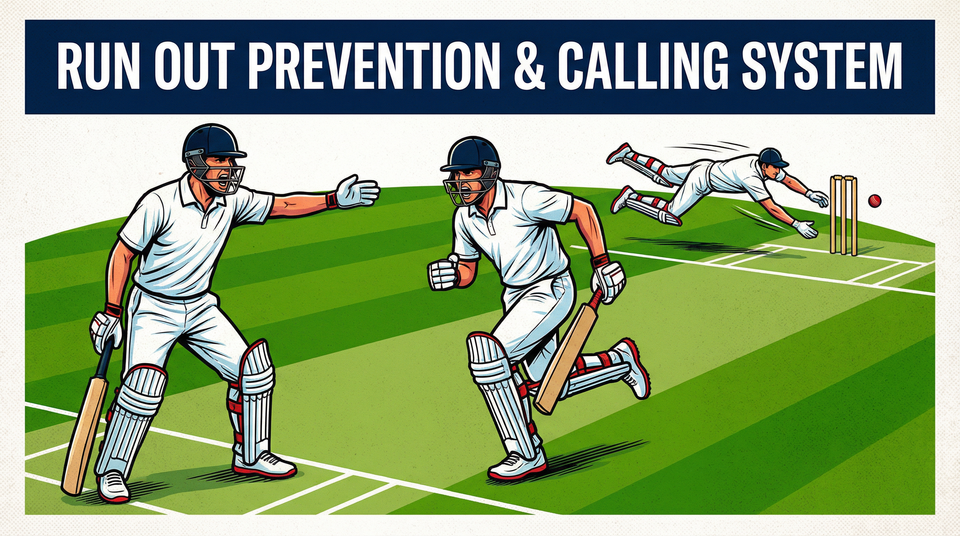
What you need
Cricket bats (2), Batting pads (2 pairs), Batting helmets (2), Cricket balls (6+), Full set of stumps and bails (2 sets), Cones or markers (optional)
Overview
This set play establishes a clear, decisive, and non-negotiable system for communication between batters to eliminate disastrous run outs. Running between the wickets is a fundamental source of pressure and scoring in cricket, yet it is often the area where partnerships break down due to hesitation and poor calling. This system assigns clear responsibility for calling based on the ball's position, creating an instinctual and efficient running partnership. It is best used in all game scenarios — from high-pressure death overs to early-innings partnership building — to instil good habits, maximise scoring opportunities, and minimise risk.
Setup
Equipment
For this drill you will need standard cricket bats, pads, and helmets for two batters, one full set of wickets (stumps and bails) at each end of the 22-yard pitch, a supply of cricket balls, and optional cones or markers for zone boundaries.
Pitch and Field Setup
Use a standard 22-yard cricket pitch with clearly marked batting and popping creases on an oval cricket ground. Position at least two fielders in realistic game positions — Cover and Mid-On are ideal starting points — to create authentic pressure. A coach or third person acts as the feeder/bowler from a position approximately 8 yards to the off side of the pitch.
Player Positions
| Position | Role | Location |
|---|---|---|
| Batter 1 (Striker) | Calls for balls in front of the wicket on the off side | Batting crease, striker's end |
| Batter 2 (Non-Striker) | Calls for balls behind the wicket and on the leg side | Bowler's end crease, backing up |
| Coach / Feeder (C) | Feeds ball into specific zones to test the calling system | ~8 yards off side of pitch |
| Fielder 1 (F1) | Applies pressure, attempts run out at bowler's end | Cover, ~20 yards from pitch |
| Fielder 2 (F2) | Applies pressure, attempts run out at striker's end | Mid-On, ~20 yards from pitch |
Scroll horizontally to see every column.
Step-by-Step Instructions
Step 1 — Brief the Batters on the Calling Zones. Before the drill begins, walk both batters through the three Calling Zones shown in Diagram 1. The Striker's Zone covers all balls hit in front of the wicket on the off side — the striker has the clearest view and owns the call. The Non-Striker's Zone covers all balls hit behind the wicket or on the leg side — the non-striker is watching the ball travel away from the striker and is best placed to judge. The Ambiguous Zone covers straight hits and deflections — the first batter to call takes full responsibility and the other commits immediately.
Step 2 — Set the Drill. Position all players as per Diagram 3. The coach holds the ball and is ready to feed. Both batters confirm they understand their zone responsibilities before the first ball.
Step 3 — Feed into the Striker's Zone. The coach underarms or rolls the ball towards Cover. The striker watches the ball off the bat, assesses the fielder's position and distance, and makes a loud, sharp call: "YES! YES! YES!" or a firm "NO!" The call must be made within one second of the ball leaving the bat.
Step 4 — Execute the Run. On a "YES" call, both batters explode from their crease and sprint hard down the pitch on opposite sides to avoid collision, as shown in Diagram 2. The non-striker's eyes move from the ball to the striker's body language in the first two strides, confirming the call before committing fully.
Step 5 — Ground the Bat. As each batter arrives at the far crease, they must slide or drag the bat firmly behind the popping crease. The bat, not the body, must cross the line. Reinforce this as a non-negotiable habit on every single run.
Step 6 — Reset and Repeat into the Non-Striker's Zone. The coach now feeds the ball to fine leg or square leg. The non-striker owns the call. Repeat the process, ensuring the striker trusts the call and reacts without hesitation.
Step 7 — Introduce Live Fielders. Once the batters demonstrate consistent, loud calling and clean running mechanics, the fielders actively attempt run outs. This introduces real pressure and tests the system under match-realistic conditions.
Key Coaching Points
The most important principle in this system is that the call must be loud, early, and continuous. A call made half a second after the ball is hit is a call made too late. Teach your batters to call as the ball leaves the bat, not after it has reached the fielder. A single sharp "Yes" is insufficient — the call should be repeated: "YES! YES! YES!" until both batters are safely home.
Zone ownership builds trust. The system only functions when both batters fully trust the designated caller. Once the responsible batter makes the call, the other commits without hesitation or second-guessing. Reinforce this trust in every repetition. A batter who ignores their partner's call and makes their own decision is the number one cause of mid-pitch collisions and run outs.
Backing up is free ground. The non-striker must be moving forward — 2 to 3 yards out of their crease — as the ball is delivered. This is not optional. Every yard of backing up is a yard of free running that can be the difference between being safe and being run out on a tight single.
Run the first run as if a second run is available. Aggressive running puts the fielder under pressure, forces errors, and creates overthrows. A batter who jogs the first run invites a run out. Sprint every run.
Turn on the correct side. When turning for a second run, the batter must turn on the side that keeps their eyes on the ball and the fielder. Turning blind — away from the ball — removes the ability to make an informed decision about whether to continue.
Talk between deliveries. Encourage batters to communicate between balls: identify the fielder with the weakest arm, note who is positioned deep, and agree on the plan for the next ball. Running between the wickets is a partnership skill, not an individual one.
Common Mistakes
The table below outlines the most common errors coaches will observe and how to correct them.
| Mistake | Why It Happens | Correction |
|---|---|---|
| Both batters calling simultaneously | Neither batter knows their zone responsibility | Reinforce zone ownership; stop the drill and re-brief immediately |
| Hesitant or quiet calls | Batter is unsure and hoping the partner will call | Insist on a loud, committed call; use a "volume rule" — if the coach can't hear it, it doesn't count |
| Non-striker watching the ball, not the striker | Habit from fielding; wrong focus point | Drill the non-striker to fix their eyes on the striker's body language within two strides |
| Not grounding the bat at the crease | Laziness or assumption of safety | Make it a rule: every run must end with a deliberate bat slide; penalise any run where the bat is not grounded |
| Turning blind when going for a second run | Poor footwork habit | Teach the correct turning side explicitly; use slow-motion walk-throughs before full-speed runs |
Scroll horizontally to see every column.
Variations and Progressions
Progression 1 — The Third Run Call. Once batters are proficient with singles and doubles, introduce the "GO FOR THREE!" call. This call is made by the batter running toward the danger end — the end the fielder is throwing to — who has the clearest view of the play. This batter must call loudly and early, as the risk of a run out is highest at this end.
Progression 2 — Live Bowler and Full Field. Transition from coach feeding to a live bowler with a full field of nine fielders. This simulates match pressure completely and forces batters to assess fielder positions, identify gaps, and judge throwing arms in real time. Introduce a scoring system: one point for a completed run, minus two for a run out.
Variation 1 — The "No" Discipline Drill. The coach deliberately feeds the ball to a fielder positioned very close — 10 to 12 yards away. The goal is for the batters to practise the firm "NO!" call and hold their ground, resisting the instinct to steal a risky single. This builds discipline and teaches batters that the best run is sometimes the one not taken.
Variation 2 — Pressure Scenario Running. Create a specific match scenario before the drill begins: "You need 14 runs off the last 10 balls, one wicket in hand." This adds narrative context and forces batters to weigh risk and reward on every potential run, replicating the decision-making demands of a real match.
Age Adaptations
Under 8 and Under 10 players should focus purely on the "YES" and "NO" calls using a softer ball. The coach can model the calling role initially, making the call for both ends to demonstrate what good communication sounds like before handing over responsibility. Shorten the pitch to 16 to 18 yards to ensure success and build confidence in the running process.
Under 12 and Under 14 players are ready to learn the full Calling Zones system. Introduce the concept of the designated caller and emphasise the importance of backing up and running the first run hard. Drills can be conducted with two or three fielders to add moderate pressure without overwhelming the decision-making process.
Under 16 and Open Age players should use all progressions and variations. Coaches should expect loud, decisive calling and aggressive, intelligent running as a baseline standard. Introduce advanced concepts such as identifying a fielder's weaker throwing arm, reading a fielder's body position before the ball is hit, and communicating the "safe end" to run to when a direct hit is likely.
