Running Between the Wickets: Call, Commit and Turn Drill
A progressive, game-relevant running drill that teaches batters to make early calls, finish safely through the crease and convert a clean single into a sharp second run.

Equipment Needed
Overview
Running between the wickets is not a fitness extra; it is a repeatable scoring skill that must hold up when players are tired, a ball is in play and a decision has to be made in a fraction of a second. This drill develops the complete exchange: the striker’s first call, the non-striker’s response, a straight sprint over a full pitch, safe bat-grounding and the judgement to turn for a second run. Use it early in a batting session to establish communication standards, then revisit it in the final 15 minutes as a pressure block.
The full-size practice lane is a 22-yard / 20.12 m pitch, as specified in MCC Law 6; the back edge of each popping crease is 4 ft / 1.22 m in front of the bowling crease under Law 7. [1] [2] For junior groups, shorten the lane only where the local governing body permits it, but retain a clearly marked completion line so the habit remains transferable.
Setup
Set up one regulation or marked practice wicket on the central strip of an oval ground. Place stumps at both ends. If you are on a non-turf surface, use spring-back stumps or three cones at each end, then tape or cone the popping creases. Start with one batting pair, a wicketkeeper, a cover fielder and a point fielder; add a deep cover and a target fielder as the drill progresses.
| Item | Coaching specification |
|---|---|
| Players | 8 players: B1 striker, B2 non-striker, No. 1 wicketkeeper, No. 2 cover, No. 3 point, No. 4 deep cover, a feeder and a reserve/umpire. |
| Equipment | 2 bats, 12–16 balls, 2 sets of stumps or 6 cones, 10 flat markers, 4 coloured cones, bibs and a whistle. |
| Distances | 22 yards / 20.12 m between bowling creases; popping creases 1.22 m from each wicket. Set cover 12–15 m from the striker and deep cover 25–30 m out, adjusted for age and throwing ability. |
| Work-rest | Six live balls per pair, then change roles. Allow 45 seconds for feedback and reset; run three rounds for a 20–25 minute block. |

Player roles and numbering
Keep the language consistent: B1 is the striker and initial caller; B2 is the non-striker and immediate responder. No. 1 is the wicketkeeper; No. 2 cover; No. 3 point; and No. 4 deep cover/target fielder. The feeder starts 3–4 m beside striker’s end, outside the running lane.
Step-by-Step Instructions
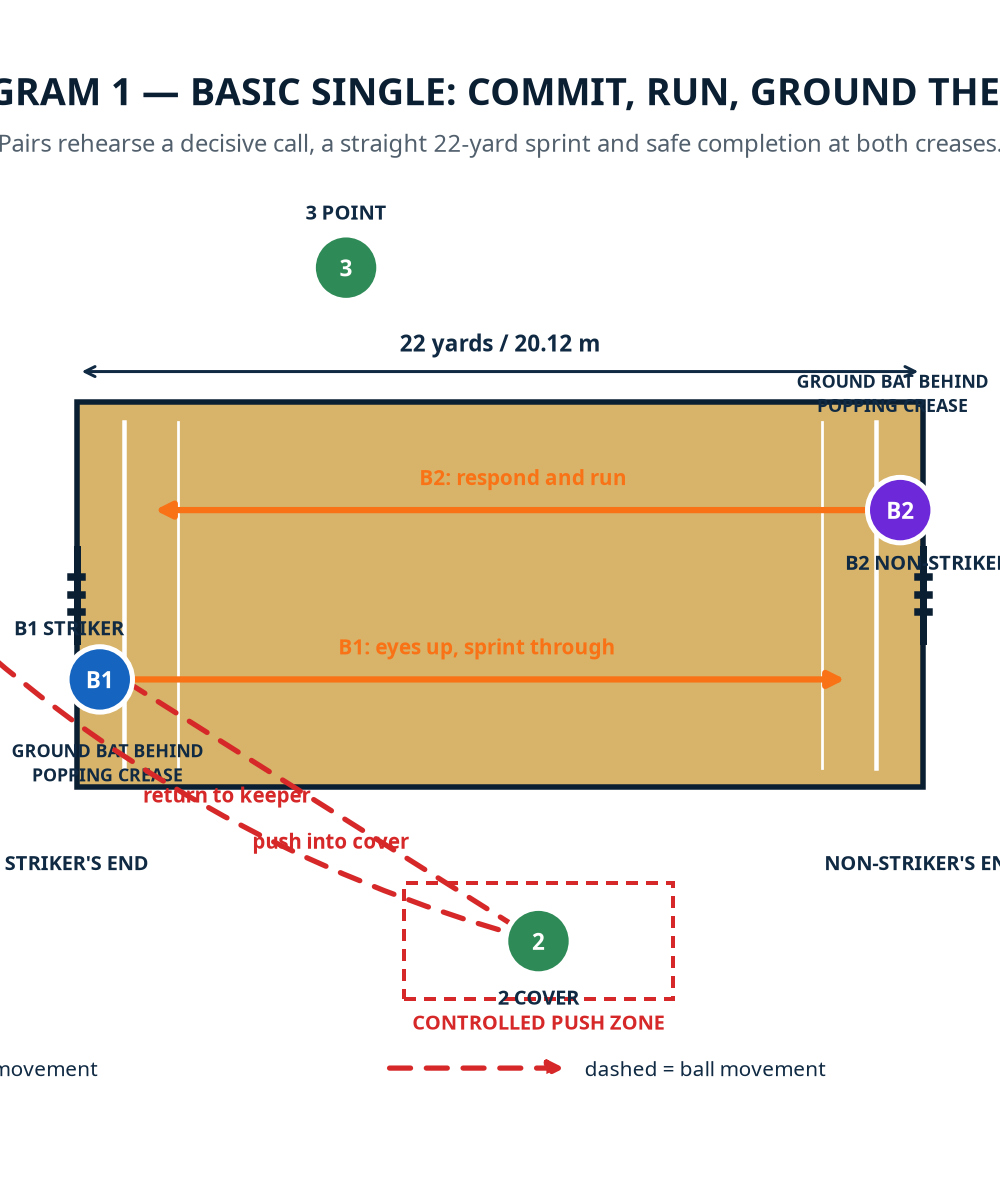
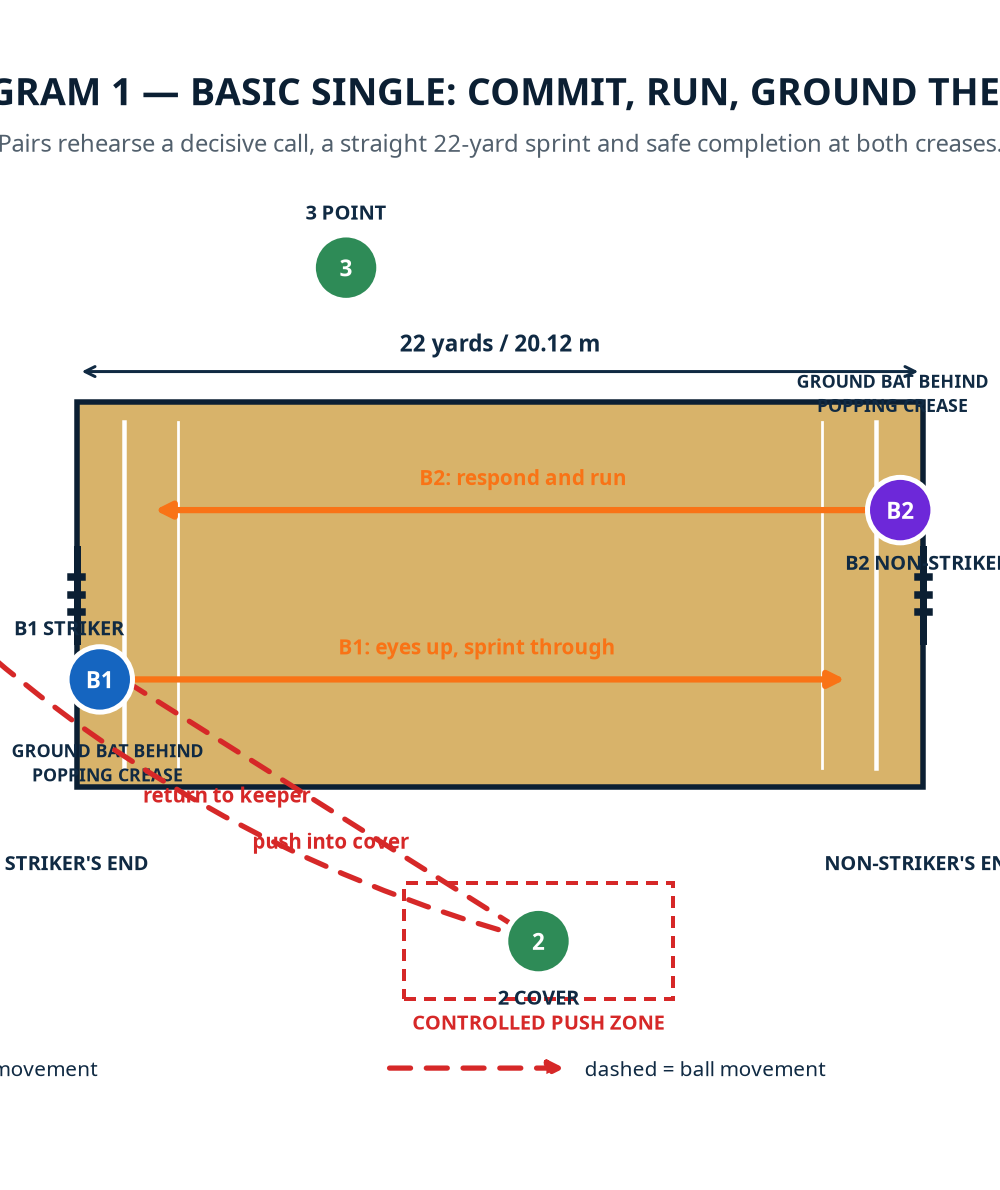
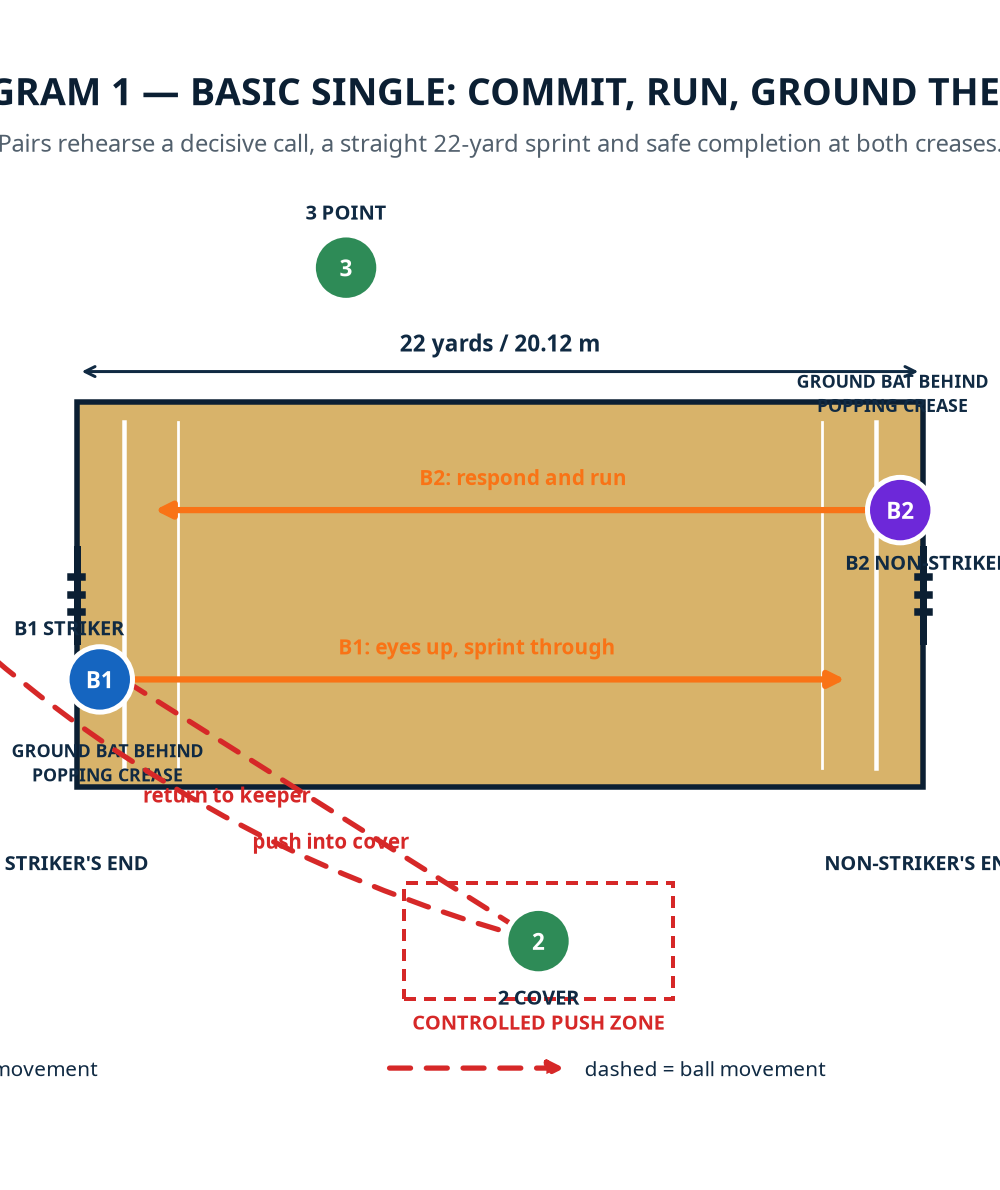
Brief the pair before the ball. Ask B1 and B2 to agree the three calls: “yes”, “no” and “wait”. Insist that the first call is loud enough for a teammate at the far crease to hear it. Give B1 one scoring zone—initially a controlled push to cover—and tell the pair they are completing only one run.
Create the first-ball picture. The feeder delivers a gentle underarm ball to B1. B1 plays a controlled push along the ground toward No. 2 cover. As the ball leaves the bat, B1 calls “yes” or “no”; B2 moves only on that audible information. The cover fielder attacks the ball and returns it to No. 1 wicketkeeper.
Run the lane correctly. On “yes”, both batters accelerate in their own half of the wicket. The first three steps must be committed, with the bat carried in the inside hand and angled low. Coach players to run through the popping crease rather than slowing at it. The final action is to slide or lower the bat so it is grounded behind the crease before the body decelerates.
Freeze and check the finish. On the whistle, the pair freezes after completing the run. Check that each batter’s bat is grounded behind the popping crease, that there is no collision line through the middle of the pitch, and that the wicketkeeper has received the ball cleanly. If the run is safe, award one point; if the pair hesitates, crosses dangerously or leaves the bat raised, replay the ball without a point.
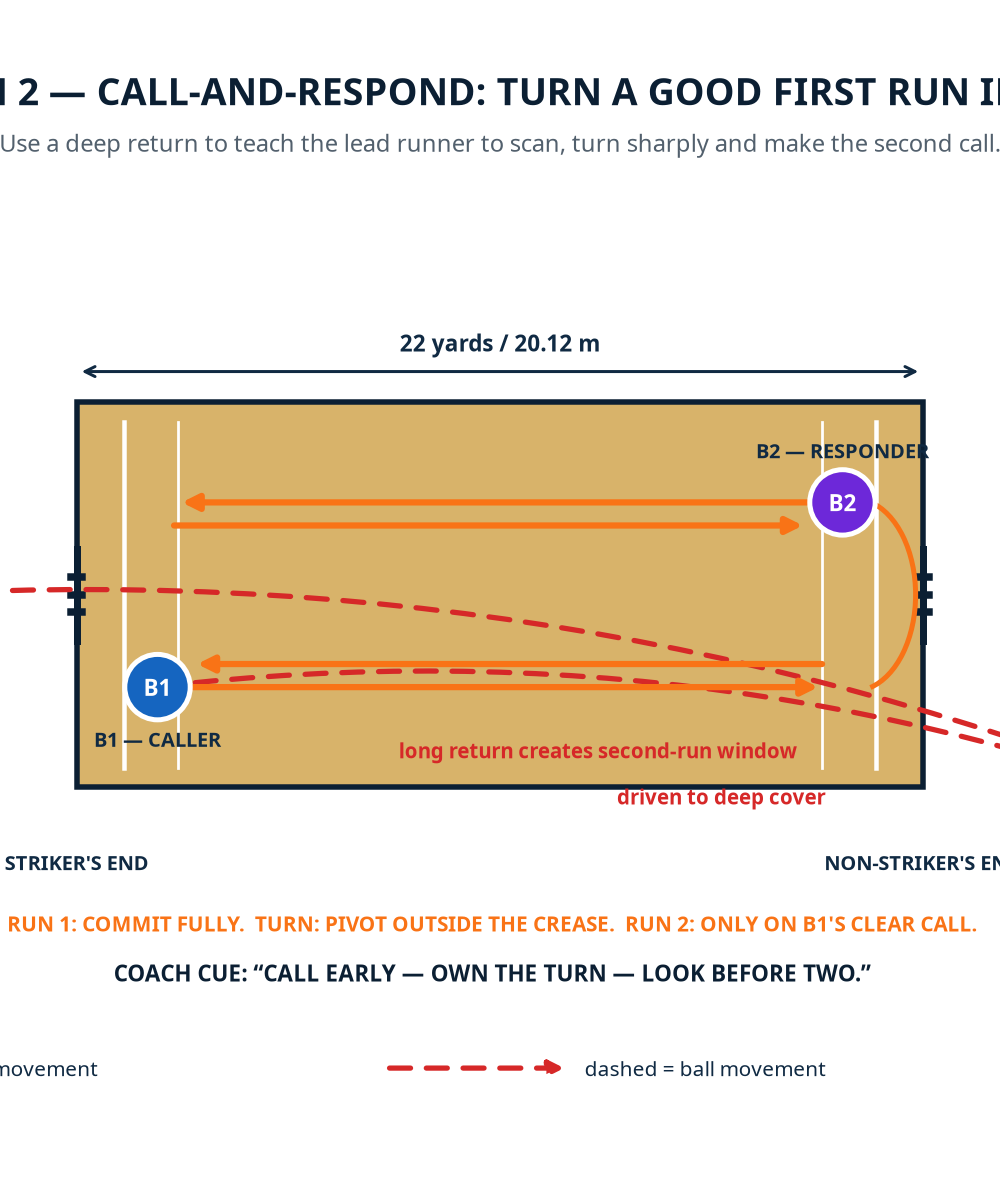
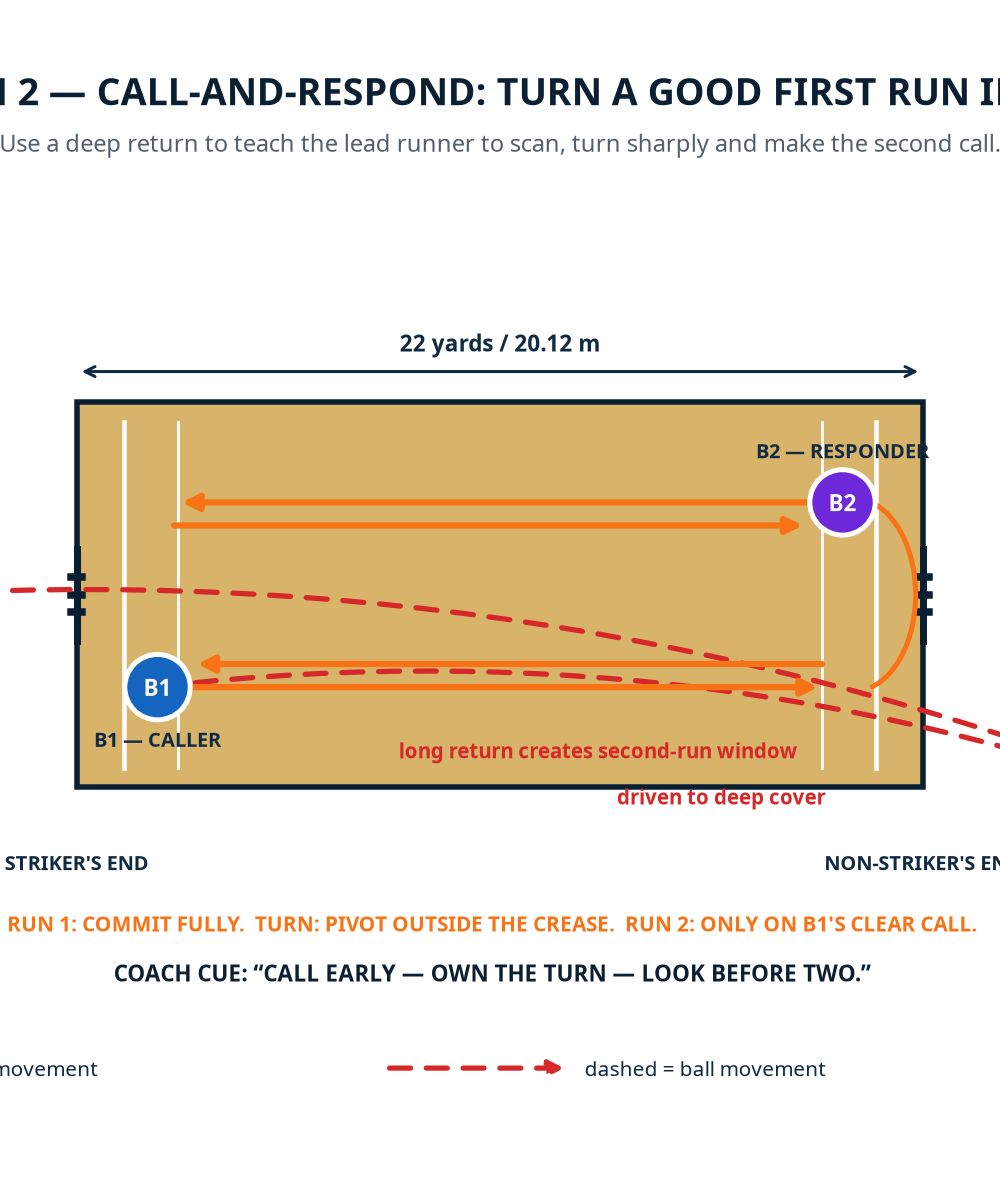
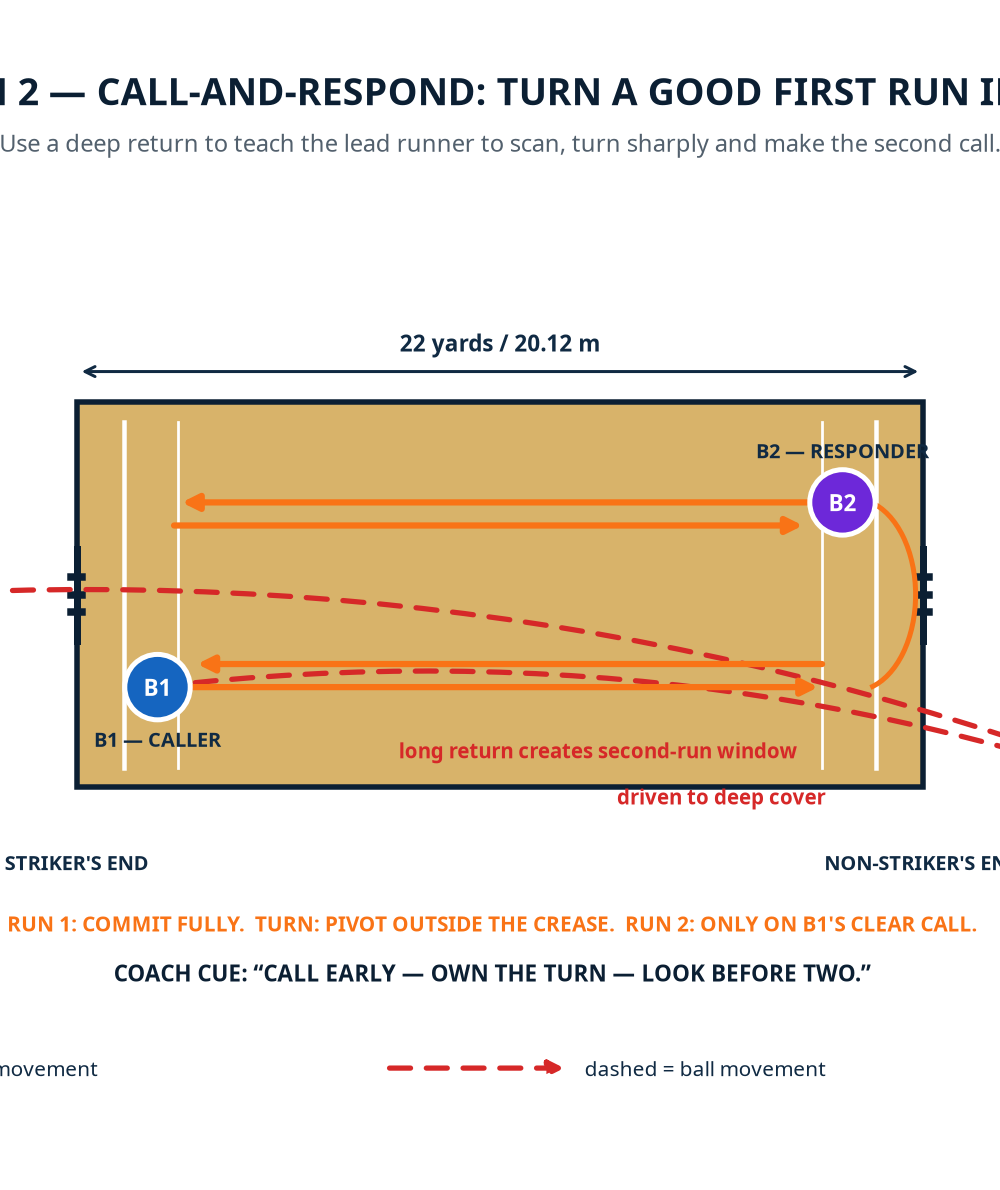
Introduce the decision for two. Move No. 2 to deep cover and instruct B1—the lead runner after the first run—to look over the shoulder, own the turn and make the second call. The second run only counts if the call is made before B2 reaches the far popping crease.
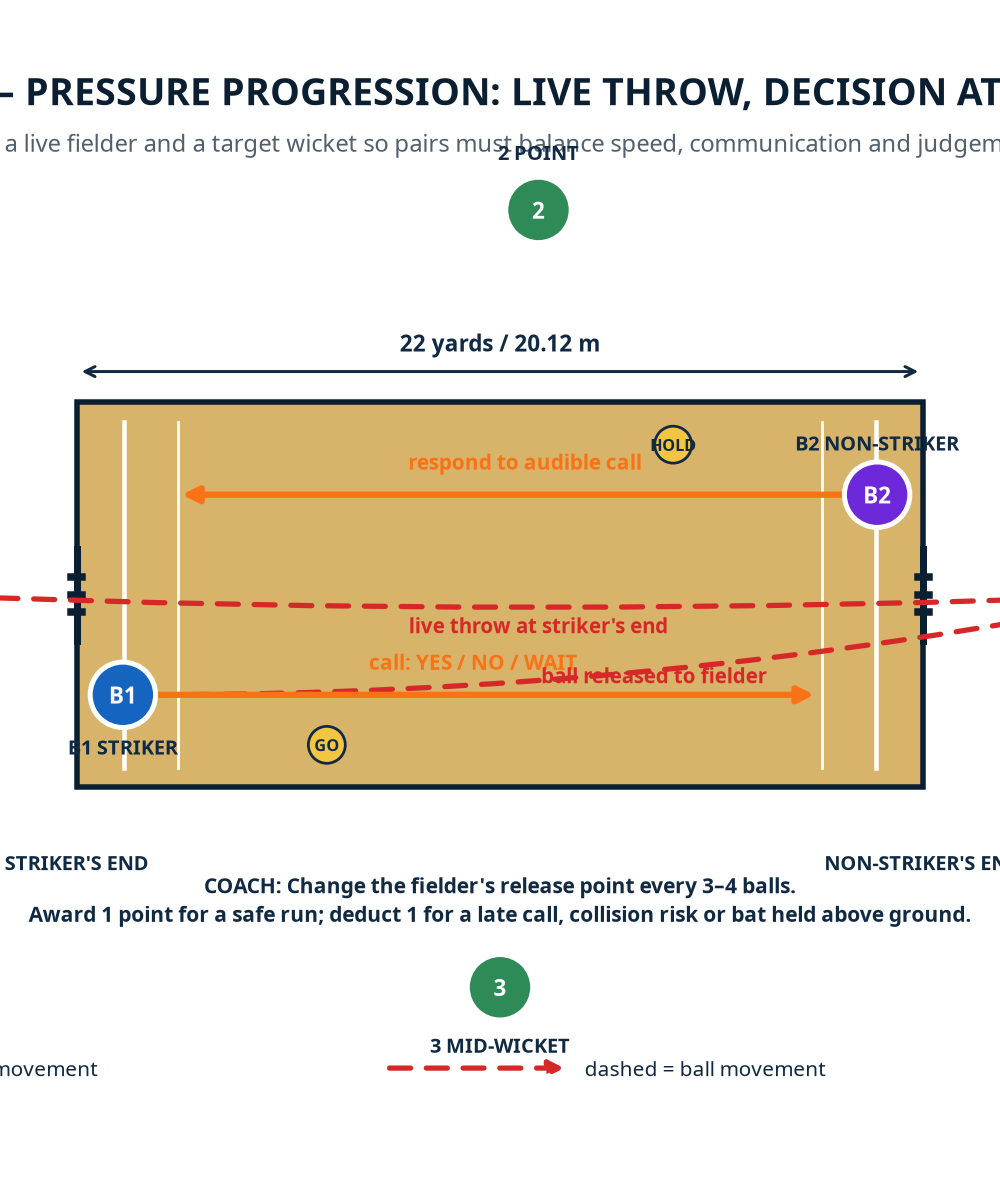
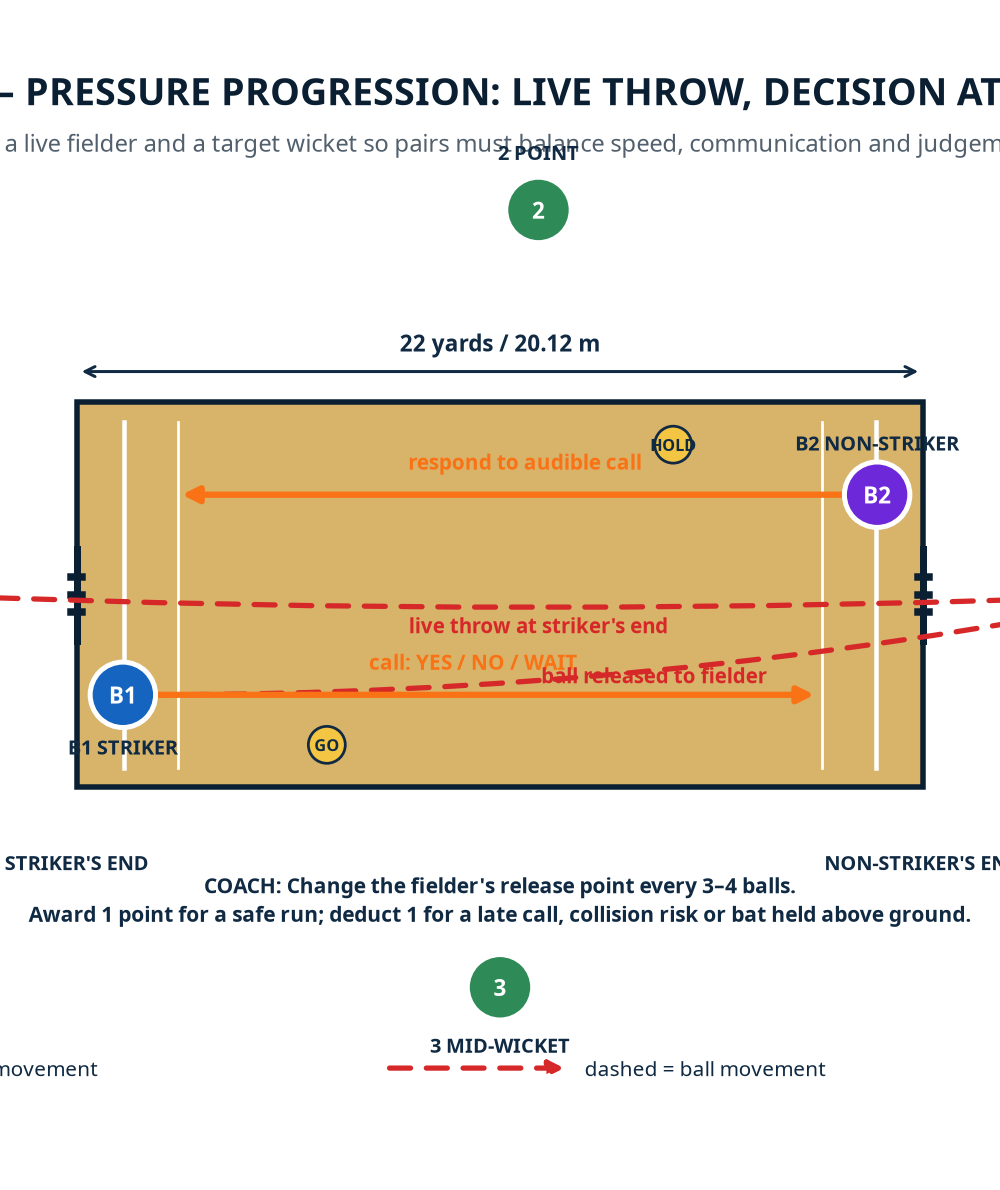
Finish with live pressure. In the final round, vary the feeder’s direction between point, cover and deep cover. The target fielder makes a live throw at the striker’s-end stumps. Keep the scoring simple: one point for a safe single, two for a safely completed pair, minus one for an unnecessary or late run. Let fielders celebrate a run-out chance, then coach the decision rather than merely the outcome.
Key Coaching Points
| Coaching focus | What the coach should demand |
|---|---|
| Early, decisive call | B1 calls as soon as the ball is played, not after admiring the shot. Use a firm “YES”, “NO” or “WAIT”; remove vague calls such as “maybe”. |
| Eye contact and trust | B2 listens first and glances only once running. The pair must trust the nominated caller rather than both watching the ball. |
| Straight running lane | Each batter holds a line on their own side of the pitch. This prevents shoulder contact and leaves room for the bat to enter the crease. |
| Bat-grounding | The bat travels low in the inside hand and is grounded behind the popping crease. Do not accept a raised bat, a jump or a late reach. |
| Turn mechanics | The lead runner decelerates only after the crease, plants outside the line of the stumps, turns with the bat in hand and calls the next run early. |
| Game awareness | Praise a correct “no” as strongly as a successful run. Intelligent running means protecting wickets as well as taking scoring opportunities. |
Common Mistakes
| Error to spot | Immediate correction |
|---|---|
| Both batters look at the ball and no one calls. | Stop the repetition. Nominate B1 as the caller for balls in front of square and replay at half speed with a mandatory verbal call. |
| B2 leaves late or drifts across the pitch. | Mark two 0.75 m running channels with flat cones for three repetitions; remove the cones once the running line is reliable. |
| Players slow before the crease or carry the bat in the outside hand. | Use the cue “run through, then brake.” Demonstrate the bat staying low in the inside hand and require a clear ground-behind-the-line finish. |
| The first runner turns without scanning the fielder. | Hold a coloured cone above the deep fielder after the first run; B1 must call the colour before deciding on two. This forces a look without adding a lecture. |
Variations & Progressions
Easier—call-and-run rehearsal. Remove the ball and fielders for two minutes. The coach points left or right and gives B1 a visual trigger; B1 calls, both players sprint one length and ground the bat. This is ideal for installing language before the ball distracts younger players.
Harder—two-run window. Place No. 2 deep at 25–30 m and No. 1 at the striker’s stumps. B1 must make the second call before B2 reaches the far popping crease. Use a five-point target over six balls to make decision quality visible.
Game-real—live field and consequence. Use point, cover, deep cover and a wicketkeeper. Feed randomly into one of three zones and make the return live. Award fielders one point for hitting the stumps or creating a run-out chance; this sharpens both the runner’s judgement and the fielding unit’s urgency.
Age Adaptations
| Group | Practical adaptation |
|---|---|
| Under 8 | Use 12–14 m between cone wickets, a soft ball and one explicit call—“go”. Run one at a time before pairing. |
| Under 10 | Use 16–18 m, introduce “yes” and “no”, and keep fielders 10–12 m away so every return is catchable. |
| Under 12 | Build toward the full pitch where appropriate. Add “wait”, two runs and a stationary wicketkeeper target. |
| Under 14 and above | Use a full 22-yard pitch, live throws, random feeds and score consequences. Demand that the lead runner owns the second call under fatigue. |
Coach’s close
End by asking each pair for one call they made well and one decision they would change. Keep the feedback linked to observable actions: voice, first three steps, running lane, grounded bat and turn. When those five behaviours are consistently sharp, the pair will take more low-risk runs and turn routine singles into pressure on the fielding side.
References
[1]: https://www.lords.org/mcc/the-laws/the-pitch "Marylebone Cricket Club, Law 6: The Pitch"
[2]: https://www.lords.org/mcc/the-laws/the-creases "Marylebone Cricket Club, Law 7: The Creases"