

Cricket
Mastering Spin Bowling Variations: The 4-Zone Target Drill
A high-intensity target drill designed to help spin bowlers master their stock ball and execute variations with pinpoint accuracy under pressure.

What you need
6-12 cricket balls, 4 flat target markers or coaching cones, Stumps (both ends), Chalk or masking tape
1. Overview
Spin bowling is as much about deception and control as it is about turning the ball. The '4-Zone Target Drill' is a comprehensive session designed to help spin bowlers—whether off-spinners or leg-spinners—develop consistency with their stock delivery while building the confidence to execute variations (such as the top-spinner, slider, or googly) on command. By using visual target zones on a standard 22-yard pitch, bowlers receive immediate feedback on length and line, allowing coaches to assess release points, flight, and accuracy under simulated match pressure.
2. Setup
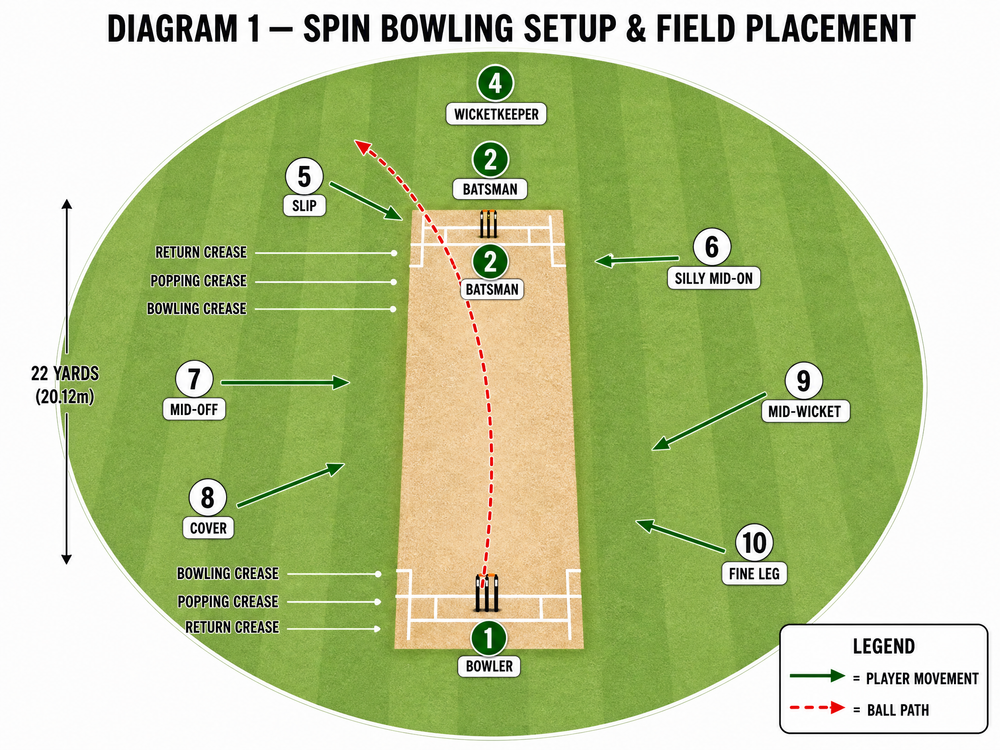
Equipment Needed:
- 6-12 cricket balls (preferably of similar age/wear)
- 4 flat target markers or coaching cones
- Stumps (both ends)
- Chalk or masking tape to mark zones on the pitch
Pitch & Field Setup:
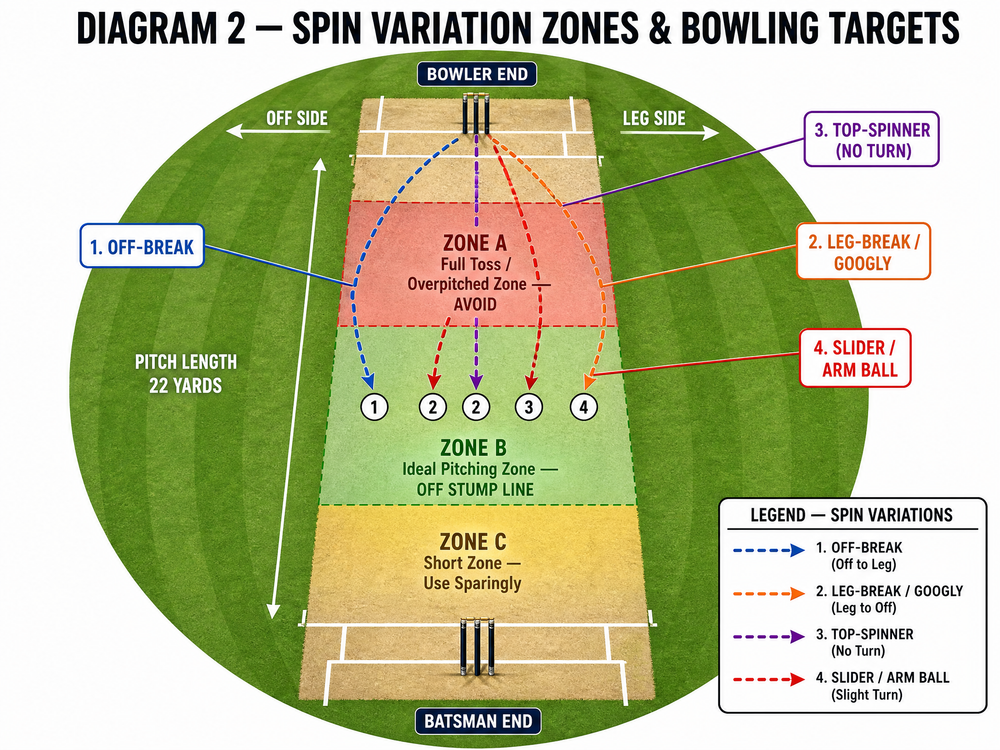
Set up on a standard 22-yard cricket pitch. Use chalk or tape to divide the pitch into three distinct length zones:
- Zone A (Red): Full Toss / Overpitched Zone (Avoid)
- Zone B (Green): Ideal Pitching Zone (Good length, off-stump line)
- Zone C (Yellow): Short Zone (Use sparingly)
Place the four flat target markers within Zone B to represent specific landing spots for different variations.

Player Positions:
- Bowler (1): Operates from the bowling crease.
- Wicketkeeper (4): Stands back or up to the stumps to provide a target and collect deliveries.
- Batsman (2) (Optional): Can stand at the striker's end (passive, no bat) to provide a realistic sightline for the bowler.
3. Step-by-Step Instructions
- Warm-Up (Stock Ball Only): The bowler bowls 12 deliveries using strictly their stock ball (off-break or leg-break). The goal is to land 9 out of 12 balls in Zone B, hitting Target 1 or 2.
- Introduce Variations: The coach calls out a specific variation (e.g., "Top-spinner" or "Arm ball") just before the bowler begins their run-up. The bowler must adjust their grip and release to execute the variation, aiming for the designated target (e.g., Target 3 or 4).
- The 6-Ball Over Simulation: The bowler bowls a 6-ball over. The coach mandates a specific sequence: 4 stock balls, 1 variation, and 1 stock ball. The bowler must maintain the same run-up and arm speed for all 6 deliveries.
- Target Practice: Remove the zones and leave only one flat marker on an off-stump line. The bowler must hit the marker with a variation delivery 3 times out of 6.
- Review and Feedback: After every 12 balls, the coach and bowler review the groupings. Discuss any changes in action, arm speed, or trajectory when bowling the variations.
4. Key Coaching Points
- Consistent Arm Speed: The most crucial element of a successful variation is maintaining the same arm speed as the stock delivery. Slowing down the arm alerts the batsman to the change.
- Release Point: Ensure the bowler's release point remains consistent. Dropping the arm lower for a slider or googly is a common tell.
- Strong Pivot and Follow-Through: A vigorous pivot on the front foot and a complete follow-through ensure maximum revolutions on the ball, regardless of the variation.
- Flight and Dip: Encourage bowlers to use the crease and vary their trajectory. A well-flighted variation that dips late is far more deceptive than a flat delivery.
- Grip Disguise: Work with the bowler to ensure their grip changes are hidden within their run-up or action, not telegraphed early.
5. Common Mistakes
- Telegraphing the Variation: The bowler visibly changes their run-up speed, stride length, or arm slot when attempting a variation.
- Over-Bowling the Variation: Using the variation too frequently in a match scenario, rendering it predictable and ineffective.
- Loss of Accuracy: Sacrificing line and length in an attempt to generate excessive turn or bounce with the variation.
- Weak Follow-Through: Decelerating through the crease, resulting in a lack of revolutions and a 'floaty' delivery that is easy to hit.
6. Variations & Progressions
- Progression 1 (Active Batsman): Introduce a batsman who plays defensive shots. The bowler must use variations to draw the batsman forward or push them back.
- Progression 2 (Match Scenario): Set a specific field (e.g., attacking field with slips and a silly point). The bowler must bowl to the field, using variations to induce a mistake.
- Variation (Blind Call): The coach calls the variation during the bowler's run-up, forcing rapid cognitive processing and physical adjustment.
7. Age Adaptations
- Under 10s / Under 12s: Focus purely on the stock ball and hitting the green zone. Introduce one simple variation (e.g., a faster ball) only when the stock ball is consistent.
- Under 14s / Under 16s: Introduce the top-spinner and arm ball. Focus on maintaining arm speed and disguising the grip.
- Open / Senior: Full drill implementation. Emphasize tactical awareness—when to use the variation based on the batsman's weaknesses and the match situation.
