

Cricket
T20 Innings Acceleration Plan: The 12–16 Over Launchpad
Run a match-realistic middle-overs set play that teaches batting pairs to create boundary options, rotate decisively, and accelerate from overs 12 to 16 without giving away soft wickets.

What you need
24 white practice balls plus 8 spare balls, Full batting and wicketkeeping protective equipment, Cones or flat markers in two colours, Boundary rope or boundary cones, Scoreboard or whiteboard and marker, Stopwatch, Fielding bibs or mannequins when player numbers are limited
1. Overview
This is a middle-overs launchpad set play for the 12th to 16th over of a T20 innings. Its purpose is not to ask batters to swing at every ball; it gives them a repeatable decision sequence that converts a settled partnership into sustained scoreboard pressure. The two batters first identify the bowler’s defensive field, then create two scoring threats, and finally take the release ball with a clear boundary option. The coach controls the situation, the field, and the scoring target so that the session feels like a live innings rather than a throw-down contest.
Use the drill when your side is two or three wickets down and needs a controlled jump in run rate. The standard scenario is 86/3 after 12 overs, with the pair tasked to score 49 runs from the next 24 legal balls—12.25 per over—while retaining a wicket.
Coach’s outcome: create repeatable boundary chances, run hard, and keep poor-shot dismissals to one or fewer.
2. Setup
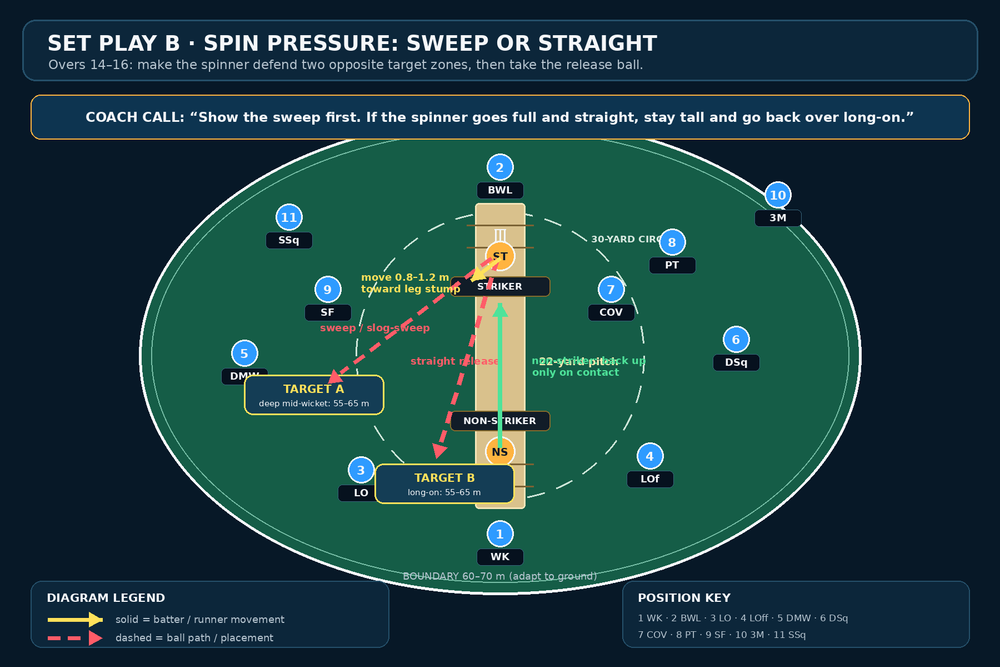
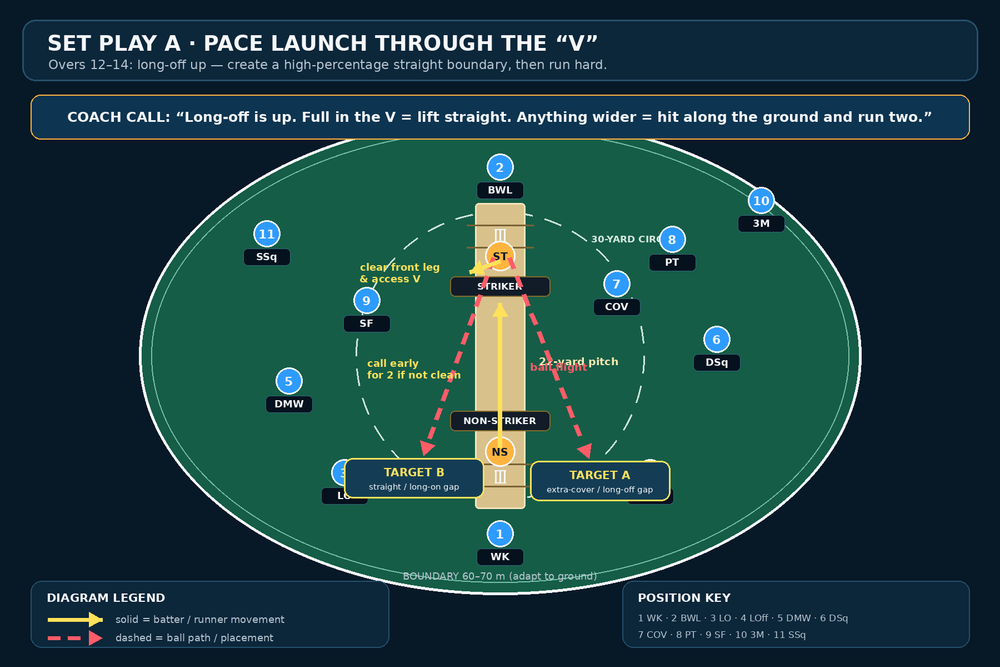
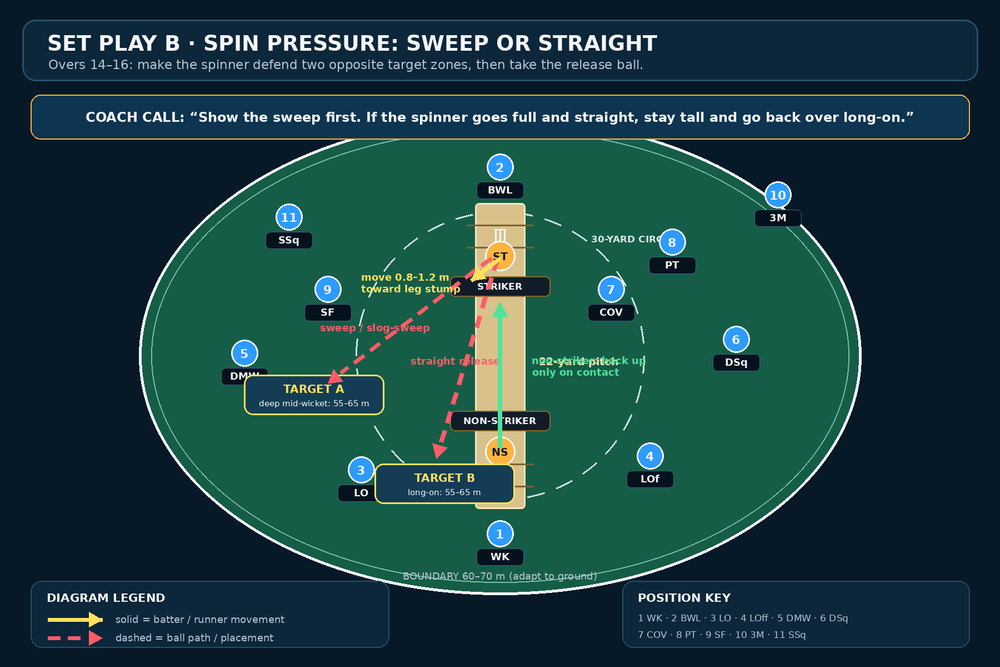
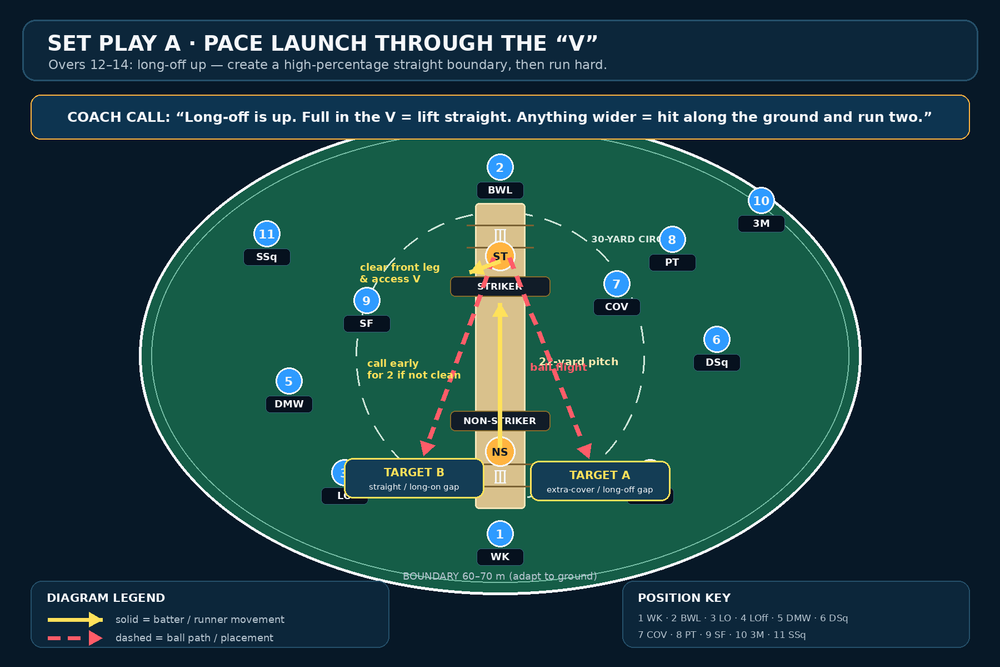
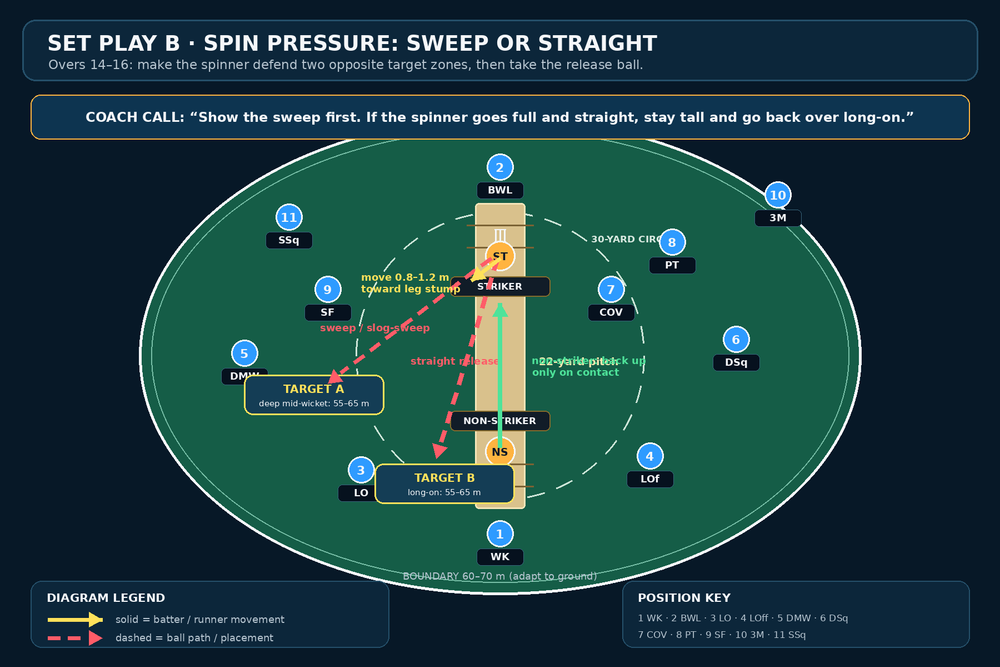
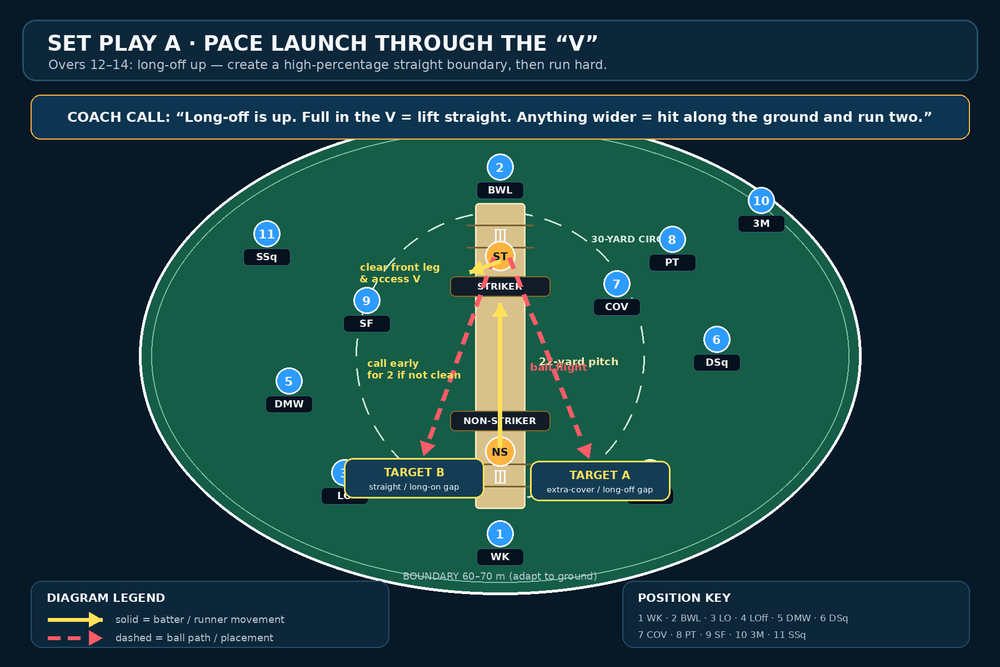
Mark and use a full 22-yard / 20.12 m pitch, with the standard 10 ft / 3.05 m width, where the venue permits. 1 Place a rope, cones, or flat discs at the actual boundary. For a full-field simulation, mark a 30-yard/27.43 m fielding-restriction circle with cones; where space is limited, scale the boundary proportionally but retain the angle of each target zone. The diagrams use the following coaching numbering: 1 WK, 2 BWL, 3 LO (long-on), 4 LOf (long-off), 5 DMW (deep mid-wicket), 6 DSq (deep square leg), 7 COV, 8 PT, 9 SF, 10 3M, and 11 SSq.
| Item | Coaching setup | Why it matters |
|---|---|---|
| Players | 2 batters, 1 bowler, 1 wicketkeeper, and 9 fielders; use fielding mannequins where numbers are short | Preserves real visual cues and running pressure. |
| Balls | 24 legal balls per set, plus 8 spare white balls | Lets the coach run a genuine four-over block without pauses. |
| Zones | Two 8–10 m “boundary windows” between fielders, marked with contrasting cones | Gives the striker a clear, repeatable scoring picture. |
| Scoreboard | Whiteboard: score, wickets, balls left, bowler type, and target | Makes every decision accountable to the match context. |
| Timing | 55 minutes: 10-minute briefing, 8-minute rehearsal, 18-minute pace block, 15-minute spin block, 4-minute review | Keeps the session competitive and brisk. |
Tell bowlers to use genuine T20 plans—yorker, hard length, slower ball, wide-yorker, or spin variation—rather than feed the shots. An assistant records legal balls, score, dots, wickets, and poor-shot dismissals.
3. Step-by-Step Instructions
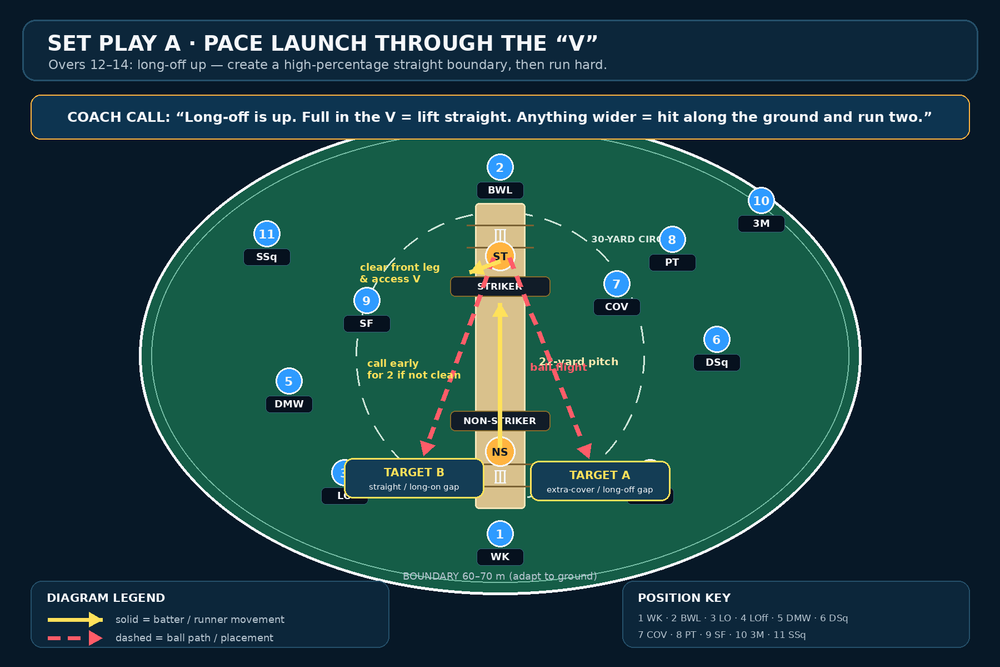
A. Brief the pair and rehearse the language — 8 minutes
- Give the pair 30 seconds to state the required rate, bowling type, and two scoring zones. The striker names one primary option and one escape option: “full in my arc, straight; wide, open face and run two.”
- Rehearse only “yes”, “wait”, and “back”; count a late half-call as a run-out.
- For the first six balls, bring long-off (4) 8–10 m inside the boundary while long-on (3) and deep mid-wicket (5) stay back. This offers a straight option while protecting the leg-side miss.

B. Pace launch: win the “V” — 18 minutes
- Ball 1 is a read ball. The striker may score, but the coaching priority is to identify release point, length, and field movement. The pair must exchange one concise observation before the next ball: “slower ball in hand,” “cover deep,” or “long-off up.”
- On balls 2–4, the striker attacks only if the ball is in the pre-agreed zone. A full ball at off stump or just outside it is driven through the straight/long-on or extra-cover/long-off windows. The intent is clean bat speed and a high elbow, not maximum force. A hard-length ball is punched into cover or mid-wicket for one, then the pair reset.
- On balls 5–6, give the bowler freedom to use a yorker or wide-yorker. The striker must show the secondary solution: squeeze the yorker into the off-side ring, or leave the wide delivery if it is outside their hitting range. Award one bonus run for a correctly identified leave and two bonus runs for a hard-run two.
- After every over, the fielding captain may move one fielder. The batting pair has 20 seconds to name the new gap and alter their plan. This forces observation before premeditation.
C. Spin pressure: create a two-sided problem — 15 minutes
- Change to a spinner for the next 12 legal balls. Put deep mid-wicket (5) and long-on (3) back; place long-off (4) 8–10 m in from the boundary, cover (7) in the ring, and short fine leg (9) up. This gives the batter a sweep threat on the leg side and a straight release if the bowler over-corrects.
- The striker begins 0.8–1.2 m toward leg stump only after the bowler commits to the delivery stride. From there, they sweep or slog-sweep a leg-stump ball toward Target A, but stay tall and hit through Target B if the ball is full and straight. The movement must be early enough to create access, but not so early that the bowler has time to fire a wide.
- For the final over, give the batting pair a simple target: 13 runs, no reckless shot before ball four. They must manufacture three scoring options—boundary, two, or strike rotation—and call the score after every legal delivery. End the set immediately if the coach sees a second avoidable dismissal; review the decision, reset the scenario, and replay the ball rather than simply continuing.
4. Key Coaching Points
| Coaching point | What to cue | What good looks like |
|---|---|---|
| Scan early, decide late | “Field first; ball second.” | The batter has a target before the run-up but adjusts to length after release. |
| Create two threats | “Make the bowler protect both sides.” | A sweep setup opens the straight hit; a straight stance reopens the leg side. |
| Win the 1s and 2s | “Boundary intent, running discipline.” | Batters accelerate with placement and turn hard, not only aerial shots. |
| Move with purpose | “One movement, one reason.” | A 0.8–1.2 m trigger changes access without losing head position. |
| Keep the base under the ball | “Stable head, full swing.” | The batter clears the front leg only when it improves access and balance. |
| Close the over well | “Last two balls: calm, clear, ruthless.” | The pair retains a boundary plan but takes the safe single when the bowler wins the matchup. |
5. Common Mistakes
First, stop premeditation before the bowler is committed. Moving too soon invites a wide yorker or change of length; delay the 0.8–1.2 m trigger until delivery. Second, correct hitting to a named zone without reading the fielder. After a field change, ask the striker to identify the safe side of the boundary rider.
Third, avoid boundary-or-dot thinking. Reward a hard-run two as strongly as a clean boundary attempt. Correct ball-watching by the non-striker—they back up only on contact and own the first call—and stop batters swinging across hard length when a ground stroke or single is better.
6. Variations & Progressions
| Variation or progression | How to run it | Coaching effect |
|---|---|---|
| Green progression: called zones | Coach calls the target window before each ball; bowlers use a fixed length | Builds shot shape and running habits before decision complexity. |
| Amber progression: hidden field change | Fielding captain moves one player after every two balls without announcing it | Tests scanning, communication, and rapid re-planning. |
| Red progression: live defence | Bowlers select their own plan and earn points for dots, wickets, and false shots | Recreates real T20 contest pressure. |
| Left-right pair | Alternate a left- and right-hander each over | Forces the bowling side to reset lines, fields, and communication. |
| Target squeeze | Require 22 from the last 12 legal balls with one wicket in hand | Trains balance between calculated aggression and wicket preservation. |
7. Age Adaptations
For Under 8–10, follow local junior pitch regulations, reduce to five defenders, use one boundary corridor, and reward ground strokes, loud calls, and hard first singles.
For Under 12–14, introduce two zones but use predictable lengths first; add one variation per over and use replay-and-correct coaching.
For Under 16 and open age, retain the 22-yard pitch, full field, live score, wide-yorkers, slower balls, match-up spin, and a penalty for a second poor-shot dismissal. Give the pair 20 seconds to adapt after a field move.
