

Football
Defensive Heading and Clearing: Dominate the Box
Master the art of defensive heading and clearing under pressure to ensure your team dominates the penalty area and eliminates second-phase threats.

What you need
1 Full-size goal, 10-15 Footballs, Cones, Bibs (2 colors)
1. Overview
Winning aerial duels in the defensive third is a non-negotiable skill for any successful football team. The "Defensive Heading and Clearing" drill is designed to train defenders to attack the ball aggressively, direct their headers safely away from the danger zone, and maintain structural integrity under pressure. This session focuses on the mechanics of the defensive header—timing, power, and direction—while also addressing the critical second phase of play where midfielders must secure the cleared ball.
Use this drill when your team is struggling with set-piece defending, conceding goals from crosses, or failing to win the second ball after an initial clearance.
2. Setup
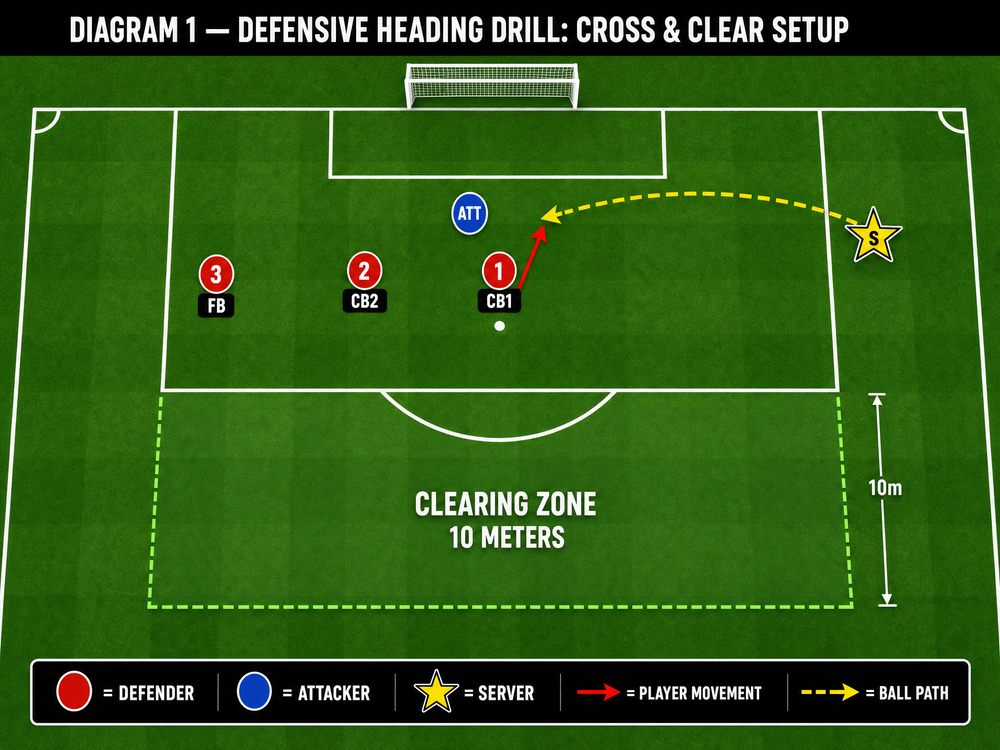
Pitch Dimensions: Standard half-pitch (approximately 50m x 70m) utilizing the full penalty area and extending 20 meters beyond it.
Equipment Needed:
- 1 Full-size goal
- 10-15 Footballs (stationed with servers)
- Cones (to mark the safe clearing zones and starting positions)
- Bibs (2 colors to differentiate attackers and defenders)
Player Positions:
- 1 Goalkeeper (GK)
- 4 Defenders (Back four: RB, CB1, CB2, LB)
- 1 Defensive Midfielder (DM)
- 2-3 Attackers (ATT)
- 2 Servers (S1, S2) positioned wide on both flanks

3. Step-by-Step Instructions
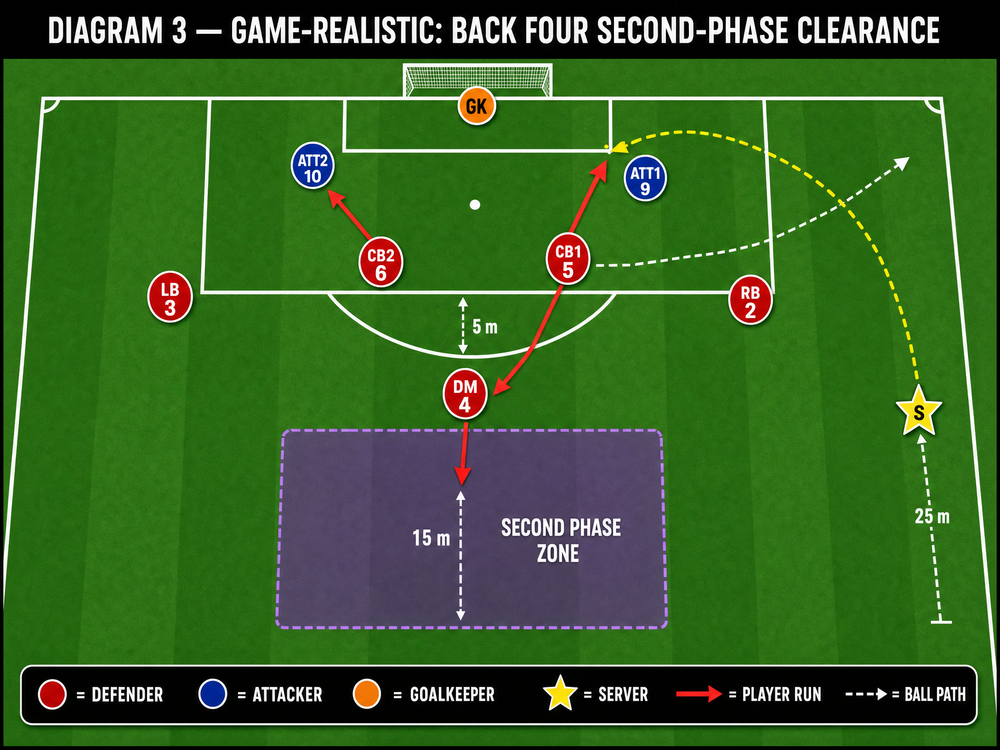
- Starting Positions: The back four start on the edge of the 6-yard box, maintaining a tight, compact shape. The DM positions themselves at the top of the penalty arc. Attackers start near the penalty spot.
- The Delivery: Server 1 (S1) from the right flank delivers a high, looping cross into the penalty area, aiming between the penalty spot and the 6-yard box.
- Attacking the Ball: The nearest center-back (CB1) must read the flight of the ball, communicate early ("Keeper's" or "Away"), and step forward aggressively to attack the ball at its highest point.
- The Clearance: CB1 executes a defensive header, aiming to clear the ball high, wide, and far out of the "Danger Zone" towards the designated "Safe Clearing Area" on the flanks.
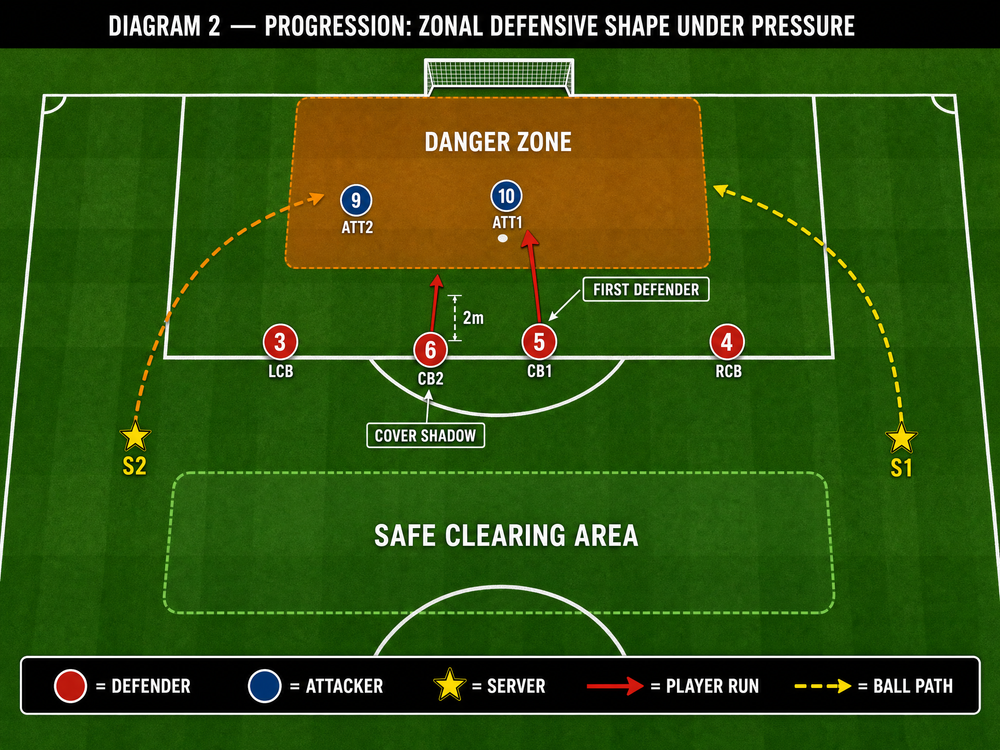
- Covering Shape: As CB1 attacks the ball, CB2 drops slightly to provide a cover shadow, protecting the space behind CB1 in case the ball is missed or flicked on.
- Second Phase: The DM must anticipate the trajectory of the clearance, move into the "Second Phase Zone," and secure possession before the opposition can launch a secondary attack.
- Reset and Repeat: The defensive line immediately pushes up to the edge of the penalty area to reset their shape. The next delivery comes from Server 2 (S2) on the opposite flank.
4. Key Coaching Points
- Read and React: Defenders must track the ball from the moment it leaves the server's foot. Early recognition of the flight path dictates the starting position for the jump.
- Take-off Mechanics: Drive off one foot for maximum height. Use the arms for leverage and protection against attackers.
- Contact Point: Strike the ball with the center of the forehead (the hairline). Keep eyes open and mouth closed through contact.
- Direction and Distance: "High, Wide, and Handsome." Clearances should never be headed back into the central danger zone. Aim for height and distance to give the team time to push up.
- Communication: Loud, clear, and early calls are essential to avoid collisions between defenders or with the goalkeeper.
5. Common Mistakes
- Waiting for the Ball: Defenders standing flat-footed and letting the ball come to them, allowing attackers to gain momentum and win the header.
- Heading Downwards: Heading the ball down into the central area directly at the edge of the box, setting up an easy volley for the opposition.
- Closing Eyes: Shutting eyes right before impact, resulting in a mistimed jump or the ball striking the top of the head.
- Lack of Cover: The secondary center-back failing to drop and cover the space behind the primary challenger.
6. Variations & Progressions
- Progression 1: Active Attackers: Introduce 2-3 active attackers who make dynamic runs across the face of the defenders to create game-realistic physical pressure and distraction.
- Progression 2: Transition to Attack: Once the DM secures the cleared ball, they must immediately play a forward pass to target mini-goals placed on the halfway line, simulating a counter-attack.
- Variation 1: Goalkeeper Integration: Allow the GK to call for and claim crosses within their zone. Defenders must learn to block attackers and protect the GK when the call is made.
7. Age Adaptations
- Under 8 - Under 10: Focus strictly on the technique of heading with soft, lightweight balls (or sponge balls). Eliminate the jumping aspect and focus on forehead contact and keeping eyes open. No defensive pressure.
- Under 12 - Under 14: Introduce standard footballs but keep deliveries predictable. Focus on the mechanics of the one-footed jump and aiming for width.
- Under 16 - Open: Full game-realistic pressure. Emphasize the second phase of play, aggressive communication, and immediate transition after the clearance.
