

Netball
Defensive Marking Pressure Drill: Deny and Intercept
Master the art of tight one-on-one marking, denying the ball, and forcing turnovers with this essential defensive netball drill.

What you need
1 Netball, Bibs, 4 Cones
1. Overview
The Defensive Marking Pressure Drill is designed to enhance a defender's ability to maintain relentless pressure on an attacker, specifically focusing on tight one-on-one marking, denying the ball, and creating interception opportunities. This drill is essential for developing a team's defensive intensity and teaching players how to force turnovers by restricting the attacking team's passing options. It is highly effective when preparing your squad to face fast-paced, direct attacking teams, as it instills the discipline required to maintain a strong defensive stance and dictate the attacker's movements.
2. Setup
To set up this drill, you will need one third of a standard netball court (30.5m x 15.25m), preferably the goal third to simulate circle edge pressure, although the centre third can also be utilised.

Equipment Required:
- 1 Netball
- Bibs for Attackers and Defenders
- 4 Cones (optional, to define specific boundaries if not using court lines)
Player Positions:
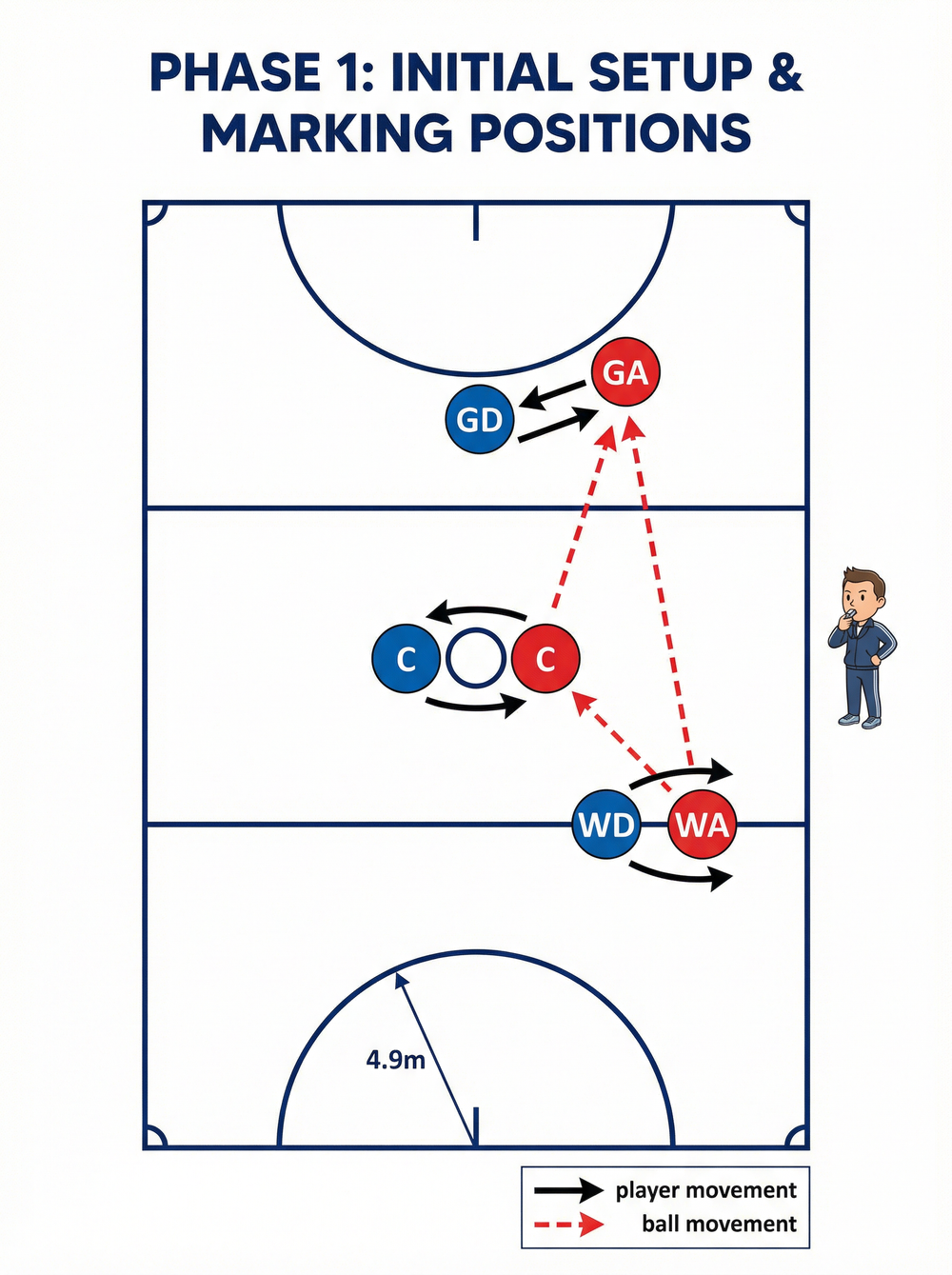
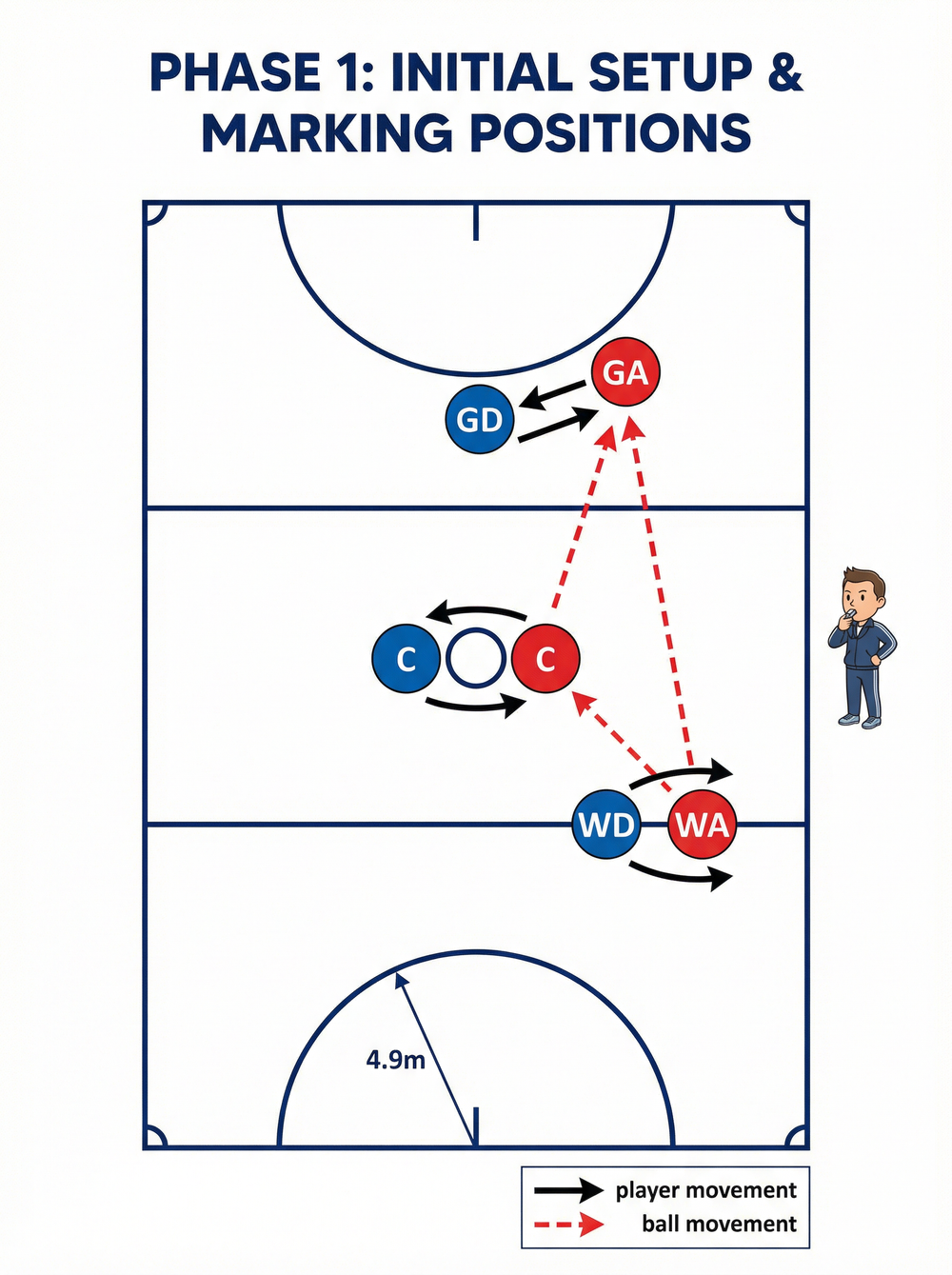
- Attackers: Goal Attack (GA), Wing Attack (WA), and Centre (C)
- Defenders: Goal Defence (GD), Wing Defence (WD), and Centre (C)

Place the attackers and defenders in their respective starting positions. The Centre with the ball will start near the transverse line, looking to feed the ball into the GA or WA.
3. Step-by-Step Instructions
- Initial Positioning: The GD and WD must start in a strong defensive stance, positioned slightly side-on to their respective attackers (GA and WA). They should be on the toes, knees slightly bent, and arms ready to react.

- The Drive: On the coach's whistle, the GA and WA make explosive leads to receive the pass from the Centre.
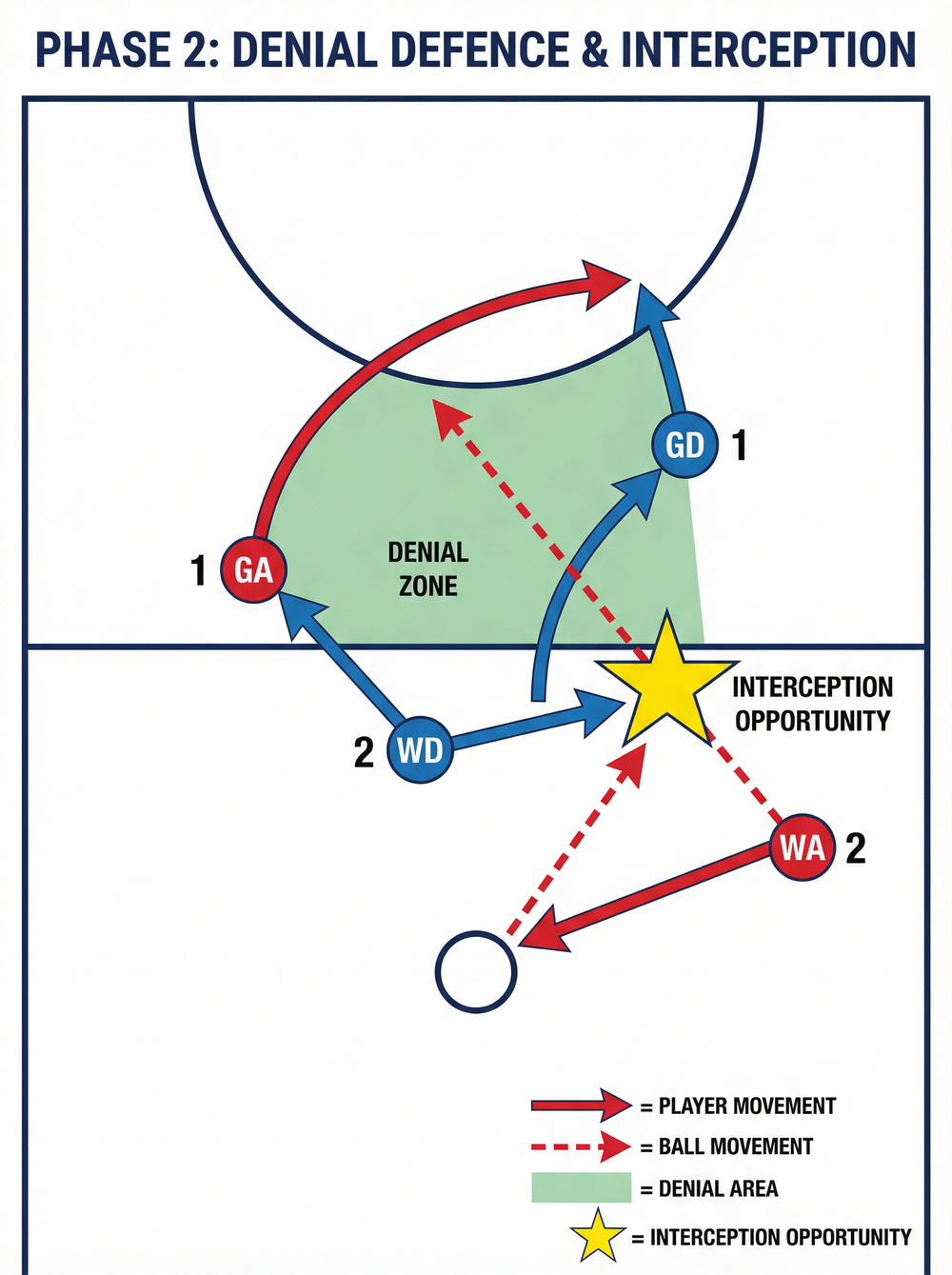
- First Phase Marking: The defenders (GD and WD) must react instantly, using quick footwork to stay with their attackers. The primary goal is to deny the direct pass by staying tight on the outside shoulder and forcing the attacker wide or high up the court.
- Denial and Repositioning: If the attacker changes direction, the defender must drop step and reposition quickly to maintain the "denial zone" (the space between the attacker and the ball).
- The Pass: The Centre attempts to pass the ball to the most available attacker.
- Interception or Contesting: The defender must read the pass. If the pass is forced or lofted, the defender should drive through the line of the ball to attempt an interception. If the attacker receives the ball, the defender must immediately set a 3-foot mark and apply maximum hands-over pressure.
4. Key Coaching Points
- Vision: Defenders must maintain peripheral vision, keeping sight of both their attacker and the ball carrier. This is crucial for anticipating the pass and making an interception.
- Footwork: Emphasize fast, small steps. Defenders should avoid crossing their feet or lunging, which can cause them to lose balance and allow the attacker to break free.
- Body Angle: Maintain a 45-degree angle to the attacker. This allows the defender to dictate the attacker's path and makes it easier to drive for an interception.
- Timing the Interception: Teach players to attack the ball, not the player. The drive for the interception should be explosive and timed perfectly as the ball leaves the thrower's hands.
- Recovery: If the attacker beats the defender and receives the ball, the defender must recover instantly, get back to 3 feet, and put arms up to restrict the next pass.
5. Common Mistakes
- Ball Watching: Defenders focus entirely on the ball and lose track of their attacker, allowing the attacker to easily slip away into open space.
- Flat Footedness: Standing flat-footed instead of being on the toes. This significantly delays reaction time and makes it impossible to stay with a fast attacker.
- Lunging: Over-committing or lunging for an interception that isn't there, which takes the defender out of the play entirely if they miss.
- Incorrect Distance: Setting the mark too close (resulting in a penalty) or too far away (applying no pressure) once the attacker has received the ball.
6. Variations & Progressions
- Progression 1: Add a Second Feeder: Introduce a second feeder to increase the complexity of the drill. Defenders must now be aware of multiple passing options and adjust their positioning accordingly.
- Progression 2: Continuous Play: Instead of stopping after one pass, allow the attackers to link three passes together before attempting a shot or resetting. This tests the defenders' endurance and ability to maintain pressure over a longer period.
- Variation 1: Restricted Space: Confine the drill to a smaller area (e.g., half a third). This forces attackers to work harder to get free and allows defenders to practice extremely tight marking.
7. Age Adaptations
- Under 10s: Focus heavily on the basics of the defensive stance and staying with the player. Reduce the emphasis on interceptions and instead reward players for successfully denying a pass for 3 seconds.
- Under 12s/14s: Introduce the concept of dictating the attacker's movement. Encourage players to force the attacker away from their preferred receiving zones.
- Under 16s/Open: Demand high intensity and perfect execution. Focus on the timing of the interception and the immediate transition into attack upon securing a turnover.
