

Football
Dynamic Wide Crossing and Multi-Run Finishing Drill
A high-intensity drill designed to perfect wide deliveries and synchronise attacking runs into the penalty area for clinical finishing.
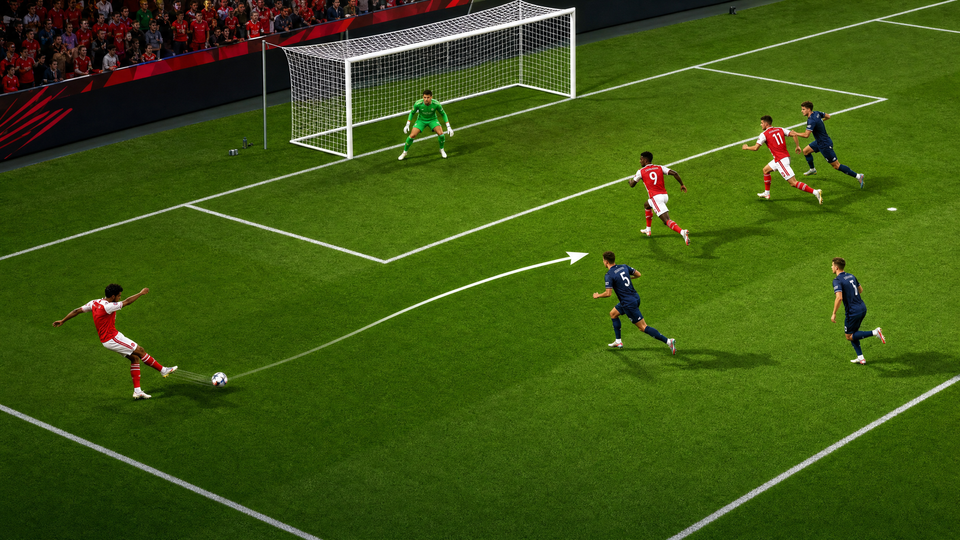
What you need
10-12 Footballs, 6-8 Cones, 1 Full-size Goal, Bibs (for defenders)
Overview
Crossing and finishing are fundamental components of attacking play. This drill is specifically designed to develop a winger's ability to deliver accurate crosses from wide areas while simultaneously training strikers and midfielders to time their runs perfectly into the box. By focusing on specific movement patterns—near post, far post, and central runs—coaches can create game-like scenarios that demand precision, communication, and clinical finishing.
Use this drill during the main phase of your session when focusing on wide attacking play, overlapping fullbacks, or improving your team's conversion rate from crosses.
Setup
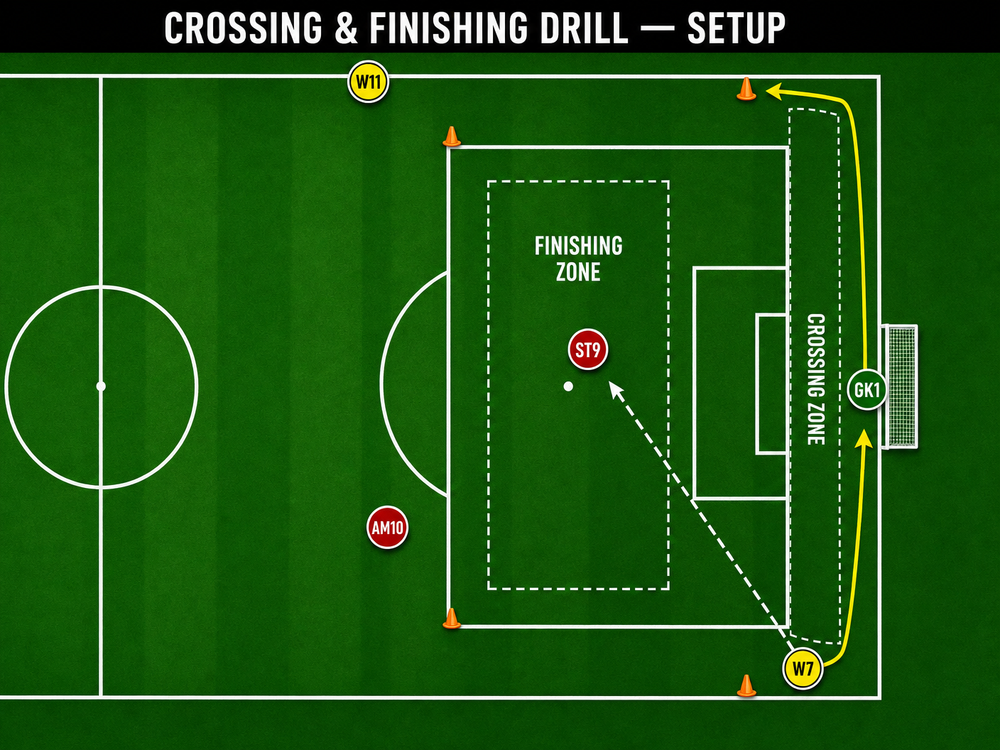
To ensure this drill runs smoothly, proper pitch organisation is essential. You will be working in the attacking third of the pitch.
- Pitch Area: Use one half of a standard football pitch (approximately 50m x 65m).
- Equipment: 1 full-size goal, 10-12 footballs (placed with the wide players or a feeder), 6-8 cones (to mark crossing zones and starting positions), and bibs (if introducing defenders).
- Players: Minimum of 6 players (1 Goalkeeper, 1 Winger/Fullback, 2 Strikers/Attacking Midfielders, and 2 additional players for rotation or defending).
Pitch Organisation
- Place a full-size goal on the goal line with a goalkeeper in position.
- Mark a 'Crossing Zone' on the right or left flank using cones, typically 10-15 metres from the byline and 5-10 metres wide.
- Set starting positions for the attacking runners approximately 5-10 metres outside the penalty area, positioned centrally.
Step-by-Step Instructions
Follow these steps to execute the drill effectively. Start without defenders to build confidence and timing before progressing.
- Initiate the Play: The drill begins with a pass from a central feeder (or coach) out to the winger positioned in the wide area.
- The Wide Delivery: The winger takes a positive first touch towards the byline, driving into the marked 'Crossing Zone'. They must look up to assess the movement in the box before delivering the cross.
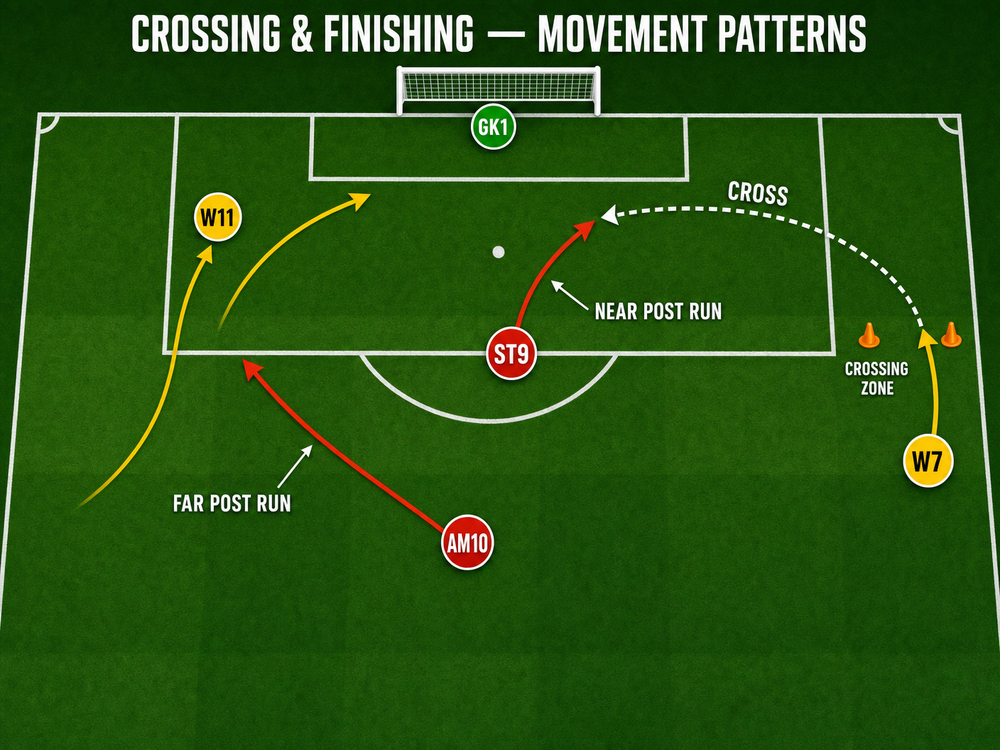
- Synchronised Runs: As the winger prepares to cross, the attacking players make their coordinated runs into the penalty area:
- Player 1 (ST9): Makes a sharp, aggressive run across the front of the goal towards the near post.
- Player 2 (AM10): Delays their run slightly, arriving centrally around the penalty spot or making a late run to the far post.
- Player 3 (W11): If available, arrives at the back post to cover any deep crosses.
- The Finish: The attackers must attempt to finish first-time if possible, using the appropriate technique (header, volley, or side-foot finish) based on the delivery.
- Reset and Rotate: Once the phase is complete, players jog back to their starting positions. Rotate the winger and the runners after every 4-5 repetitions to ensure all players practice both delivering and finishing.
Key Coaching Points
To get the most out of this drill, focus your feedback on these critical areas:
- Quality of the Cross: The winger must prioritise accuracy over power. Encourage them to pick out a specific zone (near post, far post, or cut-back) rather than just hitting the ball aimlessly into the box. The cross should ideally be delivered with pace and whip.
- Timing of the Runs: Attackers must not enter the penalty area too early. They should hold their runs until the winger is about to strike the ball. "Arrive on time, not early."
- Types of Runs: Emphasise the importance of double movements (e.g., checking away before darting to the near post) to lose imaginary defenders. Runs must be aggressive and purposeful.
- Finishing Technique: Encourage players to use the pace of the cross. Often, a controlled side-foot finish or a redirected header is more effective than trying to strike the ball with maximum power.
- Communication: The winger and the runners must communicate. A simple shout or eye contact can ensure the cross is delivered to the right area.
Common Mistakes
Watch out for these frequent errors and correct them immediately:
- Crossing Without Looking: Wingers often put their head down and cross without assessing the box. Correction: Demand that wingers take a quick glance up before striking the ball.
- Static Attackers: Runners standing still in the box waiting for the ball. Correction: Insist on dynamic movement. Attackers must be moving onto the ball as it arrives.
- Running in Straight Lines: Attackers making predictable, straight runs that are easy to defend. Correction: Coach curved or angled runs to attack the space effectively.
- Overhitting the Cross: Delivering the ball too high or too far, making it impossible for the attackers to reach. Correction: Focus on technique and picking a specific target area.
Variations & Progressions
Once the players have mastered the basic mechanics, introduce these variations to increase the difficulty and game realism.
Progression 1: Add Passive Defenders
Introduce 1 or 2 passive defenders inside the penalty area. Their role is not to tackle but to occupy space and force the attackers to make more intelligent runs and the winger to deliver a more precise cross.
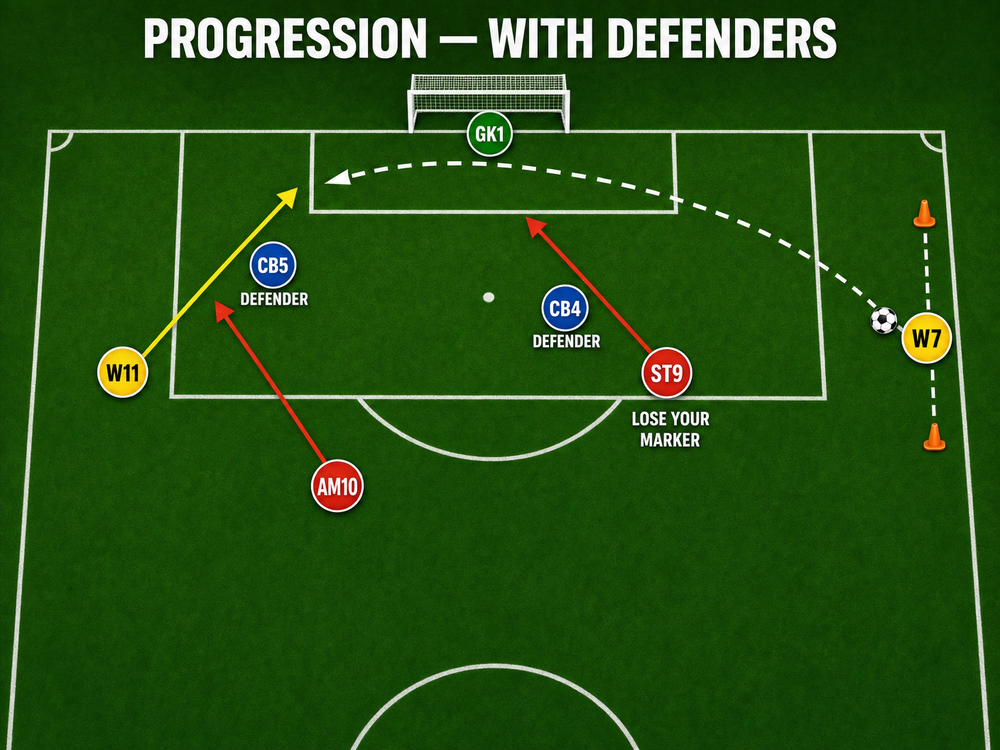
Progression 2: Active Defending
Make the drill fully opposed by adding 2 active central defenders and a recovering full-back. This creates a highly realistic 3v3 or 4v3 scenario in the box. The attackers must now use double movements to lose their markers, and the winger must deliver under pressure.
Variation: The Cut-Back
Instead of always crossing into the six-yard box, instruct the winger to occasionally drive closer to the byline and deliver a low cut-back to an attacking midfielder arriving late at the edge of the penalty area.
Age Adaptations
Tailor the drill to suit the age and ability level of your players:
- Under 8 - Under 10: Focus purely on the technique of striking the moving ball and basic finishing. Reduce the crossing distance and remove defenders entirely. Use a smaller pitch area.
- Under 12 - Under 14: Introduce the concept of near and far post runs. Add passive defenders to encourage players to look up before crossing and finishing.
- Under 16 - Open: The drill should be run at match intensity with active defenders. Focus on complex double movements, communication, and varied types of delivery (whipped, driven, lofted).
