

Football
Elite Cone Dribbling & Clinical Finishing Drill
Master close ball control, agility, and clinical finishing under pressure with this essential attacking drill for players of all levels.
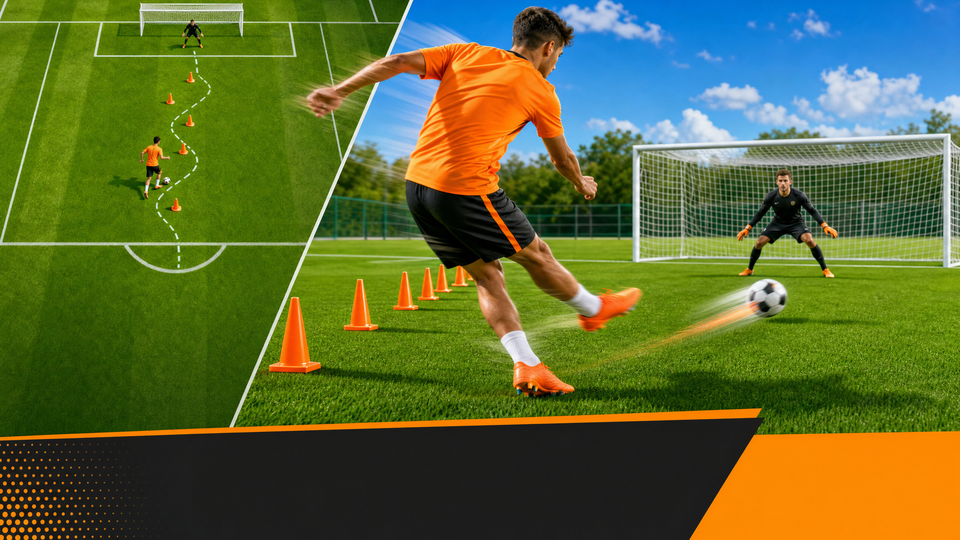
What you need
6-10 Training cones, 1 Full-size goal, 5-10 footballs, Training bibs
1. Overview
The 'Elite Cone Dribbling & Clinical Finishing Drill' is a fundamental attacking exercise designed to improve a player's close ball control, agility, and ability to finish accurately after a dynamic movement. This drill replicates the match scenario of a forward driving through a defensive line before taking a shot on goal. It is highly effective for developing quick feet, spatial awareness, and composure in the final third. Coaches should use this drill to sharpen attacking instincts, particularly during the warm-up or technical phase of a training session.
2. Setup
To run this drill effectively, you will need a well-organised setup. Ensure the pitch is clearly marked and the equipment is placed accurately.
Equipment Needed:
- 6-10 Training cones (preferably bright orange or yellow)
- 1 Full-size goal (or appropriate size for the age group)
- Minimum of 5-10 footballs
- Training bibs (optional, for progressions)
Pitch Setup:
- Set up on a standard football pitch (100-110m x 64-75m) or an appropriately sized training area.
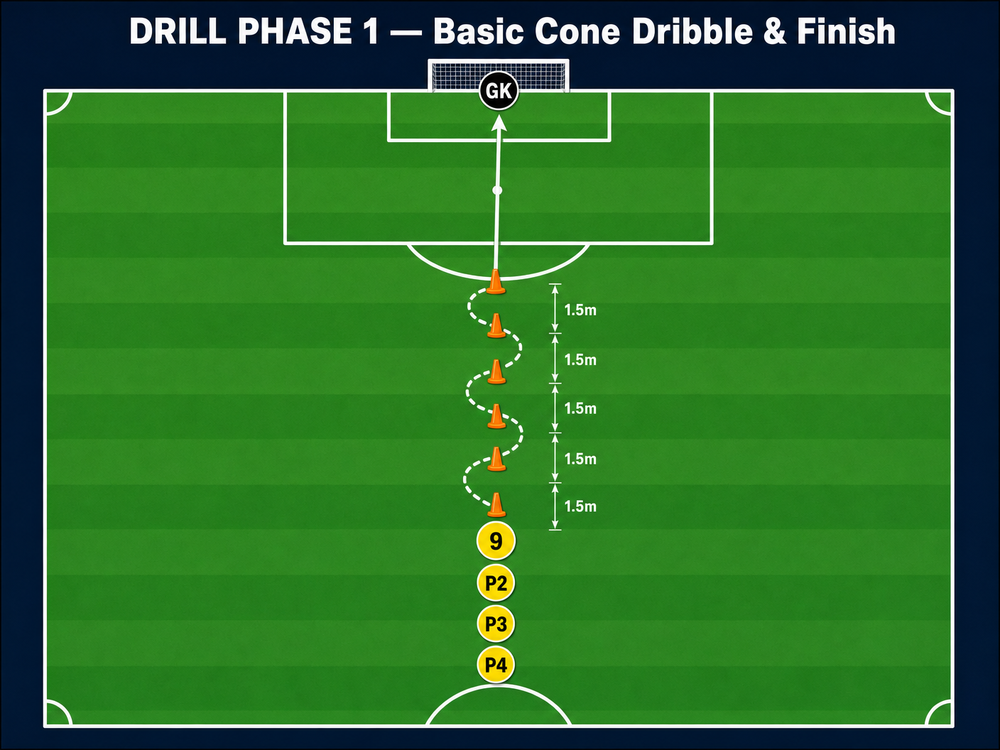
- Place a line of 6 cones starting roughly 25 metres from the goal line, extending towards the penalty area. Space the cones exactly 1.5 metres apart.
- Position a goalkeeper in the goal.
- The attacking players should form a queue behind the starting cone, each with a ball.
3. Step-by-Step Instructions
- Starting Position: The first player in the queue (Player 9) starts with the ball at their feet, facing the line of cones.
- The Dribble: On the coach's whistle, Player 9 dribbles the ball, weaving in and out of the cones. The focus must be on keeping the ball close, using both the inside and outside of the foot.
- The Acceleration: Upon passing the final cone, the player must take a heavier touch out of their feet to accelerate into the designated shooting zone (just outside the penalty area).
- The Finish: Without breaking stride, the player strikes the ball towards the goal, aiming for the corners. The goalkeeper attempts to make the save.
- Rotation: After the shot, Player 9 retrieves their ball and joins the back of the queue. The next player in line begins their dribble as soon as the previous player takes their shot.
4. Key Coaching Points
- Close Control: Encourage players to take small, rapid touches while navigating the cones. The ball should never be more than a foot away during the dribble.
- Head Up: Players must practice scanning the area. They should look up to check the goalkeeper's positioning before striking the ball, rather than staring solely at their feet.
- Change of Pace: The transition from the tight dribble to the shot is crucial. Players must explode out of the final cone with a purposeful touch to set up the strike.
- Shooting Technique: Emphasize technique over power. Players should lock their ankle, strike through the center of the ball, and follow through towards the target. Aim for the bottom corners.
- Use Both Feet: Ensure players are comfortable dribbling and finishing with both their dominant and weaker foot.
5. Common Mistakes
- Taking Touches That Are Too Heavy: This causes the player to lose control and disrupts the rhythm of the dribble through the cones.
- Looking Down Continuously: Failing to scan the field means the player won't see the goalkeeper's positioning, leading to poor shot selection.
- Slowing Down Before the Shot: Players often decelerate to compose themselves, allowing defenders to recover in a real match. Encourage a seamless transition from dribble to shot.
- Leaning Back on the Strike: This results in the ball flying over the crossbar. Remind players to keep their chest over the ball when finishing.
6. Variations & Progressions
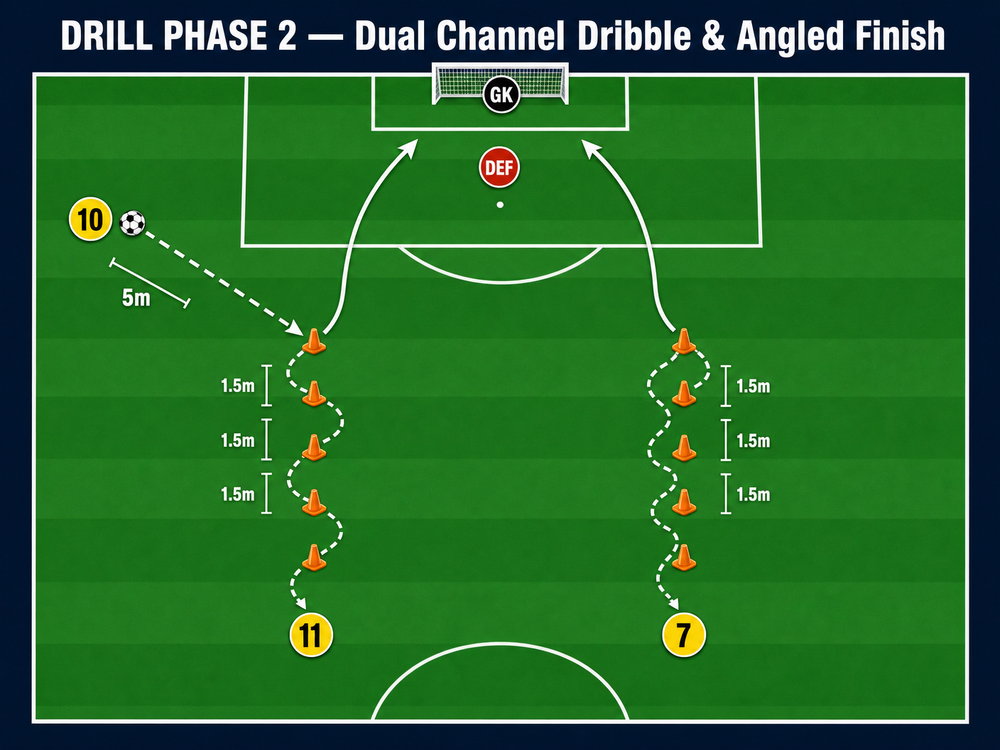
Progression 1: Dual Channel Dribble & Angled Finish
Set up two parallel lines of cones. Have players start from wide positions (wingers) and dribble inwards before taking an angled shot. This replicates cutting inside from the flank.
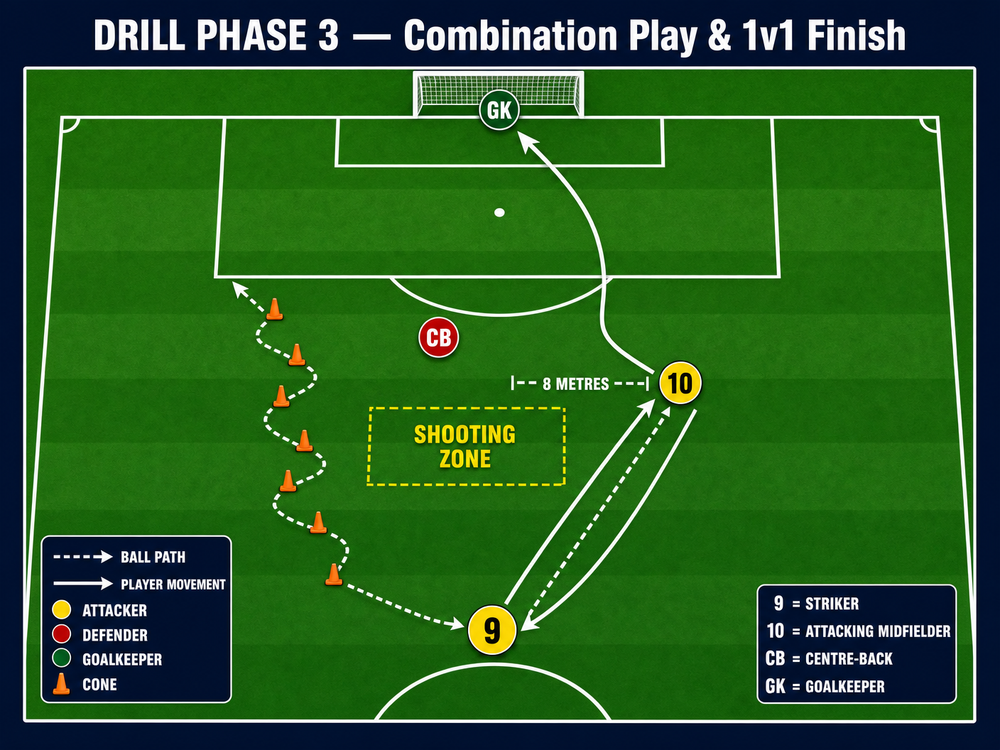
Progression 2: Combination Play & 1v1 Finish
Introduce an attacking midfielder (Player 10) and an active centre-back (CB). After the dribble, the striker plays a one-two combination with the midfielder to bypass the defender before finishing.
7. Age Adaptations
- Under 8s - Under 10s: Increase the distance between cones to 2 metres to allow for looser control. Focus heavily on basic mechanics and having fun. Use a smaller goal and no goalkeeper initially to build confidence.
- Under 12s - Under 14s: Keep the 1.5-metre cone spacing. Introduce time limits for the dribble to increase urgency. Emphasize using the weaker foot for both dribbling and finishing.
- Under 16s - Open Age: Decrease the cone spacing slightly to demand elite close control. Introduce active defenders and complex combination play (as seen in Progression 2) to simulate high-pressure match scenarios.
