

Football
Elite One-Touch Passing Combination & Movement Drill
Develop rapid ball circulation, precise one-touch passing, and dynamic off-the-ball movement to break down deep defensive blocks.
What you need
Marker cones (4-6 per station), Footballs (2-3 per station), Training bibs (optional)
Overview
The modern game demands rapid ball circulation and players who can process information quickly under pressure. The Elite One-Touch Passing Combination & Movement Drill is designed to develop these essential attributes. This drill focuses on quick, precise one-touch passing combinations coupled with immediate, dynamic off-the-ball movement. By running this session, coaches will help their players develop the technical proficiency and tactical awareness required to break down deep, compact defensive blocks. It is an ideal drill for the activation phase of a session or as a technical primer before moving into opposed possession games.
Setup
Proper setup is crucial for the success of this drill. Ensure the pitch dimensions are accurate to maintain the required intensity and realism.
- Pitch Area: Create multiple grids of 10x10 meters for Phase 1, and expand to 12x12 meters for Phase 2, depending on the age and ability of your players. A standard full-size pitch (105m x 68m) can accommodate multiple stations simultaneously.
- Equipment Needed: 4-6 marker cones per station, 2-3 footballs per station (to ensure continuous flow if a ball goes out of bounds), and training bibs (optional, but good for progression into opposed drills).
- Players Required: 3 players per station for Phase 1 (Triangle), and 4 players per station for Phase 2 (Diamond).
Step-by-Step Instructions
Phase 1: The Triangle Combination
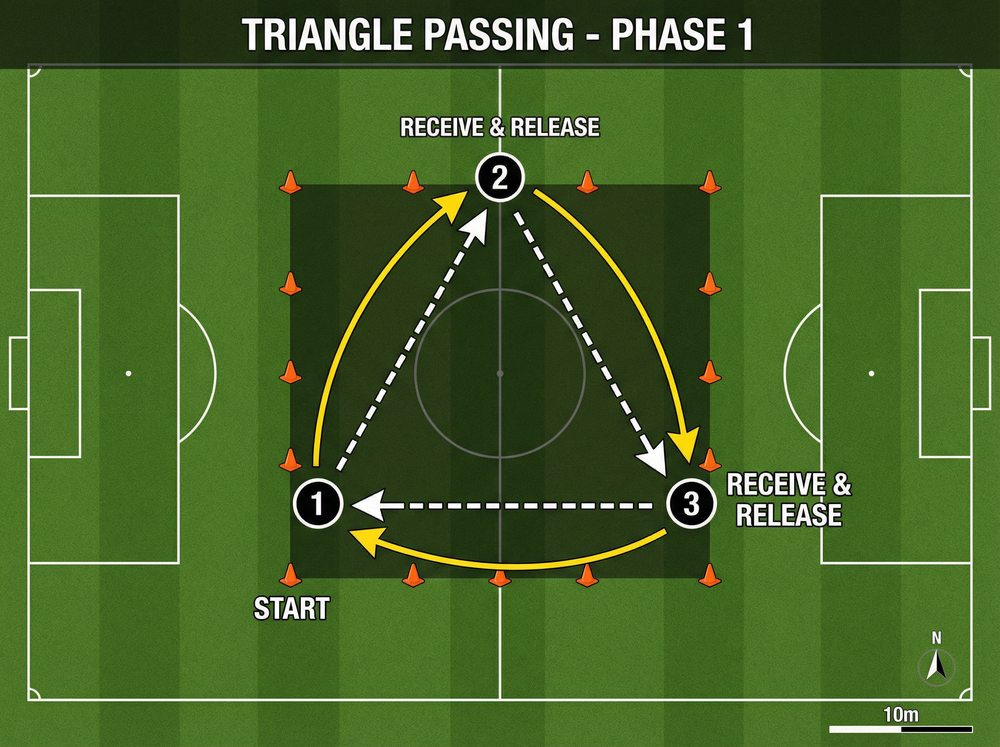
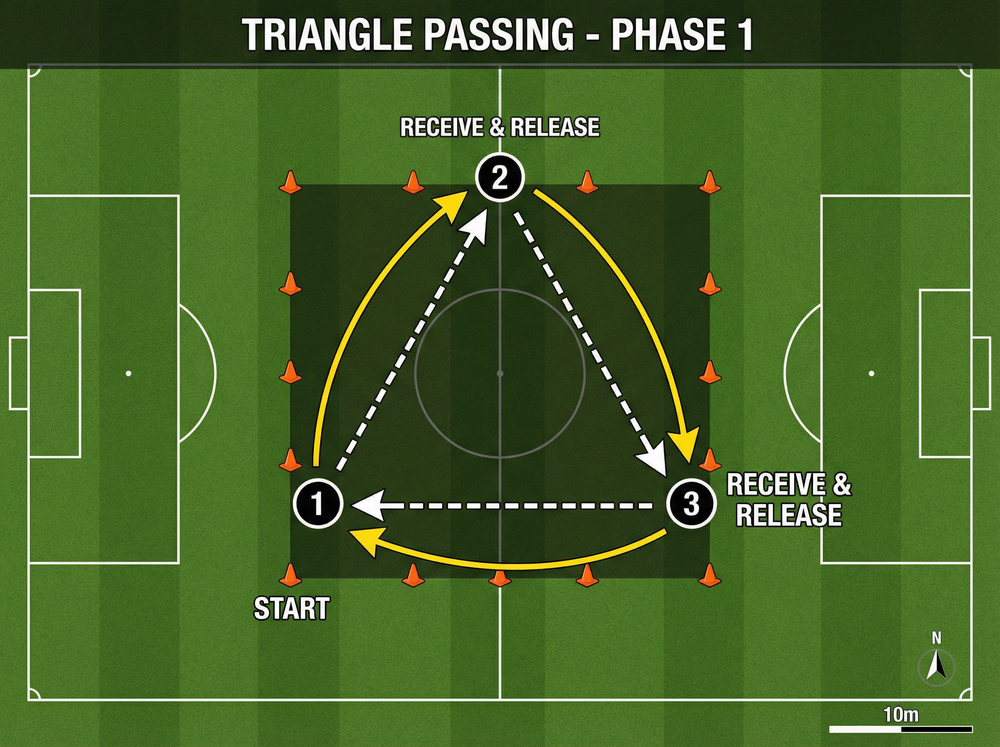
- Positioning: Set up three marker cones in a triangle shape, approximately 10 meters apart. Place one player at each cone: Player 1 at the starting cone, Player 2 at the top cone, and Player 3 at the right-side cone.
- The Initial Pass: Player 1 initiates the drill with a crisp, firm pass along the ground to Player 2.
- Receive and Release: Player 2 must adjust their body shape before the ball arrives, receiving on the half-turn and immediately playing a one-touch pass to Player 3.
- Completing the Circuit: Player 3 then plays a one-touch pass back to Player 1, completing the triangle.
- Movement: After each pass, the player must take two explosive steps to adjust their angle of support, simulating game-realistic movement.
- Rotation: Change the direction of the passing (counter-clockwise) after 2 minutes to ensure players practice receiving and passing with both feet.
Phase 2: The Diamond Combination with Movement
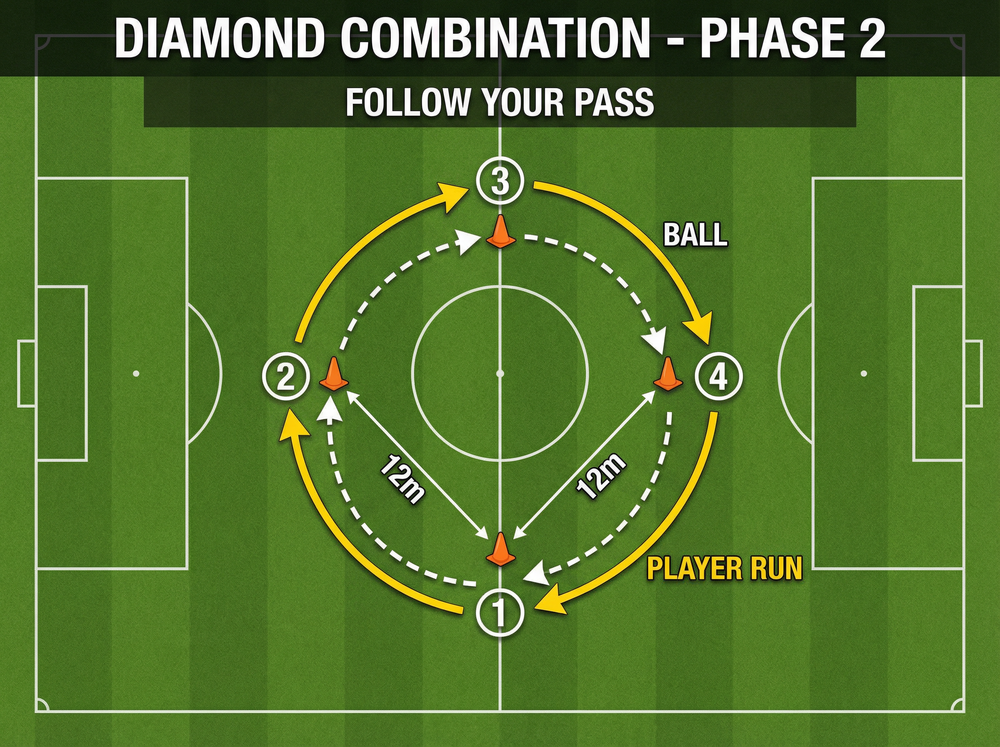
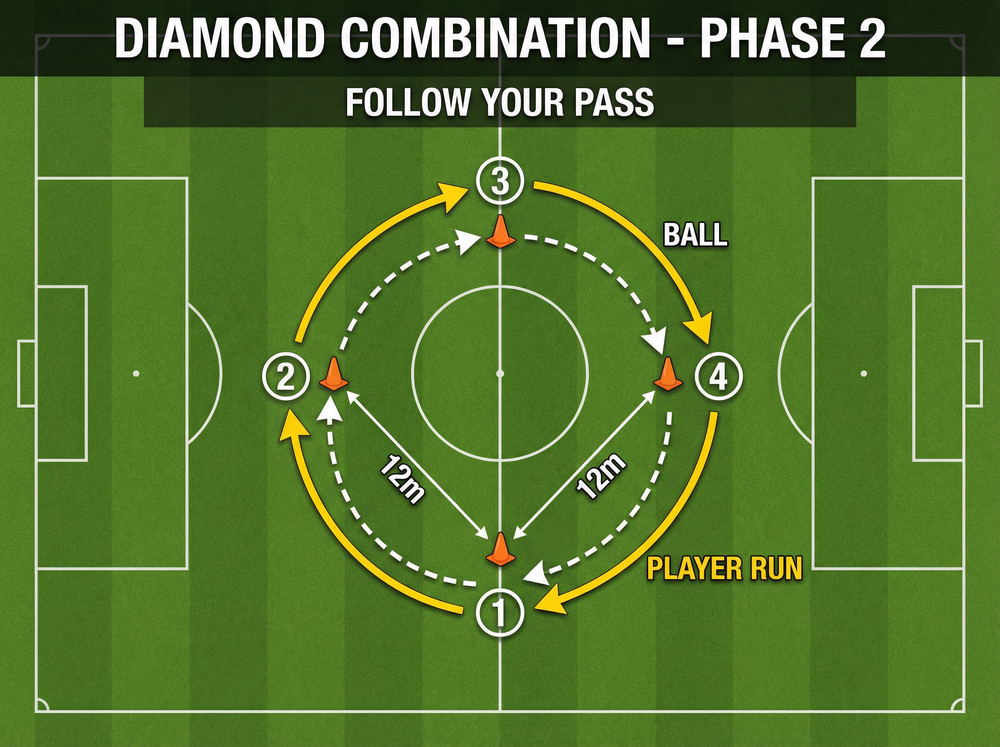
- Positioning: Expand the area to a 12x12 meter diamond shape using four cones. Place one player at each cone (Players 1, 2, 3, and 4).
- The Sequence: Player 1 passes to Player 2. Player 2 plays one-touch to Player 3. Player 3 plays one-touch to Player 4. Player 4 completes the sequence by passing back to Player 1.
- Follow Your Pass: The critical element in this phase is movement. Immediately after making a pass, the player must sprint to the cone they just passed to (e.g., Player 1 passes to Player 2 and sprints to Player 2's cone).
- Timing and Rhythm: The drill must maintain a high tempo. Players arriving at the new cone must be prepared to receive the ball almost instantly as the sequence continues around the diamond.
- Continuous Play: Keep the drill running continuously for 3-minute blocks, followed by a 1-minute active recovery period.
Key Coaching Points
- Weight and Accuracy of Pass: Passes must be firm and played to the receiver's safe-side foot (the foot furthest from imaginary pressure). A slow pass kills the tempo of the drill.
- Body Shape: Receivers must adopt an open body shape before the ball arrives, allowing them to see the ball and their next target simultaneously.
- Scanning: Encourage players to check their shoulders and scan the area before receiving the ball. This builds spatial awareness.
- Movement After Passing: The action does not end when the pass is made. Players must react instantly, either adjusting their supporting angle (Phase 1) or sprinting to the next position (Phase 2).
- Communication: Demand clear, concise verbal and non-verbal communication (e.g., pointing to where they want the ball, calling for the pass).
Common Mistakes
- Standing Still: Players admiring their pass instead of immediately moving to support or taking up their new position.
- Poor First Touch/Body Angle: Receiving the ball closed-off, which requires extra touches to face the next target, slowing down the combination.
- Under-hitting Passes: Playing weak passes that force the receiver to check back, disrupting the rhythm of the one-touch play.
- Lack of Anticipation: Waiting for the ball to arrive before deciding what to do next, rather than pre-planning the next action.
Variations & Progressions

- Progression 1: Add a Defender (Rondo Style): Introduce one defender in the middle of the diamond. The four outside players must maintain possession using a maximum of two touches, looking for one-touch combinations where possible.
- Progression 2: The Third-Man Run: Modify the diamond sequence so Player 1 passes to Player 3 (skipping Player 2). Player 3 sets the ball back to Player 2, who then plays a longer pass to Player 4. This introduces the concept of the third-man run.
- Variation 1: Weak Foot Only: Mandate that all passes and receptions must be executed using the players' weaker foot to develop bilateral technical proficiency.
Age Adaptations

- Under-8 to Under-10: Allow two touches instead of strictly one-touch. Focus heavily on the fundamental technique of the push pass and basic movement. Reduce the distances between cones to 5-8 meters.
- Under-12 to Under-14: Enforce the one-touch rule but allow a second touch if the initial pass is poor. Introduce the 'follow your pass' movement and emphasize scanning.
- Under-16 to Open/Senior: Demand strict one-touch play, maximum intensity, and game-realistic pass weight. Incorporate the progressions with defenders to increase cognitive load and decision-making demands under pressure.
