

Football
Elite Slalom & Strike: Precision Dribbling and Finishing Drill
Develop close ball control, explosive acceleration, and clinical finishing under pressure with this essential attacking drill.

What you need
1 Full-size goal, 6-12 Training cones, 6-8 Footballs, Bibs
1. Overview
The 'Elite Slalom & Strike' is a fundamental yet highly adaptable drill designed to bridge the gap between technical dribbling and match-realistic finishing. Far too often, players can dribble through cones beautifully but fail to compose themselves for the final shot. This drill forces players to maintain close control through a tight slalom, accelerate out of the final move, and immediately execute a composed finish on goal. It is an excellent session for developing a striker's instinct, a winger's cutting edge, and a midfielder's late-arriving threat.
2. Setup
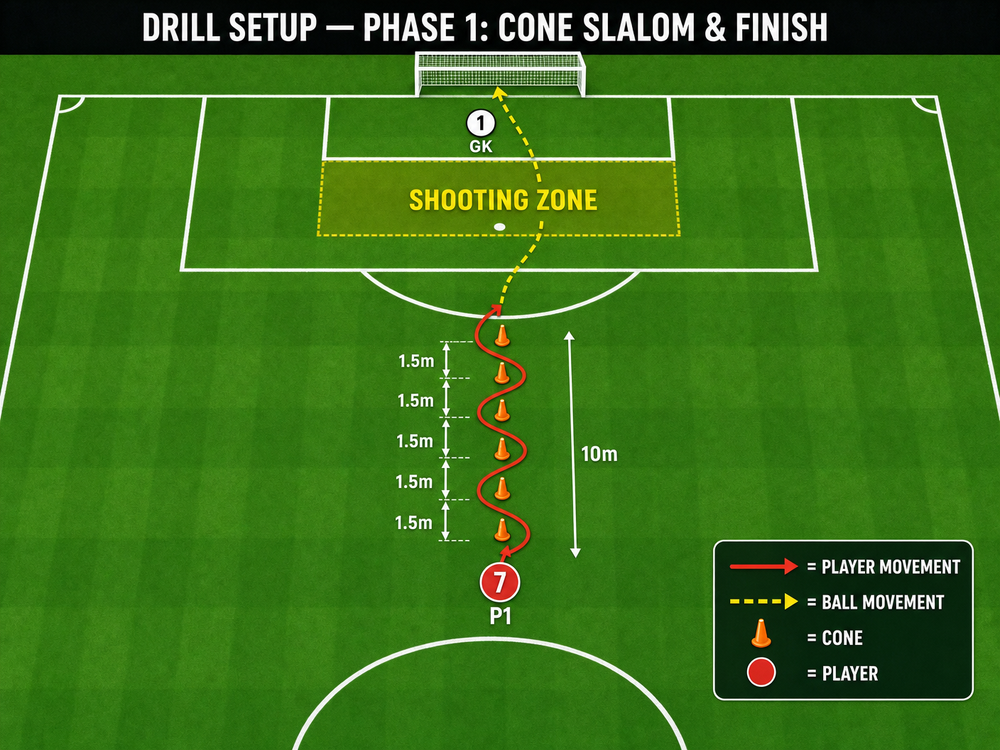
To run this drill effectively, you will need to utilize the attacking third of a standard football pitch (approximately 30-40 metres from goal).
Equipment Needed:
- 1 Full-size goal (7.32m x 2.44m)
- 6-12 Training cones (preferably bright orange or yellow)
- An adequate supply of footballs (minimum 6-8 to maintain flow)
- 1 Goalkeeper
- Bibs (if incorporating defenders in progressions)
Pitch Layout:
Set up a straight line of 6 cones, spaced exactly 1.5 metres apart, starting roughly 25 metres from the goal line and extending back towards the halfway line. This creates a 10-metre slalom zone. The final cone should sit approximately 15 metres from the goal, just outside the penalty area, creating a designated 'Shooting Zone'.

3. Step-by-Step Instructions
- Starting Position: Players form a single queue starting 2 metres behind the first cone. Each player must have a ball at their feet, ready to go.
- The Slalom: On the coach's whistle, the first player (P1) begins dribbling through the cones, weaving in and out. They must use quick, small touches, alternating between the inside and outside of both feet.
- The Acceleration: As P1 rounds the final cone, they must take a slightly larger touch out of their feet into the 'Shooting Zone' to set up the strike.
- The Finish: Without breaking stride, P1 strikes the ball firmly on goal, aiming for the corners. The goalkeeper attempts to make the save.
- The Reset: After shooting, P1 retrieves their ball (or jogs back if using a ball collector) and joins the back of the queue. The next player begins their slalom as soon as P1 takes their shot.
4. Key Coaching Points
- Close Control Over Speed: Emphasize that the slalom is about precision, not just raw pace. The ball should never be more than half a metre away from the player's feet during the weaving phase.
- Head Up: Players must scan the field. Encourage them to glance up at the goalkeeper's positioning before taking the final touch out of the slalom.
- The 'Setup' Touch: The touch past the final cone is the most critical part of the drill. It must be angled towards the goal and perfectly weighted—not too close to get stuck under the feet, and not too far to allow the goalkeeper to rush out.
- Composed Finishing: The strike should prioritize accuracy over pure power. Coach players to use the side-foot for placement in the corners or the laces for driven shots, depending on the goalkeeper's stance.
- Body Shape: When shooting, the player's non-kicking foot should be planted firmly beside the ball, pointing towards the target, with the chest and head leaning slightly forward over the ball to keep the shot down.
5. Common Mistakes
- Tunnel Vision: Players staring entirely at the ball and the cones, failing to look at the goal or the goalkeeper until the very last second.
- Poor Setup Touch: Taking the final touch straight ahead rather than at an angle, forcing an awkward, unbalanced shot.
- Leaning Back: Players leaning backwards as they strike the ball, resulting in the shot sailing high over the crossbar.
- Using Only One Foot: Relying solely on the dominant foot to navigate the slalom, which slows down the movement and makes the player predictable.
6. Variations & Progressions
Once the players have mastered the basic drill, introduce these progressions to increase the cognitive load and match realism.
Progression 1: Dual Lane Competition
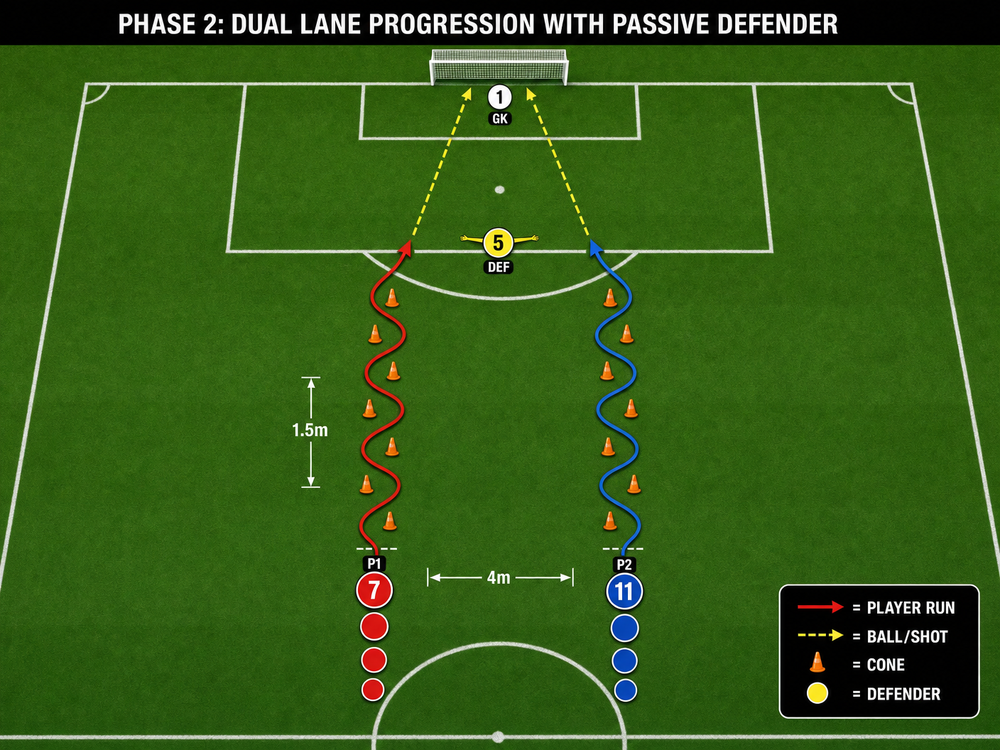
Set up a second identical slalom course parallel to the first, spaced 4 metres apart. Two players race through the slalom simultaneously. The first to finish scores a point, but they must still beat the goalkeeper. This adds immense pressure and forces players to execute technique at match speed.
Progression 2: The Passive Defender
Introduce a coach or a passive defender standing near the edge of the penalty box, just after the slalom. As the player exits the cones, the defender takes one step to the left or right. The player must react instantly, take their setup touch in the opposite direction, and finish.
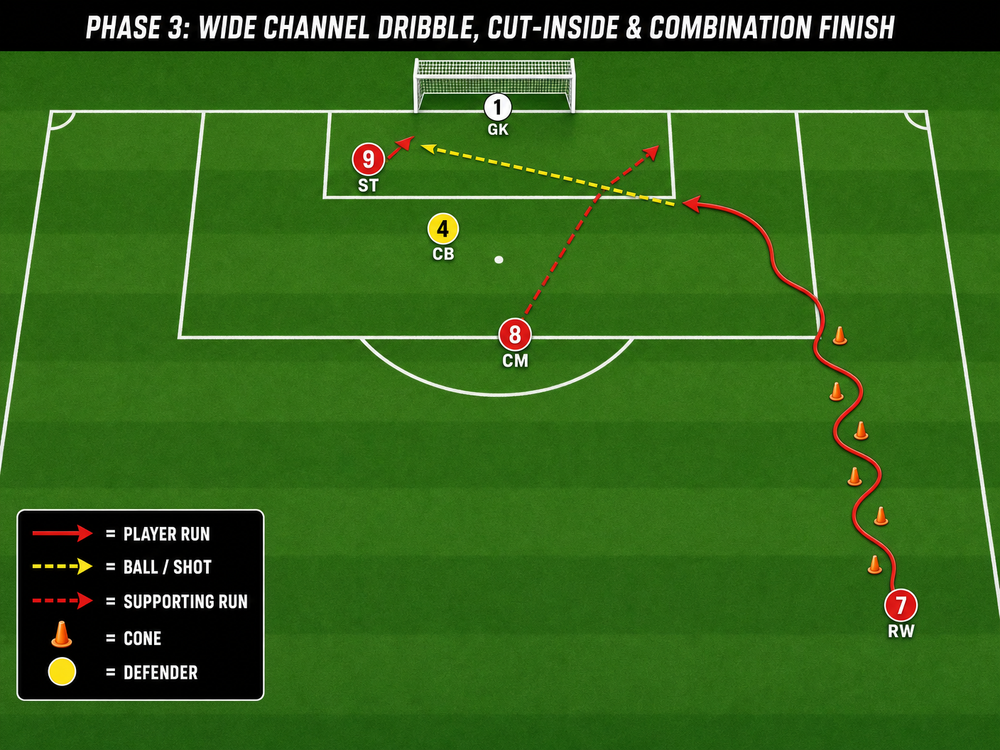
Progression 3: Wide Channel Cut-Inside
Move the cone setup to the wide channels (the wings). Players slalom down the wing, and upon exiting the final cone, they must execute a sharp cut-inside move (e.g., a Ronaldo chop or a quick inside-foot hook) before shooting or crossing to arriving forwards.
7. Age Adaptations
- Under 8 - Under 10: Increase the distance between the cones to 2 metres to allow for looser touches. Focus entirely on the fun of scoring and basic ball manipulation. Do not enforce strict weak-foot usage yet.
- Under 12 - Under 14: Tighten the cones to 1.5 metres. Demand that players use both feet (e.g., right foot only on the way up, left foot only on the next turn). Introduce the dual lane competition to build competitive spirit.
- Under 16 - Open (Seniors): Tighten the cones further to 1 metre for elite close control. Introduce active defenders immediately after the slalom to simulate high-pressure match scenarios. Demand clinical, one-touch finishing after the setup touch.
