

Netball
Fast Break Centre Pass Play: High-Speed Attacking Strategy
Learn how to execute a lightning-fast centre pass play that catches the defence off-guard and delivers the ball to the shooting circle in just three quick passes.
What you need
1 Netball, Positional Bibs, Netball Court
Overview
The Fast Break Centre Pass Play is an aggressive, high-tempo attacking strategy designed to move the ball from the centre circle to the goal shooter in the shortest possible time. This play exploits gaps in the defence before they have time to set up their zone or one-on-one marking structures. It is particularly effective when you have a quick Wing Attack (WA) and a Goal Attack (GA) who reads the play well and can time their leads perfectly. By executing this play, your team can secure quick goals and shift the momentum of the match in your favour.
Setup

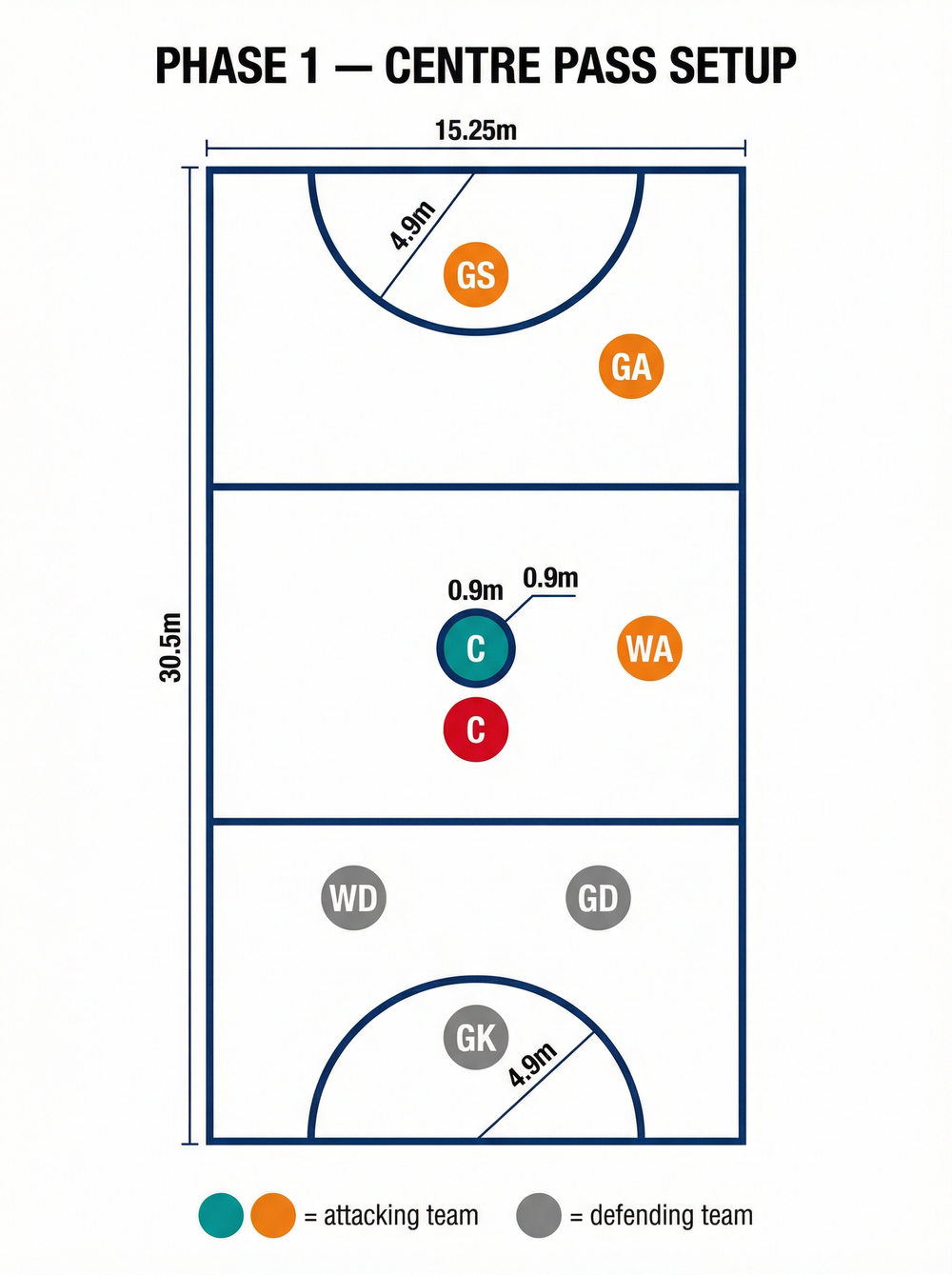
Court Dimensions: Standard Netball Court (30.5m x 15.25m)
Equipment Needed: 1 Netball, positional bibs
Players Required: 7 players (Focus on C, WA, GA, GS)
Player Positions (Initial Setup)
- C (Centre): Inside the centre circle (0.9m radius), ready to initiate the pass.
- WA (Wing Attack): Positioned on the right side of the transverse line, ready to drive hard into space.
- GA (Goal Attack): Starting in the attacking third, right side, preparing for a diagonal lead.
- GS (Goal Shooter): Inside the attacking goal circle, ready to hold position and step out to receive.
Step-by-Step Instructions

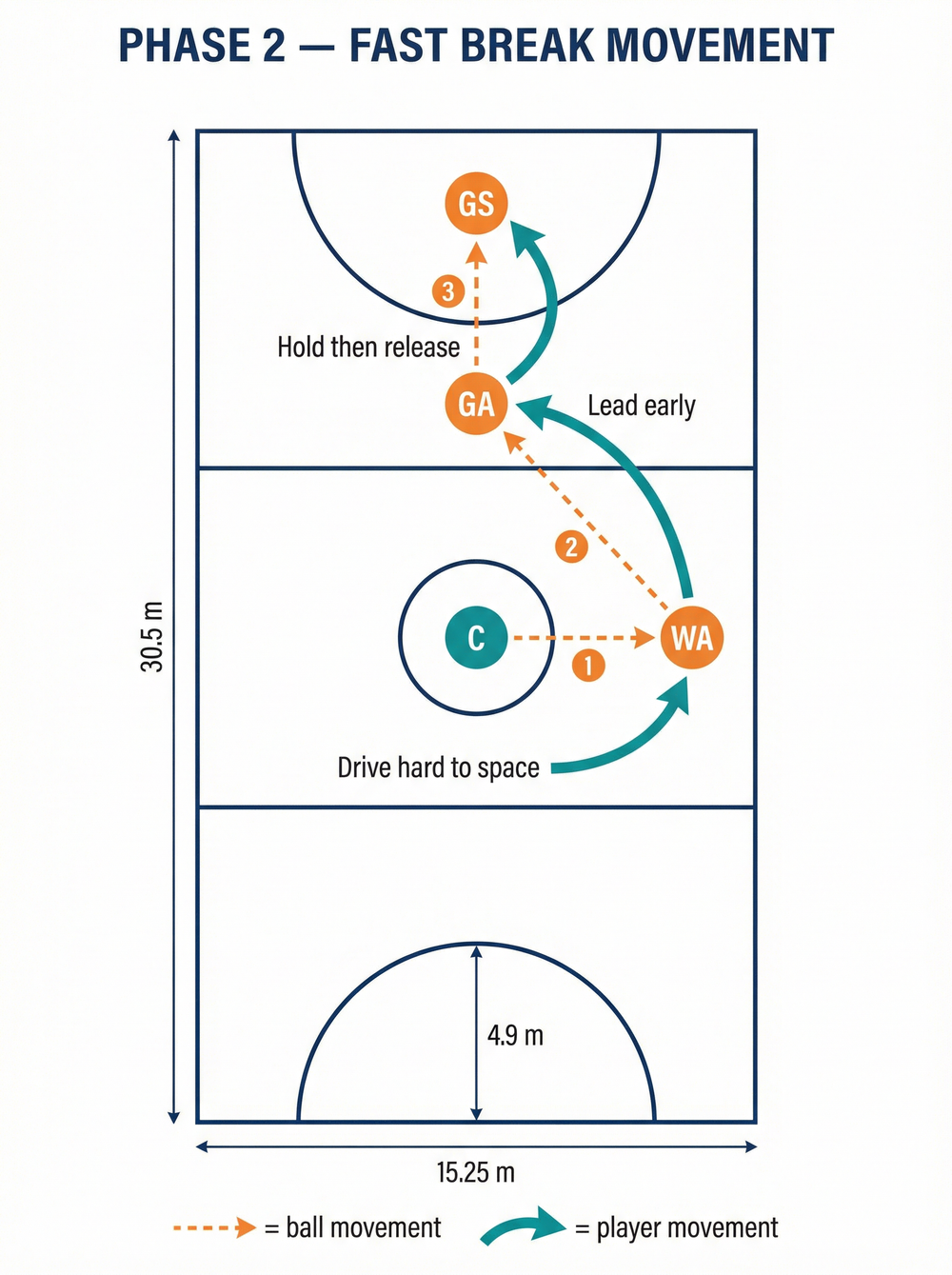
- The Initiation (Pass 1): On the umpire's whistle, the Centre (C) steps and delivers a fast, flat pass to the Wing Attack (WA). The WA must drive hard from the transverse line into the available space in the centre third, losing their defender early.
- The Diagonal Drive (Pass 2): As the WA receives the ball, the Goal Attack (GA) makes a sharp, diagonal lead into the centre channel of the attacking third. The WA delivers a quick, direct pass to the GA. Timing is crucial here; the GA must lead early to create separation from the Goal Defence (GD).
- The Final Feed (Pass 3): Upon catching the ball, the GA immediately looks to the shooting circle. The Goal Shooter (GS) should hold their position against the Goal Keeper (GK) and then step out strongly to the top of the circle to receive the feed.
- The Shot: The GS receives the ball in a balanced position, turns, and takes the shot.
Key Coaching Points

- Explosive First Steps: The WA and GA must use explosive first steps to break free from their defenders. Acceleration is key to the fast break.
- Flat, Hard Passing: To maintain speed, passes must be flat and hard. Loopy passes will give the defence time to recover and intercept.
- Timing of Leads: Players must not lead too early or too late. The GA should begin their drive just as the WA is about to receive the ball.
- Vision and Awareness: The C and WA need excellent court vision to deliver accurate passes to moving targets under pressure.
- Strong Holds: The GS must execute a strong hold in the circle to ensure they have the space to step out and receive the final feed safely.
Common Mistakes

- Hesitation: Players pausing to look for options rather than knowing the play and executing the next pass instinctively.
- Crowding the Space: The GA and WA driving into the same channel, bringing their defenders together and clogging the attacking space.
- Poor Pass Quality: Delivering inaccurate or loopy passes that slow down the momentum of the fast break.
- Leading Too Early: The GA leading before the WA has secured the ball, resulting in them running out of space and having to stop.
Variations & Progressions

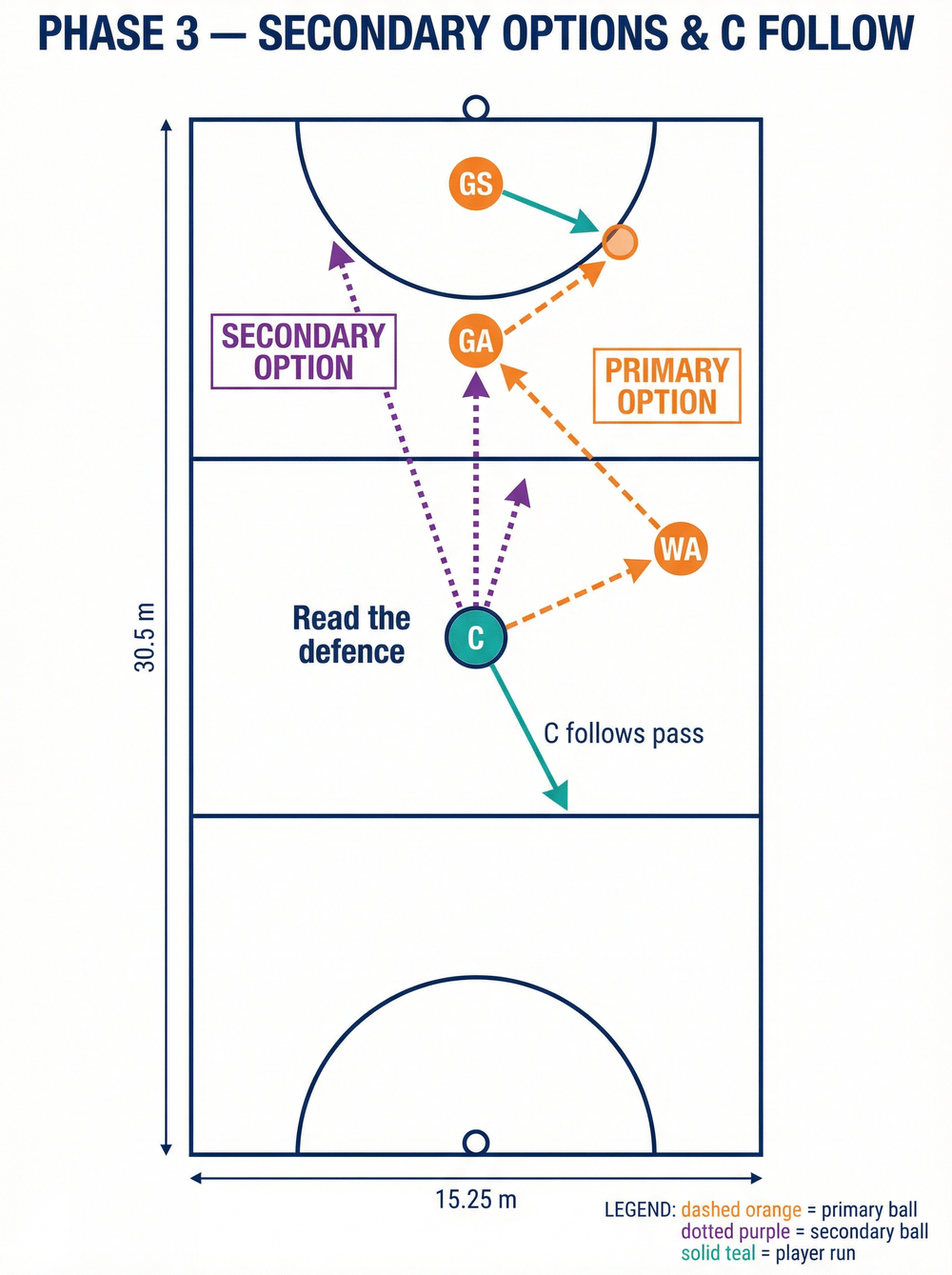
Progression 1: The Centre Follow-Up
In this progression, after the Centre (C) delivers the first pass to the WA, they immediately sprint forward into the centre third. This provides a secondary passing option if the GA is heavily defended. The C can receive a quick pass back from the WA and then deliver a long ball directly to the GA or GS.
Progression 2: The Split Lead
Instead of a single diagonal drive, the GA and WA perform a split lead. The WA drives wide, while the GA drives straight down the middle. This forces the defence to make a quick decision on who to cover, often leaving one player completely open for the first pass.
Age Adaptations

- Under 10s: Focus purely on the first two passes. Simplify the play by having the GA stay closer to the transverse line. Emphasize strong catching and passing techniques rather than raw speed.
- Under 12s/14s: Introduce the timing of the leads. Practice the play without defenders first to build confidence, then add passive defenders before moving to full pressure.
- Under 16s/Open: Execute the play at full match speed with aggressive, tight defence. Incorporate the progressions and focus on the players' ability to read the defence and make split-second decisions.
