

Football
Mastering the 8v2 Rondo: High-Intensity Passing and Possession
Develop elite passing speed, spatial awareness, and quick decision-making under pressure with this fundamental 8v2 possession rondo.
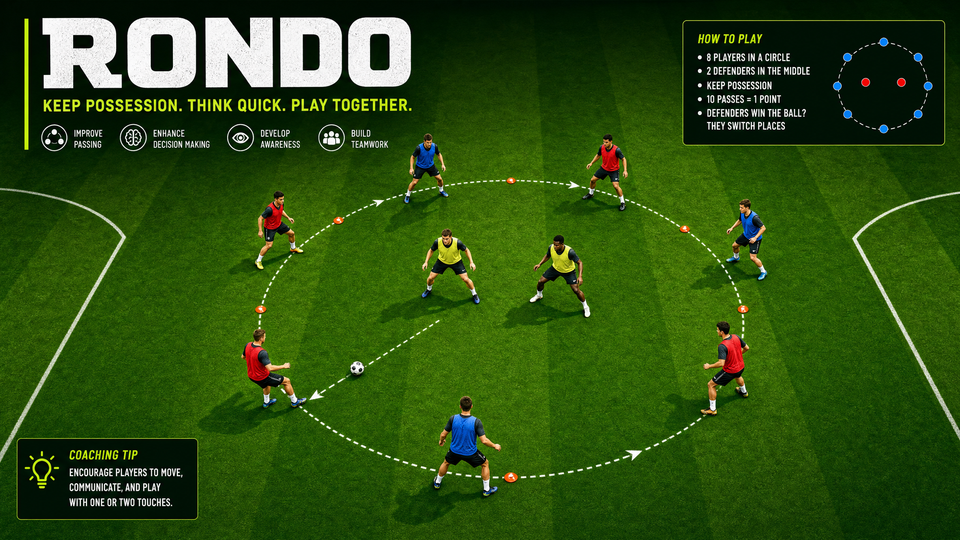
What you need
Footballs (minimum 6), Cones (minimum 4), Training Bibs (2 colors)
1. Overview
The 8v2 Rondo is a cornerstone drill in modern football coaching, utilized by top academies and professional clubs worldwide. It creates a high-tempo, pressure-rich environment where players must continuously scan, anticipate, and execute rapid passes to maintain possession. This drill is essential for developing quick decision-making, precise first touches, and the ability to play out of tight spaces. It perfectly simulates the numerical advantages teams seek to create in match situations, teaching players how to exploit overloads and maintain composure under aggressive pressing.
2. Setup
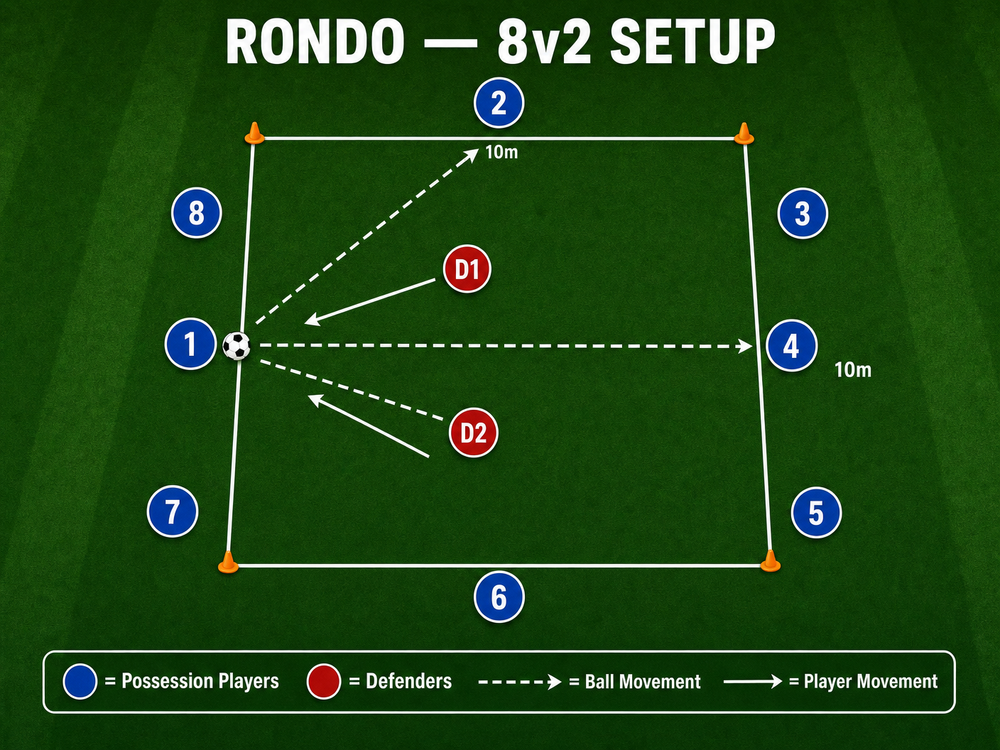
Creating the right environment is crucial for the success of this drill. The space must be tight enough to challenge the possession players but large enough to allow success.
- Pitch Area: 10m x 10m square grid (adjust based on age and ability).
- Players: 10 players total (8 possession players, 2 defenders).
- Equipment: 4 cones to mark the grid corners, plenty of footballs ready on the outside to keep the drill flowing, and two sets of colored bibs (e.g., 8 Blue, 2 Red).
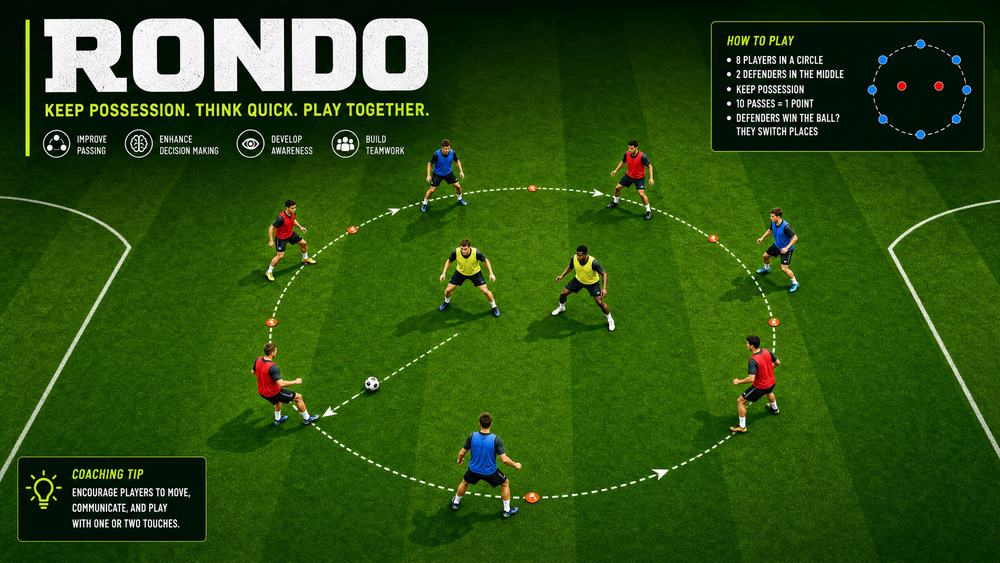
Player Positions
- Possession Players (Blue): Spread evenly around the perimeter of the 10x10m grid. They must stay on the outside lines but can move laterally along their respective lines to create passing angles.
- Defenders (Red): Positioned inside the grid. Their objective is to press together, cut off passing lanes, and win the ball.
3. Step-by-Step Instructions
- Start the Drill: The coach feeds a ball to one of the possession players on the outside to initiate the drill.
- Maintain Possession: The 8 outside players attempt to keep the ball away from the 2 inside defenders using quick, crisp passes. They should aim for one or two-touch passing.
- Defensive Pressing: The 2 inside defenders work as a pair to press the ball carrier, close down space, and intercept or tackle.
- Transition: If a defender intercepts the ball, tackles a player so the ball goes out of bounds, or if an outside player makes a bad pass out of the grid, the player who lost possession (or made the bad pass) switches roles with the defender who won the ball.
- Scoring System (Optional): Challenge the possession team to string together a specific number of consecutive passes (e.g., 10 passes = 1 point). If the defenders win the ball back within the first 3 passes, they get a point.
- Keep it Flowing: If the ball goes out of play, the coach should immediately feed a new ball in to maintain a high tempo.
4. Key Coaching Points
- Body Shape and Scanning: Players must receive the ball on their back foot with an open body shape, allowing them to see the whole grid. They must constantly scan over their shoulders before receiving the ball to know their next pass.
- Pass Quality and Weight: Passes must be punched firmly to the target's safe foot (away from the defender). Avoid slow, bobbling passes that invite pressure.
- Movement to Support: Outside players must not stand still. They must constantly adjust their positioning laterally along the line to provide clear passing angles for the ball carrier.
- Defensive Coordination: The two defenders must work together. One player presses the ball carrier (first defender), while the second provides cover and cuts off the split pass through the middle.
- Speed of Thought: Anticipate the play. Players should know what they are going to do with the ball before it arrives.
5. Common Mistakes
- Standing Flat-Footed: Possession players waiting for the ball rather than actively moving to create angles.
- Poor First Touch: Taking a touch into pressure or getting the ball stuck under their feet, slowing down the play.
- Defending as Individuals: Defenders chasing the ball randomly instead of working as a cohesive pair to trap the possession players.
- Forcing the Split Pass: Trying to play the risky pass through the middle of the defenders when the simple pass around the outside is available.
6. Variations & Progressions
Once the players master the basic 8v2, introduce these progressions to increase the cognitive and technical demands.
- Touch Restrictions: Limit possession players to a maximum of two touches, or even one touch, to force faster decision-making.
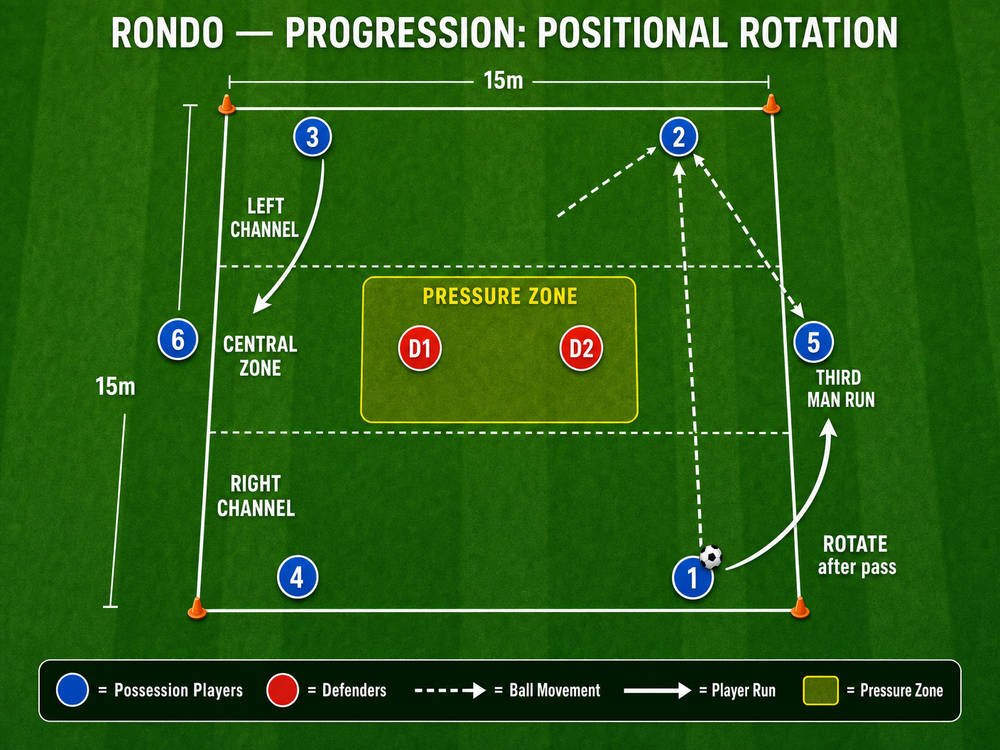
- Positional Rotation (Diagram 2): Expand the grid to 15x15m. When an outside player makes a pass, they must immediately swap positions with the player next to them. This introduces dynamic movement and positional interchange.
- The Split Pass Bonus: Award extra points if the possession team successfully completes a pass that splits the two defenders.
- Dynamic Defenders: Have a third defender waiting outside the grid. Every 30 seconds, one defender rotates out and the fresh defender sprints in, keeping the pressing intensity extremely high.
7. Age Adaptations
- Under 8 - Under 10: Increase the grid size to 12x12m or 15x15m to give players more time and space. Focus heavily on basic passing technique and receiving on the back foot. You can also play 8v1 to build confidence before introducing the second defender.
- Under 12 - Under 14: Stick to the 10x10m grid. Emphasize scanning and speed of play. Introduce the two-touch restriction.
- Under 16 - Open: Decrease the grid size to 8x8m to create extreme pressure. Demand one-touch passing where possible and highly coordinated defensive pressing.
