

Football
Dynamic Penalty Box Movement for Crossing Situations
Master the art of synchronized attacking runs to create chaos in the opposition penalty area and finish crossing opportunities.
What you need
1 Full-size goal, 10-15 Footballs, Bibs (2 colors), Flat markers
1. Overview
Crossing situations are only as effective as the movement inside the penalty box. This set play focuses on synchronized, dynamic runs designed to disrupt defensive marking, create space, and ensure all critical finishing zones are occupied when the ball is delivered. It is highly effective against low-block defenses or when playing with natural width. By coordinating runs across the near post, far post, penalty spot, and edge of the box, you force defenders into difficult decision-making scenarios, significantly increasing your chances of a successful finish.
2. Setup
- Pitch Area: Attacking third of a standard full-size pitch (approx. 35m x 64-75m).
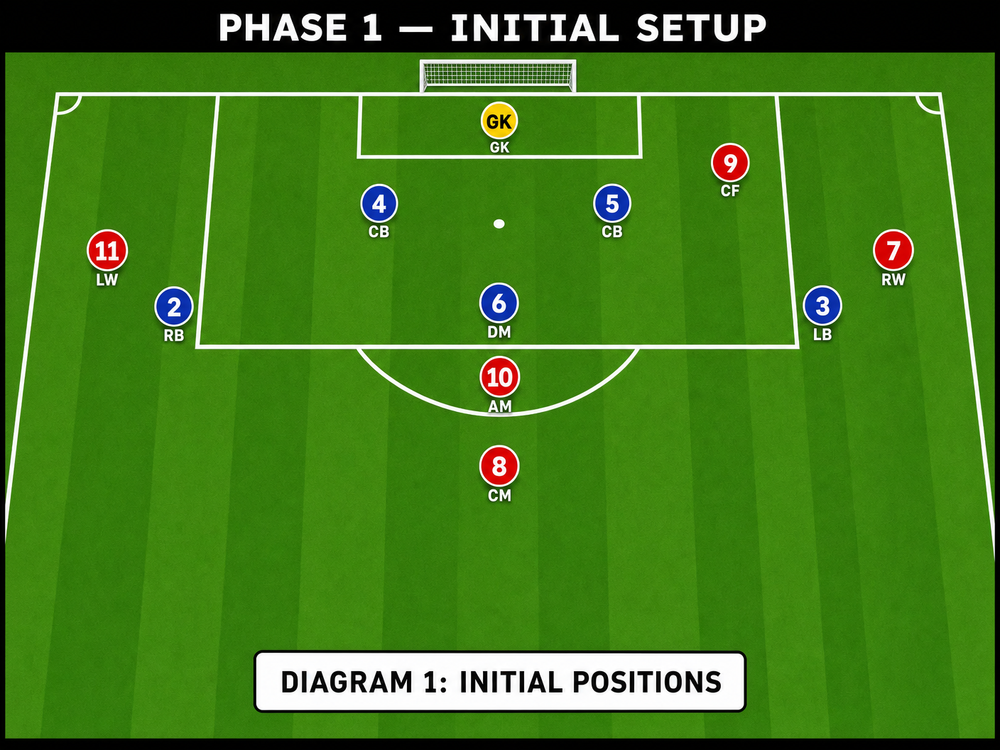
- Players Required: 10 (5 Attackers, 4 Defenders, 1 Goalkeeper).
- Equipment: 1 full-size goal, 10-15 footballs (placed with the wide players), bibs for two teams (e.g., Red for Attackers, Blue for Defenders), and flat markers to designate starting zones if required.
- Initial Positions:
- No.7 (RW): Positioned wide right, near the byline with the ball.
- No.11 (LW): Positioned wide left, ready to attack the far post.
- No.9 (CF): Positioned centrally, starting near the far post or penalty spot.
- No.10 (AM): Positioned just outside the 'D', ready for a late run.
- No.8 (CM): Positioned deeper, ready to sweep up second balls or offer a reset option.
3. Step-by-Step Instructions
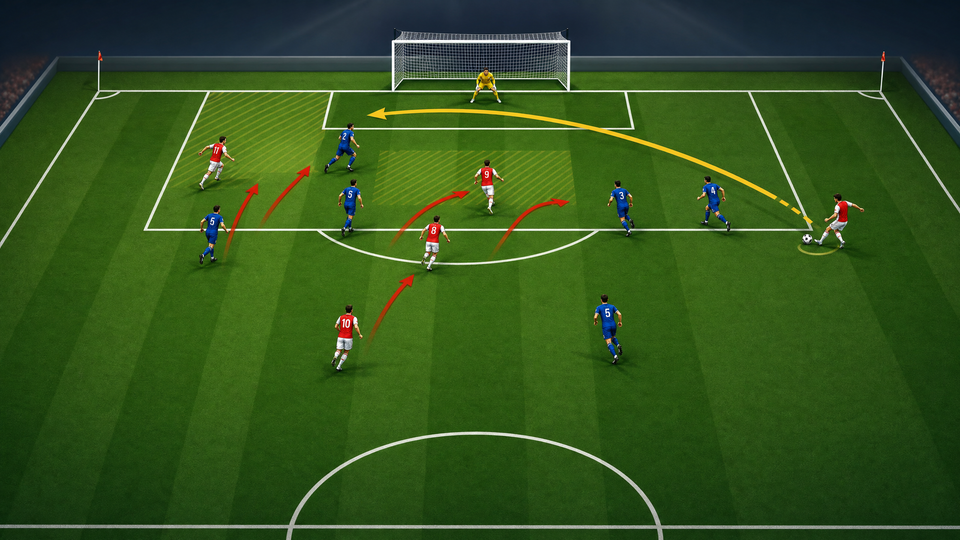
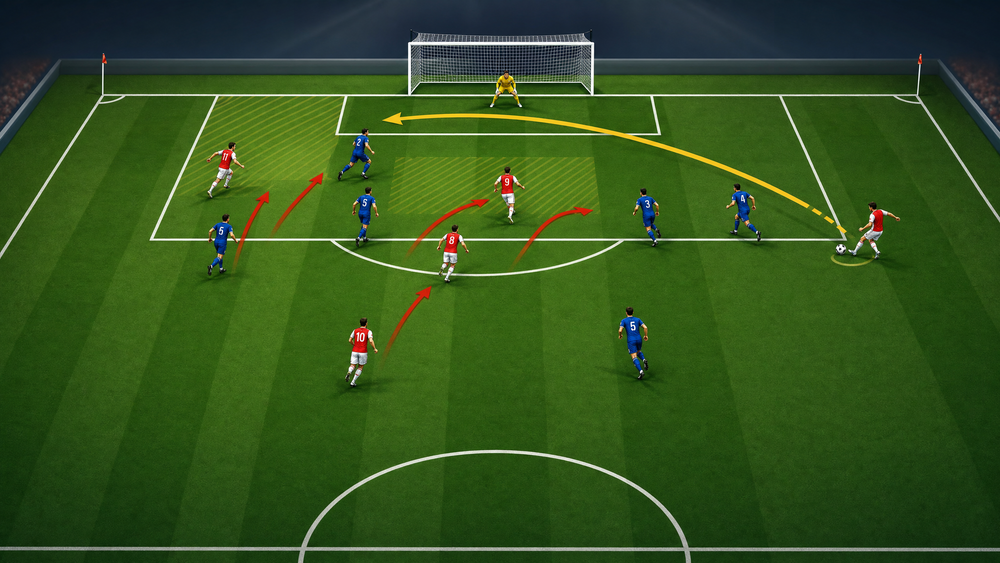
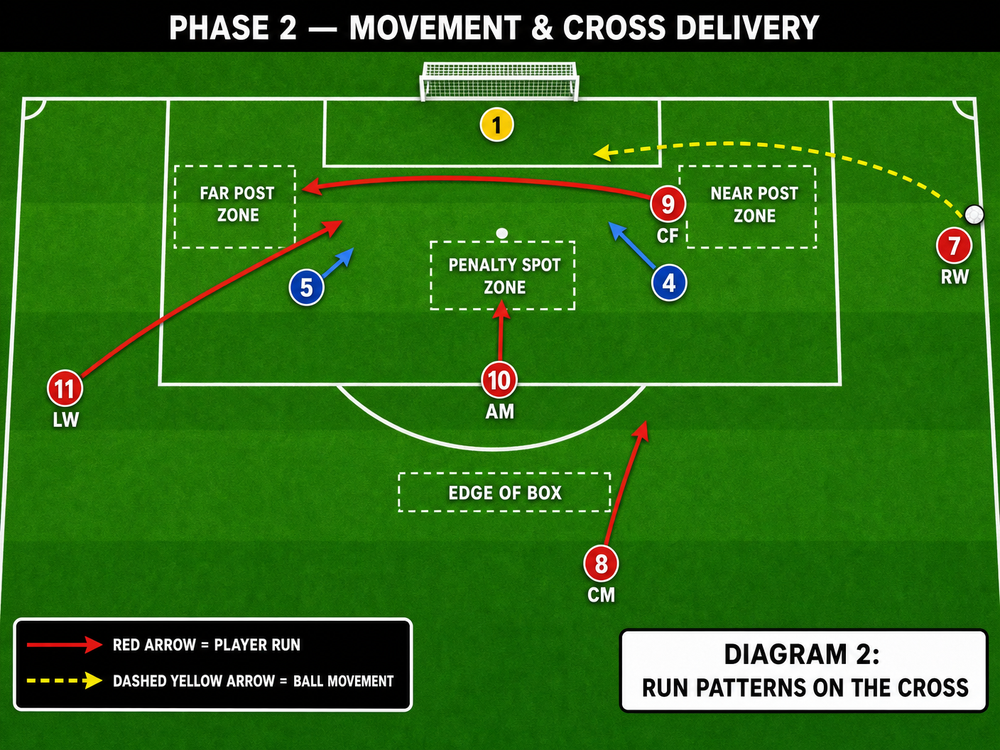
- Trigger the Play: The sequence begins when No.7 (RW) takes a heavy touch out of their feet toward the byline, signaling the intent to cross. This is the visual trigger for all central attackers to begin their runs.
- The Near Post Run (The Decoy/Flick-On): No.9 (CF) makes a sharp, explosive diagonal run across the face of the nearest centre-back toward the near post zone. The objective is to drag the defender away from the center and either win the header or flick it on.
- The Far Post Run (The Finisher): Simultaneously, No.11 (LW) drives diagonally into the penalty area, attacking the space left vacant by the No.9's run. They must time their arrival to meet a deep cross at the back post.
- The Late Run (The Cutback Option): No.10 (AM) holds their run initially, then sprints into the space around the penalty spot as the defenders drop deep toward their own goal. They are the prime target for a cutback.
- The Edge of Box Support: No.8 (CM) moves to the edge of the penalty area, anticipating any defensive clearances (second balls) to recycle possession or strike from distance.
- The Delivery: No.7 assesses the runs and delivers the appropriate cross (driven near post, lofted far post, or cutback to the penalty spot).
4. Key Coaching Points
- Timing is Everything: Attackers must not arrive in their designated zones too early. Arriving as the ball arrives ensures momentum and makes them harder to mark.
- Opposite Movements: Ensure runs cross over (e.g., CF goes near, LW goes far) to confuse defensive marking assignments.
- Visual Triggers: Teach players to read the wide player's body shape. A head-down, foot-back posture means the cross is imminent; that is the moment to sprint.
- Occupy All Zones: The near post, far post, penalty spot, and edge of the box must all have a dedicated player. If one player vacates a zone, another must fill it.
- Delivery Quality: The wide player must select the right type of cross based on the defenders' positioning, not just put the ball into an area blindly.
5. Common Mistakes
- Static Starts: Attackers standing still in the box waiting for the cross, making them easy to mark and defend against.
- Running in Straight Lines: Attackers making predictable, straight runs rather than curved or diagonal runs that take them across the defender's line of sight.
- Overcrowding: Multiple attackers running into the same zone (e.g., both CF and AM attacking the near post), leaving other critical areas empty.
- Poor Timing: Arriving in the finishing zone before the ball is kicked, resulting in lost momentum and allowing defenders to adjust.
6. Variations & Progressions
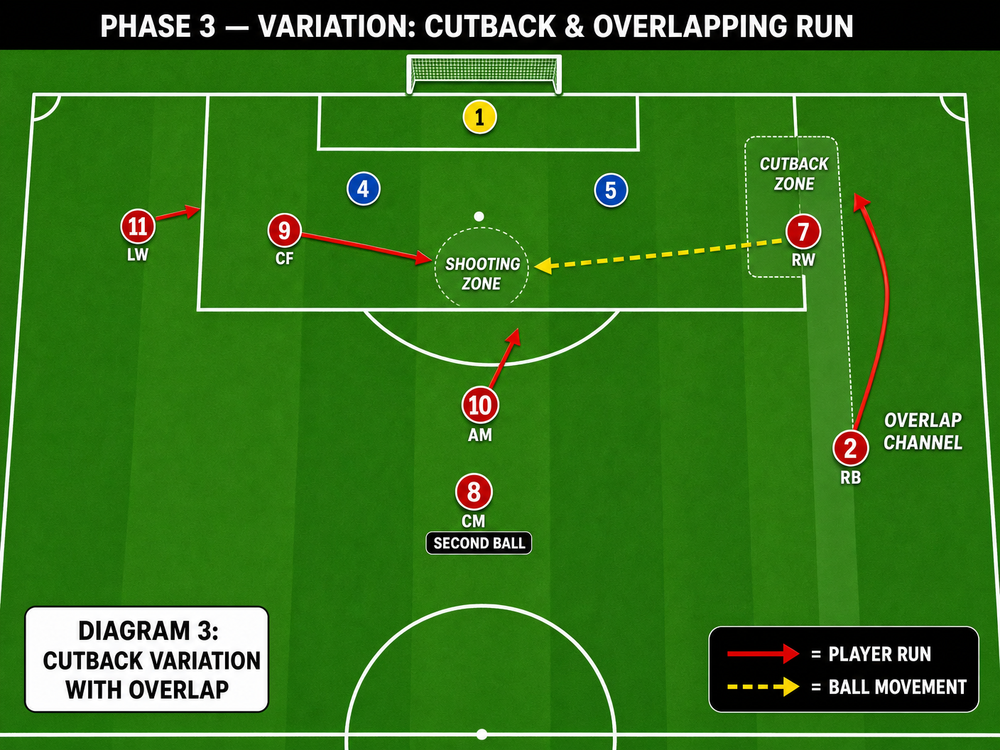
- The Overlap Cutback: Instead of No.7 crossing immediately, No.2 (RB) makes an overlapping run to the byline. No.7 plays a reverse pass to No.2, who then delivers a cutback to No.9 or No.10 arriving at the penalty spot.
- The Short Corner Routine: Adapt this movement pattern for a short corner, drawing defenders out before delivering an inswinging cross to the far post.
- Adding Defenders: Progress from unopposed (shadow play) to semi-opposed (passive defenders), and finally to fully opposed match-scenario conditions to test decision-making under pressure.
7. Age Adaptations
- Under 8 - Under 10: Focus purely on the fundamental technique of crossing and basic finishing. Introduce only two runs (near post and far post). Keep it simple and unopposed.
- Under 12 - Under 14: Introduce the concept of timing and the late run (penalty spot). Begin adding passive defenders to encourage scanning and decision-making.
- Under 16 - Open: Implement the full complex movement pattern with opposite runs, cutbacks, and full defensive pressure. Emphasize reading visual cues and exploiting specific defensive weaknesses.
