

Football
Mastering Possession: The Dynamic 5v2 and 7v3 Rondo Progressions
Enhance your team's decision-making, quick passing, and pressing intensity with this scalable Rondo drill designed for modern possession-based football.

What you need
8-10 marker cones, 3-4 footballs, Training bibs (2 colors)
1. Overview
The Rondo is the foundational building block of modern possession-based football. Far more than a simple warm-up, a properly structured Rondo develops spatial awareness, passing under pressure, and rapid defensive transitions. This specific drill starts with a classic 5v2 setup to establish rhythm and passing angles, then progresses into a more complex 7v3 environment that replicates game-realistic central overloads. By utilizing this progression, coaches can effectively teach players how to manipulate defenders, exploit passing lanes, and maintain possession in tight areas of the pitch.
2. Setup
Pitch Dimensions:
- Initial Grid: 10m x 10m square.
- Progression Grid: 15m x 15m square.
Equipment:
- 8-10 marker cones to outline the grids.
- 3-4 footballs kept nearby to maintain intensity when the ball goes out of bounds.
- Two sets of different colored training bibs (e.g., 7 white, 3 red).
Player Positions:
- Attackers (Possession Team): Positioned along the perimeter of the grid to provide maximum width and depth.
- Defenders (Pressing Team): Positioned inside the grid, working cohesively to intercept passes or force errors.
3. Step-by-Step Instructions
Phase 1: The Classic 5v2 Rondo

- Initial Setup: Create a 10m x 10m grid. Position five attackers on the outside edges and two defenders in the center.
- Start of Play: The coach feeds a ball to one of the outside attackers to begin the drill.
- Objective (Attackers): The five outside players must string together consecutive passes (aim for 10-15) without the defenders intercepting the ball or knocking it out of the grid.
- Objective (Defenders): The two central players must press aggressively as a unit. One player applies direct pressure to the ball carrier, while the second player covers the most dangerous passing lane (typically the split pass through the middle).
- Transition: If a defender intercepts the ball or forces it out of play, they swap places with the attacker who made the mistake.
Phase 2: The 7v3 Progression
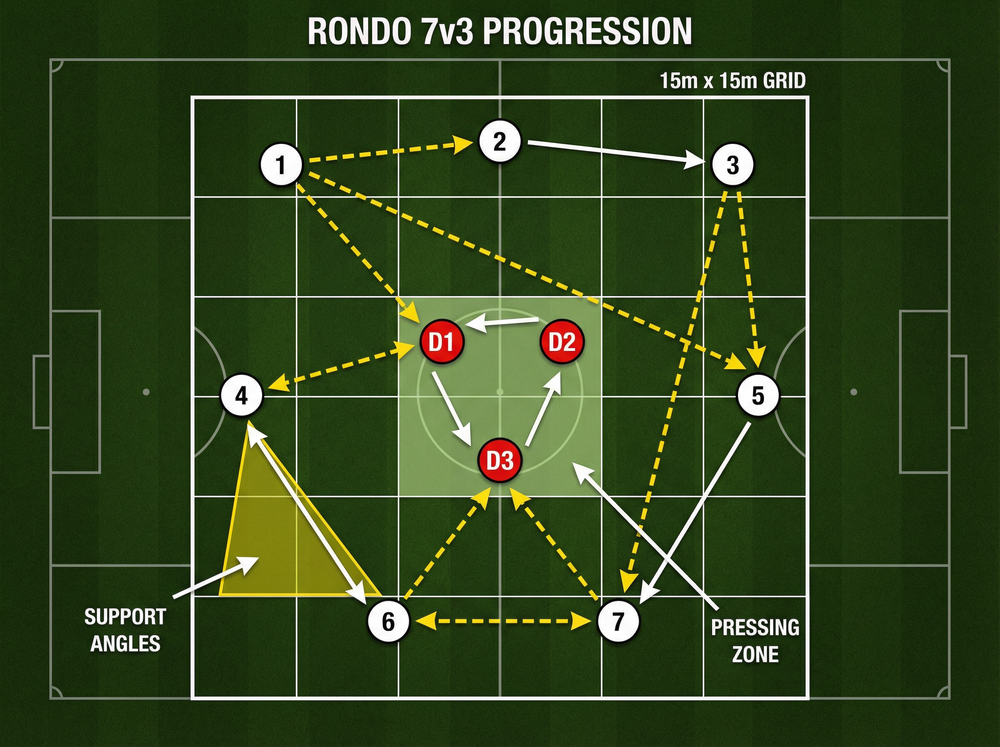
- Grid Expansion: Expand the playing area to a 15m x 15m grid.
- Player Addition: Introduce two more attackers and one more defender, creating a 7v3 scenario.
- Dynamic Movement: Attackers are no longer restricted strictly to the perimeter. They must actively adjust their positions to create passing triangles and support the ball carrier.
- Defensive Coordination: The three defenders must now operate with a clear 'press, cover, balance' structure to prevent passes through the central zone.
- Scoring System: Award the attacking team one point for every 10 consecutive passes. Award the defending team one point for every interception or clearance.
4. Key Coaching Points
- Body Shape: Players must receive the ball on their back foot with an open body shape, allowing them to see the entire grid and anticipate their next pass before receiving the ball.
- Pass Weight and Accuracy: Passes must be firm and played to the correct foot of the receiving player to maintain the speed of play and prevent defensive interceptions.
- Defensive Synchronization: Defenders must communicate constantly. The closest player presses the ball carrier aggressively, while the others cut off the most dangerous passing lanes.
- Anticipation: Attackers off the ball must constantly scan the grid and adjust their positioning to offer immediate support and clear passing angles to the ball carrier.
- Transition Speed: When possession changes, the transition from attacker to defender (and vice versa) must be instantaneous. There should be no hesitation.
5. Common Mistakes
- Static Positioning: Attackers standing flat-footed and waiting for the ball rather than actively moving to create passing angles.
- Individual Pressing: Defenders pressing the ball individually rather than working as a cohesive unit, which leaves large gaps for attackers to exploit.
- Poor First Touch: Taking a negative or heavy first touch that invites defensive pressure and slows down the speed of play.
- Lack of Communication: Silence on the pitch leads to confusion, especially regarding who is pressing the ball and who is covering passing lanes.
6. Variations & Progressions
- Touch Restrictions: Limit the attackers to a maximum of two touches, or even one touch, to increase the required speed of thought and execution.
- Directional Play: Instead of a square grid, use a rectangular grid and require the attacking team to move the ball from one end to the other, simulating building out from the back.
- The 'Joker' Player: Introduce a neutral player who always plays for the team in possession, creating a permanent numerical advantage and encouraging central combination play.
7. Age Adaptations
- Under 8 - Under 10: Increase the grid size to give players more time on the ball. Focus primarily on basic passing technique and receiving skills rather than complex tactical pressing.
- Under 12 - Under 14: Introduce touch restrictions (e.g., maximum three touches). Emphasize the importance of body shape and opening up to see the field.
- Under 16 - Open: Decrease the grid size to force quicker decision-making. Demand high-intensity pressing from the defenders and instantaneous transitions upon losing possession.
