Mastering the One-Touch Passing Combination: Speed, Vision, and Precision
Develop rapid decision-making, spatial awareness, and elite one-touch passing technique with this high-intensity combination drill designed to break down compact defensive blocks.
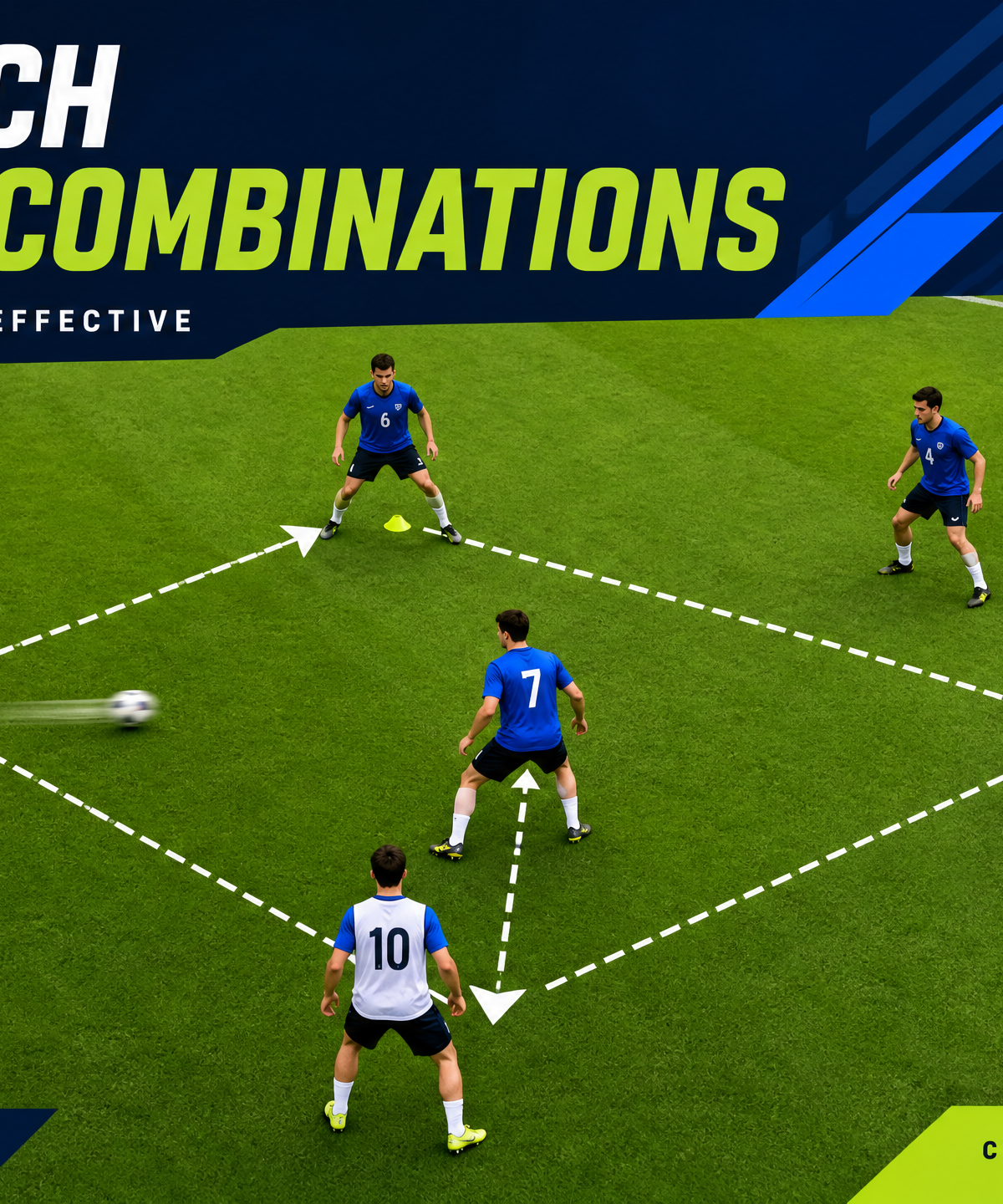
Equipment Needed
1. Overview
In modern football, the ability to manipulate the ball quickly in tight spaces is paramount. Breaking down low blocks and compact defensive structures requires rapid ball circulation, where players anticipate their next action before receiving the ball. This one-touch passing combination drill is designed to hardwire these crucial cognitive and technical skills into your players.
The core objective is to improve the speed of play, focusing on precise one-touch passing, off-the-ball movement, and scanning. By forcing players to process information quickly and execute under implied pressure, you are replicating the demands of the final third. This drill is ideal for the warm-up phase of a technical session or as a precursor to small-sided games focused on attacking combinations.
2. Setup
To run this drill effectively, you need a structured environment that encourages quick ball movement while providing clear visual cues for the players.
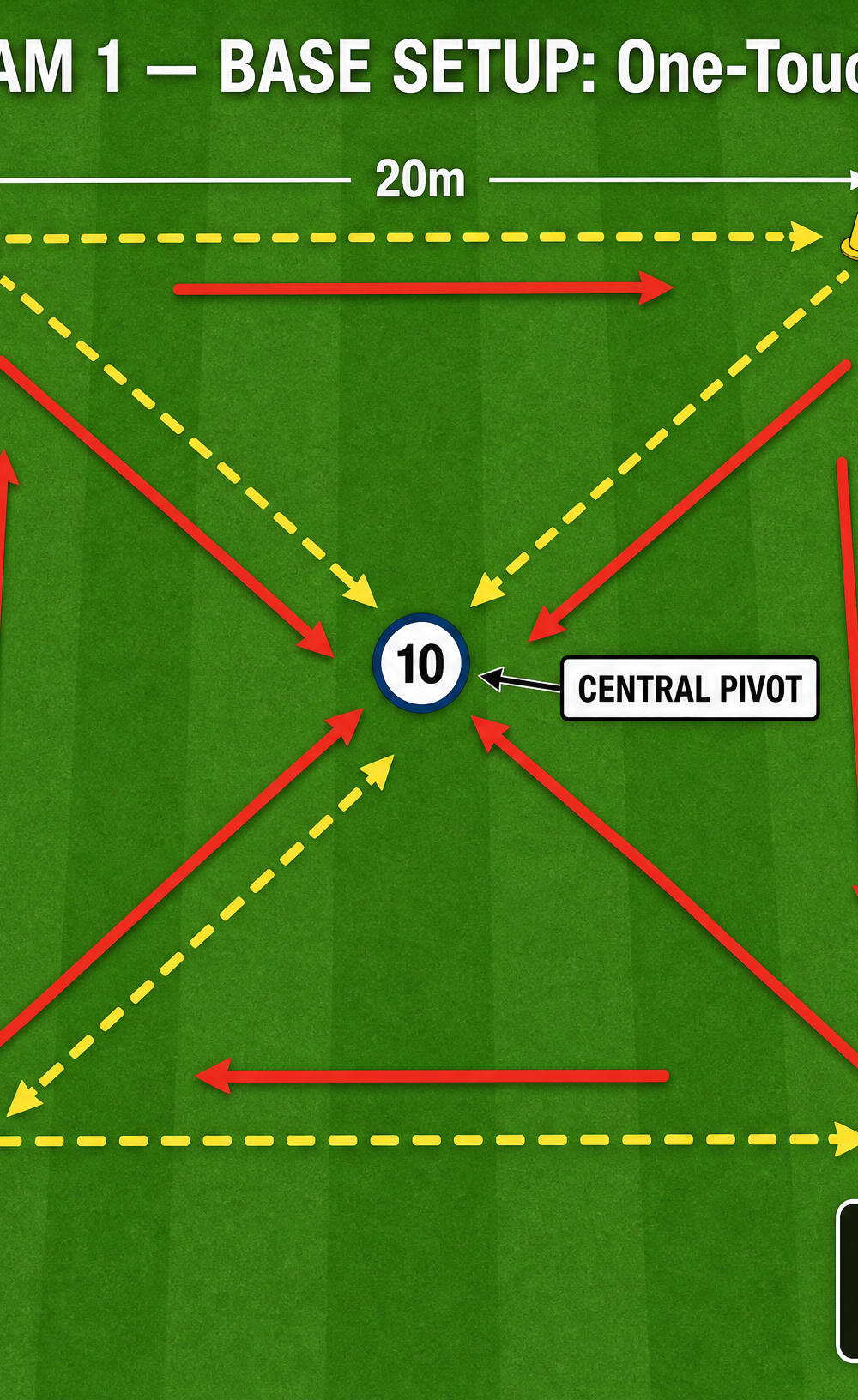
Pitch Dimensions: Create a 20m x 20m square grid using four cones.
Players Required: 5 players minimum (can scale up by creating multiple grids).
Equipment: 4 cones, an adequate supply of footballs (minimum 4-5 to maintain intensity).
Player Positioning:
- Position one player at each of the four corner cones.
- Position one player centrally as the 'pivot' or 'link' player.
- Ensure the player starting the sequence has a ball ready.
3. Step-by-Step Instructions
This drill follows a structured passing sequence that requires continuous movement and focus. The standard progression involves a 'pass and follow' mechanic.
- Initiation: Player 9 (bottom-left) starts the drill by playing a firm, precise pass to Player 10 (the central pivot).
- The Lay-off: Player 10 must scan their shoulder before receiving, then execute a one-touch lay-off pass to Player 6 (top-left).
- The Switch: Player 6 immediately plays a longer, driven pass across the grid to Player 7 (top-right).
- Movement: After passing, players must immediately sprint to follow their pass to the next station. Player 9 runs to the centre, Player 10 runs to the top-left cone, and Player 6 runs to the top-right cone.
- Continuation: The sequence repeats on the opposite side, with Player 7 playing into the new central pivot (Player 9), who lays it off to Player 8, who then switches the play back to the start.
- Tempo: The coach must demand a high tempo. If the ball goes out of bounds, a new ball should be fed in immediately to maintain the flow.
4. Key Coaching Points
- Pre-Scanning: Players must scan the field before the ball arrives.
- Body Shape: Adopt an open body shape to see both the ball and the target.
- Pass Weight and Accuracy: Firm passes to the correct (back) foot.
- Movement off the Ball: Sprint to the next station immediately after releasing.
- Communication: Verbal and non-verbal signals are essential.
5. Common Mistakes
- Taking extra touches due to poor body shape or lack of scanning.
- Poor pass weight (too soft or too hard for a one-touch lay-off).
- Static receiving — waiting for the ball instead of moving aggressively to it.
- Lack of communication between players.
6. Variations & Progressions
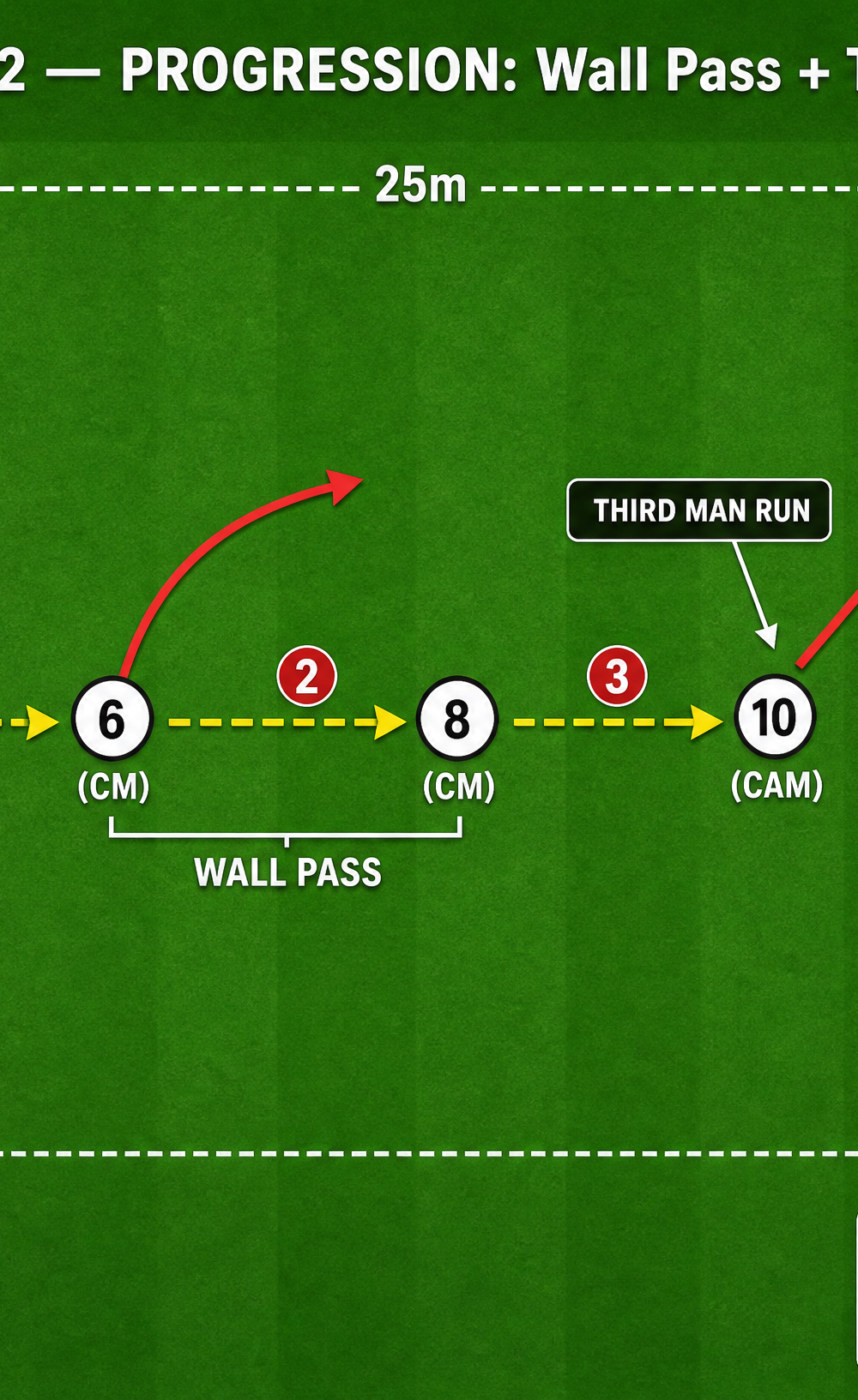
Progression 1: Wall Pass & Third Man Run
Change the grid to a 25m x 15m rectangle. Introduce a sequence involving a wall pass and a dynamic third-man run, simulating a midfield combination to break lines.
Progression 2: Advanced Rondo Under Pressure
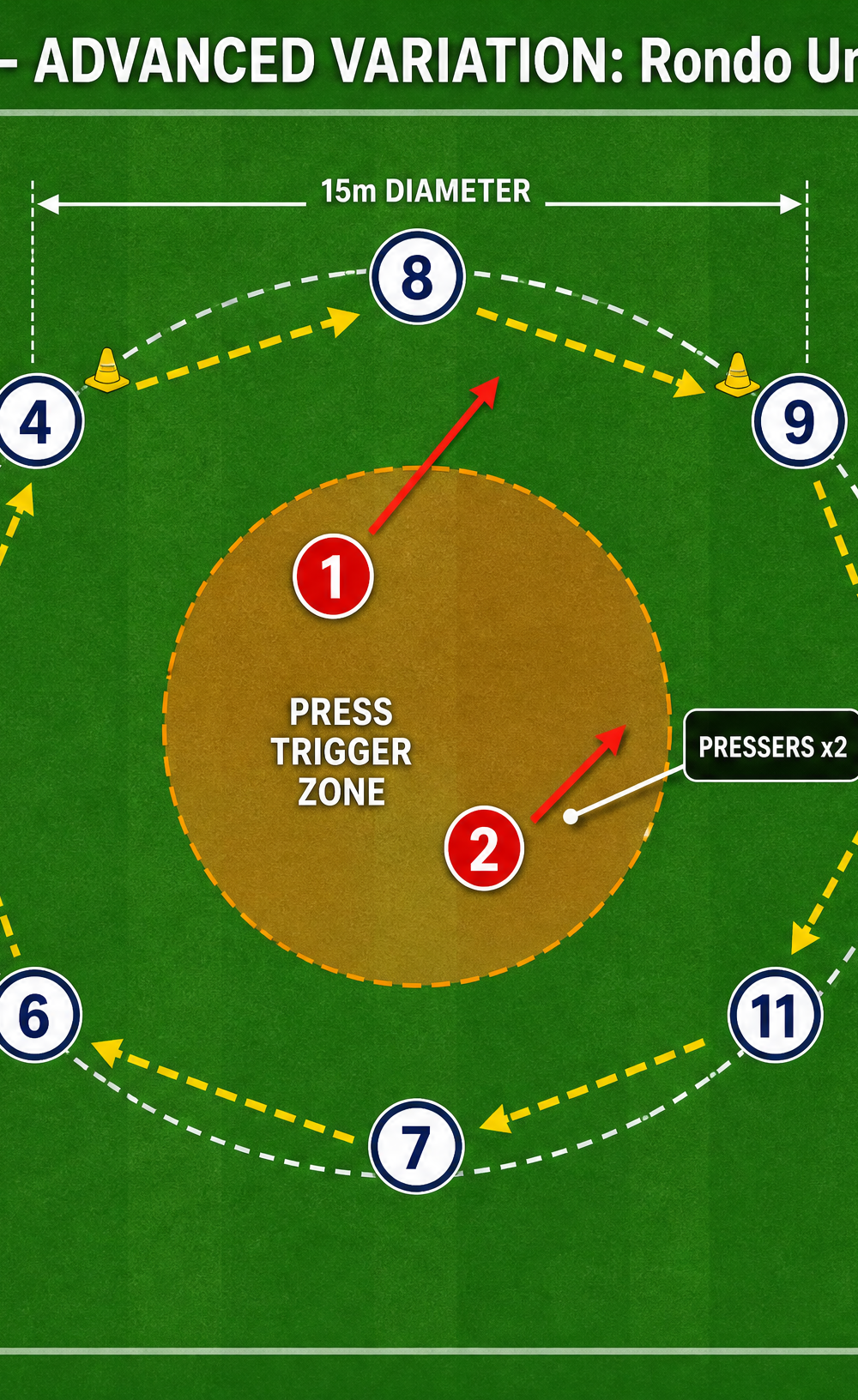
Transition to a 15m diameter circle with 8 perimeter players and 2 central pressers. Perimeter players must use one-touch passing to keep possession while the pressers attempt to win the ball.
7. Age Adaptations
- Under 8s–10s: Allow two touches initially; reduce grid size; emphasise correct technique over speed.
- Under 12s–14s: Demand one-touch play; introduce pass-and-follow strictly; focus on body shape and scanning.
- Under 16s–Open Age: Execute at match speed; introduce all variations early; demand elite precision and communication.