Quick Advantage: A Three-Player Throw-In to Break the Press
Coach a fast, repeatable three-player throw-in routine that creates a 3v2, releases the full-back into the exit channel, and protects against the counterattack.

Equipment Needed
Overview
Quick Advantage turns a middle-third throw-in into an immediate forward action. It creates a local 3v2: the full-back (#2 or #3) throws to the wide player (#7 or #11), #8 becomes the third player, and the thrower re-enters through the outside channel. It is not a long-throw routine; it exploits the two or three seconds before the opposition has set its press.
Use it between halfway and the outer edge of the attacking third, especially when the opponent's wide midfielder presses the line but their full-back has followed the ball inside. Do not force it near your own corner or against a receiver already double-marked.
What success looks like
| Outcome | Coach's measure of success |
|---|---|
| Secure first contact | #7 receives the throw facing the pitch or can protect it for one touch. |
| Create the free player | #8 receives the set pass with a forward-facing first touch. |
| Break the first line | #2 runs beyond the ball or #10 receives inside the next line. |
| Protect the counter | #6 is in a connected safety position before the throw is released. |
Setup
Work initially on a 35 m x 25 m channel along one touchline, using the middle third of a full pitch. On a regulation pitch of 100–110 m x 64–75 m, this represents the corridor from approximately 35 m to 70 m from your own goal line. Mark a 10 m inner lane and a 10–12 m outside exit channel with flat discs. Use one ball, eight to ten cones, bibs, and a full supply of spare balls with the coach or a server.
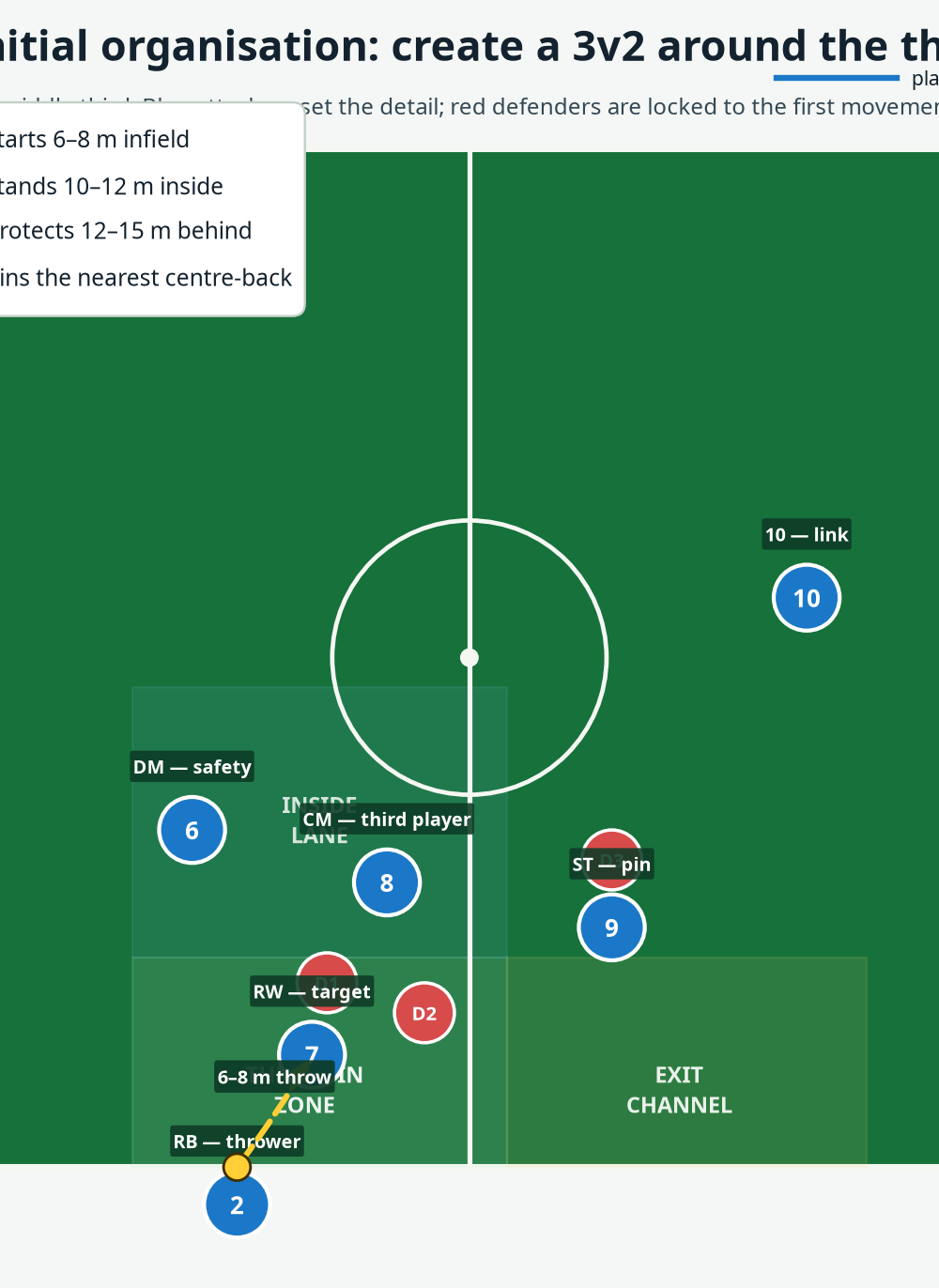
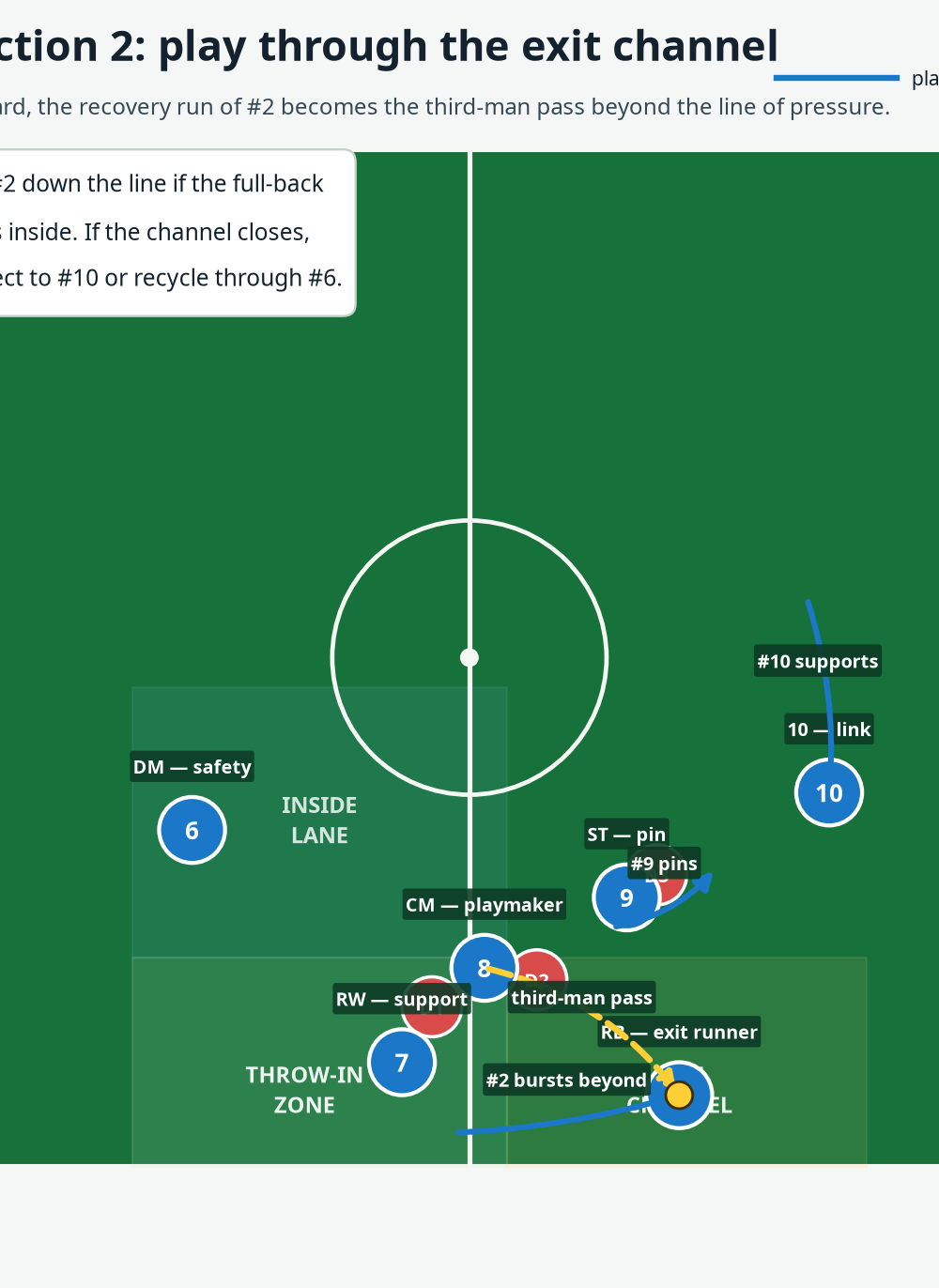
Use six attackers and three defenders. #2/#3 takes the throw; #7/#11 starts 6–8 m infield; #8 begins 10–12 m inside; and #6 sits 12–15 m behind for balance. #9 pins the nearest centre-back while #10 occupies the inside link space.

Step-by-Step Instructions
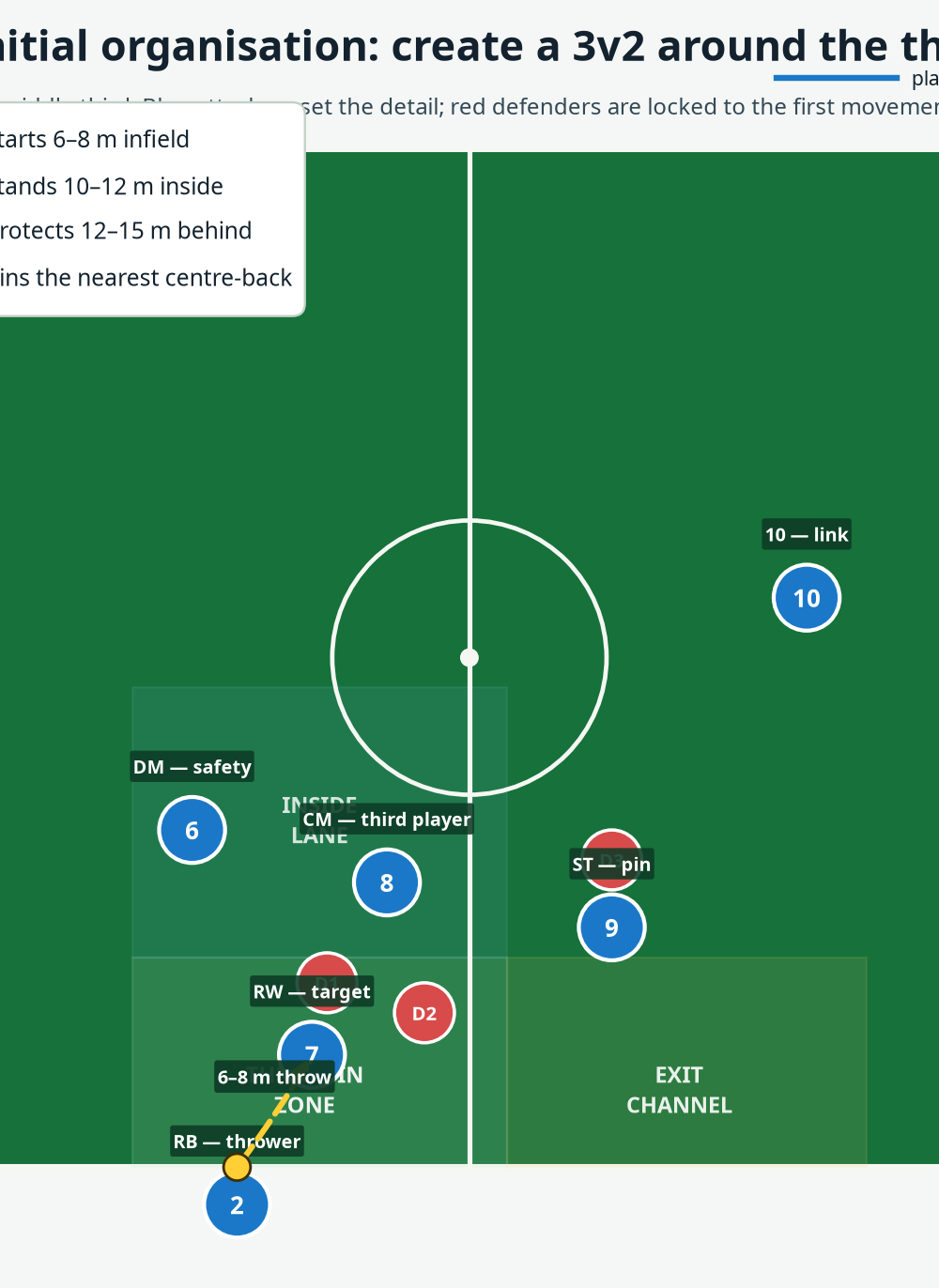
Arrive early and scan. As the ball goes out, #2 moves directly to the restart while #7 checks the nearest defender's body shape. #8 scans the inside lane; #6 gives a clear safety angle. The team calls the trigger word, such as “quick”, only when the three-player side has a realistic 3v2.
Set the reference distances. #7 starts 6–8 m from the thrower, not standing on the line. #8 is 10–12 m inside and 5–7 m higher than #7. This triangle must be stretched enough to move two defenders, while remaining close enough for a firm two-touch combination.
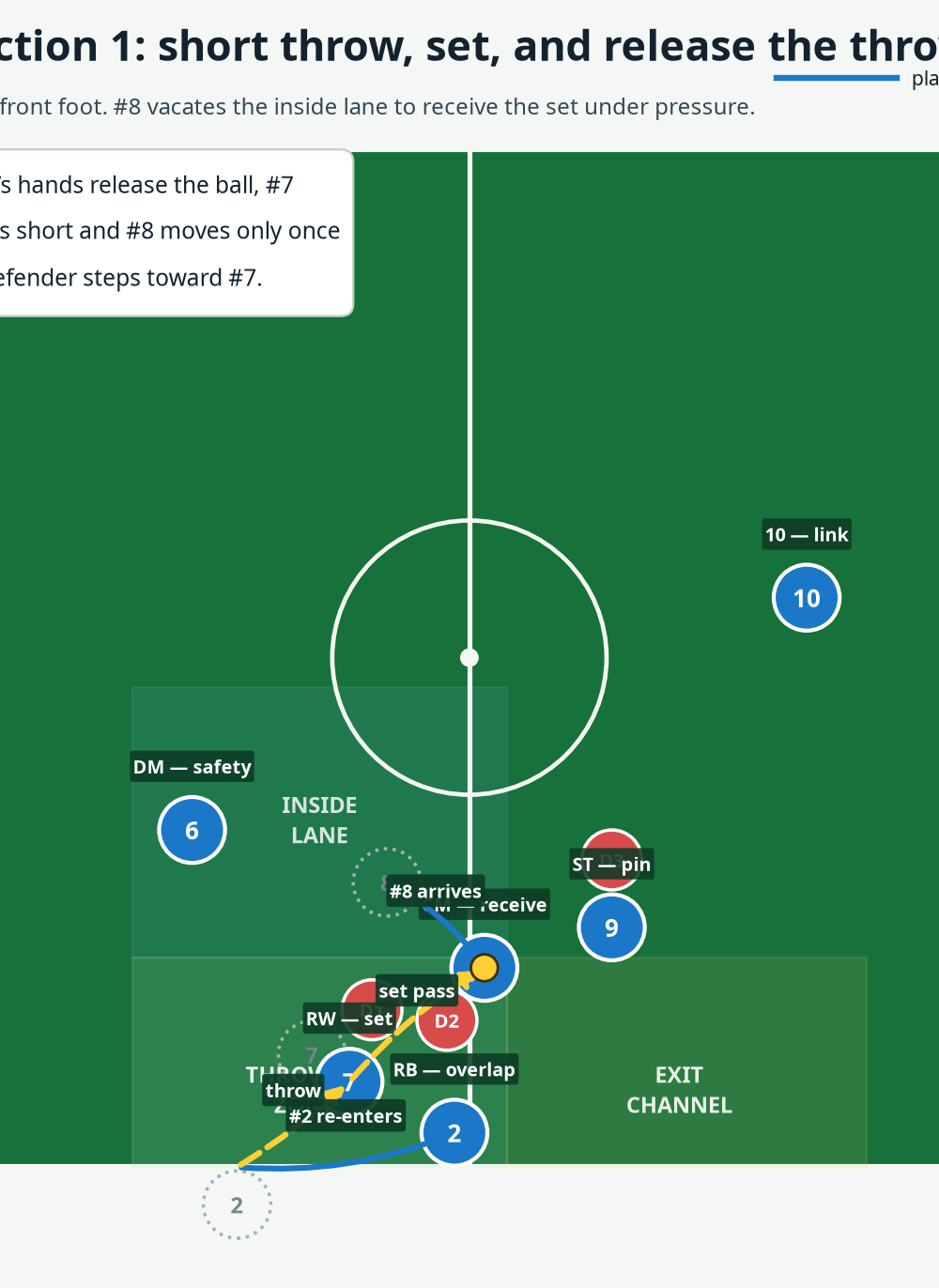
Throw to the front foot. #2 throws a flat, accurate ball to #7's front foot or chest-side foot. The target is a 6–8 m throw that arrives before the defender can press from behind. #7's first job is to secure the ball; the action is lost if the receiver tries to turn into a blind-side tackle.
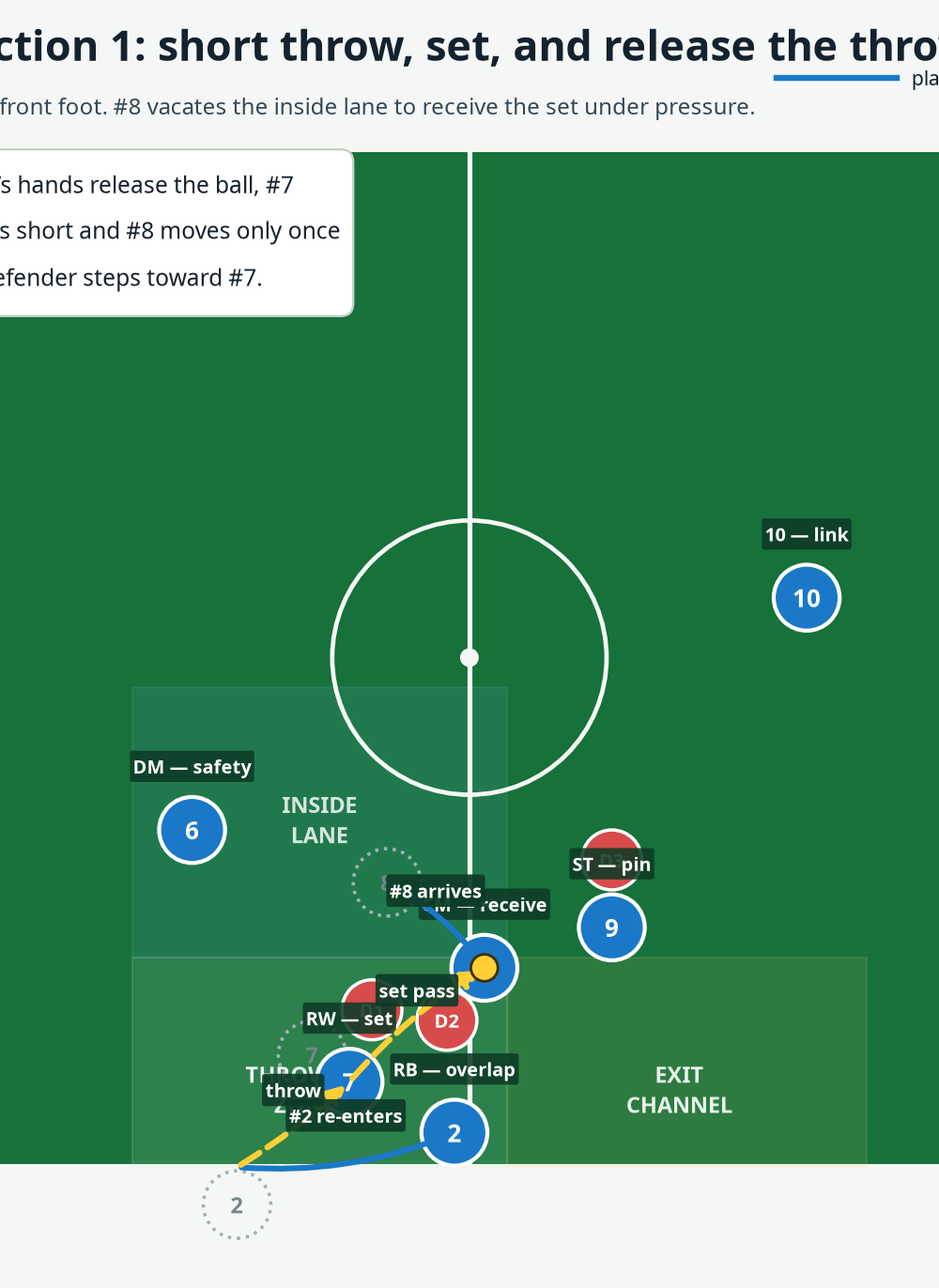
Use the set, not the dribble. #7 plays the first available set pass into #8's path, ideally with the inside foot. #8 must not move early. The cue is the defender stepping toward #7 or the ball leaving #2's hands. That delayed movement creates separation and presents #8 facing forward.
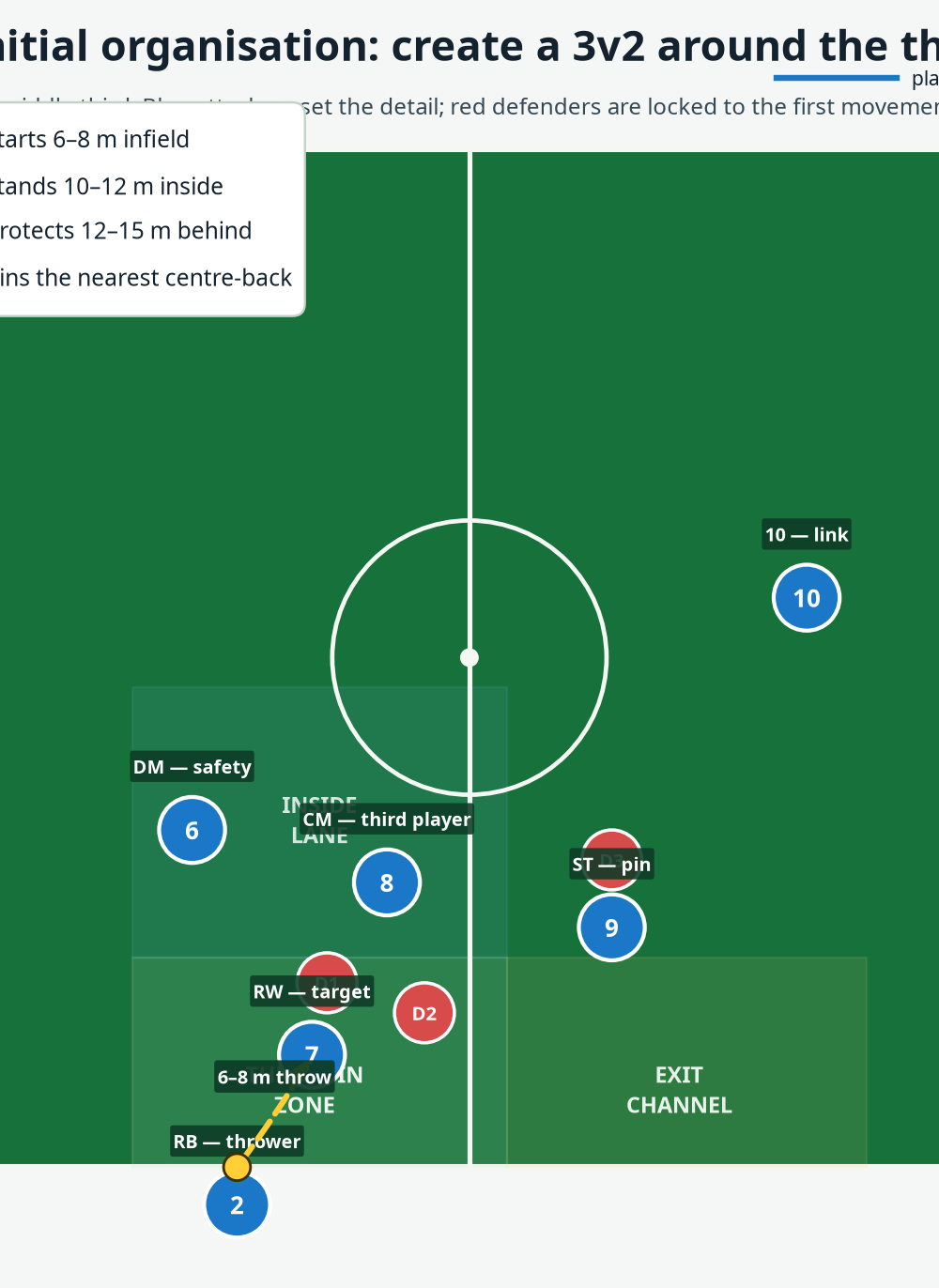
Release the thrower. The instant #2 releases the throw, they step over the line and accelerate along the outside. This is a recovery run, not a jog. #2 should be level with #7 when the set is played and beyond #7 by the time #8 takes the forward touch.
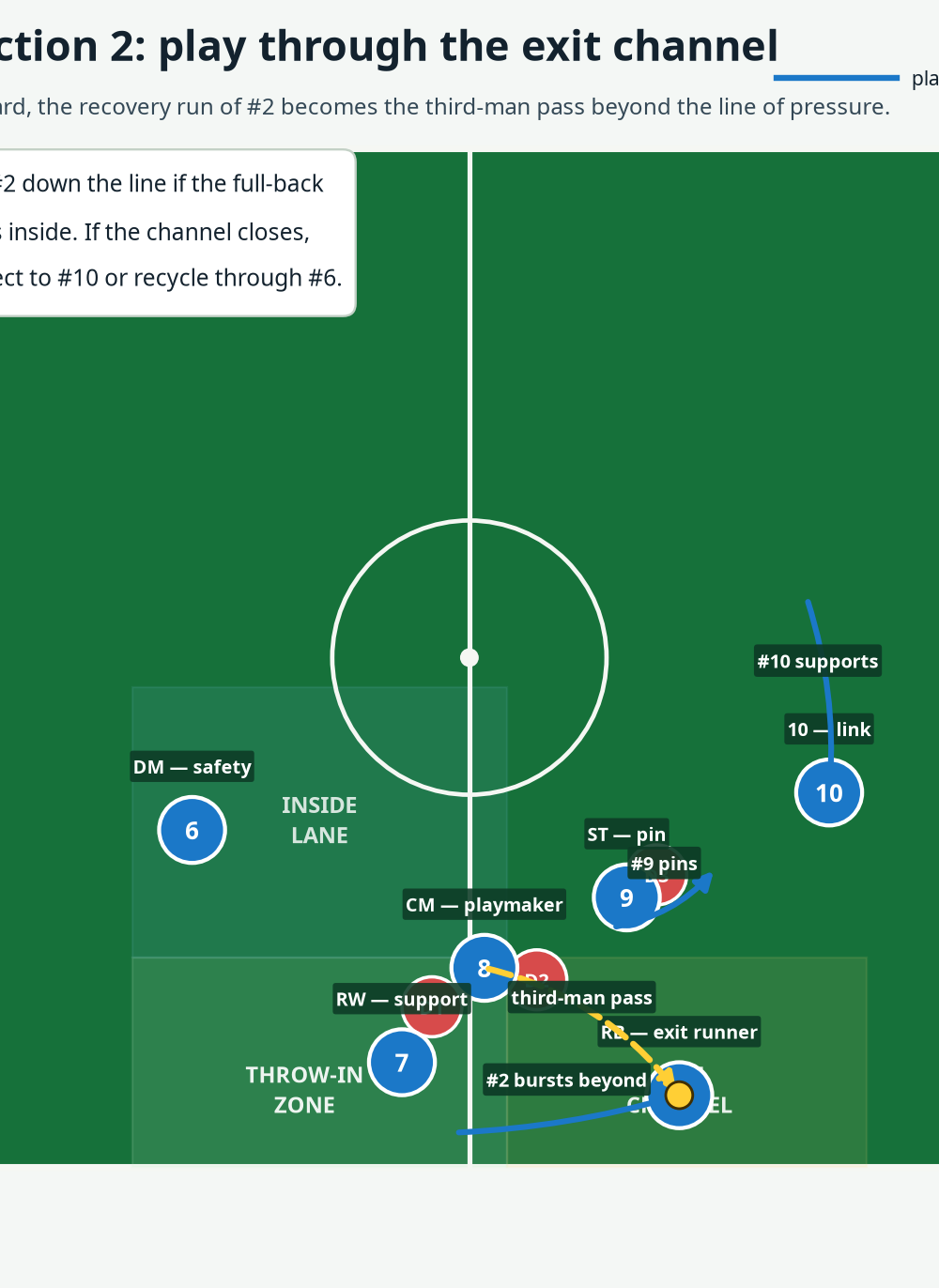
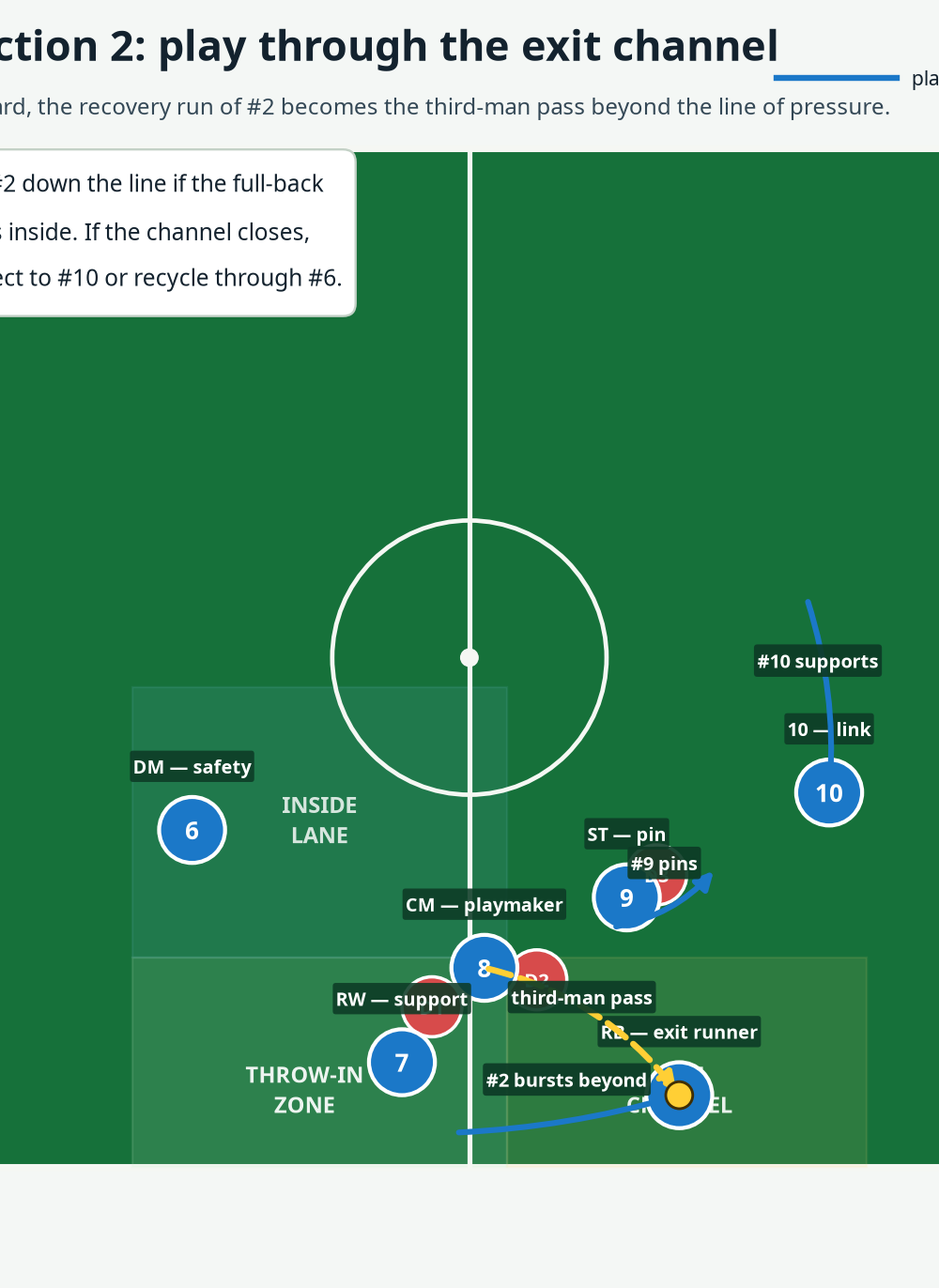
Play the third-man pass. If the opponent's full-back or wide midfielder has followed #8 inside, #8 plays first or second touch into the exit channel for #2. The pass should travel 10–15 m ahead of #2 so it can be attacked at speed. #9 maintains the pin to prevent a centre-back stepping across.
Make the final decision. #2 drives forward for up to 10–15 m and assesses the next line. If the wide lane is clear, continue down the line. If the covering defender closes, play inside to #10. If neither option is clean, recycle through #6; retaining the ball is a successful outcome when the initial advantage has disappeared.
Key Coaching Points
“The routine is won before the throw. The distances, the body angles, and the timing of the third player give the thrower a clear picture.”
First, insist on a clear trigger and immediate tempo. The ball should be returned to the pitch within three seconds of the players being set, without rushing a poor option. Second, demand that #7 receives side-on, using the furthest foot to protect from pressure and the nearest foot to set inside. Third, coach #8 to arrive after the defender commits; an early run simply lets the opposition pass players on. Fourth, make #2's re-entry explosive and onside relative to the ball—players often watch their throw instead of becoming the spare runner. Fifth, maintain counter-protection: #6 should be open to both #7 and #8, positioned where a loose pass can be recovered rather than where they merely watch the routine.
Finally, train the picture, not a blind script. #8 should know the three answers: exit pass to #2, inside link to #10, or secure recycle to #6. The coaches' language should be “recognise and release,” rather than “always force the line.”
Common Mistakes
| Common error | Correction you should coach |
|---|---|
| #7 starts too close to the line and is trapped. | Reset the target 6–8 m infield and demand a side-on receiving shape. |
| #8 moves before the throw or before the defender presses. | Freeze the picture; rehearse the cue: ball leaves #2's hands, then move. |
| #2 admires the throw and returns late. | Give #2 a timed condition: be beyond #7 before #8's second touch. |
| The throw is floated or behind the receiver. | Rehearse a firm, flat throw to the front foot; replace the thrower if accuracy does not improve. |
| #6 is too high, so a turnover becomes a counterattack. | Mark a 12–15 m safety pocket and only release #6 once control is established. |
Variations & Progressions
For a beginner regression, remove active defenders and use mannequins or passive screens. Allow #7 two touches and #8 three touches, then repeat each action until the distances are automatic. For the first progression, add two live defenders against #2, #7, and #8 and award the defenders a point for forcing the ball backwards or out. This introduces the real decision without crowding the picture.
For an advanced progression, play 6v6 plus goalkeepers in a 55 m x 44 m area, with every restart on the designated touchline. The attacking side earns two points if it connects the third-man pass into the exit channel within six seconds of the throw, one point for a successful inside connection to #10, and no bonus for a forced clearance. Defenders may counter into two mini-goals after a turnover; this keeps #6's balance position honest.
A useful variation is the decoy check. #7 checks short and deliberately carries the nearest defender toward the ball, but lets the throw travel over or around them into #8. Use this only when #8 has scanned enough space to receive securely. A second variation is the inside bounce: #8 plays #10, who sets #2 into the channel. That gives you a four-player solution when the direct exit pass is screened.
Age Adaptations
| Age group | Adaptation | Coaching emphasis |
|---|---|---|
| Under-8 / Under-10 | Use a 20 m x 15 m area, no offside detail, and only #2, #7, and #8. Allow the receiver a controlled first touch before the set pass. | Throwing technique, finding space, and enjoying quick restarts. |
| Under-12 / Under-14 | Use a 30 m x 20 m channel with two recovering defenders. Introduce #6 as a safety player and reward successful recycles. | Timing, receiving body shape, and protecting possession. |
| Under-16 / Open | Use the full 35 m x 25 m channel with live counterattacks, #9's pin, and #10's link option. Keep the six-second scoring constraint. | Scanning, opponent cues, tempo, and decision-making under pressure. |
Session Delivery Notes
Run this as a 15-minute block: four minutes unopposed, five minutes conditioned 3v2, then six minutes of a directional game. Demonstrate once, coach through short interventions, and stop only for repeat errors in timing or spacing. Ask #8 what cue they saw and #2 whether the exit channel was genuinely open; that turns a routine into a match decision.