

Netball
GK Body Positioning and Intercept Mastery Drill
A comprehensive defensive drill designed to teach Goalkeepers optimal body positioning, reading the play, and executing clean intercepts in the goal circle.
What you need
2-3 Netballs, 4 marker cones (optional), Standard Netball court
1. Overview
This drill focuses on the fundamental skills required for a Goalkeeper (GK) to dominate the defensive circle. It is designed to teach players how to establish strong initial body positioning, read the incoming feed, and explode off the mark to secure clean intercepts. By breaking down the movement into distinct phases, coaches can isolate and correct specific defensive habits. This drill is particularly useful when preparing your defensive unit to face a static holding shooter or a dynamic moving circle.
2. Setup
Proper setup is crucial for maximizing the effectiveness of this drill. Ensure the court space is clear and players understand their starting roles.
- Court Area: One defensive third of a standard Netball court (15.25m x 10.17m), focusing primarily on the goal circle (4.9m radius).
- Players Required: Minimum of 4 players (1x GK, 1x GS, 1x GD, 1x Feeder/Coach).
- Equipment: 2-3 Netballs, 4 marker cones (optional, to define starting points).
Starting Positions:
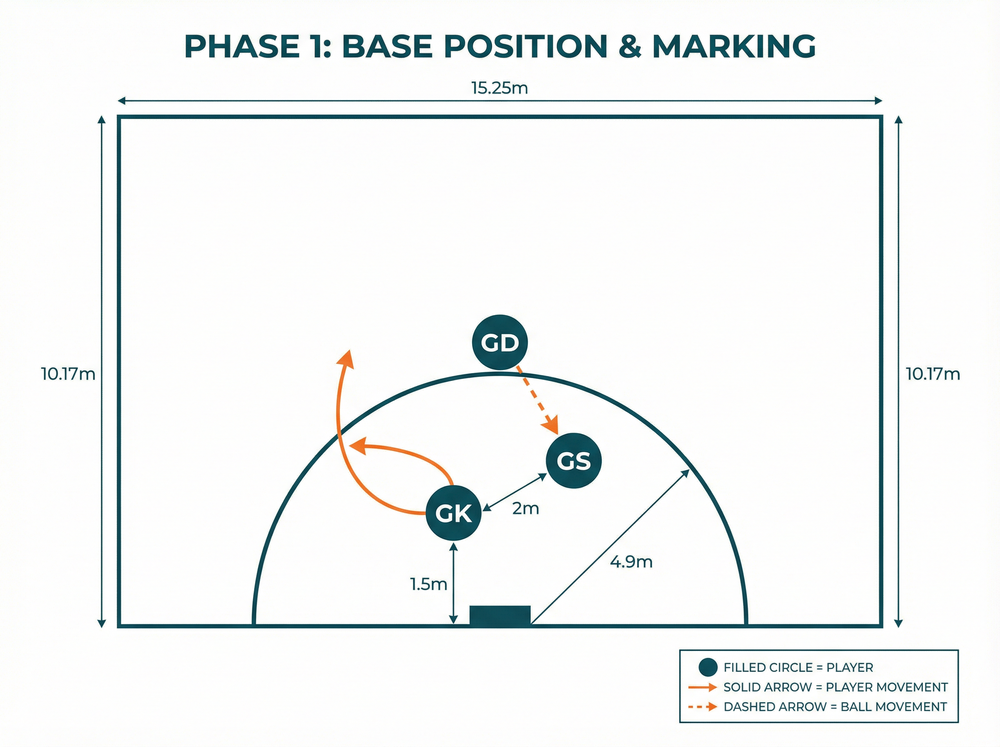
- GK: Starts approximately 1.5m in front of the goal post, slightly offset to the left or right depending on the GS position.
- GS: Positioned roughly 2m ahead of the GK, acting as the primary target.
- GD: Starts near the top edge of the goal circle, ready to receive an outlet pass or apply initial pressure.
- Feeder (F): Positioned just outside the top of the goal circle, holding the ball.

3. Step-by-Step Instructions
Follow these steps to execute the drill effectively. Start slowly to ensure correct technique before increasing the speed and intensity.
Phase 1: Base Position & Marking
- The GK establishes their base position 1.5m off the goal post. They must maintain a strong, balanced stance with knees bent, weight on the balls of their feet, and arms positioned to disrupt vision without obstructing.
- The GS begins to make small, lateral movements within a 2m radius. The GK must use short, sharp defensive shuffles to maintain their relative position, ensuring they stay goal-side and can see both the player and the eventual feeder.
Phase 2: Read, Drive & Intercept
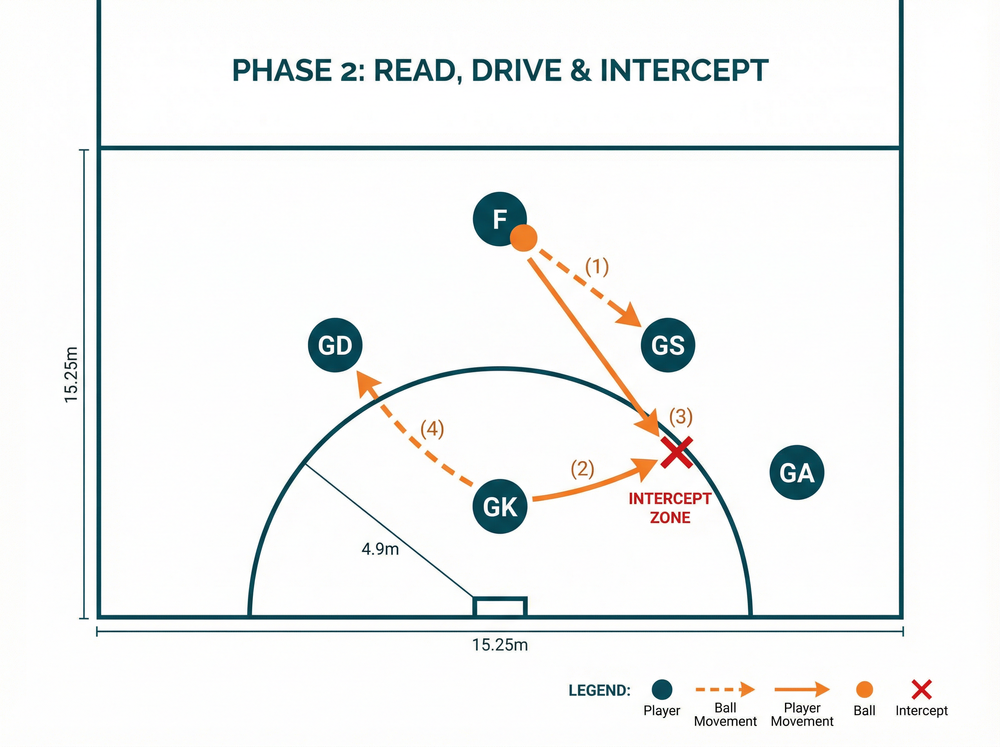
- The Feeder (F) signals the start of the active phase by raising the ball. The GD applies passive pressure to the Feeder.
- The Feeder delivers a lob or a firm chest pass into the space ahead of the GS.
- The GK must read the trajectory of the ball as it leaves the Feeder's hands.
- Pushing off their outside foot, the GK drives aggressively toward the intercept zone, extending their arms to secure the ball cleanly before it reaches the GS.
- Upon securing the intercept, the GK immediately lands, pivots, and delivers a sharp outlet pass to the GD, who has transitioned to the edge of the circle.
Phase 3: Live Pressure — GK/GD Partnership
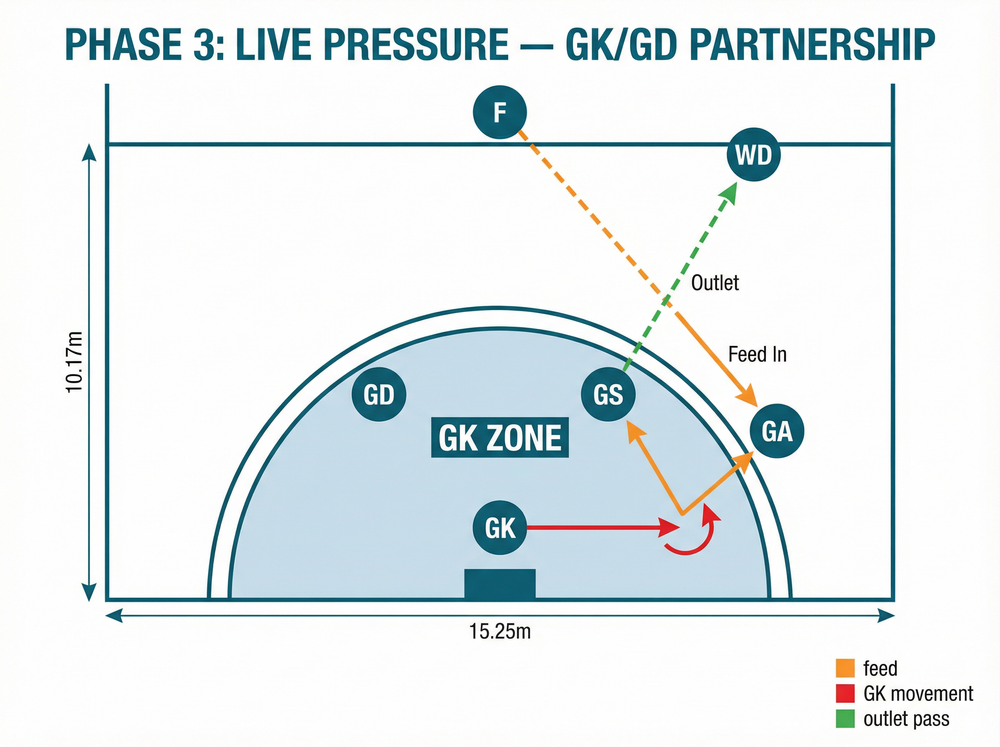
- Introduce a Goal Attack (GA) and a Wing Defence (WD) to simulate a live game scenario.
- The Feeder now has the option to pass to either the GA or the GS.
- The GK and GD must work in tandem. If the ball goes to the GA, the GK must adjust their body position to shadow the GS while remaining open to a potential secondary feed into the circle.
- If the feed comes into the GS, the GK executes the intercept as practiced in Phase 2, while the GD and WD immediately transition to offer outlet options.
4. Key Coaching Points
- Vision: The GK must maintain 'split vision'—seeing both the attacker (GS) and the ball (Feeder) simultaneously. They should not turn their back entirely on either.
- Footwork: Emphasize short, fast, lateral steps when marking. When committing to the intercept, the first step must be explosive and directed toward the ball, not the player.
- Body Angle: The GK should be angled at roughly 45 degrees to the baseline, allowing them to push off effectively in either direction.
- Clean Hands: Encourage players to attack the ball with two hands whenever possible, securing it firmly to prevent deflections or loose balls.
- Recovery: If the intercept is missed, the GK must recover instantly to defend the shot, rather than dropping their head or giving up on the play.
5. Common Mistakes
- Over-committing Early: GKs often guess the pass and move before the ball is released, leaving the GS wide open if the Feeder changes their mind.
- Flat-footed Stance: Standing with straight legs and weight on the heels makes it impossible to react quickly enough to intercept a fast pass.
- Contact on the Drive: In their eagerness to reach the ball, the GK may drive directly through the GS, resulting in a contact penalty. The drive must be angled into the space ahead of the receiver.
- Poor Outlet Vision: Securing the intercept is only half the job. Failing to immediately look for the outlet pass (GD or WD) often results in a held ball or a quick turnover.
6. Variations & Progressions
- Progression 1: Two Feeders. Introduce a second feeder on the circle edge to force the GK to adjust their body angle more frequently and read passes from different angles.
- Progression 2: Moving GS. Have the GS make continuous, dynamic drives (front cuts, baseline drives) rather than holding a static position, increasing the difficulty of the read.
- Variation 1: Restricted Vision. Have the GK start facing the baseline. On the coach's whistle, they must turn, locate the ball, and attempt the intercept. This improves reaction time and spatial awareness.
7. Age Adaptations
- Under 10s / Under 12s: Focus heavily on Phase 1. Ensure they understand the basic defensive stance and the concept of staying goal-side. Use slower, looped passes for the intercept phase to build confidence.
- Under 14s / Under 16s: Emphasize the explosive first step and the clean two-handed catch. Introduce the GD partnership (Phase 3) and focus on the speed of the outlet pass.
- Open / Advanced: Run the drill at full match intensity. The feeds should be fast and varied (lobs, bounces, bullets). The GS should use advanced holding techniques, forcing the GK to fight for their base position before attempting the intercept.
