

Netball
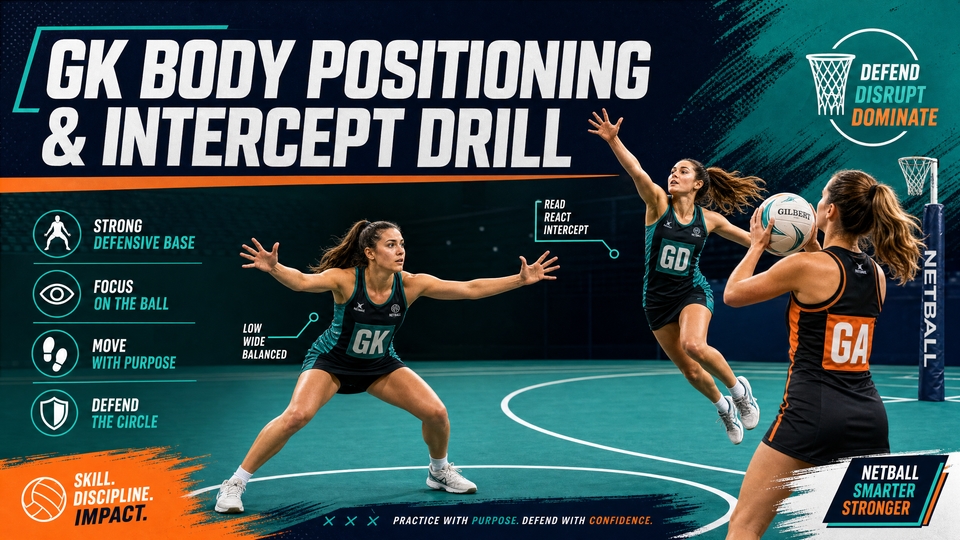
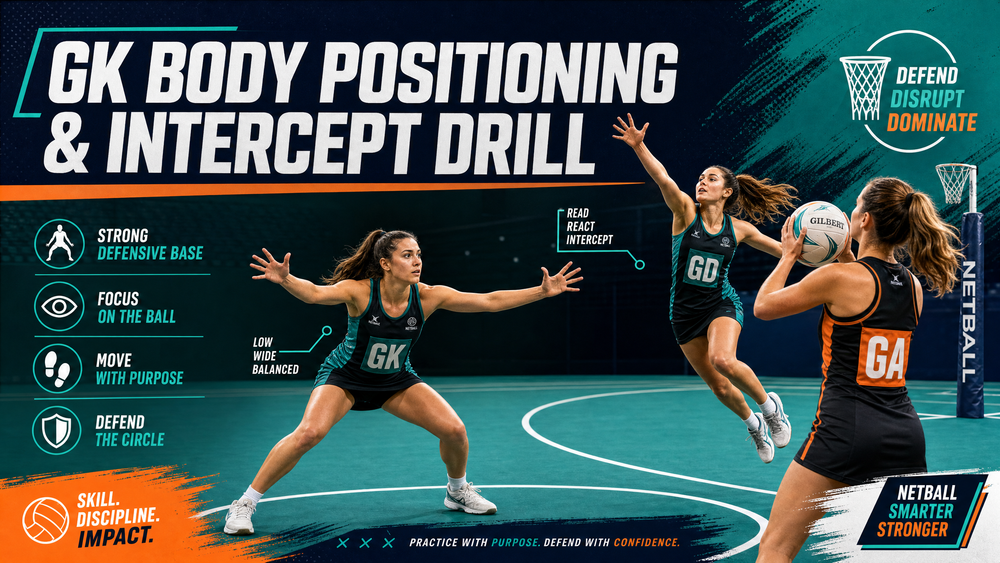
GK Body Positioning & Intercept Masterclass
Master the essential defensive base and timing required for Goal Keepers to read the play, dictate attacker movement, and execute clean intercepts in the goal circle.
What you need
1 Netball, 4 Cones
1. Overview
The Goal Keeper (GK) is the last line of defence. To be effective, a GK must not only react to the Goal Shooter (GS) but proactively dictate their movement. This drill focuses on establishing a strong defensive base, maintaining vision of both the ball and the attacker, and timing the step out to secure a clean intercept. It bridges the gap between static marking and dynamic circle defence.
Use this drill when your circle defenders are getting caught behind their attackers, or when they are reacting too late to the feed into the circle.
2. Setup
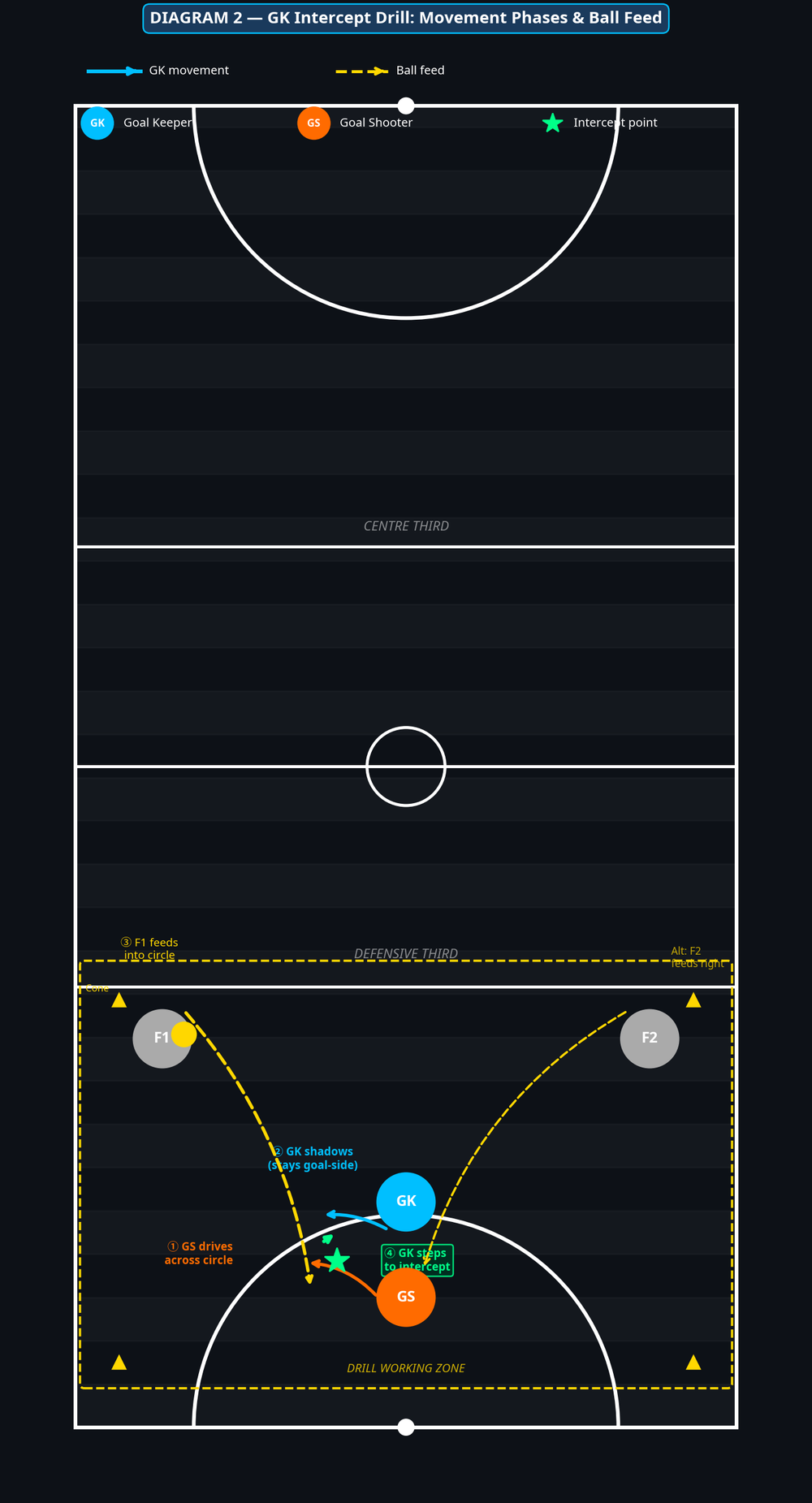
- Players: 4 (1x GK, 1x GS, 2x Feeders)
- Equipment: 1 Netball, 4 Cones (to mark the working area if needed)
- Court Area: Goal third (specifically around the goal circle)
Positions:
- Place the GK and GS inside the goal circle.
- Position Feeder 1 (F1) on the left edge of the circle in the goal third.
- Position Feeder 2 (F2) on the right edge of the circle.
3. Step-by-Step Instructions
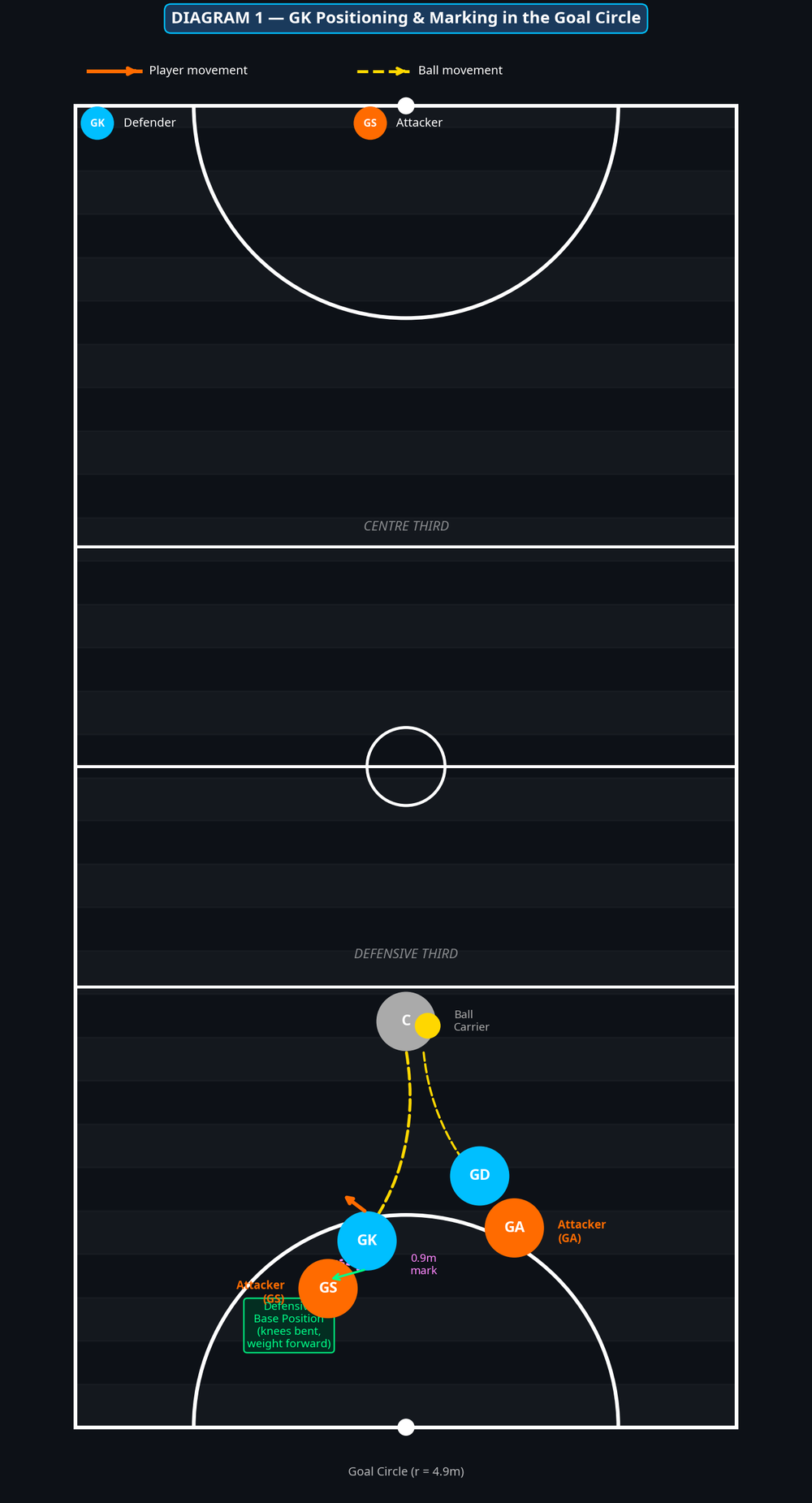
- Starting Position: The GK starts in a side-on stance, slightly in front and to the side of the GS (goal-side). The GK must maintain a low, wide base with knees bent and weight slightly forward.
- The Drive: The GS initiates a strong drive across the goal circle to receive a pass from F1.
- Shadowing: The GK must shadow the GS's movement, maintaining the 0.9m distance and staying goal-side. The GK's eyes should constantly flick between the GS and the ball carrier (F1).
- The Feed: F1 delivers a firm, flat pass into the space ahead of the GS.
- The Intercept: As the ball leaves F1's hands, the GK reads the flight path, pushes off their outside foot, and attacks the ball at its highest point, stepping across the GS to take the intercept.
- Reset: The GK lands cleanly, passes back to a feeder, and the drill resets. Alternate feeds from F1 and F2.
4. Key Coaching Points
- Defensive Base: Keep a low center of gravity. Knees bent, feet shoulder-width apart. This allows for explosive lateral movement.
- Vision (The Triangle): The GK must position themselves so they can see both the attacker (GS) and the ball carrier (Feeder) without turning their head completely.
- Dictate, Don't React: Use body positioning to force the GS into wider, less dangerous areas of the circle.
- Attack the Ball: When going for the intercept, commit fully. Drive arms forward and snatch the ball; do not wait for it to come to you.
- Clean Landing: Ensure a balanced, one-two landing after the intercept to avoid stepping or contact penalties.
5. Common Mistakes
- Flat-Footed Stance: Standing too upright prevents quick acceleration to the ball.
- Ball Watching: Losing sight of the GS allows them to slip behind on the baseline.
- Late Reaction: Waiting until the ball is halfway to the receiver before moving. The movement must start as the ball leaves the feeder's hands.
- Reaching: Trying to intercept by reaching an arm out rather than moving the feet to get the body in front of the ball.
6. Variations & Progressions
- Progression 1 (Add a GD/GA): Introduce a Goal Defence (GD) and Goal Attack (GA) to create a 2v2 scenario in the circle, increasing the cognitive load and decision-making for the GK.
- Progression 2 (Continuous Feed): If the GK misses the intercept, the GS must immediately put up a shot, and the GK must transition into a rebounding position.
- Variation 1 (Lob Pass): Have the feeders use lob passes instead of flat passes to practice aerial intercepts and timing the jump.
7. Age Adaptations
- Under 10s: Focus purely on the footwork of shadowing. Remove the ball initially and have the GK just practice staying goal-side of the GS.
- Under 12s-14s: Introduce the ball but allow the feeders to hold it slightly longer so the GK has more time to read the play.
- Under 16s & Open: Run the drill at match intensity. Feeders should disguise their passes and use a variety of feeds (bounce, flat, lob).
