

Cricket
High-Intensity Running Between the Wickets: The Pressure Cooker Drill
Master the art of quick singles and turning under pressure with this game-realistic running between the wickets drill designed to test communication and fitness.

What you need
2x Cricket Bats, Batting Pads, Gloves, Helmets, 6x Stumps, 4x Cricket Balls, Marker Cones
1. Overview
Running between the wickets is often the difference between a competitive total and a match-winning one. This drill, the "Pressure Cooker," is designed to simulate the physical and mental demands of turning ones into twos and twos into threes during the death overs. It focuses on explosive acceleration, efficient turning techniques, clear communication, and decision-making under the stress of incoming throws.
Use this drill during the conditioning phase of your practice or as a high-intensity finisher. It is particularly effective leading up to limited-overs fixtures where strike rotation is paramount.
2. Setup
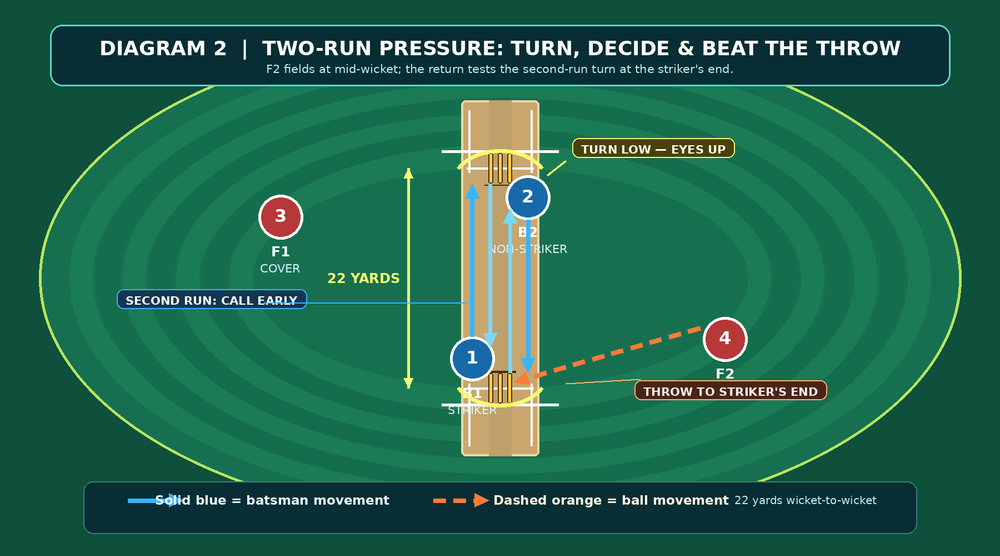
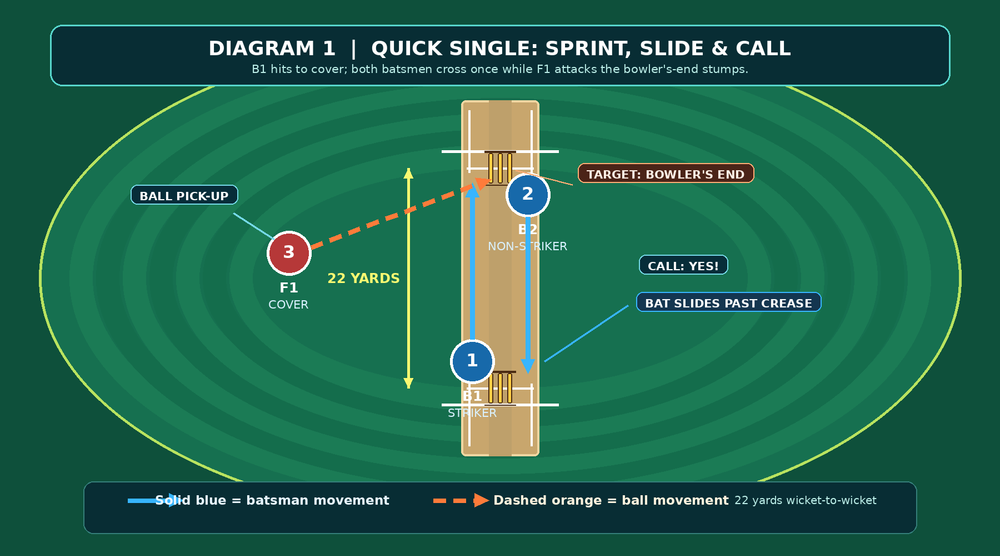
To run this drill effectively, you need to replicate match conditions as closely as possible.
Pitch and Field Dimensions:
Provide a standard 22-yard pitch (or a marked equivalent on the outfield) [1]. Ensure clear popping creases are marked at both ends.
Equipment:
Provide two cricket bats and full batting protective gear (pads, gloves, and helmets) to ensure realistic movement restriction. You will also need six stumps (two sets of three), four cricket balls or training equivalents, and cones for marking fielding positions.
Player Positions:
Position the Batsmen (B1 and B2) with one at the striker's end and one at the non-striker's end. Position the Fielders (F1 and F2) at Cover and Mid-Wicket, approximately 20 to 25 yards from the pitch. The Coach or Feeder should be positioned near the umpire's spot at the bowler's end.
3. Step-by-Step Instructions

- The Call: The coach initiates the drill by calling out a number (1, 2, or 3) representing the number of runs required.
- The Sprint: Upon the call, both batsmen (B1 and B2) must immediately accelerate, communicating clearly with "Yes", "No", or "Wait".
- The Turn: If the call is for 2 or 3 runs, the batsmen must execute a low, balanced turn. They must slide the bat across the popping crease, keeping their eyes on the fielders. A batter is considered to have made their ground once some part of their person or bat is grounded behind the popping crease [2].
- The Fielding Pressure:
As the batsmen turn for the second or third run, the coach rolls a ball to either Fielder 1 (Cover) or Fielder 2 (Mid-Wicket). - The Throw: The designated fielder must pick up the ball cleanly and execute a direct throw at the stumps at the bowler's or wicket-keeper's end (depending on the coach's instruction).
- The Finish: The batsmen must ground their bats past the crease before the ball hits the stumps. If they are run out, a penalty (such as 5 push-ups) is applied.
4. Key Coaching Points
Explosive First Few Steps: Batsmen must push off hard, staying low to generate maximum acceleration.
Slide the Bat: The bat should be slid along the ground well before the crease, rather than being stabbed down at the last millisecond.
Run in Straight Lines: Deviating from the shortest path costs crucial fractions of a second.
Clear, Loud Communication: Calls must be decisive. The non-striker typically calls for balls hit behind square, and the striker for balls hit in front of square.
Look for the Ball on the Turn: Batsmen must keep their heads up and locate the ball while turning to assess the risk of an extra run.
5. Common Mistakes
Running on the Pitch: Ensure players are running on the edge of the pitch, as the 'danger area' rules apply even in practice.
Turning Blind: Turning without locating the ball often leads to run-outs or missed opportunities for overthrows.
Running with the Bat in the Wrong Hand: The bat should ideally be in the hand closest to the fielder throwing the ball to act as a shield and extend reach.
Poor Calling: Hesitation or quiet calls lead to confusion and collisions.
6. Variations & Progressions
The 'Blind' Start: Have the batsmen start facing away from each other. They must turn and communicate only after the coach shouts "Go!".
Fatigue Factor: Run this drill immediately after a 5-minute intense fielding or batting net session to simulate late-innings fatigue.
Add a Wicket-Keeper: Introduce a wicket-keeper to take the throws, adding realism to the run-out attempts.
7. Age Adaptations
Under 10s: Focus purely on the mechanics of sliding the bat and loud calling. Remove the fielding pressure initially.
Under 12s to Under 14s: Introduce the fielders but use softer balls to build confidence in aggressive running without fear of injury from throws.
Under 16s to Open: Full gear, hard balls, and maximum intensity. Introduce penalties for poor communication or failing to ground the bat properly.
References
[1] MCC Law 6: The Pitch
[2] MCC Law 30: Batter out of his/her ground
