

Football
Lightning Transition: 11v11 Counter-Attack Masterclass
Teach your team to exploit spaces ruthlessly with this full-pitch counter-attacking drill focused on speed, directness, and clinical finishing.
What you need
Full size goals, Minimum 10 footballs, Bibs (two colors), Flat markers or cones
1. Overview
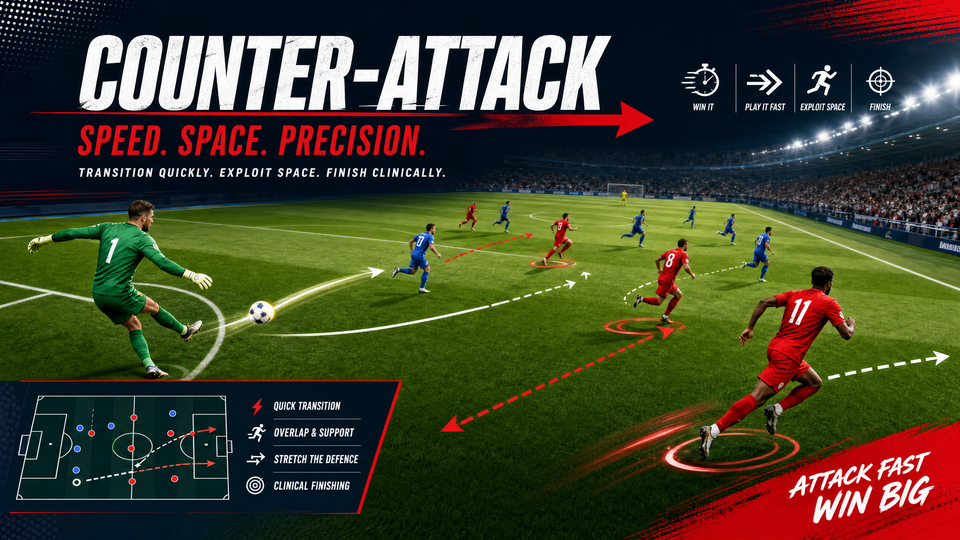
In modern football, matches are frequently won or lost during the transition phases. The Lightning Transition: 11v11 Counter-Attack Masterclass is designed to train your team to recognize the moment possession is regained and immediately exploit the disorganized opponent. This drill focuses on direct forward passing, rapid support runs, and clinical finishing before the defensive team can establish their shape. Use this drill when preparing to face a team that commits numbers forward or dominates possession, allowing you to hit them on the break.
2. Setup
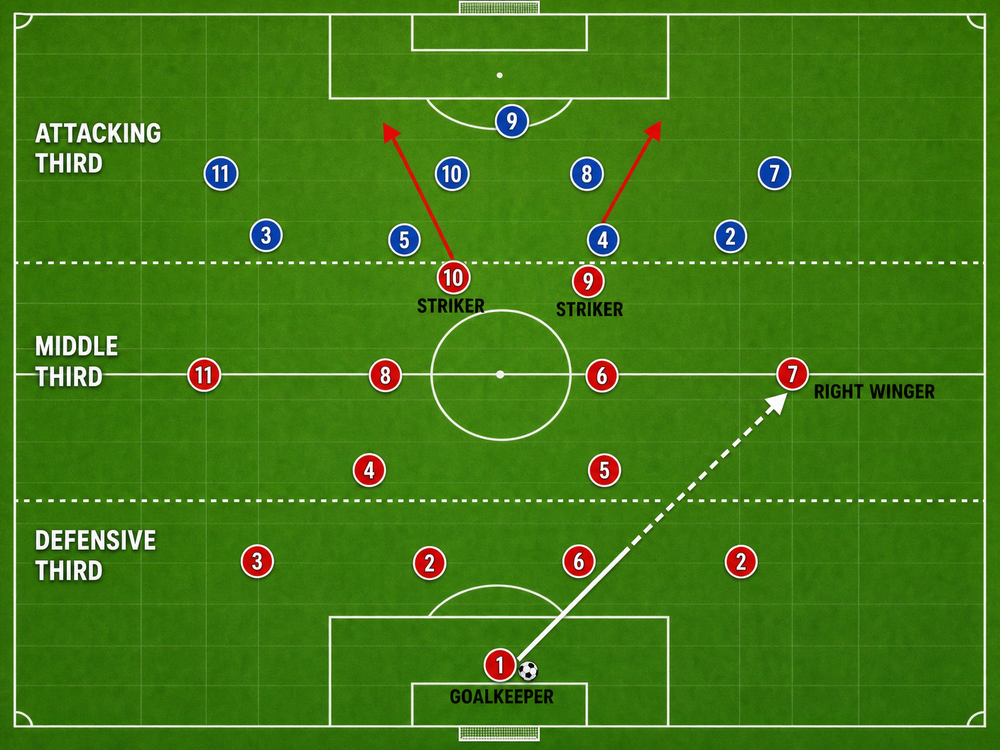
- Pitch Dimensions: Full pitch (100-110m x 64-75m) to ensure realistic physical demands and spatial awareness.
- Players Required: 22 players (11v11 format). Can be adapted to 9v9 if numbers are lower.
- Equipment: Full size goals, minimum 10 footballs (placed in the goals and around the pitch for quick restarts), bibs for two teams (e.g., Red vs Blue), flat markers or cones to divide the pitch into thirds if necessary for visual reference.
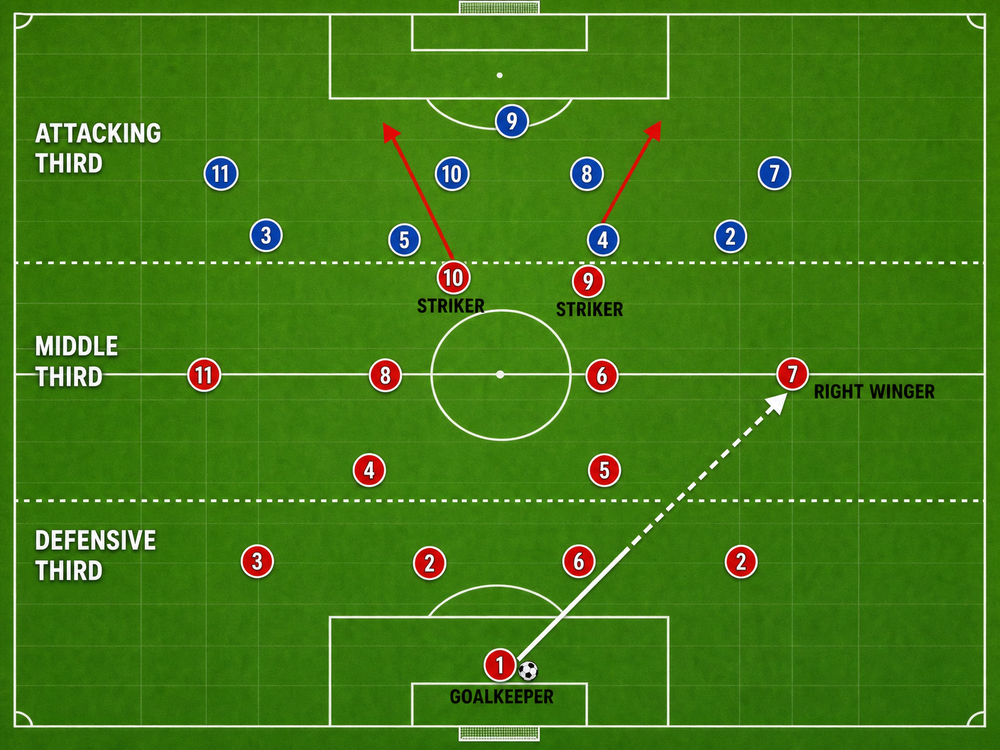
- Starting Positions: Set the attacking team (Red) in a mid-to-low block formation (e.g., 4-4-2 or 4-2-3-1). The defending team (Blue) starts high up the pitch in an attacking shape, simulating a sustained period of possession in the Red team's defensive third.
3. Step-by-Step Instructions
- The Trigger: The drill begins with the Red team's Goalkeeper (1) in possession, simulating a claim from a cross or a quick save.
- Initial Distribution: The Goalkeeper must immediately look to distribute the ball quickly, ideally via a long, driven throw or a precise kicked pass to the widest available outlet. In this scenario, the target is the Right Winger (7) positioned near the halfway line.
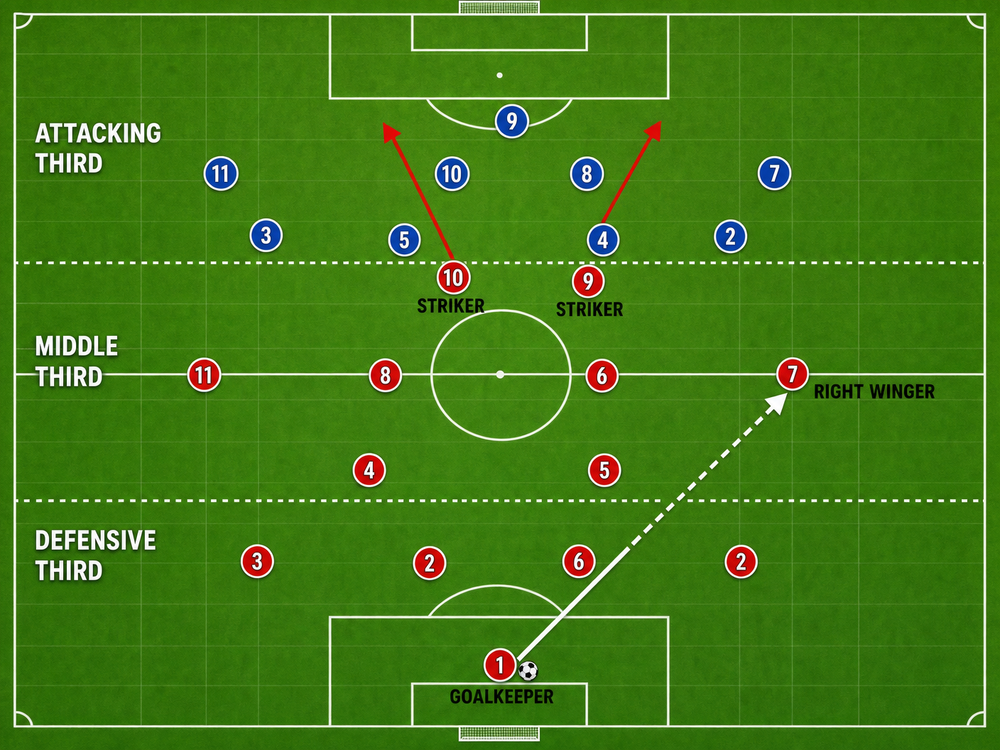
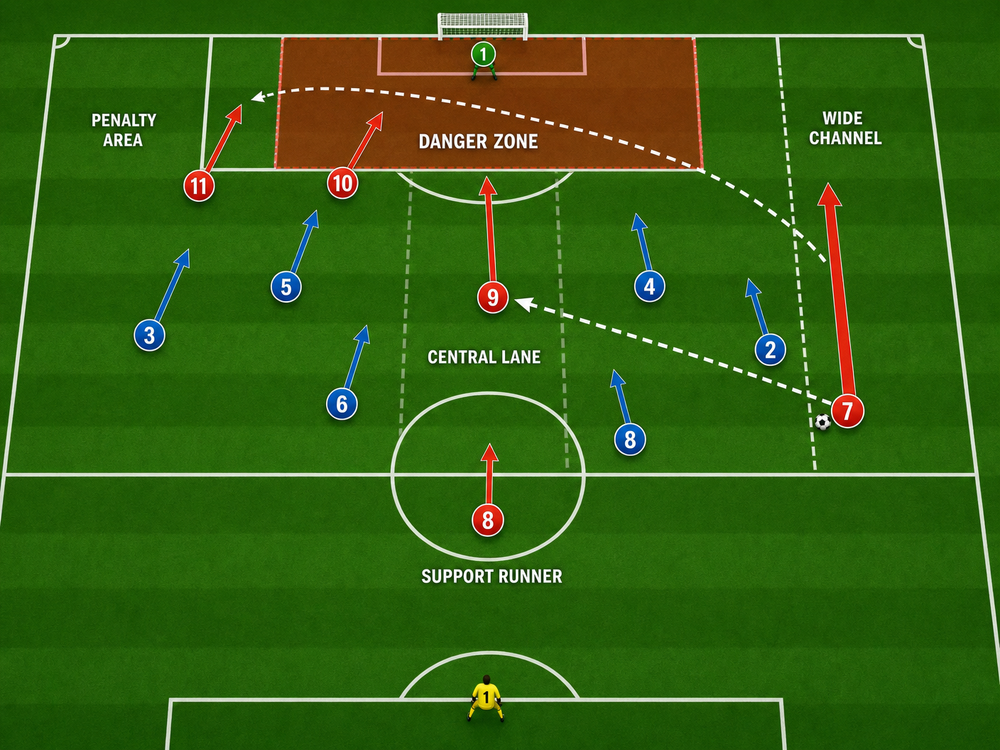
- The Breakout: As the Right Winger (7) receives the ball, the entire Red team must shift their mindset from defense to attack instantly. The Winger should look to drive forward aggressively into the space behind the Blue team's high defensive line.
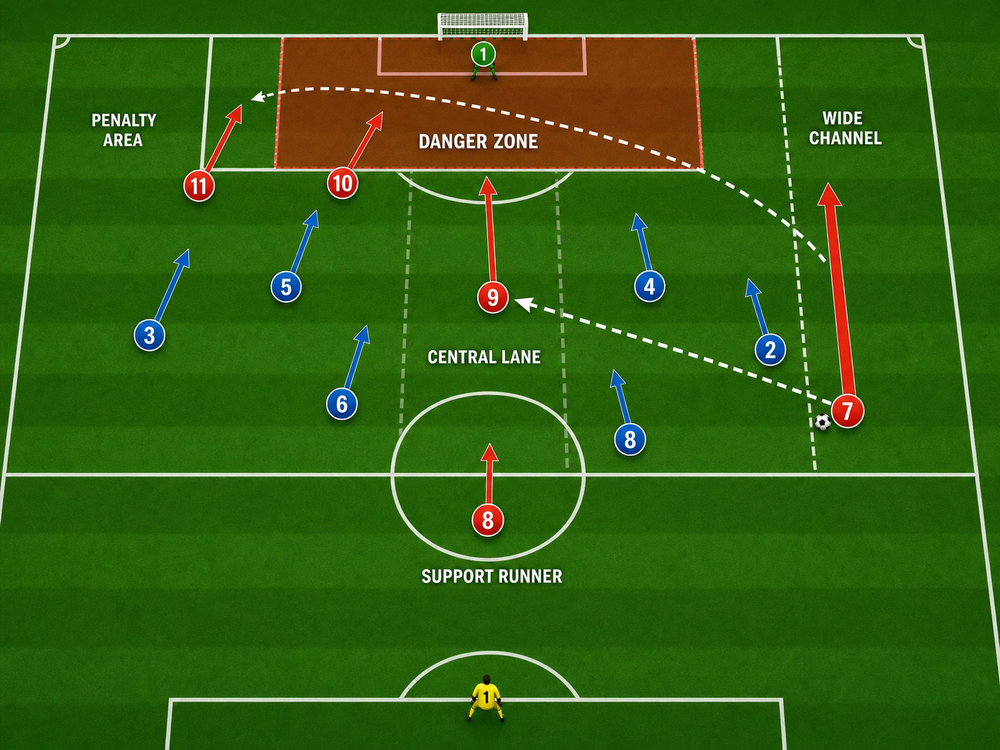
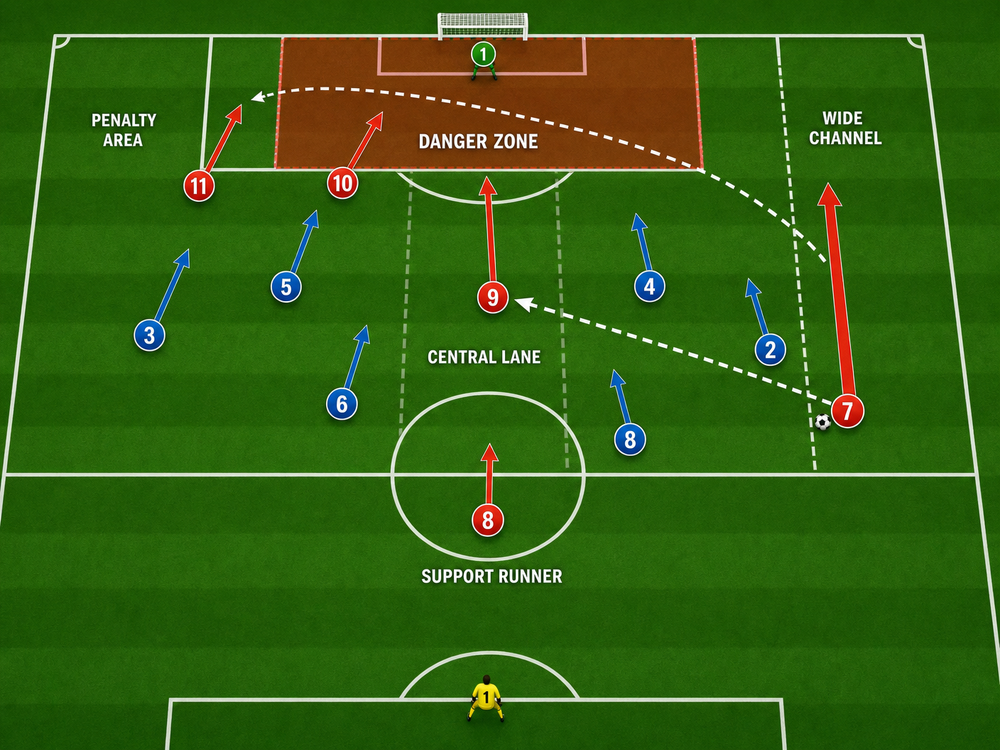
- Support Runs: Simultaneously, the central Strikers (9 and 10) must make explosive, diagonal runs into the channels or directly toward the penalty area to offer passing options and stretch the retreating defenders. The Left Winger (11) sprints to attack the far post.
- The Execution: The ball carrier (7) assesses the situation: if the space is open, drive toward the goal; if closed down, look for the cutback or cross to the arriving runners (9, 10, or 11) in the 'Danger Zone'.
- The Finish: The attacking sequence must conclude with a shot on goal within 10-12 seconds of the Goalkeeper's initial distribution.
- Reset: If the Blue team wins the ball back, they have 8 seconds to try and score against the unorganized Red team. If the ball goes out of play or a goal is scored, reset to the starting positions.
4. Key Coaching Points
- First Look Forward: The first thought upon winning the ball must be "Can we play forward?" Encourage players to look for the furthest advanced teammate.
- Speed of Thought and Action: The transition must be explosive. Hesitation allows the defense to recover. Passes should be firm and to the advantage of the runner.
- Width and Depth: As soon as possession is secured, players must sprint to provide maximum width and depth, forcing the retreating defenders to cover more ground.
- Commitment to the Box: Attackers must flood the penalty area with varied runs (near post, far post, penalty spot) to overwhelm the recovering defense.
- Rest Defense: Even while counter-attacking, the deeper midfielders and defenders must maintain a shape that prevents a counter-counter-attack if the ball is lost.
5. Common Mistakes
- Taking Too Many Touches: Players often slow the attack down by taking unnecessary touches instead of playing first-time or driving into space.
- Lack of Support: The ball carrier is left isolated because teammates fail to make the required 40-50 yard sprint to join the attack.
- Poor Decision Making in the Final Third: Rushing the final pass or shot instead of assessing the best option (e.g., shooting from a tight angle when a cutback is available).
- Predictable Runs: Strikers running in straight lines, making it easy for recovering defenders to track them. Diagonal, intersecting runs are essential.
6. Variations & Progressions
- Time Limit: Reduce the time allowed to score from 12 seconds to 8 seconds to increase urgency and speed of play.
- Conditioned Starts: Instead of the Goalkeeper starting, begin the drill with a specific turnover scenario, such as an interception by a central midfielder or a clearance from a center-back.
- Overload Transition: Start the drill with an overload for the defending team (e.g., 8v6 in the defensive third) to make winning the ball harder, simulating a high-pressure defensive block.
7. Age Adaptations
- Under 10 - Under 12: Reduce pitch size to half-pitch or use a smaller format (7v7 or 9v9). Focus primarily on the concept of playing forward quickly rather than complex tactical shapes. Allow more time to finish the attack.
- Under 14 - Under 16: Introduce full-pitch dimensions but perhaps remove the strict time limit initially. Focus on the quality of the first pass and the specific types of runs made by the forwards.
- Open/Senior: Implement strict time limits, require high-intensity sprints, and focus heavily on the 'rest defense' structure while the attack is progressing.
