

Football
Mastering the Back-Four Offside Trap
Teach your defensive line the crucial timing, communication, and coordination required to execute a flawless offside trap.
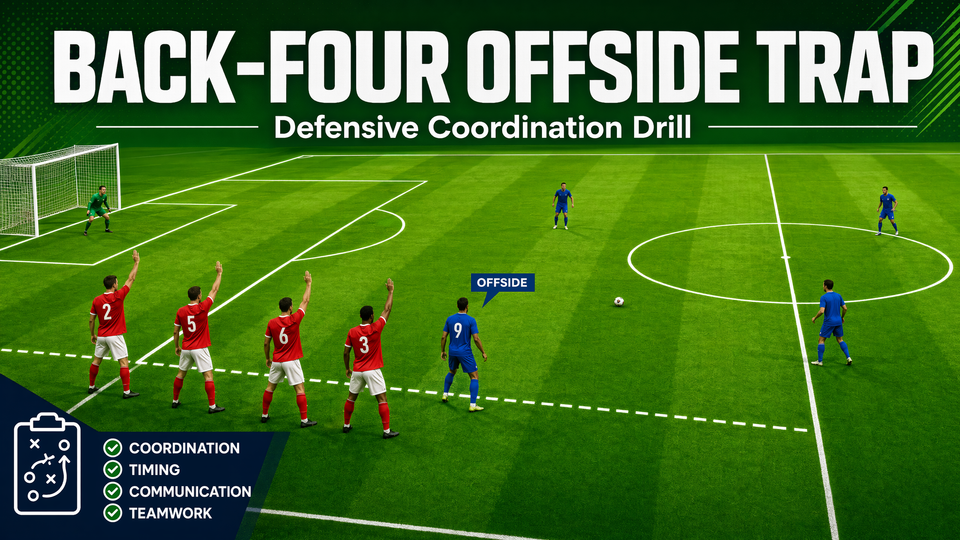
What you need
10-12 cones, 4-6 training bibs, full-size goal, multiple footballs
1. Overview
The offside trap is an advanced defensive tactic that requires immense coordination, communication, and timing from the back four. When executed correctly, it neutralizes the opponent's attacking threat by catching their forwards offside just as the ball is played. This drill focuses on building the necessary chemistry among your defenders (Right Back, Centre Backs, and Left Back) to step up in unison. It teaches them to read the body language of the opposing ball carrier, recognize the trigger to step up, and quickly recover if the trap fails.
This resource is designed to help coaches of intermediate to advanced teams implement the offside trap safely and effectively, minimizing the risk of defensive breakdowns.
2. Setup
Pitch Dimensions: 100-110m x 64-75m (Full Pitch width, using one half of the pitch).
Equipment Needed: 10-12 cones, 4-6 training bibs (two different colours), full-size goal, multiple footballs.
Players Required: Minimum 9 players (4 Defenders, 1 Defensive Midfielder, 3 Attackers, 1 Goalkeeper).
Player Positions:
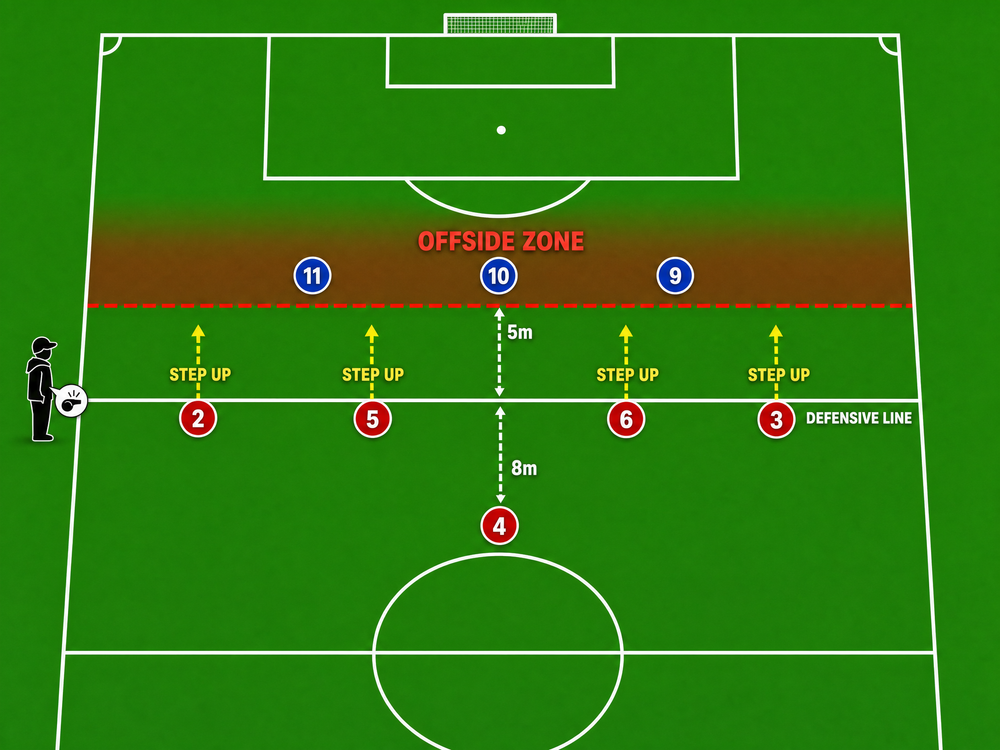
- Defenders (Red): 2 (Right Back), 5 (Centre Back), 6 (Centre Back), 3 (Left Back) positioned in a flat line roughly 35 metres from goal.
- Defensive Midfielder (Red): 4 positioned about 8 metres ahead of the defensive line.
- Attackers (Blue): 9 (Striker), 10 (Attacking Midfielder), 11 (Winger) positioned 5-10 metres ahead of the defensive line.
- Goalkeeper (Yellow): Positioned at the edge of the penalty area, ready to sweep.
3. Step-by-Step Instructions
- Initial Positioning: Set up the back four in a perfectly flat line. The defensive midfielder (4) starts with the ball near the centre circle, passing it among the attackers (9, 10, 11).
- Reading the Trigger: The attackers pass the ball laterally. The defenders must maintain their line, shifting side-to-side with the ball. The "trigger" occurs when an attacker puts their head down and draws their leg back to play a penetrating pass.
- The Call: The designated leader of the back four (usually one of the Centre Backs, 5 or 6) shouts a clear, concise command like "STEP!" or "UP!".
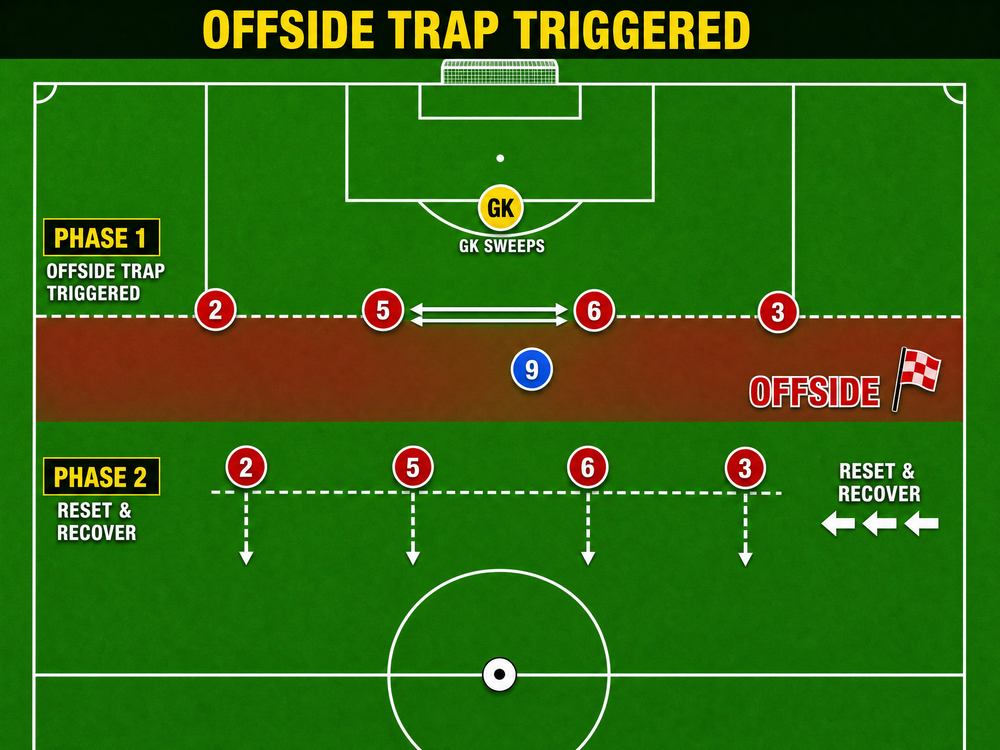
- Executing the Trap: Immediately upon hearing the call, all four defenders sprint forward 2-3 aggressive steps in unison, leaving the attackers stranded in an offside position just before the ball is kicked.
- The Sweeper Keeper: The Goalkeeper must be positioned high (edge of the box) to sweep up any balls played over the top if the trap fails or the pass is delayed.
- Recovery Phase: If the trap is triggered but the ball is not played (a fake pass), the defenders must immediately recognize this, communicate ("DROP!"), and quickly retreat to establish a deeper defensive line to prevent being beaten by a subsequent run.
4. Key Coaching Points
- Designate a Leader: One Centre Back must take charge. The line moves on their command. There cannot be hesitation or conflicting calls.
- Body Shape: Defenders must keep their bodies open, able to see both the ball carrier and the attacking runners. They should be on their toes, ready to sprint forward or backward.
- Identify the Trigger: Teach players to read the visual cues of the passer—head down, arm out for balance, leg cocked back. This is the exact moment to step up.
- The Goalkeeper's Role: The offside trap is a high-risk strategy. The Goalkeeper must act as a sweeper, starting high up the pitch to intercept long balls if the trap is beaten.
- Instant Recovery: The trap won't always work. Players must react instantly to a failed trap by dropping deep at full speed to protect the goal.
5. Common Mistakes
- The Straggler: One defender (often a full-back) keeps a deeper position than the rest of the line, playing the attackers onside. This is the most common and fatal error.
- Late Stepping: Stepping up after the ball has already been played. The attackers will not be offside, and the defenders will be caught moving in the wrong direction.
- Lack of Communication: Silence in the backline leads to disjointed movements. The call to step up must be loud and authoritative.
- Goalkeeper Rooted to the Line: If the Goalkeeper stays on their goal line, any ball played through a failed trap will result in a 1v1 with the striker.
6. Variations & Progressions
- Progression 1: Add Wide Play. Introduce wingers for the attacking team and have them attempt diagonal runs behind the full-backs. The back four must adjust their line and trap timing based on crosses and wide passes.
- Progression 2: Live Scrimmage. Move from a controlled drill to an 8v8 or 11v11 game situation. Award double points to the attacking team if they score from a through ball, forcing the defense to actively practice the trap under pressure.
- Variation 1: The "Drop and Hold". Instead of stepping up to catch the attacker offside, practice dropping the line deep as the ball is prepared to be played, then holding the line at the edge of the penalty area to force the play wide.
7. Age Adaptations
- Under 12s: Focus primarily on keeping a straight line and shifting together laterally. Introduce the concept of stepping up on command, but do not rely on it as a primary match tactic.
- Under 14s: Begin teaching the specific visual triggers (head down, leg back). Emphasize the communication aspect and the role of the lead Centre Back.
- Under 16s & Open: Implement the full trap at match speed. Focus heavily on the recovery phase and the integration of the Sweeper Keeper.
