Rugby
Drill
intermediate
Mastering the Offload: Contact and Continuity Drill
Equip your players with the technical skills and decision-making ability to keep the ball alive through contact and break defensive lines.
Jul 4, 20265 min read20 min drill6 players

Equipment Needed
4-6 Rugby balls
8 marker cones
Tackle shields (optional)
Overview
The ability to keep the ball alive through contact is a hallmark of modern, dynamic rugby. This drill focuses on the "Offloading in Contact" technique, teaching players how to manipulate defenders, fight through the tackle, and deliver a sympathetic pass to a supporting runner. It is designed to develop both the ball carrier's physical dominance and technical passing skills, alongside the support runner's timing and communication. This drill is highly effective for breaking down organized defenses and creating line breaks.
Setup
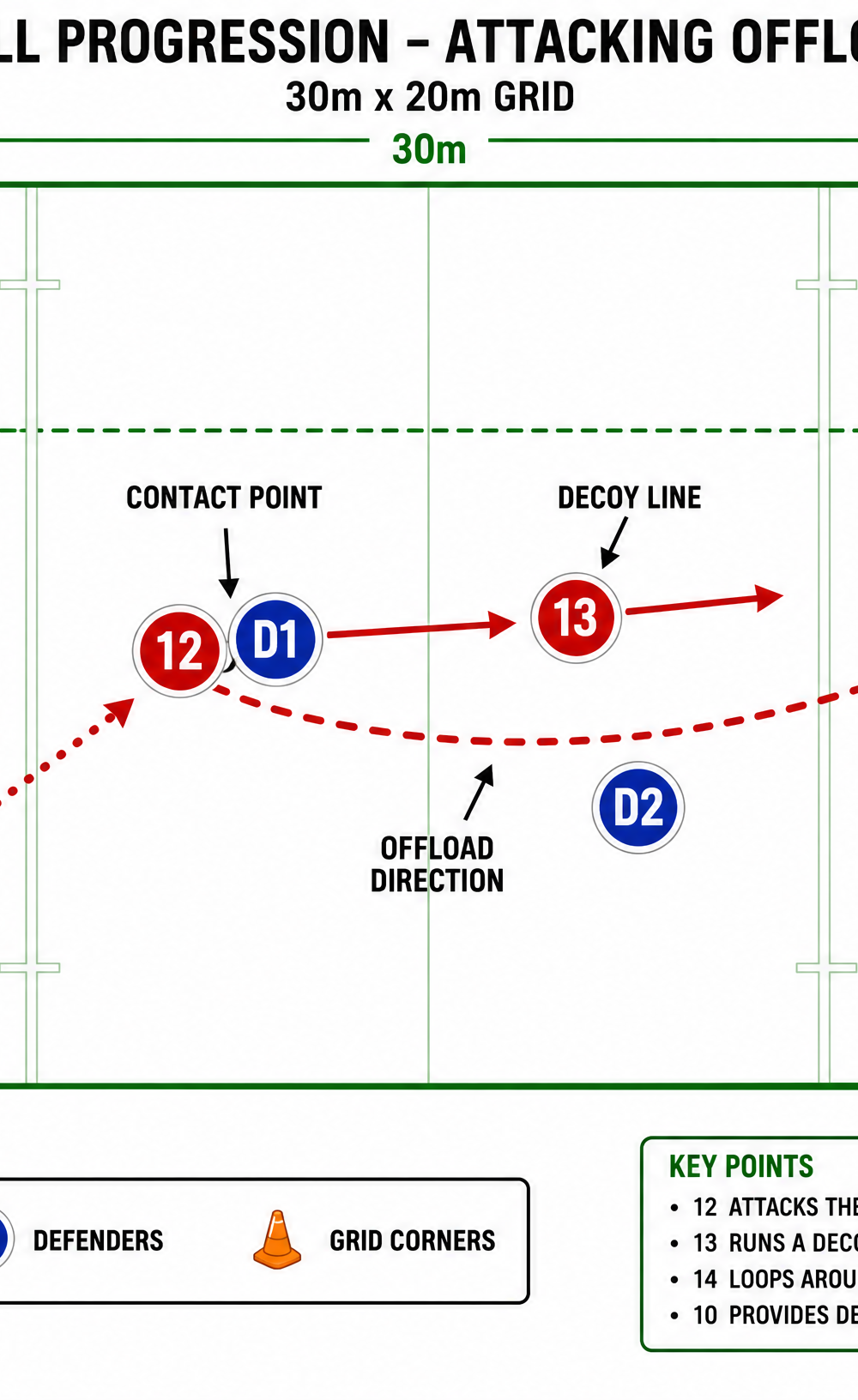
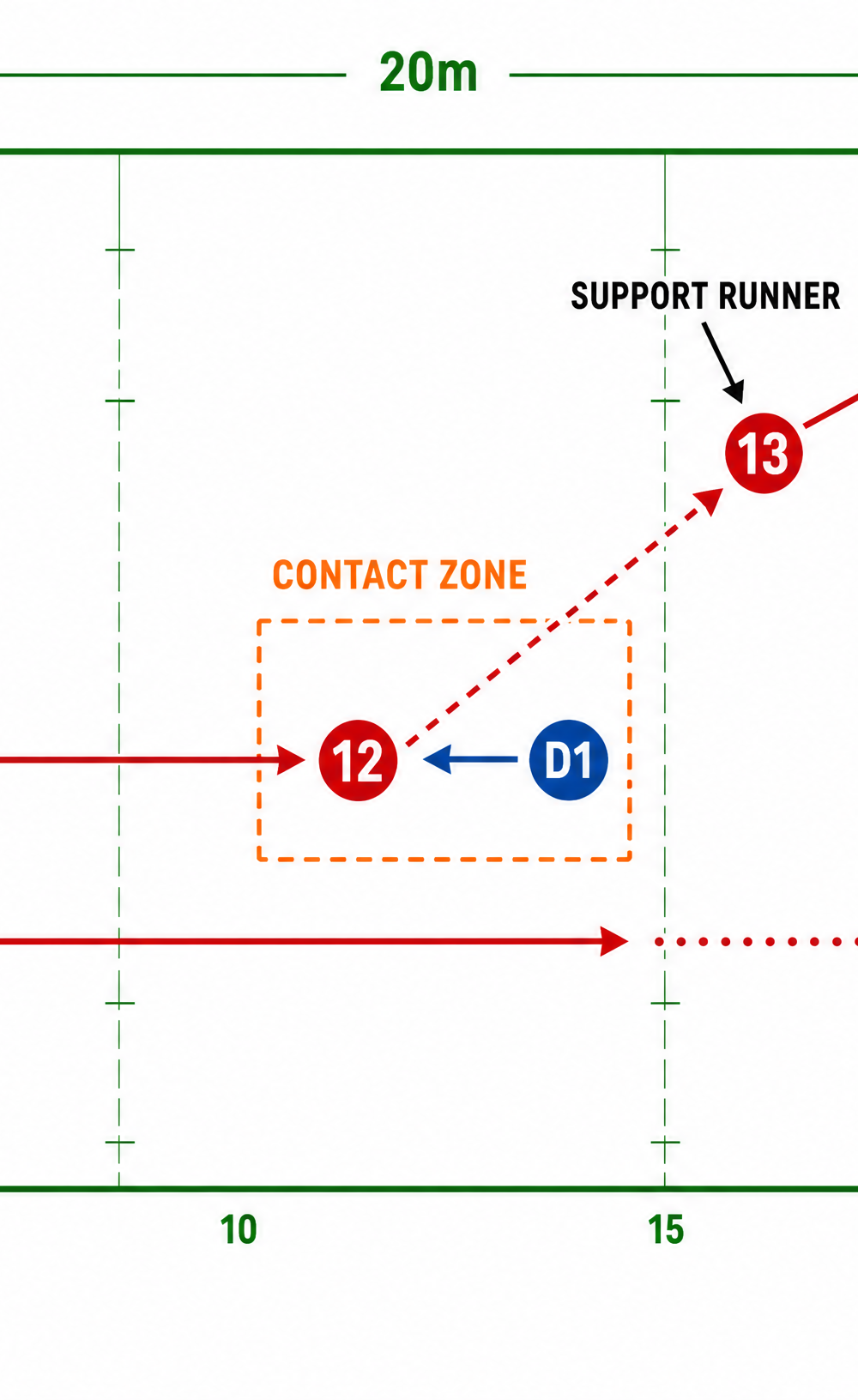
- Pitch Area: Create a 20m x 15m grid using cones. For progressions, expand to a 30m x 20m grid.
- Equipment: 4-6 Rugby balls, 8 marker cones, tackle shields (optional for early progressions).
- Players: Minimum of 6 players (3 attackers, 1 defender, 2 waiting to rotate in). Optimal group size is 8-10 to maintain high intensity and allow for rest.
- Starting Positions: Attackers line up on one end of the 20m grid. The defender starts 10m away, inside the designated contact zone.
Step-by-Step Instructions

- The Approach: The drill begins with the primary ball carrier (e.g., 12) receiving a pass from a stationary halfback position. The carrier must accelerate towards the defender (D1), aiming to attack the defender's outside shoulder to create an initial advantage.
- The Contact: As the carrier approaches D1, they must drop their body height and brace for impact. The goal is to stay on their feet and drive through the tackle, using strong leg drive.
- Ball Presentation (Pre-Offload): Crucially, the carrier must keep the ball secure, ideally in two hands, but shift it away from the defender's primary point of contact. If the defender hits the left shoulder, the ball should be protected on the right side.
- The Support Line: Simultaneously, the support runner (e.g., 13) must time their run. They should not overrun the carrier. They need to communicate clearly (e.g., calling "Left!" or "Right!") and run a hard line, typically at a 45-degree angle off the carrier's hip, anticipating the offload.
- The Offload: Once the carrier has absorbed the initial impact and freed their arms, they execute the offload. This should be a controlled, "sympathetic" pass—often a one-handed pop or a backhand flick—directly into the path of the support runner.
- The Finish: The support runner catches the ball at pace and accelerates through the remaining grid to score. The players then rotate positions.
Key Coaching Points
- Win the Collision First: Players must understand that a successful offload is earned by dominating the initial contact. If they are driven backward, the offload is too risky.
- Free the Arms: The ball carrier must actively fight to keep their arms free during the tackle. This requires core strength and the ability to fend or twist away from the defender's wrap.
- Eye Contact and Communication: The carrier must look for the support runner before releasing the ball. Blind offloads often result in turnovers. The support runner must be vocal.
- Sympathetic Passing: The offload is not a bullet pass. It should "hang" slightly for the support runner to run onto. A soft touch is essential.
- Timing is Everything: The support runner must hold their depth until the contact is made. If they arrive too early, they will overrun the pass; too late, and the carrier will be taken to ground.
Common Mistakes
- Forcing the Offload: Players often try to offload when they have lost the collision or are securely wrapped up, leading to knock-ons or interceptions.
- Poor Ball Security: Carrying the ball loosely into contact makes it easy for the defender to dislodge it before the offload can happen.
- Flat Support Lines: Support runners who run completely flat (parallel to the carrier) are easily covered by drifting defenders and struggle to adjust to the offload.
- Looking at the Defender: The ball carrier focuses solely on the defender they are hitting, failing to scan for their support options.
Variations & Progressions
- Progression 1: Introduce Tackle Shields: Start with the defender holding a tackle shield to allow the attackers to focus on technique and arm freedom without the fear of a full tackle.
- Progression 2: Live Defender (1v1 + 1): Remove the shield and allow a full, live tackle. The defender must try to wrap the ball and prevent the offload.
- Progression 3: Add a Second Defender (2v2 + 1): Expand the grid to 30m x 20m. Introduce a second defender and a second support runner (e.g., a decoy or a wide option). This forces the ball carrier to make a decision: take the tackle and offload, or pass early if the defense commits.
Age Adaptations
- Under 8 - Under 10: Focus heavily on two-handed carries and basic evasion. Use touch or tag rugby rules instead of full contact. The "offload" can be a simple pop pass after a tag is made.
- Under 12 - Under 14: Introduce tackle shields and controlled contact. Emphasize body height and ball security. Begin teaching the one-handed pop pass.
- Under 16 - Open: Full contact variations. Focus on complex decision-making (when to offload vs. when to go to ground) and advanced handling skills (backhand offloads, out-the-back passes) under pressure.