

Basketball
The 'Middle-Release' Press Break: Defeating Full-Court Man Pressure
A reliable, structured press break designed to relieve pressure by attacking the middle of the floor, creating high-percentage scoring opportunities in transition.
What you need
1 Basketball, Full Court, 10 Players (5 Offense, 5 Defense)
1. Overview
Full-court man-to-man pressure is designed to force turnovers, speed up your offense, and create chaos. The 'Middle-Release' press break counters this by establishing clear spacing, utilizing misdirection, and prioritizing the middle of the floor as the primary release valve.
By drawing defenders to the sidelines and then flashing a player hard to the middle, this set play creates a highly advantageous numbers situation once the ball crosses half-court. It is best utilized against aggressive, trapping man-to-man defenses, but its structured spacing makes it adaptable against zone presses as well.
2. Setup
Equipment Needed:
- 1 Basketball
- Full FIBA regulation court (28m x 15m)
- 10 Players (5 Offensive, 5 Defensive)
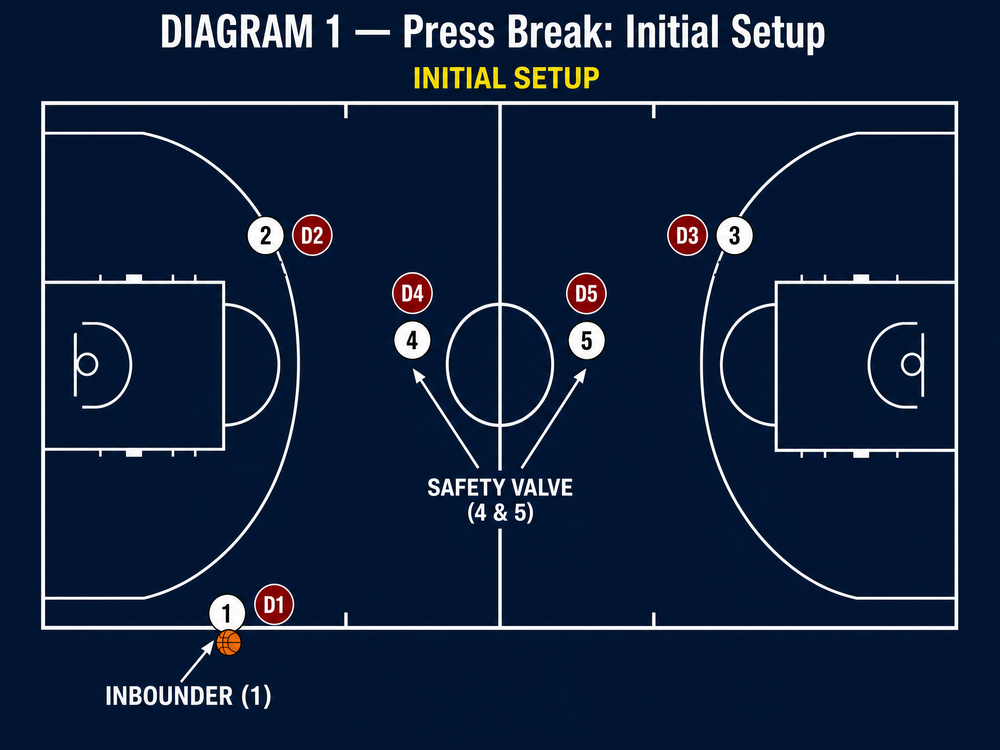
Player Positions:
- Player 1 (Point Guard): Starts out of bounds as the inbounder.
- Player 2 (Shooting Guard): Starts on the left sideline, free-throw line extended (~6m from the baseline).
- Player 3 (Small Forward): Starts on the right sideline, free-throw line extended (~6m from the baseline).
- Player 4 (Power Forward): Starts near the half-court line on the left side, acting as a safety valve.
- Player 5 (Center): Starts near the half-court line on the right side, acting as a secondary safety valve and deep threat.
3. Step-by-Step Instructions
Phase 1: The Initial Action
- As the referee hands the ball to Player 1, Player 2 and Player 3 execute hard V-cuts to get open along their respective sidelines.
- Player 4 and Player 5 maintain their spacing near half-court, keeping their defenders away from the primary inbound area.
Phase 2: The First Pass & Middle Release
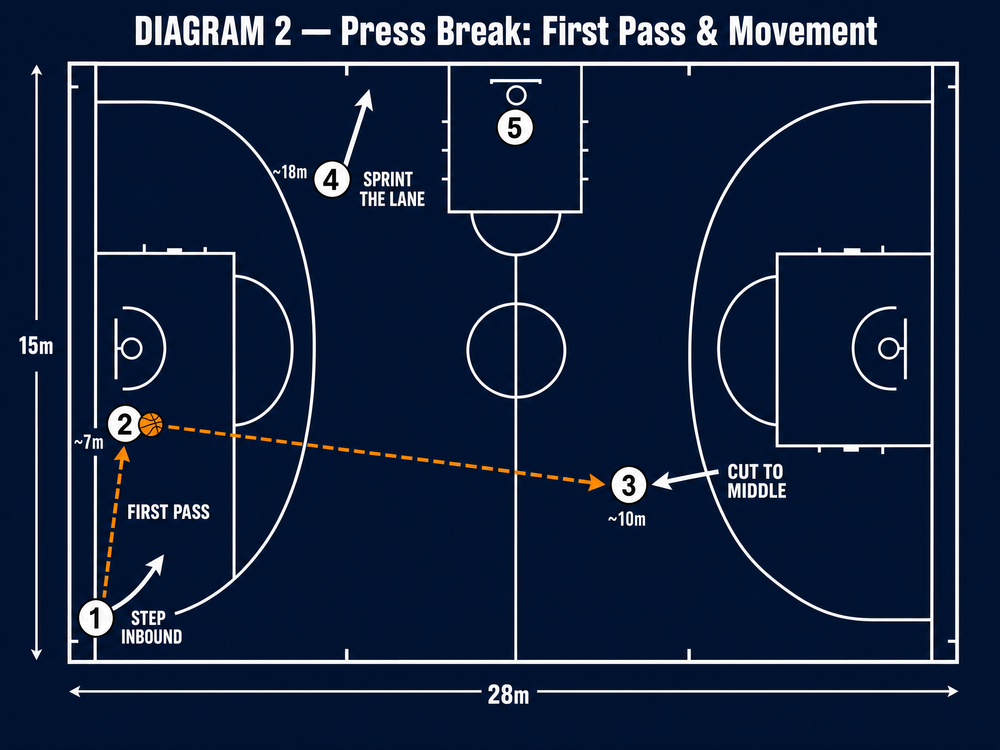
3. Player 1 makes a strong, crisp pass to Player 2 on the left sideline.
4. Immediately after releasing the pass, Player 1 steps inbounds to provide a backward release option.
5. As the ball travels to Player 2, Player 3 (on the opposite sideline) sprints diagonally toward the middle of the court, aiming to receive the ball around the top of the defensive key (~10m from the baseline).
6. Player 4 sprints hard up the left lane line toward the offensive basket.
Phase 3: The Attack
7. Player 2 pivots and looks to the middle, delivering a firm pass to the flashing Player 3.
8. Upon receiving the ball, Player 3 immediately turns to face the offensive basket. The press is now broken.
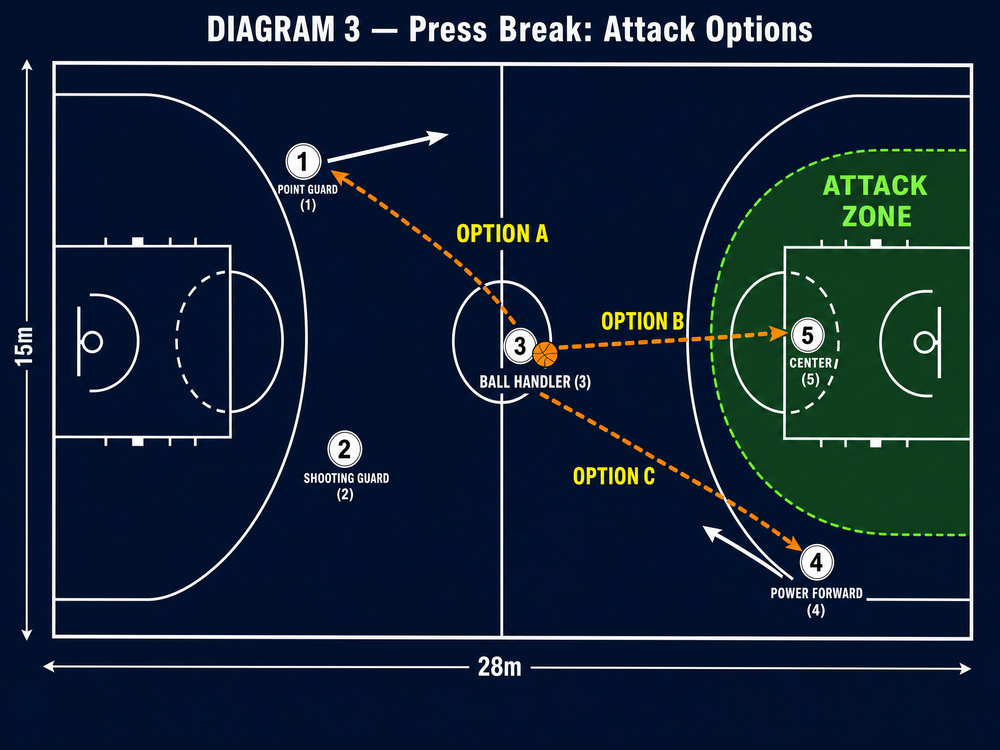
9. Player 3 evaluates the floor and has three primary attack options:
- Option A: Pass ahead to Player 1, who is sprinting up the left wing.
- Option B: Pass to Player 5, who has established deep post position.
- Option C: Pass to Player 4, who is filling the left corner.
- If no immediate scoring opportunity presents itself, Player 3 pulls the ball out to set up the half-court offense.
4. Key Coaching Points
- Meet the Pass: The receivers (Player 2 and Player 3) must aggressively step toward the ball. Waiting for the ball allows defenders to deflect or intercept the pass.
- See the Floor: Player 2 must catch the ball, immediately pivot, and look up the floor. They should never put the ball on the floor (dribble) immediately after catching it against a press.
- The Middle is Gold: The middle of the floor is the most dangerous area for a pressing defense. Player 3 must cut hard and demand the ball in this space.
- Maintain Spacing: Players 4 and 5 must stay high initially. If they creep too close to the baseline, they bring their defenders into the passing lanes, suffocating the inbounder.
- Attack Mentality: Once the ball reaches the middle (Player 3), the mindset must shift from 'breaking the press' to 'scoring in transition.'
5. Common Mistakes
- Panicking on the Inbound: The inbounder (Player 1) rushes the pass instead of waiting for the play to develop. Remind them they have 5 seconds.
- Dribbling into Traps: Player 2 catches the inbound pass and immediately dribbles toward the sideline or corner, walking directly into a defensive trap.
- Weak Cuts: Players jog through their cuts instead of sprinting. This allows defenders to easily deny the passing lanes.
- Looking Down: Players catch the ball and look at the floor rather than surveying the court for the next pass.
6. Variations & Progressions
- Progression 1: Add a Dribble Hand-Off (DHO). If Player 2 is heavily pressured upon receiving the inbound pass, Player 1 can step inbounds and execute a quick DHO to relieve pressure and change the angle of attack.
- Progression 2: The Deep Throw. If the defense aggressively overplays the middle cut by Player 3, Player 5 can release deep toward the offensive basket for a long, over-the-top pass from Player 2.
- Variation 1: 4-Across Setup. Instead of a 2-up, 2-down setup, start all four receivers across the free-throw line extended. This forces the defense to make immediate decisions on who to guard and opens up the backcourt.
7. Age Adaptations
- Under 10 / Under 12: Focus heavily on the fundamentals of pivoting and passing under pressure. Reduce the distance of the passes. Emphasize that dribbling is the last resort.
- Under 14 / Under 16: Introduce the concept of reading the defense. Teach Player 2 to recognize whether the defense is trapping or playing straight man-to-man, and adjust the speed of the middle pass accordingly.
- Open / Advanced: Incorporate false action before the inbound. Have players set screens for each other before breaking to their spots to further confuse the defense.
