

Rugby
The 'Mirror & Spring' Lineout Steal: Disrupting the Opposition Throw
Master the timing, positioning, and explosive lifting required to steal opposition lineout ball and launch a devastating counter-attack.

What you need
Rugby balls, Cones for marking the 5m and 15m lines, Tackle shields (optional, for post-steal breakdown practice)
1. Overview
Securing your own lineout ball is essential, but stealing the opposition's throw is a momentum-shifting play that demoralizes the attacking team and provides your backline with unstructured transition ball. The 'Mirror & Spring' lineout steal is designed to read the opposition hooker's cues, match their jumper's movement, and use explosive, coordinated lifting to beat them to the apex of the throw. This set play is most effective when defending inside your own half or when the opposition is heavily reliant on a primary jumper.
2. Setup
Pitch Location: Defending an opposition lineout anywhere on the pitch, typically between your own 22m and the halfway line.
Personnel: A full 7-man lineout.
Key Roles:
- The Steal Jumper (4 or 5): Must be agile, have excellent timing, and possess strong hands.
- The Lifters (1, 3, or 6): Require explosive leg drive and strict discipline to wait for the trigger.
- The Defensive Captain (usually 2 or 8): Responsible for calling the defensive read and identifying the target jumper.
3. Step-by-Step Instructions
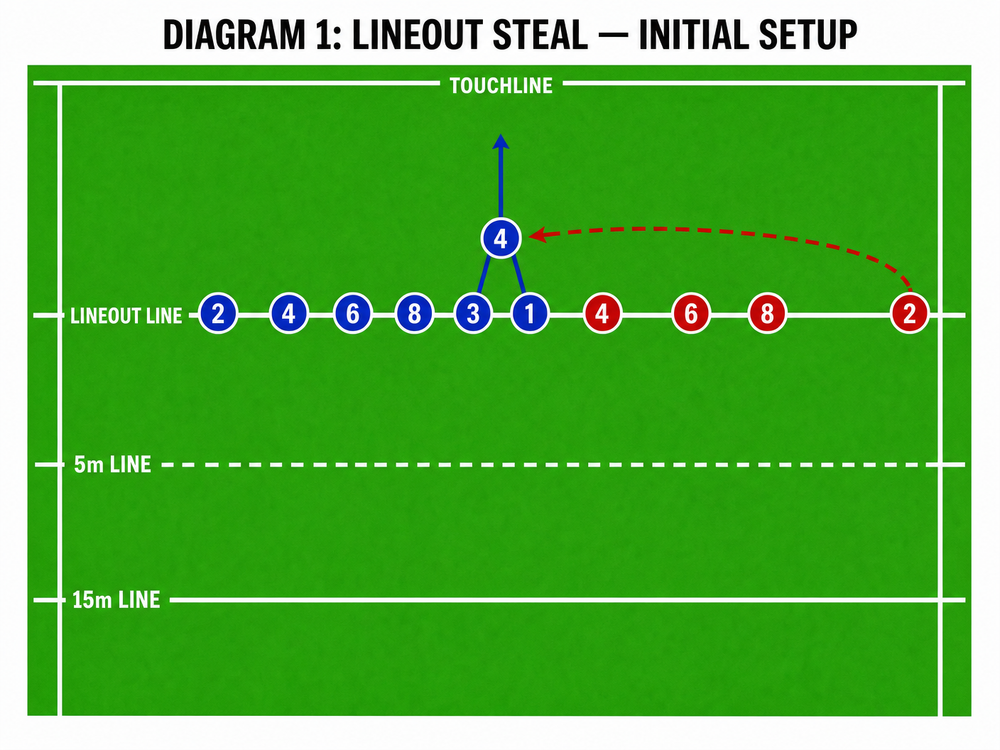
- The Mirror Phase: As the opposition forms their lineout, the defensive captain identifies their primary jumper. The steal jumper aligns themselves directly opposite the target, ensuring the lifters are tightly bound on either side.
- The Read: The defensive pod watches the opposition hooker, not just the jumper. The trigger for the lift is the hooker's throwing motion (the 'cocking' of the ball behind the head), not the movement of the opposition jumper.
- The Spring: The moment the hooker initiates the throw, the steal jumper dips and explodes upward. The lifters simultaneously drive through their legs, extending fully to push the jumper as high as possible, penetrating the space across the lineout line.
- The Steal: The jumper extends their inside arm (the arm closest to the thrower) to intercept the ball at its highest point, aiming to tap it back to the scrum-half or secure it cleanly with two hands.
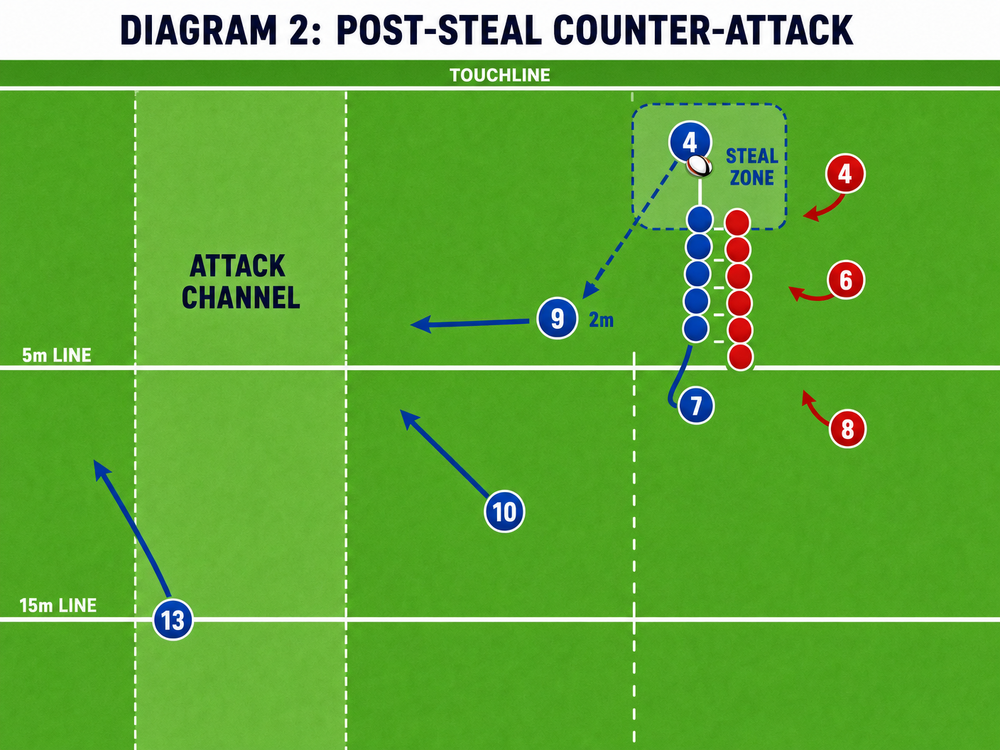
- The Counter-Attack: Upon securing the ball, the scrum-half (9) immediately shifts it away from the congested forward pack to the fly-half (10), exploiting the disorganized opposition defense.
4. Key Coaching Points
- Watch the Hooker, Not the Jumper: The most common mistake is reacting to the opposition jumper's dummy movement. The hooker dictates the timing of the throw; read their body language.
- Explosive, Synchronized Lifting: The lift must be a coordinated, dynamic movement. Lifters must get low, establish a strong base, and drive through their hips and knees simultaneously.
- Penetrate the Space: The steal jumper shouldn't just jump straight up; they need to aggressively close the gap and attack the ball's trajectory across the line of touch.
- Inside Arm Dominance: Reaching with the inside arm provides greater extension and protects the ball from the opposition jumper's contest.
- Immediate Transition: The forwards must instantly transition from lineout defense to attack support or breakdown security the moment the ball is won.
5. Common Mistakes
- Biting on Dummies: Lifters reacting to the opposition jumper's pre-jump movement, leaving them flat-footed when the actual throw occurs.
- Slow Lift Speed: A sluggish lift allows the attacking team to win the race to the apex, even if the read was correct.
- Poor Jumper Body Position: The jumper leaning backward or failing to stay tight in the core, resulting in a weak contest in the air.
- Ignoring the Counter-Attack: Winning the ball but failing to capitalize on the disorganized opposition defense due to slow distribution from the scrum-half.
6. Variations & Progressions
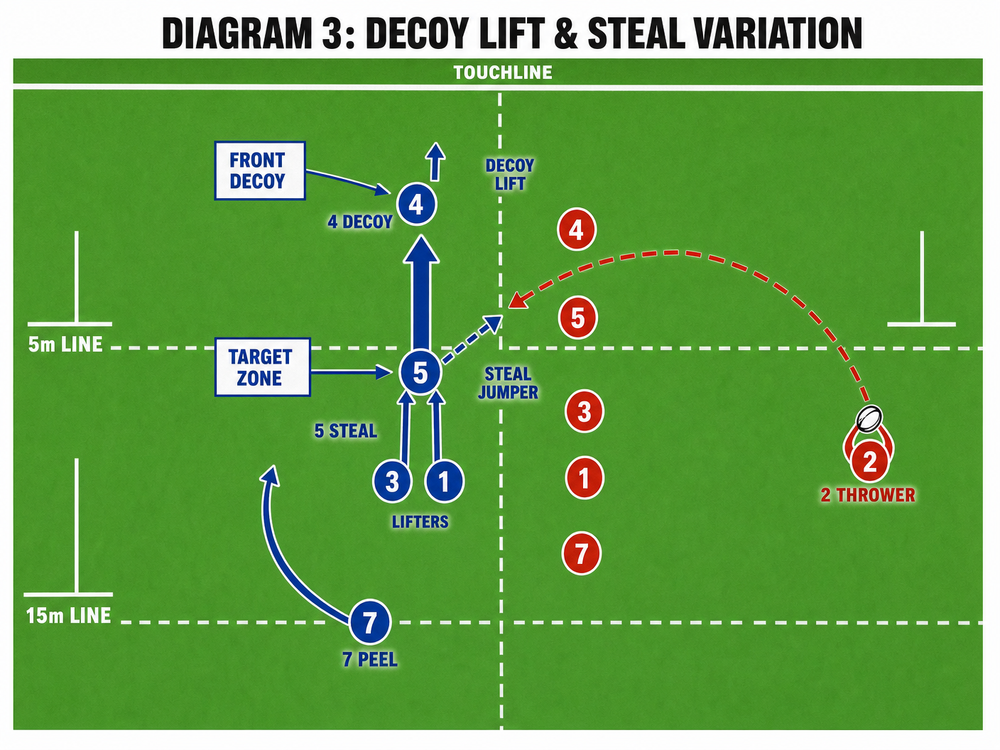
- The Decoy Lift: Have a secondary pod at the front of the lineout perform a dummy lift a split second before the actual throw to distract the opposition hooker and lifters.
- The Sack: If the steal is unsuccessful and the opposition secures the ball, the lifters immediately transition into a coordinated drive to 'sack' the jumper as soon as their feet touch the ground, preventing a driving maul.
7. Age Adaptations
- Under 12s/14s: Focus entirely on reading the hooker and the timing of the jump without lifting (if lifting is not permitted in your jurisdiction). Emphasize catching the ball at the highest point.
- Under 16s: Introduce the mechanics of the lift, prioritizing safety, core stability, and synchronized movement over maximum height.
- Open/Senior: Focus on the explosive speed of the lift, reading complex opposition dummy movements, and the immediate transition into counter-attack structures.
