

Basketball
Motion Offense Continuity Play: The Ultimate Guide for Coaches
Master the Motion Offense Continuity Play to create endless scoring opportunities, maintain offensive flow, and keep the defense constantly guessing.
What you need
1 Basketball, Half-court (FIBA standard)
1. Overview
The Motion Offense Continuity Play is a dynamic, continuous offensive system designed to create high-percentage scoring opportunities through constant player movement, precise passing, and strategic screening. Unlike static set plays that end if the primary option is denied, a continuity offense seamlessly resets and flows into the next phase of the attack. This play is particularly effective against man-to-man defenses, as it forces defenders to navigate through multiple screens and make split-second decisions, ultimately leading to defensive breakdowns and open looks. By implementing this system, coaches can ensure their team maintains offensive rhythm, shares the ball effectively, and creates advantages all over the court.
2. Setup
Equipment Needed:
- 1 Basketball
- Half-court (FIBA standard: 28m x 15m)
- 5 offensive players (and optionally 5 defensive players for live drills)
Court Setup & Player Positions:
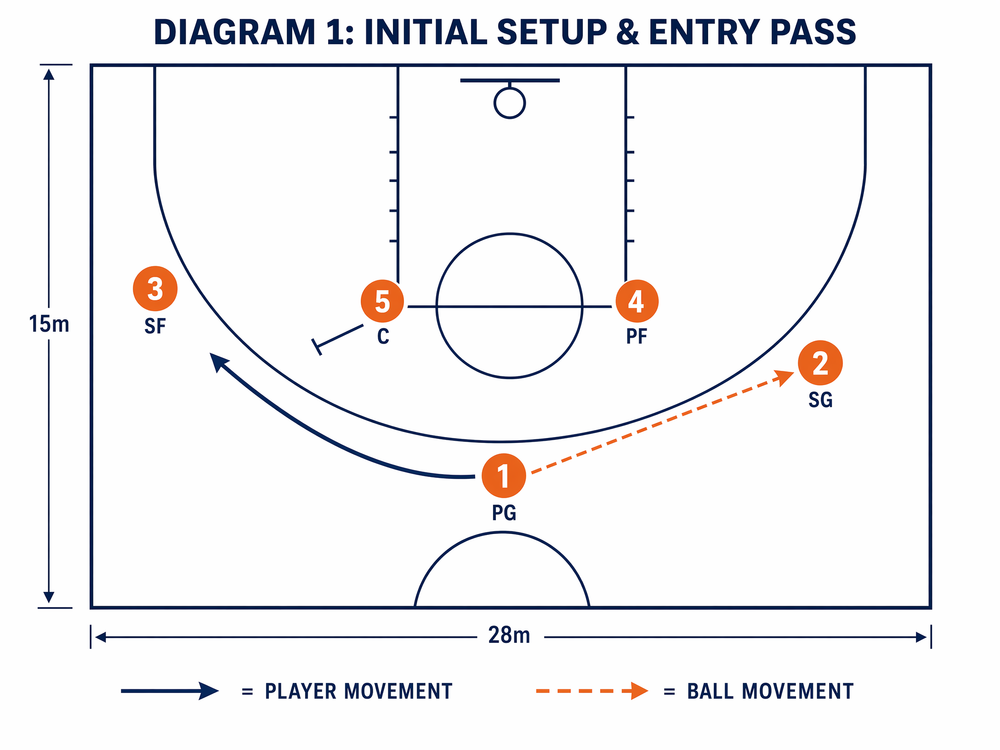
- 1 (Point Guard): Starts at the top of the key, initiating the offense.
- 2 (Shooting Guard): Positioned at the right wing, ready to receive the entry pass.
- 3 (Small Forward): Positioned at the left wing, providing floor spacing.
- 4 (Power Forward): Positioned at the right elbow/high post.
- 5 (Center): Positioned at the left elbow/high post.
This initial 3-out, 2-in alignment provides excellent spacing and opens up the middle of the floor for cutting and screening action.
3. Step-by-Step Instructions
Phase 1: The Entry Pass and Cut
- Initiate the Offense: The Point Guard (1) brings the ball up the court and signals the play.
- Entry Pass: Player 1 makes a crisp, accurate entry pass to the Shooting Guard (2) on the right wing.
- Pass and Cut: Immediately after passing, Player 1 makes a hard, decisive cut toward the basket, looking for a quick give-and-go return pass from Player 2. If the pass is not available, Player 1 continues their cut and clears out to the left corner.
- High Post Setup: Simultaneously, the Center (5) moves slightly to establish a strong screening position near the left elbow, preparing for the next action.
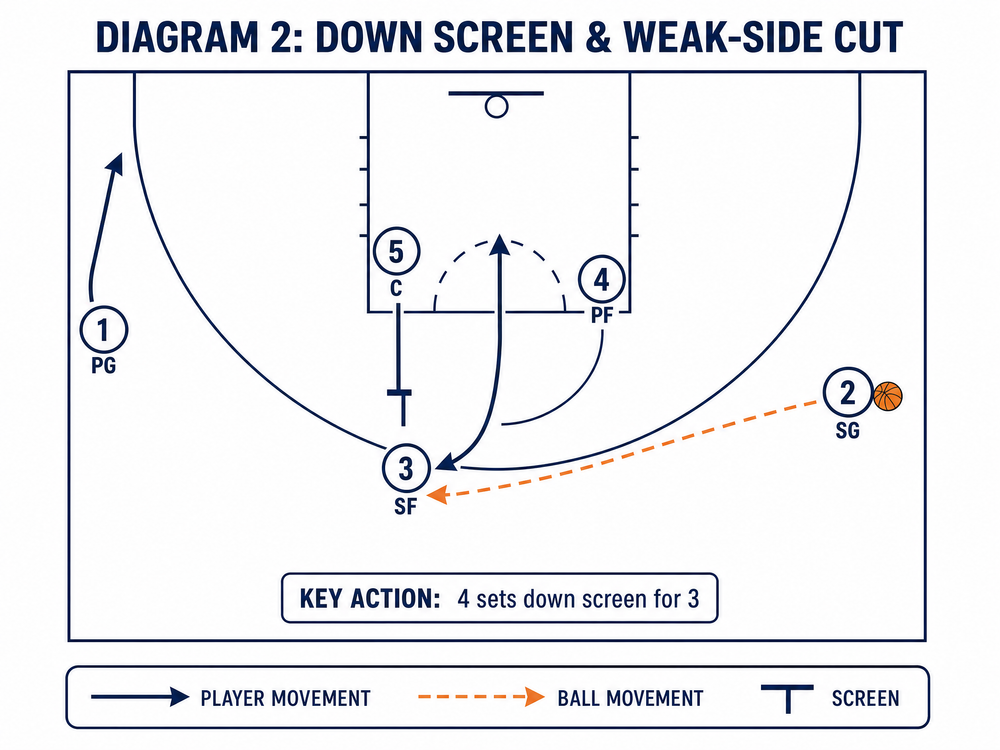
Phase 2: Down Screen and Weak-Side Cut
- Setting the Screen: As Player 1 clears to the corner, the Power Forward (4) moves down from the right elbow to set a solid down screen for the Small Forward (3) on the left wing.
- Using the Screen: Player 3 reads their defender, sets them up with a subtle jab step, and curls tightly off Player 4's down screen, cutting aggressively toward the top of the key.
- The Reversal Pass: Player 2, reading the action, delivers a timely pass to Player 3 as they arrive at the top of the key.
- Post Re-alignment: After the pass is made, Player 5 steps up to the high post area, while Player 4 seals their defender on the low block after setting the screen.
Phase 3: Continuity Reset and Scoring Options
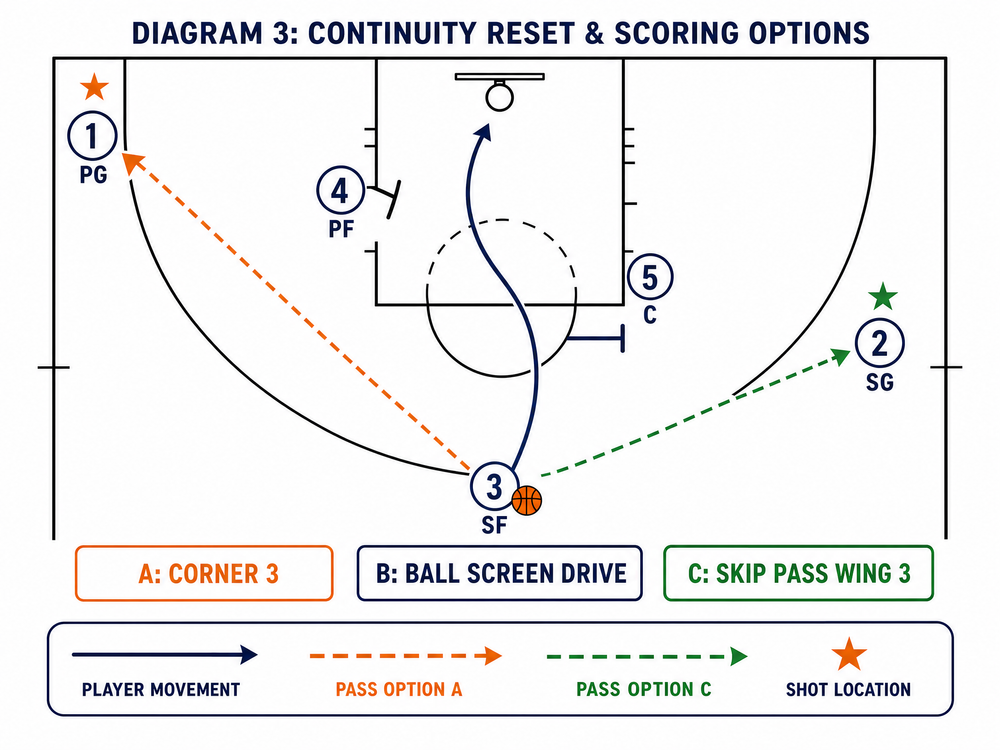
- Assess the Options: Player 3 now has the ball at the top of the key, and the offense has essentially reset, mirroring the initial setup but with players in different positions. Player 3 must immediately read the defense and choose the best scoring option.
- Option A (Corner 3): If the defense sags or over-helps, Player 3 can kick the ball out to Player 1 in the left corner for an open three-point shot.
- Option B (Ball Screen Drive): Player 5 can step out and set a high ball screen for Player 3. Player 3 uses the screen to drive hard into the paint, looking to finish at the rim or draw a foul.
- Option C (Skip Pass Wing 3): If the defense collapses on the drive or overplays the strong side, Player 3 can fire a skip pass across the court to Player 2 on the right wing for a catch-and-shoot three-pointer.
- Continuity: If none of these options result in a shot, Player 3 can pass to Player 1 or Player 2 to initiate the entry pass and cut sequence again, seamlessly continuing the motion offense.
4. Key Coaching Points
- Spacing is Critical: Maintain proper spacing (12-15 feet between perimeter players) to stretch the defense and open up cutting lanes. Poor spacing clogs the offense and makes it easy to defend.
- Patience and Timing: Do not rush the screens or cuts. Wait for the screener to be set before cutting, and ensure the passer delivers the ball on time and on target.
- Read the Defense: Players must be taught to read how the defense is playing the screens. If the defender trails, curl tightly. If the defender goes under, flare out for a shot.
- Hard Cuts: Every cut must be executed at game speed. A slow, lazy cut will not force the defense to react or create an advantage.
- Communication: Players must communicate verbally and non-verbally, calling out screens and signaling for the ball.
5. Common Mistakes
- Standing and Watching: Players often pass the ball and then stand still. Emphasize that the pass is the trigger for movement; passing must immediately be followed by a cut or a screen.
- Slipping Screens Too Early: Screeners sometimes slip the screen before making solid contact, rendering the action ineffective. Ensure the screener holds their position until the cutter has passed.
- Telegraphing Passes: Staring down the intended receiver allows the defense to anticipate and intercept the pass. Teach players to use ball fakes and look away before passing.
- Ignoring the Post: Teams often get caught up in perimeter passing and forget to look inside. Always check the post players (4 and 5) after a screen or cut to see if they have sealed their defender for an easy entry pass.
6. Variations & Progressions
- Dribble Entry: Instead of a pass to the wing to initiate the offense, the Point Guard can use a dribble entry (dribble at the wing), forcing the wing player to back-cut to the basket, initiating a different sequence of movements.
- Flare Screens: Incorporate flare screens on the weak side to counter defenses that aggressively deny the reversal pass to the top of the key.
- Post Isolation: If a post player has a favorable mismatch, run the continuity to isolate them on the block, clearing out the strong side to give them room to operate.
7. Age Adaptations
- Under 10/12: Focus heavily on the fundamental skills: passing, catching, and basic cutting (pass and cut). Simplify the offense by removing the complex down screens and focusing purely on 5-out motion with simple give-and-go actions.
- Under 14/16: Introduce the screening actions (down screens and away screens). Teach players how to set proper screens, read the defense, and make the correct cut (curl, flare, straight cut). Emphasize spacing and timing.
- Open/Advanced: Run the full continuity offense with all options, variations, and reads. Incorporate ball screens, dribble hand-offs, and complex weak-side actions. Demand high-level execution, precise timing, and quick decision-making.
