

Netball
Double Lead to Quick Feed: Centre Pass Set Play
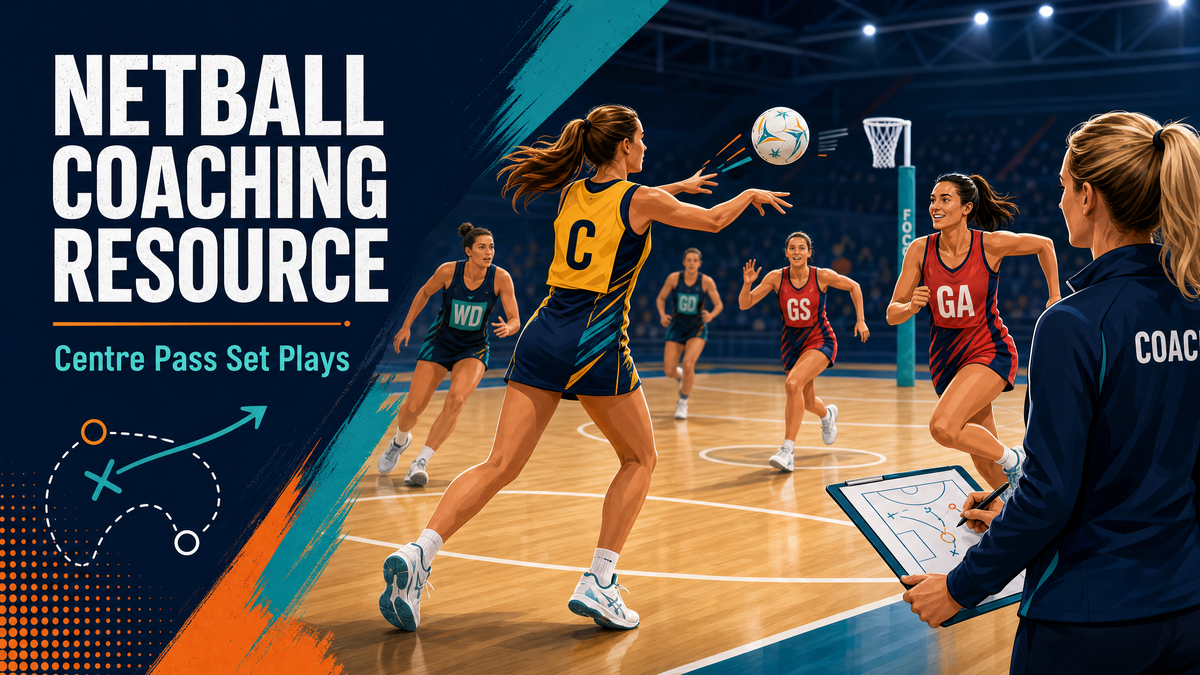
Master a high-tempo centre pass set play designed to bypass midcourt defence and deliver the ball to the shooters in under five seconds.
What you need
1 Netball, Positional Bibs, Full Court
Overview
The "Double Lead to Quick Feed" is an aggressive, high-tempo centre pass set play designed to bypass the opposition's midcourt defence and deliver the ball directly into the goal circle in three quick passes. This play is highly effective when your team needs a quick goal, or when the opposition's Wing Defence (WD) and Goal Defence (GD) are playing a tight, restrictive marking style. By utilising a coordinated double lead, the attacking team forces the defenders to make a split-second decision, opening up a clear passing lane for the primary receiver.
This set play aims to shift the ball from the centre circle to the goal shooter in under five seconds, maintaining attacking momentum and catching the defensive unit off-guard before they can set up their zone or structured defensive wall.
Setup
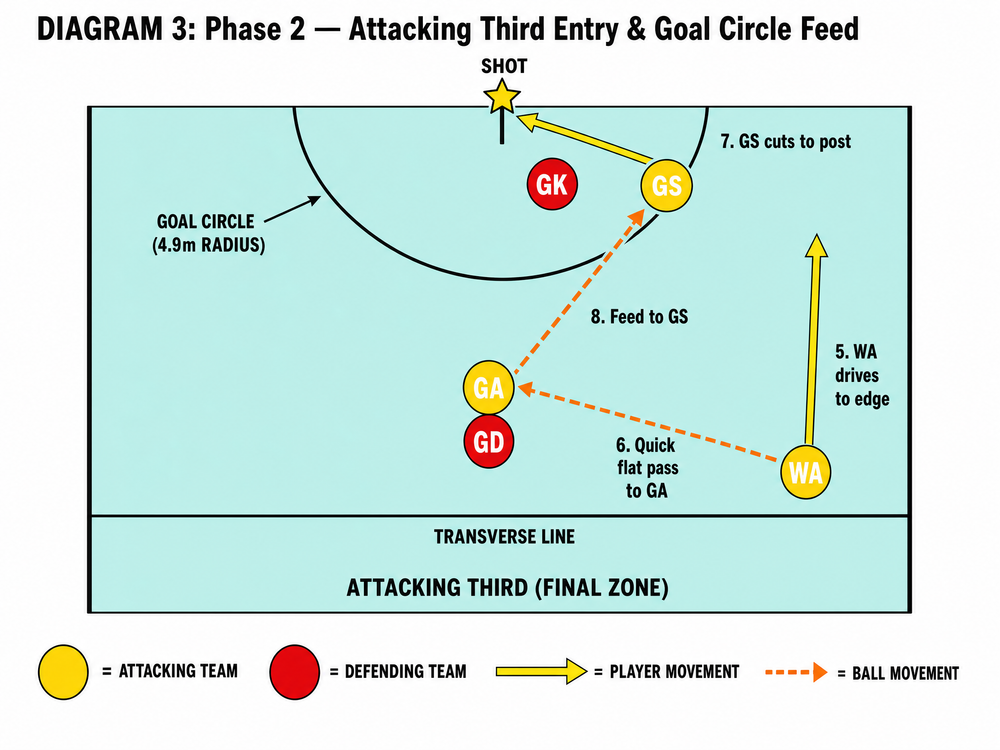
- Equipment: 1 Netball, full court markings (30.5m x 15.25m), positional bibs.
- Court Setup: Full court.
- Player Positions:
- Centre (C): Standing fully within the centre circle (0.9m radius), facing the attacking goal end.
- Wing Attack (WA): Positioned on the right side of the centre third, approximately 1-2 metres back from the transverse line.
- Goal Attack (GA): Positioned on the left side of the centre third, slightly wider than the WA, also 1-2 metres back from the transverse line.
- Goal Shooter (GS): Positioned inside the goal circle (4.9m radius), holding position against the Goal Keeper (GK) near the baseline.
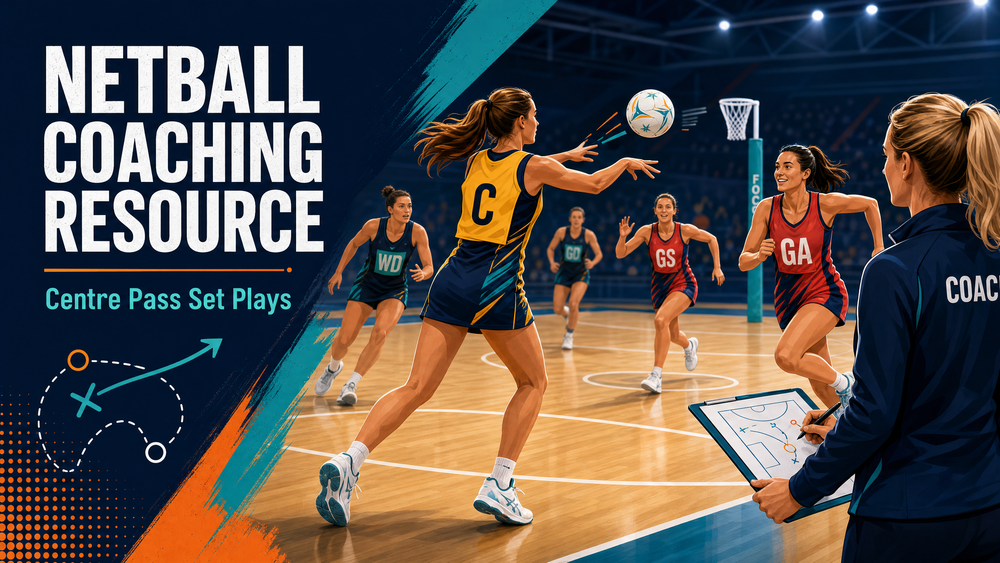
Step-by-Step Instructions
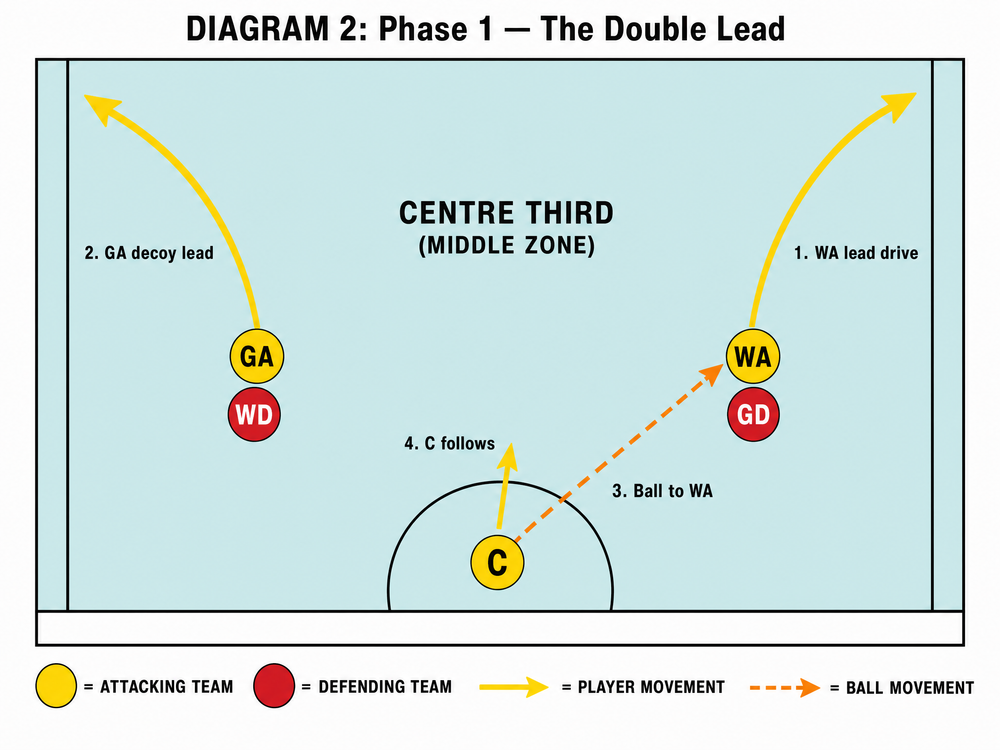
- The Setup and Stance: The Centre (C) steps into the centre circle. The Wing Attack (WA) and Goal Attack (GA) must be stationary, holding their starting positions on the transverse line. They should be in an athletic stance, ready to explode off the mark.
- The Whistle: As the umpire blows the whistle for the centre pass, the play initiates immediately.
- The Double Lead (Phase 1):
- The GA executes a hard, convincing decoy drive diagonally towards the top-left corner of the centre third. The goal is to draw the Goal Defence (GD) away from the central channel.
- Simultaneously, the WA executes a sharp, explosive diagonal lead drive towards the top-right corner of the centre third, aiming to hit the top of the circle edge.
- The Centre Pass: The C steps forward and delivers a strong, flat, and fast chest pass or shoulder pass to the driving WA. The pass must be placed in front of the WA, allowing them to take the ball on the run without breaking stride.
- The Follow Up: After releasing the pass, the C immediately drives forward to offer a short, secondary passing option, but their primary role is to clear the space for the next phase.
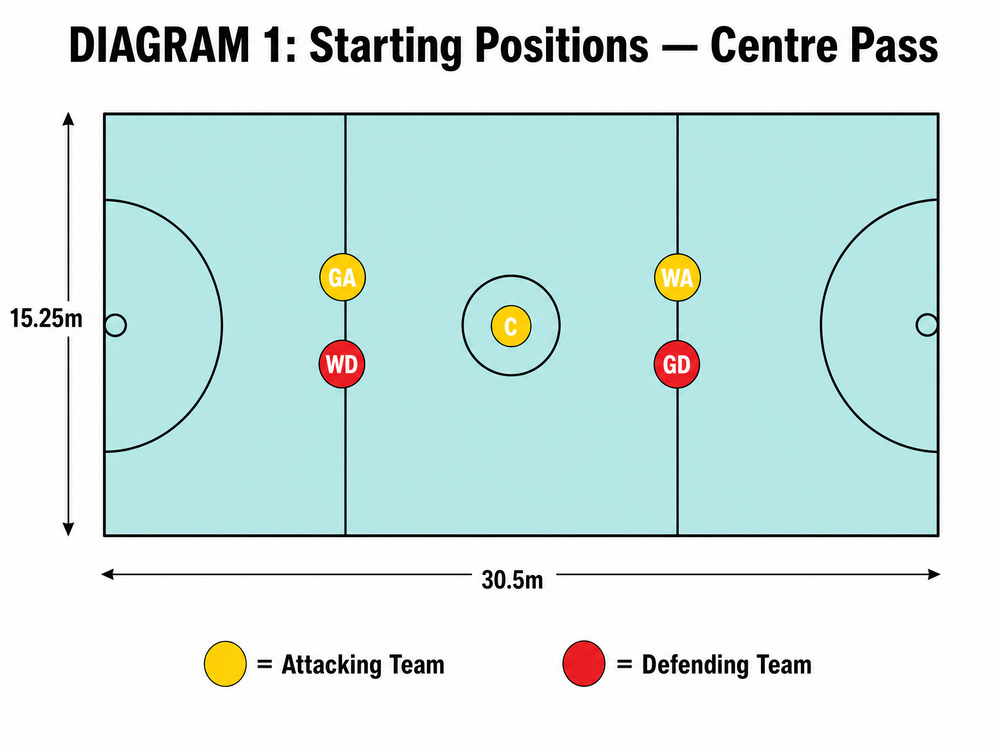
- Attacking Third Entry (Phase 2): Upon receiving the ball, the WA lands cleanly (preferably on one foot to maintain momentum) near the top right edge of the goal circle.
- The Re-Offer: The GA, having completed their decoy run, immediately changes direction and cuts hard towards the top centre of the goal circle to offer a secondary passing option.
- The Quick Feed: The WA quickly assesses the circle. If the GS has established a strong holding position or has made a clear cut to the post, the WA delivers a quick, flat feed directly to the GS.
- The Alternative: If the GS is heavily marked, the WA executes a quick flat pass to the driving GA, who can then either shoot or feed the GS from a better angle.
- The Shot: The GS (or GA) receives the ball in a strong shooting position and takes the shot.
Key Coaching Points
- Timing is Everything: The GA and WA must initiate their drives at the exact moment the umpire's whistle sounds. If they go too early, they risk a breaking call; if they go too late, the defenders will easily intercept.
- Convincing Decoy: The GA's decoy run must be run at 100% intensity. If the GA jogs or looks disinterested, the GD will simply drop off and clog the space for the WA.
- Pass Placement: The Centre must pass the ball into the space where the WA is running, not directly at their body. This allows the WA to maintain their speed and attacking momentum.
- Strong Holds: The GS must work hard off the ball to establish a strong physical hold against the GK, ensuring they have a clear space to receive the final feed.
- Vision and Decision Making: The WA must have their head up as they receive the centre pass, scanning the goal circle immediately to decide whether to feed the GS or use the GA.
Common Mistakes
- Breaking Early: Players moving across the transverse line before the whistle is blown.
- Weak Decoy Runs: The GA not committing to the decoy run, allowing the defence to double-team the WA.
- Lofted Passes: The Centre throwing a high, loopy pass instead of a flat, fast pass, giving the defence time to recover and intercept.
- Crowding the Circle Edge: Both the WA and GA ending up in the exact same space on the circle edge, making it easy for the defence to shut down the play.
Variations & Progressions
- The Switch: Instead of the WA being the primary receiver, run the exact same play but mirror the roles. The WA runs the decoy, and the GA makes the primary lead drive to receive the centre pass.
- The Screen: Introduce a screen. The GA sets a screen on the WA's defender (WD) just before the whistle, allowing the WA a completely free run to the top of the circle.
- The Long Bomb: If the GS has a significant height advantage and a strong hold, the Centre can bypass the midcourt entirely and attempt a long, high pass directly from the centre circle to the GS (only recommended for advanced teams).
Age Adaptations
- Under 8 / Under 10: Focus primarily on the timing of the lead and the accuracy of the centre pass. Simplify the play by removing the decoy run and just having one player (WA or GA) make a straight drive for the ball.
- Under 12 / Under 14: Introduce the decoy run but emphasize the importance of passing accuracy and landing correctly (footwork rules). Ensure players understand why the decoy run is important.
- Under 16 / Open: Execute the full play at match intensity. Focus on the speed of the transition from the centre pass to the circle feed, and encourage the WA to make split-second decisions on the edge of the circle.
