

Netball
Mastering the Circle Edge Rotation Play
Learn how to dismantle static circle defense with this dynamic, multi-phase rotation play that creates high-percentage shooting opportunities under the post.
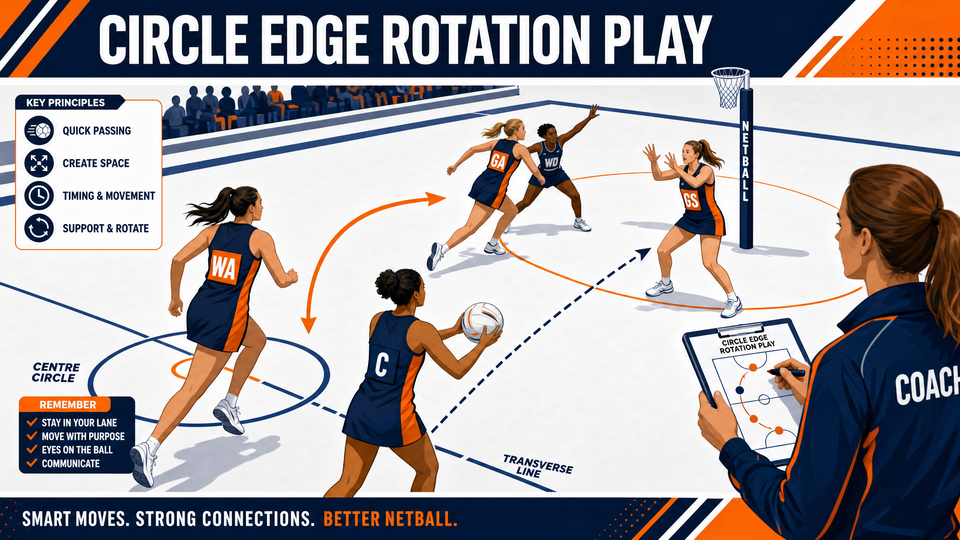
What you need
1 Netball, 4-6 Training Bibs, Flat Marker Cones (optional)
1. Overview
The Circle Edge Rotation Play is a highly effective attacking strategy designed to break down a static, zone-style, or tightly man-on-man circle defense. By utilizing synchronized movement between the Goal Shooter (GS) and Goal Attack (GA), combined with precise feeding from the Wing Attack (WA) and Centre (C), this play forces defenders to make split-second decisions—often resulting in a mismatch or an open player under the post.
Coaches should implement this play when the attacking team is struggling to penetrate the goal circle due to strong defensive pressure on the edge, or when the shooters are becoming isolated and stagnant.
2. Setup
Court Area: Attacking third of the court (30.5m x 15.25m total court dimensions).
Players Required: 4 Attackers (GS, GA, WA, C) and 2-4 Defenders (GD, GK, WD, C) for opposed practice.
Equipment: 1 Netball, 4-6 training bibs, flat marker cones (optional, to mark starting points).
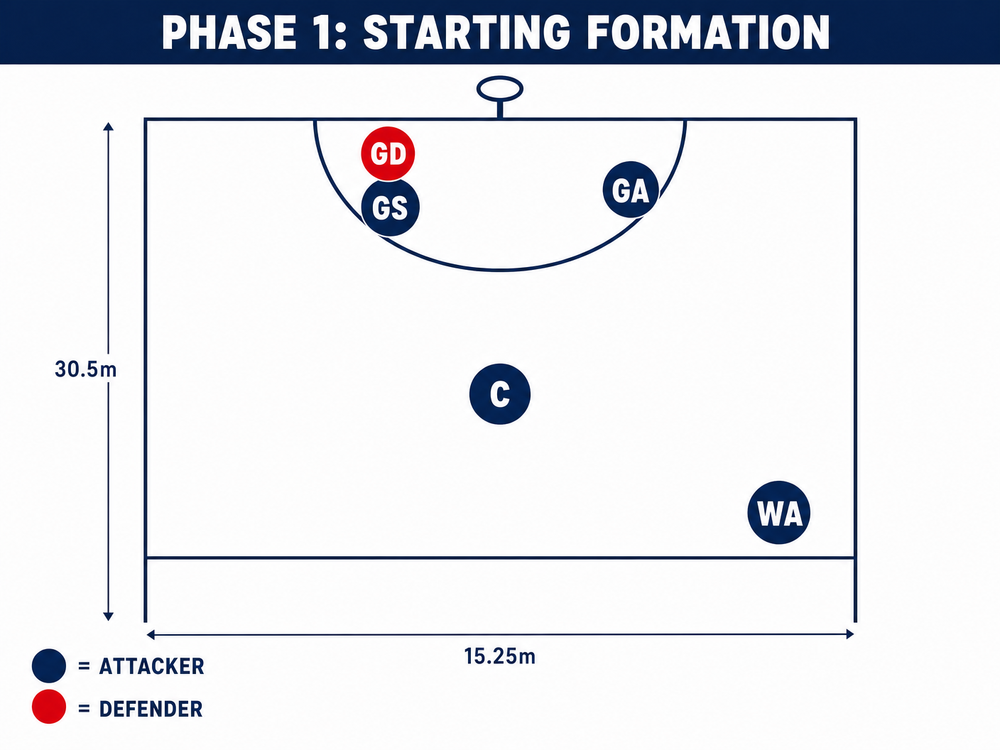
Starting Positions:
- GS: Positioned deep in the goal circle, slightly offset to the left side.
- GA: Positioned on the right side of the goal circle edge, acting as the primary decoy/initiator.
- WA: Positioned wide on the right wing, near the transverse line, ready to receive the center pass or transition ball.
- C: Positioned centrally in the attacking third, acting as the primary ball carrier and playmaker.
3. Step-by-Step Instructions
Phase 1: The Initiation
- The C brings the ball down the middle channel of the attacking third.
- The WA makes a strong, angled drive toward the sideline to receive the pass from the C just above the transverse line.
- As the WA receives the ball, the GA (positioned on the right circle edge) initiates the rotation by dropping off the edge and pushing slightly wide to draw the Goal Defence (GD) away from the top of the circle.
Phase 2: The Rotation
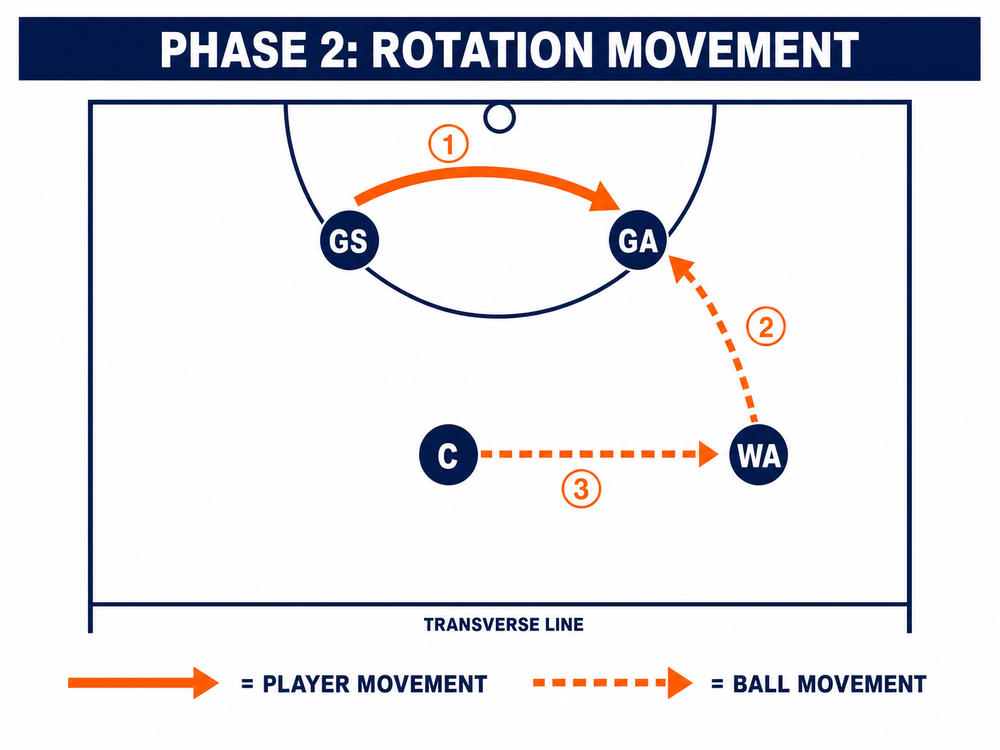
- Recognizing the space created by the GA, the GS executes a hard, sweeping baseline drive from the left side of the circle to the right side (clockwise rotation across the top or middle of the circle).
- The WA looks to feed the GS if the Goal Keeper (GK) is caught trailing. If the pass is not on, the WA hits the GA who has now re-offered toward the top right of the circle edge.
Phase 3: The Penetration and Shot
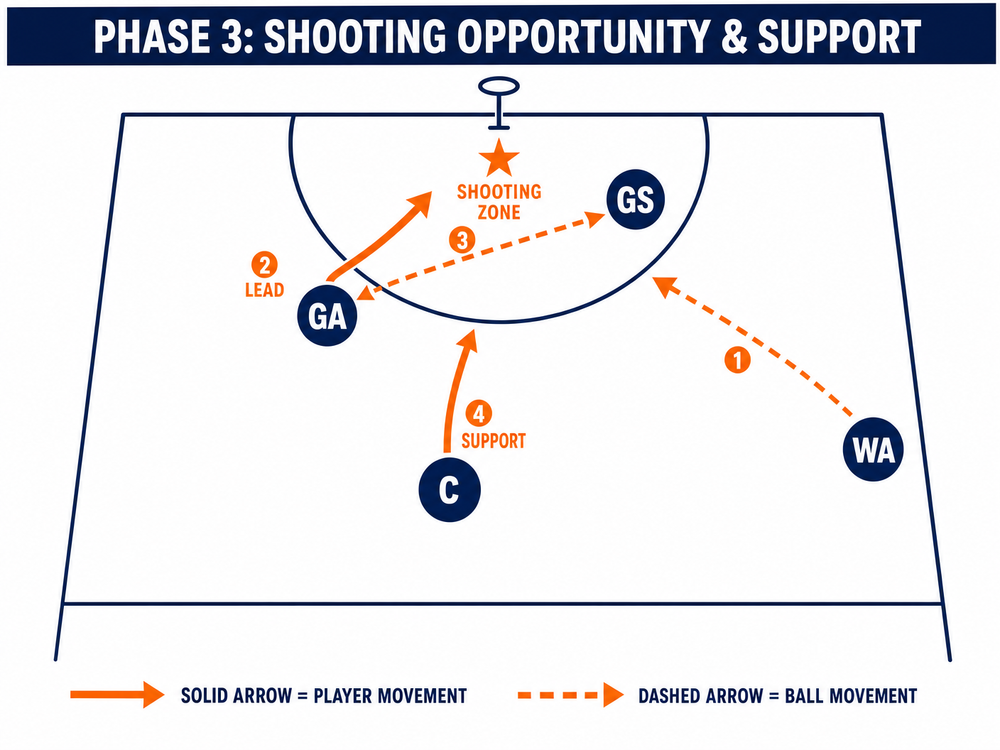
- With the ball now in the hands of the GA on the circle edge, the GS holds strong on the right side of the post.
- The GA fakes a shot or a high ball, then executes a sharp, cutting drive into the circle (the "Lead").
- The C pushes up to the top of the circle edge to provide a reset option (Support).
- The GA receives a quick give-and-go pass from the WA (if the WA retained the ball) or feeds the GS directly under the post for a high-percentage shot.
4. Key Coaching Points
- Timing is Everything: The GS must not start their rotation until the GA has actively cleared the space on the circle edge. Premature movement will clog the attacking channel.
- Strong Decoy Drives: The GA's initial drop-off must be convincing. They must demand the ball to force the GD to commit to them, opening the space for the GS.
- Vision and Patience from the Feeders: The WA and C must keep their eyes up and not force the pass. If the primary option (GS rotation) is covered, they must patiently hit the reset (C) or the secondary option (GA re-offer).
- Hold the Space: Once the GS completes their rotation to the right side, they must establish a strong, wide stance to hold off the GK and provide a clear target for the feed.
5. Common Mistakes
- Clogging the Top of the Circle: Both shooters ending up in the same space at the top of the circle because the GA didn't clear wide enough or the GS rotated too early.
- Flat Passing: Feeders throwing flat, easily interceptable passes into the circle instead of using bounce passes or perfectly weighted lob passes over the defense.
- Lack of Support: The C failing to push up to the circle edge, leaving the WA isolated if the feed into the circle is shut down.
6. Variations & Progressions
- Progression 1: Add Full Defense. Start with passive defense (shadowing only) and progress to full, live, opposed defense to test the play under pressure.
- Progression 2: The "Pop" Pass. Instead of the GA driving into the circle, the GS rotates, receives the ball, and immediately "pops" a short pass back to the GA who has wrapped around for a mid-range shot.
- Variation 1: Left-Side Initiation. Mirror the entire play to start with the WA on the left wing and the GA on the left circle edge, ensuring players are comfortable executing from both sides of the court.
7. Age Adaptations
- Under 10s / Under 12s: Focus heavily on the basic timing of the GS/GA swap. Use flat marker cones to show exactly where they need to run. Simplify the feeding to just the WA.
- Under 14s / Under 16s: Introduce the concept of the C providing the "reset" option. Demand sharper, faster changes of direction from the shooters.
- Open / Seniors: Focus on the subtleties of the hold under the post and the disguise of the passes from the WA and C. Introduce the variations (like the "Pop" pass) to keep the defense guessing.
