Centre-Pass Defensive Press: Funnel, Trap and Intercept
A coach-ready, three-phase defensive press that funnels the first centre pass to the sideline, closes the return option and releases the Goal Defence to intercept.
Equipment Needed
Overview
This is a three-phase defensive centre-pass play designed to take the opposition away from the centre corridor, funnel their first receiver towards a sideline, then create a high-value intercept or forced contest on the next pass. It is not a full-court scramble. The press is a connected shape: C applies first pressure, WD removes the easy release, GD reads the next flight, and GK stays behind the ball. Use it after your team has identified a predictable first-pass preference, especially an opposition C who likes to receive on the same side of the centre circle.
The play suits Under 14 and older players who can hold a role while reading the ball. Aim to slow and widen the first two passes. Measure success: in three of five repetitions, force the first catch within 1.5 m of the sideline or make the second pass cross GD's line of sight.
Non-negotiable: press the space and the receiver, not the person. On the catch, defenders must arrive legal and balanced; do not turn a good trap into an obstruction or contact penalty. Refer to the current Rules of Netball used in your competition. 2
Setup
Use a regulation 30.5 m x 15.25 m court divided into equal thirds; its centre circle is 0.9 m in diameter and each goal circle has a 4.9 m radius. 1 Mark a funnel lane with two cones 1.5 m in from the sideline, then an intercept window 3 m further up court. The full version uses 14 players, although the core press is C, WD, GD and GK versus C, WA, GA and GS.
| Defensive call number | Position | Starting responsibility | Starting reference |
|---|---|---|---|
| 1 | Centre (C) | First-ball hunter | Half a step off the receiver's outside shoulder |
| 2 | Wing Defence (WD) | Remove the return and WA outlet | Inside shoulder of WA, 1.5–2 m off |
| 3 | Goal Defence (GD) | Protect the next pass and attack the flight | 2–3 m goal-side of GA, eyes on ball then player |
| 4 | Goal Keeper (GK) | Hold depth and organise the back line | Goal-side of GS; never join the first trap |
Give your defenders the call Funnel–Lock–Fly. Funnel means C takes away the middle. Lock means WD and C close the short return without fouling. Fly is GD's cue to drive through the anticipated second-pass line. The playing positions and their court restrictions are prescribed by the rules, so retain the correct positional match-ups during every repetition. 1
Step-by-Step Instructions
1. Set the picture before the whistle
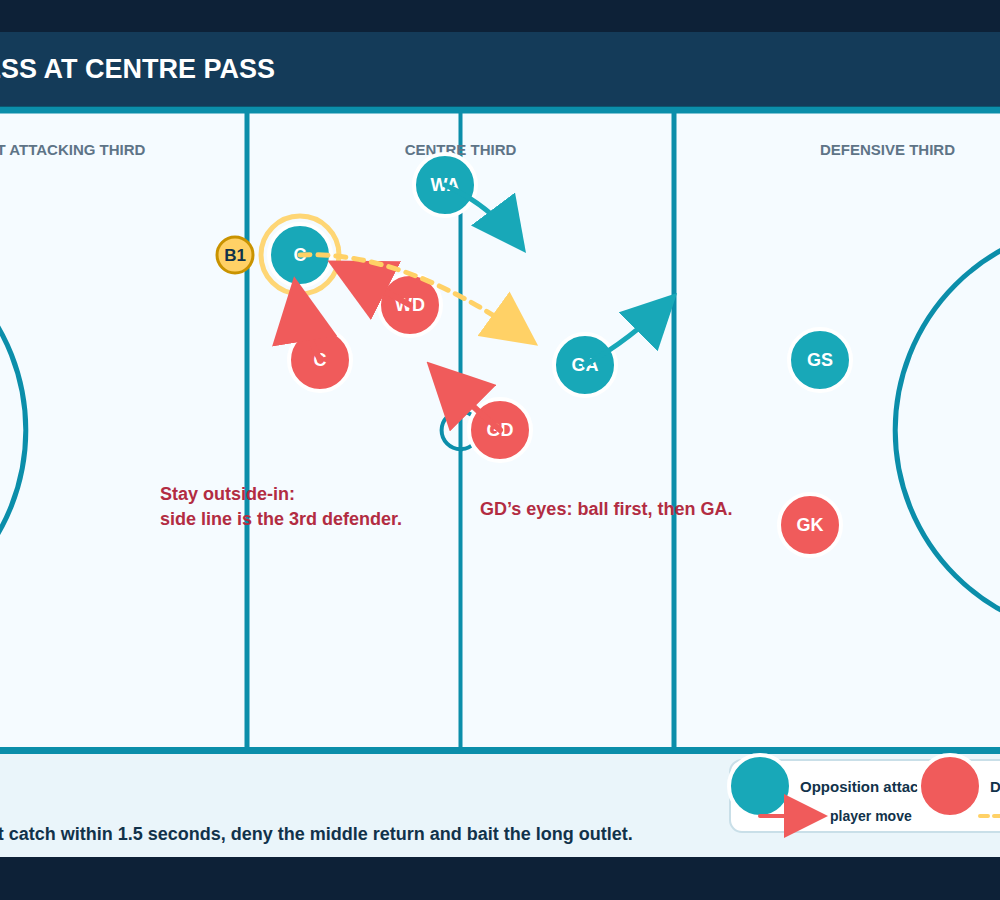
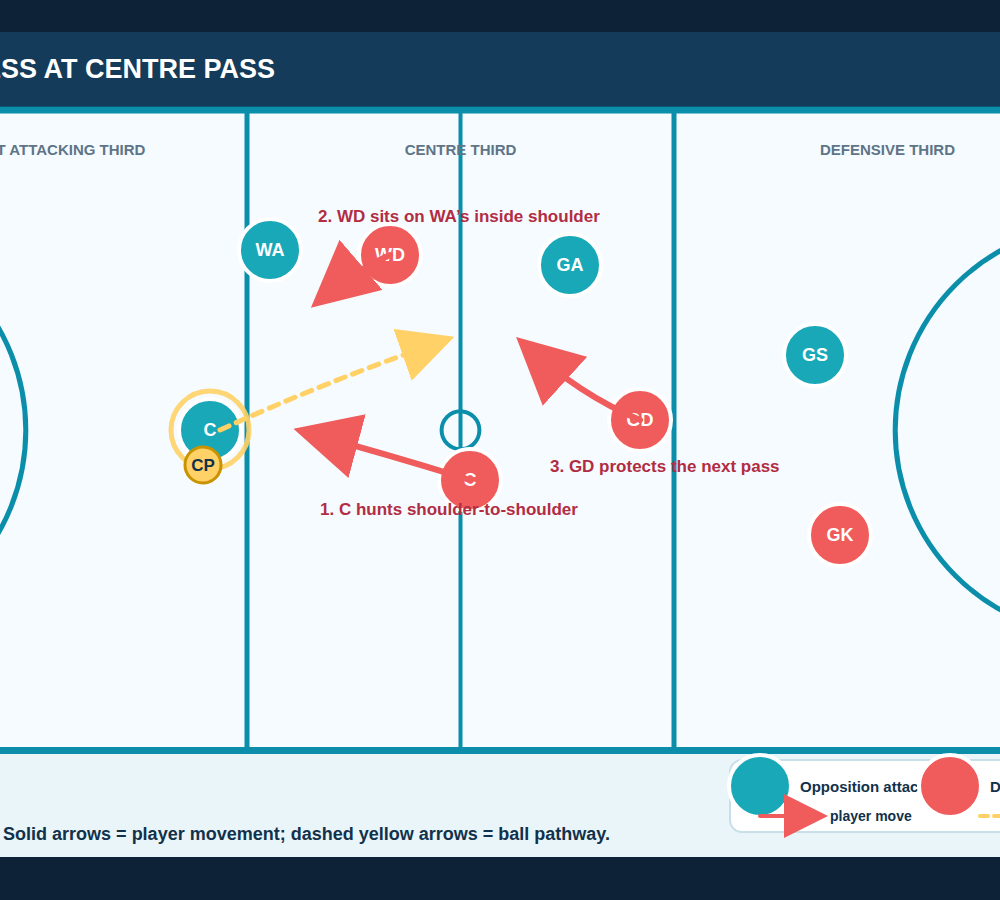
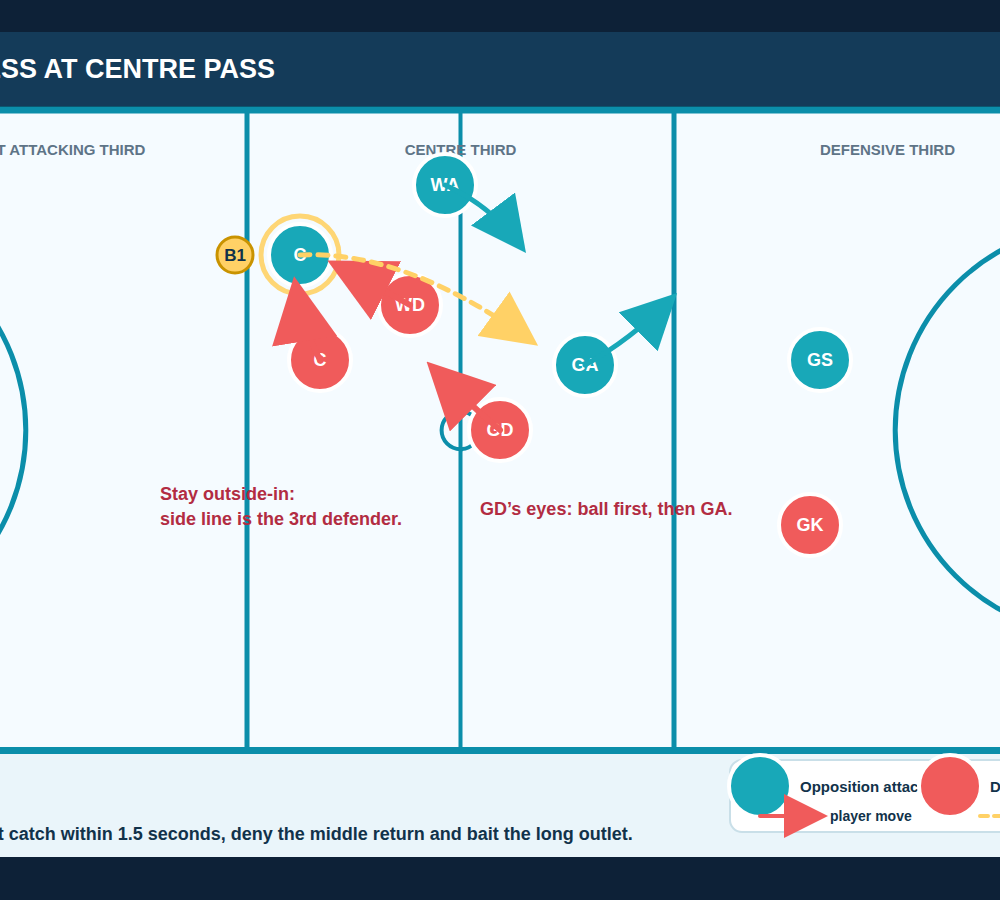
Place the attacking C inside the centre circle, facing the chosen sideline. Defender 1, C, starts just outside the receiver's leading shoulder, showing enough space to invite the sideline catch but not the centre channel. Defender 2, WD, sets on the inside shoulder of WA so the obvious release is already crowded. Defender 3, GD, holds a patient, slightly goal-side position on GA. Defender 4, GK, stays connected to GS and calls the depth of the line. Your coaching language here is: middle closed, sideline offered.
2. Funnel the centre pass
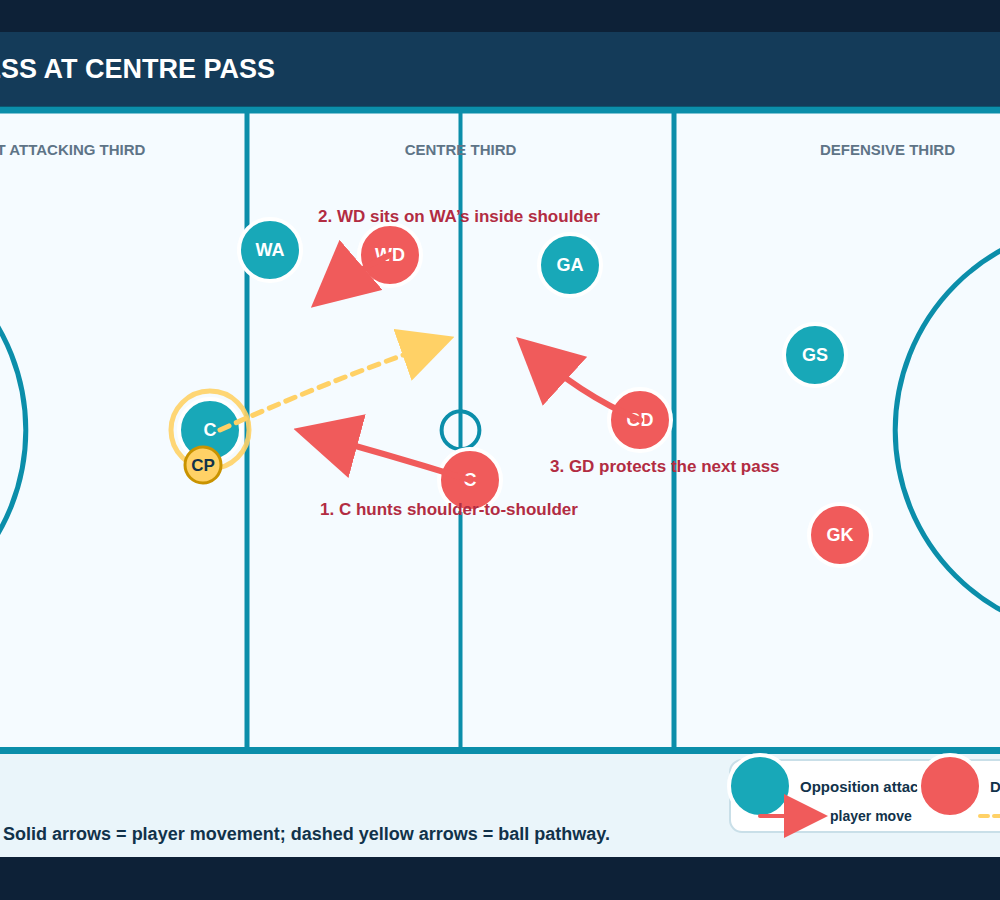
At the whistle, C drives on a 30–45 degree line towards the receiver's inside shoulder, arriving under control. The target is not a tackle; it is to turn the attacker's hips towards the sideline and remove their comfortable view of the centre corridor. WD moves on the same beat, sliding across the WA line to deny a one-pass escape back inside. GD does not chase the initial catch. GD holds the intercept window, checking GA's first drive and keeping a clear view of the ball.
When the ball is caught, the closest defender brakes, establishes a legal distance from the ball carrier, gets hands high and makes the receiver see only the sideline or a long, floated pass. The second defender closes the near return. The ball carrier has only a short decision window under the rules, so controlled pressure is more valuable than a reckless lunge. 2
3. Lock the first catch
If the attacking C catches near the funnel lane, C takes the line back towards the centre while WD owns the WA release. Use the sideline as the third defender: neither C nor WD should overrun past the ball. Their feet stop first; their arms and vision then close the pass. GD reads the attacker's body shape. A square shoulder or high elbow usually signals the long or cross-court release; a turned hip suggests a short drop to WA.
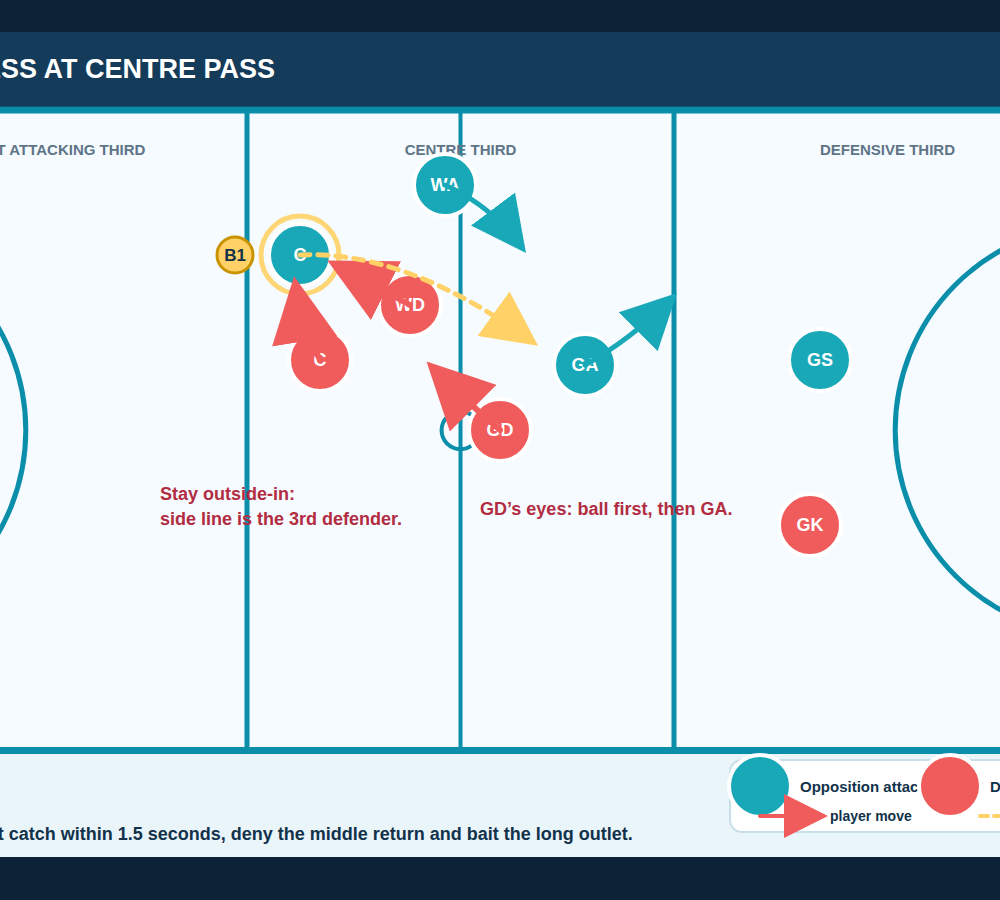
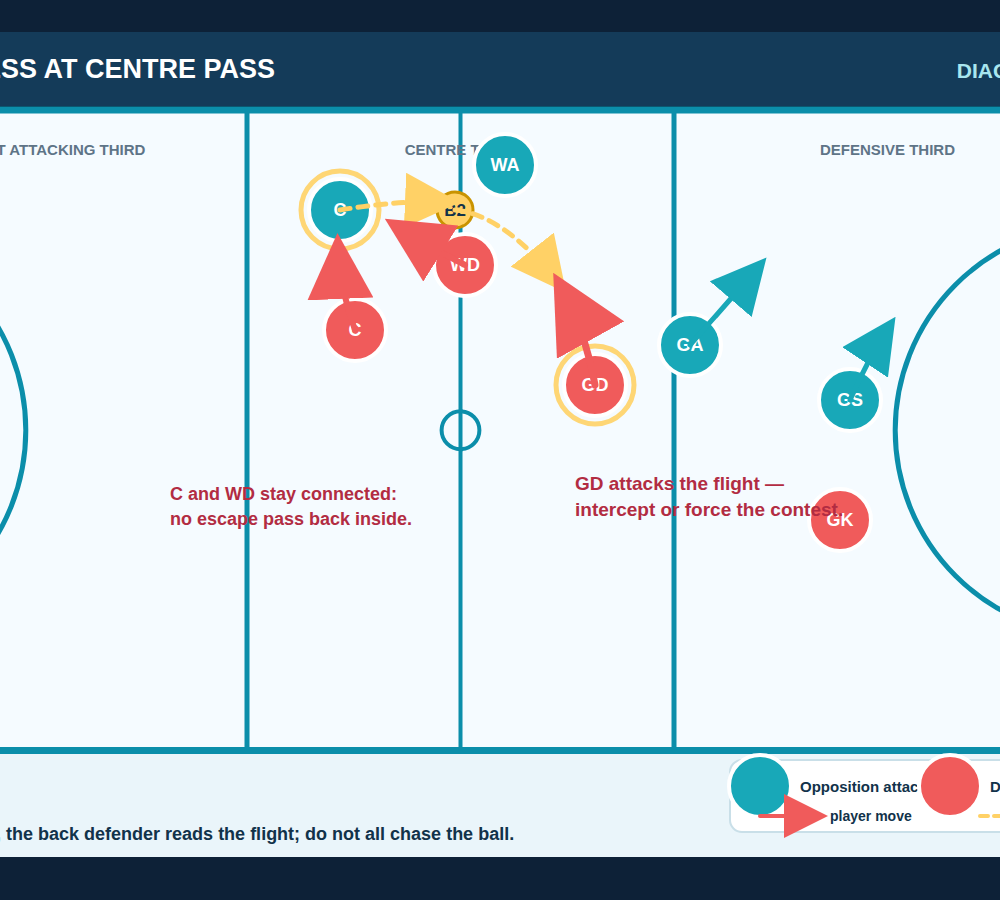
Make the trap last only long enough to force a poor choice. The trigger for the next action is the ball carrier raising the ball above shoulder height, looking across court for longer than a beat, or stepping back to create a passing lane. On that trigger, C calls Fly.
4. Fly to the intercept; do not all chase
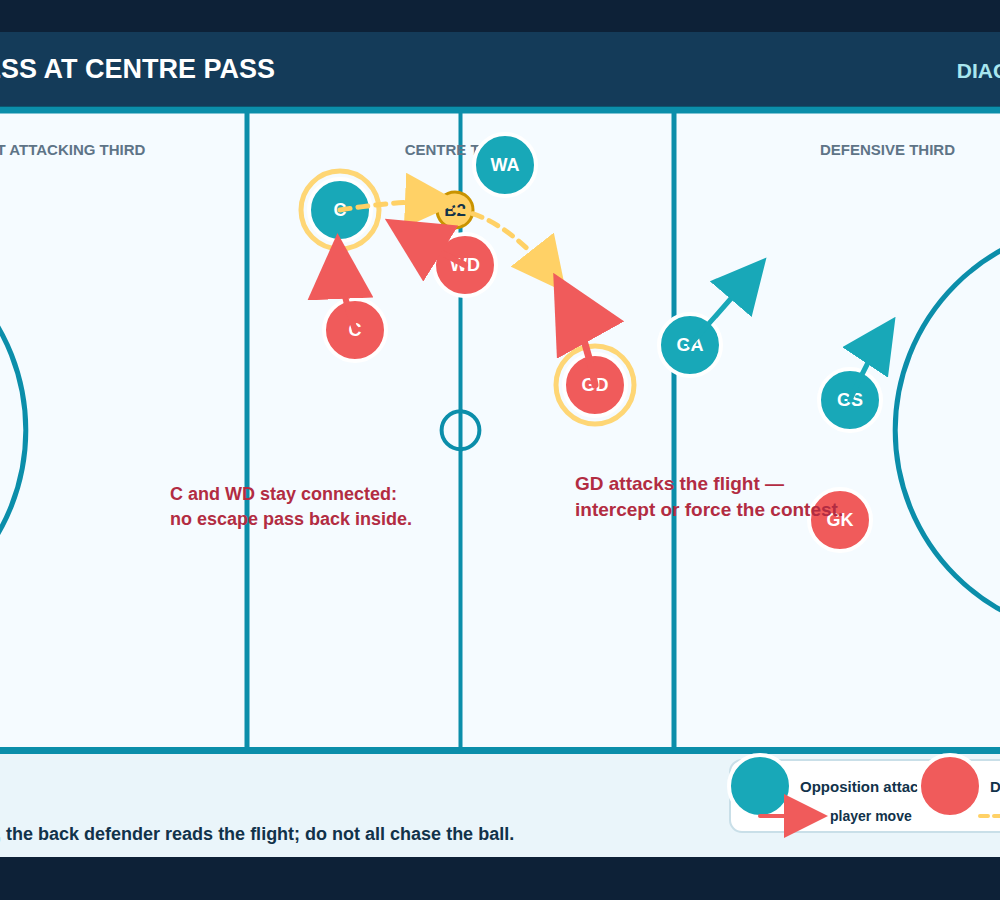
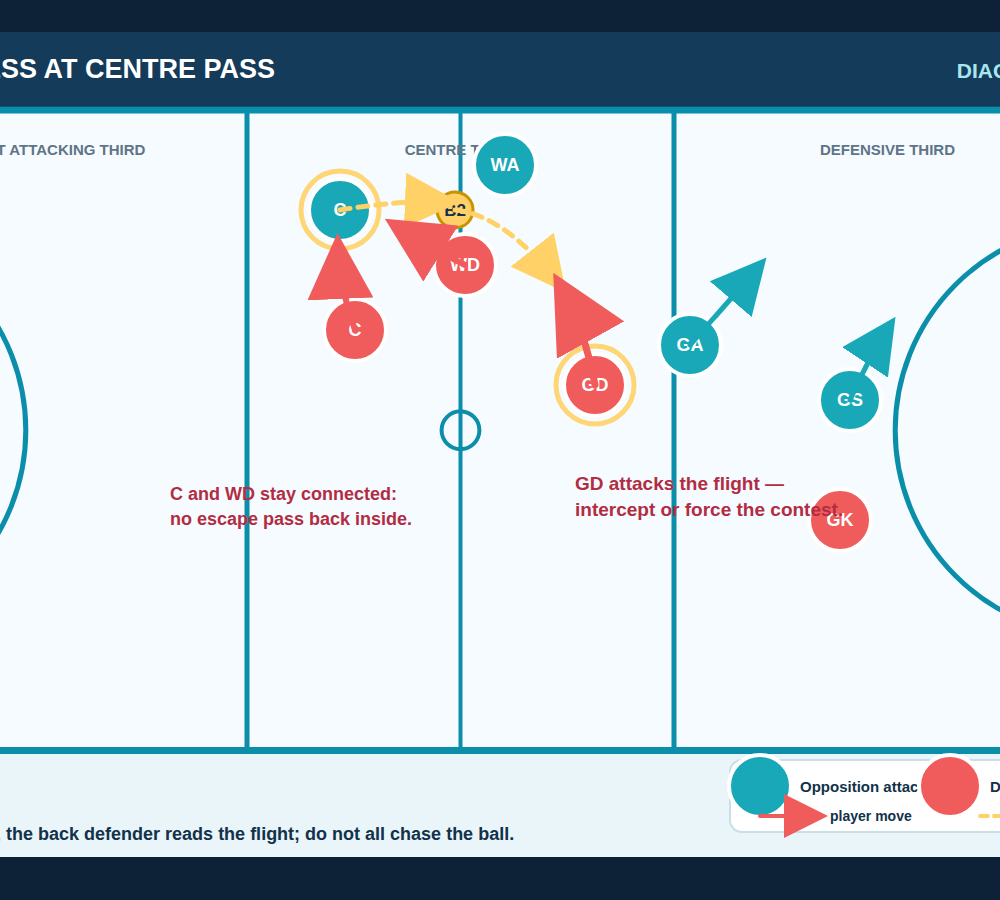
On Fly, GD drives through the projected line of the second pass, taking the ball with two hands if possible or creating a clean deflection into C/WD space. C and WD remain connected to block the easy safety pass back inside. GK holds GS and protects the goal circle in case the ball is released deep. Once the ball is won, your first attacking instruction is simple: secure, turn, then outlet. Do not throw a speculative transition ball because the press has already achieved its purpose.
5. Reset with a specific review
Run three repetitions to one side, then switch. Give only one correction between repetitions: C's approach, WD's shoulder, GD's patience, or GK's depth. Film from the centre-third sideline if available; check that C and WD remain within one pass-length as the ball is trapped.
Key Coaching Points
| Coaching focus | What a good repetition looks like | Coach cue |
|---|---|---|
| C's approach | C arrives balanced and shows the sideline without body contact | Close the middle, feet first |
| WD's relationship | WD is early on WA's inside shoulder and can see ball plus player | Lock the return |
| GD's patience | GD protects space first, then attacks the release at full commitment | Ball, body, flight |
| Team connection | C and WD stay close enough to remove the reset; GK stays deep | Four defenders, one picture |
| Legal pressure | Hands are active, feet are controlled, and the defender does not crowd the ball carrier | Win it clean |
Common Mistakes
C runs straight at the receiver. This leaves the centre corridor open and allows a simple pivot to the inside. Correct it by placing a cone on the inside shoulder and asking C to finish on that cone line, not through the player's body.
WD watches the ball and loses WA. The press then creates the very short pass it was intended to remove. Correct the starting stance: WD's chest should be half-open so they can see ball and WA, with their inside foot ready to slide.
GD chases the first pass. This collapses the back line and leaves GA free. Demand that GD holds the intercept window until the ball carrier's hands and eyes commit.
All defenders jump at the trap. The sideline looks busy but the long release is unprotected. Freeze the play and ask, Who owns the next pass? The answer is GD, with GK still covering GS.
Pressure becomes illegal. Players may arrive too close on the catch or lean into the receiver. Build a visible 0.9 m check into early practice and ask an umpire or assistant coach to call the standard used in your competition. 2
Variations & Progressions
Start with a guided 4 v 4 in the centre and defensive thirds, requiring the nominated sideline first and pausing after the catch to check shape. Progress to live 7 v 7, scoring one point for a funnel, two for a deflection and three for an intercept retained for two passes. For advanced players, let WA clear and GA double back; GD must call whether to hold the flight line or hand over to C.
Age Adaptations
For Under 10, use 3 v 3 in a half-third and reward steering the catch to a cone-marked sideline; use 20–30 second bouts. For Under 12, use 4 v 4, pause after the first catch and practise the legal-distance check. For Under 14 to Under 16, go live 7 v 7 and ask C and WD to name the Fly trigger. For Open teams, scout the first-pass side and install a left/right version plus a counter-call when WA clears.