

Netball
Defensive Zone Intercept Drill: The Triangle Press
Master the art of defensive zone pressure and interception with this high-intensity drill designed to force errors and create turnovers in the middle and defensive thirds.
What you need
1 Netball, 6-8 Cones, Bibs (2 colours)
1. Overview
The Defensive Zone Intercept Drill, also known as the Triangle Press, is a high-intensity tactical exercise designed to teach defenders how to work as a cohesive unit to restrict passing options, force the attackers into making high-risk passes, and ultimately secure clean interceptions. This drill is particularly effective for teams looking to transition from a strict one-on-one defensive structure to a more dynamic, space-oriented zone defence. It is best utilised during the mid-season when players have a solid understanding of basic defensive positioning and are ready to develop their spatial awareness and anticipation skills. By forcing attackers to pass through congested areas, defenders learn to read the play, communicate effectively, and explode onto the ball at the critical moment.
2. Setup
Equipment Needed:
- 1 Netball
- 6-8 Cones (for marking specific zones if required)
- Bibs (2 distinct colours for Attackers and Defenders)
Court Setup:
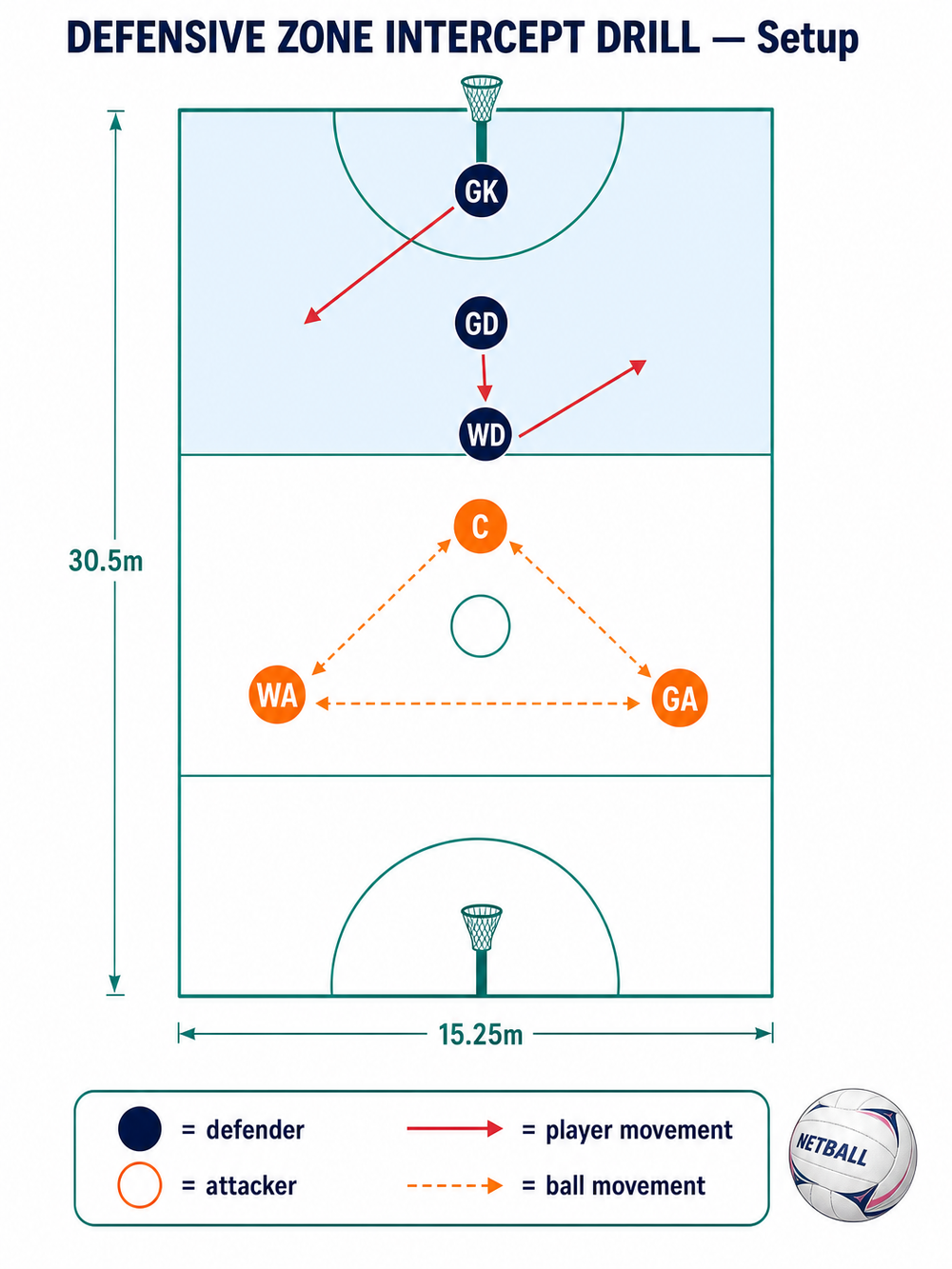
This drill primarily takes place in the middle third and the defensive third of a standard netball court (30.5m x 15.25m).
Player Positions:
- Defenders (Navy): Goal Keeper (GK), Goal Defence (GD), Wing Defence (WD). They will start in a structured zone formation.
- Attackers (Orange): Goal Attack (GA), Wing Attack (WA), Centre (C). They will start in a triangle formation in the middle third, aiming to transition the ball to the circle edge.
3. Step-by-Step Instructions
- Initial Positioning: The attackers (GA, WA, C) set up in a triangle formation in the middle third. The defenders (GD, WD) position themselves slightly off their direct opponents, creating a 'zone' rather than a tight one-on-one mark. The GK starts near the top of the shooting circle (4.9m radius).
- The Trigger: The drill begins with the Centre (C) holding the ball. The C passes the ball to either the GA or the WA.
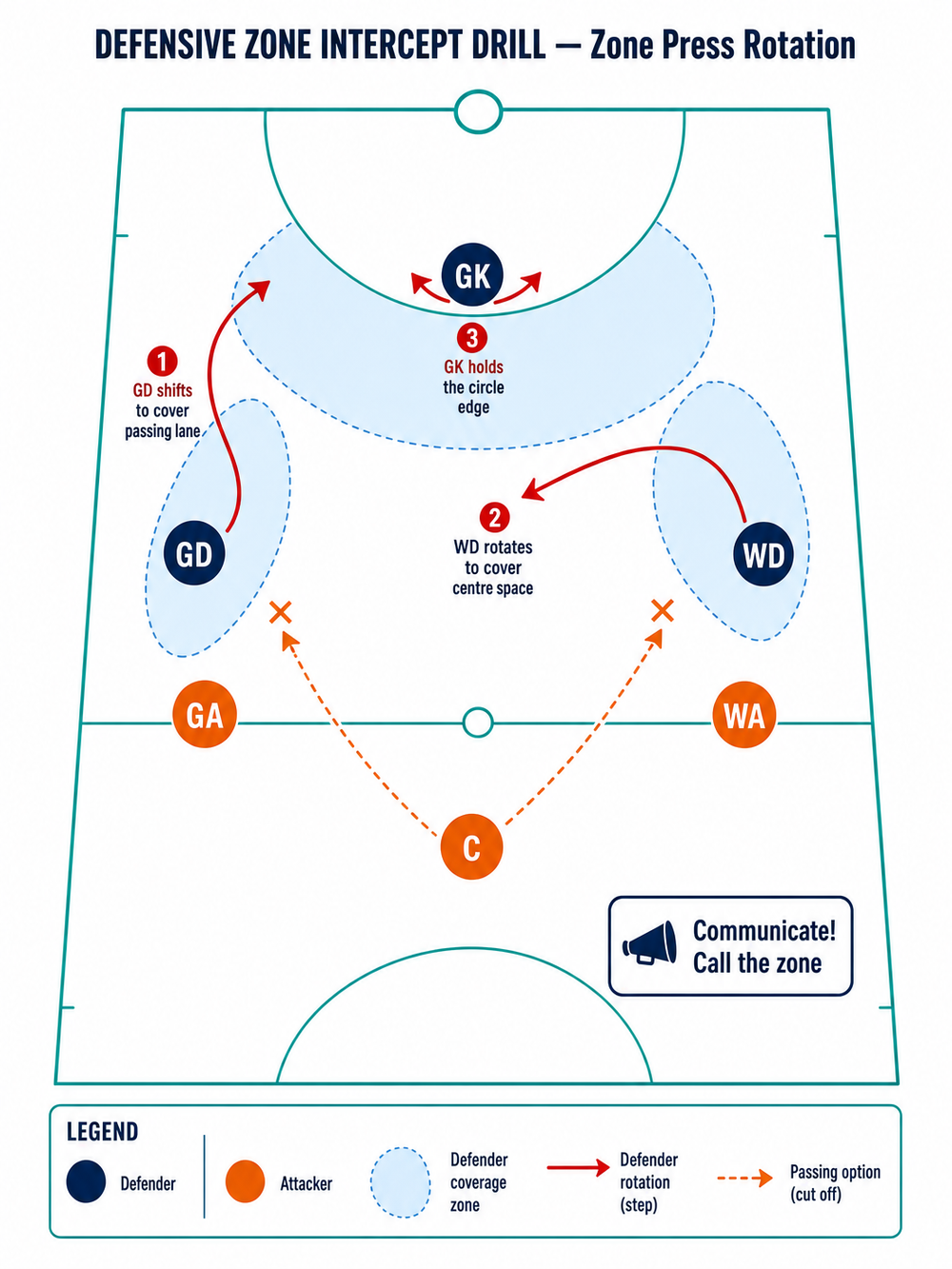
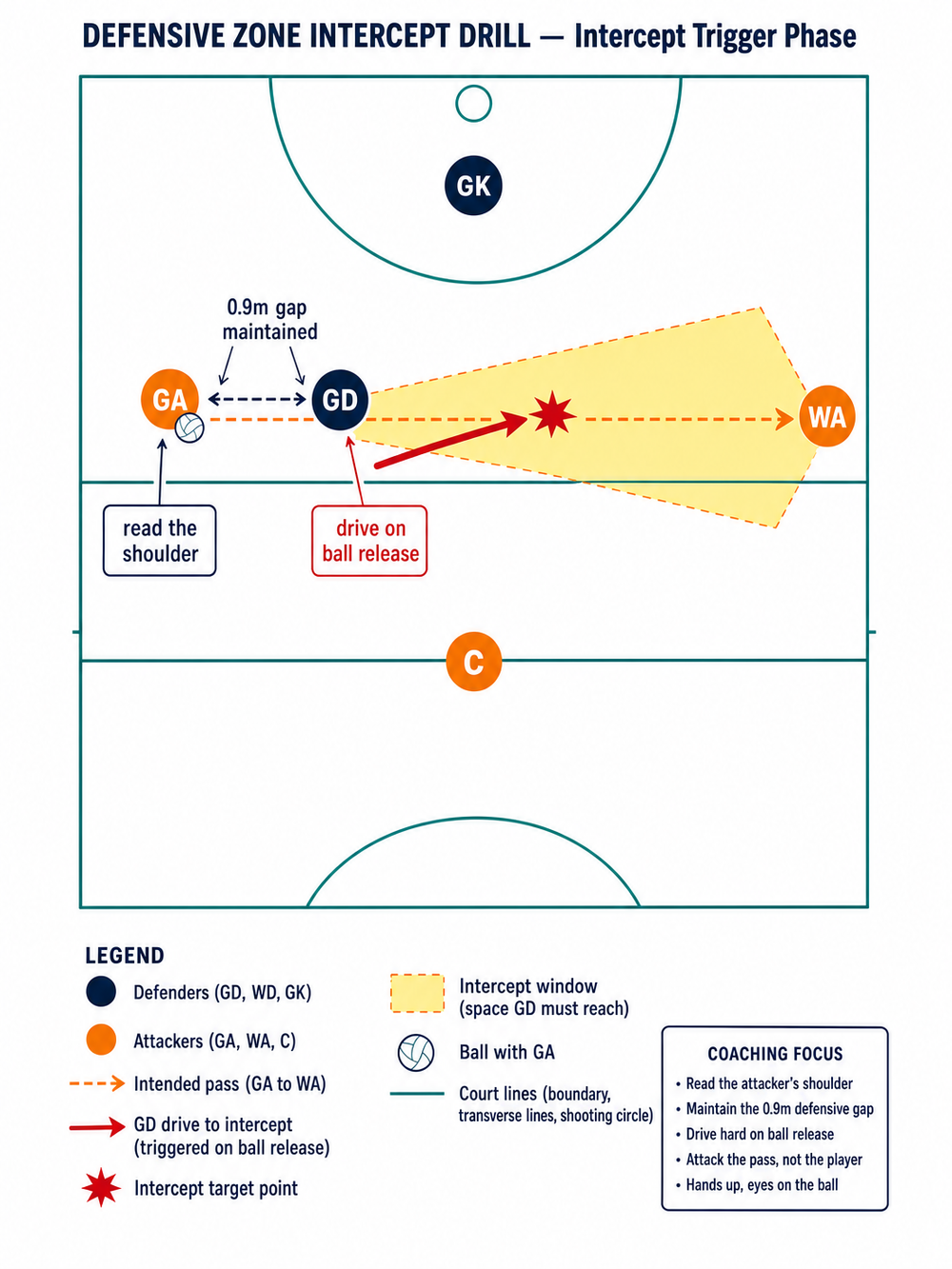
- The Squeeze: As the ball is in flight, the defenders must immediately adjust their positioning. If the ball goes to the GA, the GD must apply immediate pressure (maintaining the required 0.9m distance), while the WD drops slightly to cover the passing lane to the WA.
- Forcing the Error: The attackers must attempt to pass the ball among themselves, aiming to feed the ball to a designated target player (e.g., a stationary GS) inside the shooting circle. The defenders must communicate and shift as a unit, ensuring that at least two passing options are always heavily contested or completely blocked.
- The Intercept: The defenders must read the attacker's body language (shoulders and eyes) to anticipate the next pass. When a high-risk pass is attempted, the designated defender (usually the one covering the space, not the player on the ball) must drive hard and fast to intercept the ball cleanly.
- Reset and Rotate: Once an interception is made, or the attackers successfully feed the ball into the circle, the drill resets. Rotate players through different positions to ensure all defenders experience the different roles within the zone press.
4. Key Coaching Points
- Read the Play, Not Just the Player: Encourage defenders to watch the ball handler's eyes and shoulders to anticipate where the pass is going, rather than just reacting to their direct opponent's movement.
- Explosive Movement: The interception requires a sudden, explosive burst of speed. Defenders must be on the balls of their feet, ready to drive hard the moment the ball leaves the attacker's hands.
- Communication is Vital: A successful zone defence relies on constant communication. Defenders must call out who is applying pressure to the ball handler and who is covering the passing lanes.
- Maintain the 0.9m Gap: Ensure defenders are setting up their initial pressure legally. They must be 0.9m away from the player with the ball before defending the pass.
- Attack the Ball: When going for the intercept, defenders must attack the ball at its highest or earliest point, rather than waiting for it to reach the intended receiver.
5. Common Mistakes
- Ball Watching: Defenders become fixated on the ball and lose track of the attackers moving into their designated zone.
- Going Too Early: A defender attempts the intercept before the ball is released, allowing the attacker to fake the pass and easily bypass them.
- Lack of Communication: Defenders fail to call their zones, resulting in two players covering the same space and leaving an attacker completely open.
- Flat-Footed Defending: Defenders are caught flat-footed, making it impossible to generate the explosive speed needed to secure the intercept.
6. Variations & Progressions
- Progression 1: Add a Goal Shooter (GS). Introduce a stationary GS in the shooting circle. The attackers must successfully feed the ball to the GS, increasing the pressure on the GK and the edge-of-circle defence.
- Progression 2: Time Limit. Give the attackers a strict time limit (e.g., 5 seconds) to move the ball from the transverse line to the circle edge, forcing quicker, potentially riskier passes.
- Variation 1: Uneven Numbers. Run the drill with 4 attackers against 3 defenders to increase the difficulty for the defensive unit and force them to work harder to cover the extra player.
- Variation 2: Restricted Space. Confine the drill to only one side of the court (e.g., the right channel), forcing tighter passes and quicker defensive reactions.
7. Age Adaptations
- Under 10s: Focus primarily on the one-on-one intercept rather than a complex zone. Emphasise watching the ball and driving forward to catch it.
- Under 12s: Introduce the concept of 'covering space'. Have one defender apply pressure on the ball while the other drops back to cover the most obvious passing option.
- Under 14s: Begin implementing the full triangle press. Focus heavily on communication and the timing of the intercept drive.
- Under 16s & Open: Run the drill at full match intensity. Introduce the variations (uneven numbers, time limits) to challenge their decision-making and spatial awareness under fatigue.
