

Netball
Mastering the Two-Foot Landing: A Complete Footwork Circuit
A high-intensity footwork drill designed to help players perfect their two-foot landings, improve balance, and execute quick transitions into accurate passes.
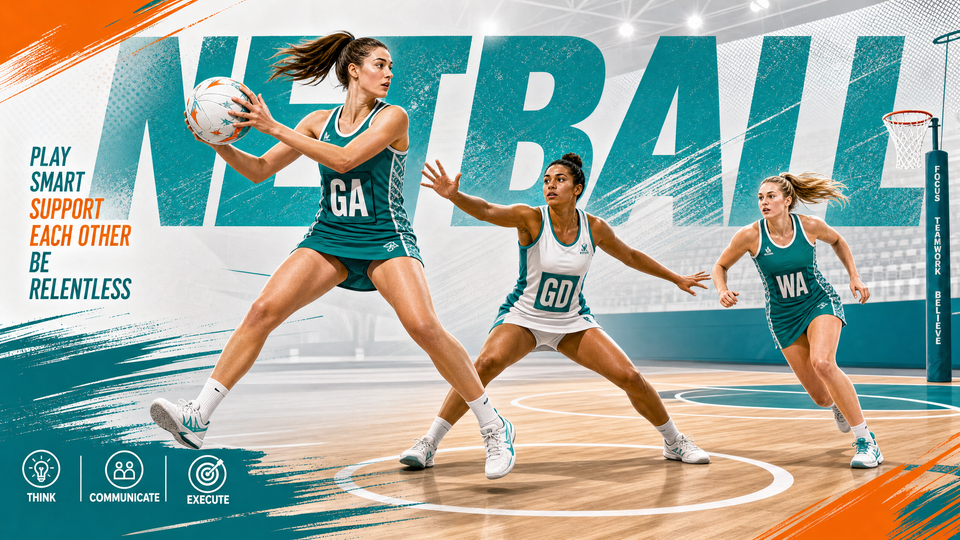
What you need
1 Netball, 3-5 Cones
1. Overview
Proper footwork and landing technique form the foundation of effective netball. The two-foot landing is crucial because it gives the player the option to pivot on either foot, providing maximum flexibility to avoid defenders and deliver a strong pass. This drill focuses on building the neuromuscular control required for a stable, balanced two-foot landing under pressure, simulating match intensity.
2. Setup
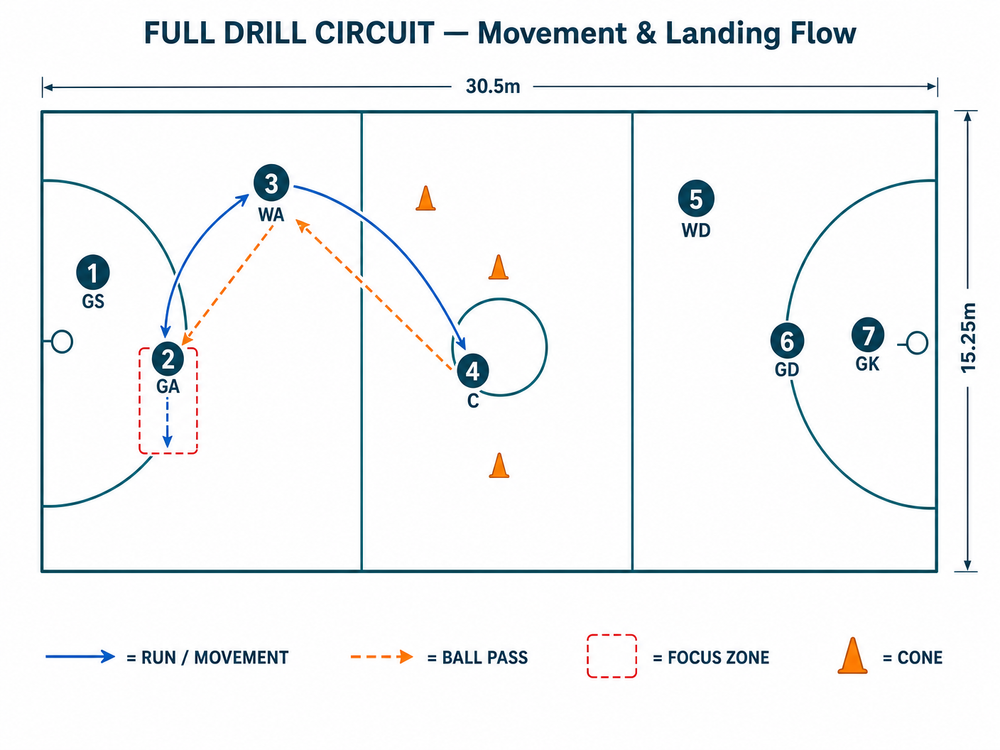
- Court Setup: Use a standard netball court (30.5m x 15.25m). The drill utilizes the centre third and one goal third.
- Equipment: 1 Netball, 3-5 cones/markers.
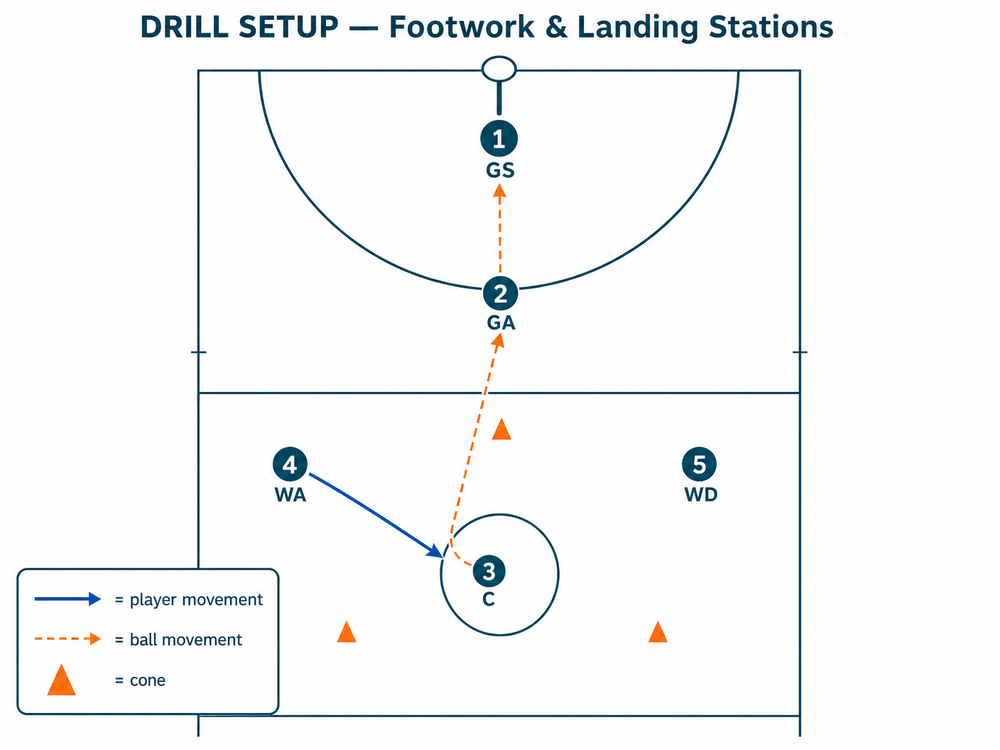
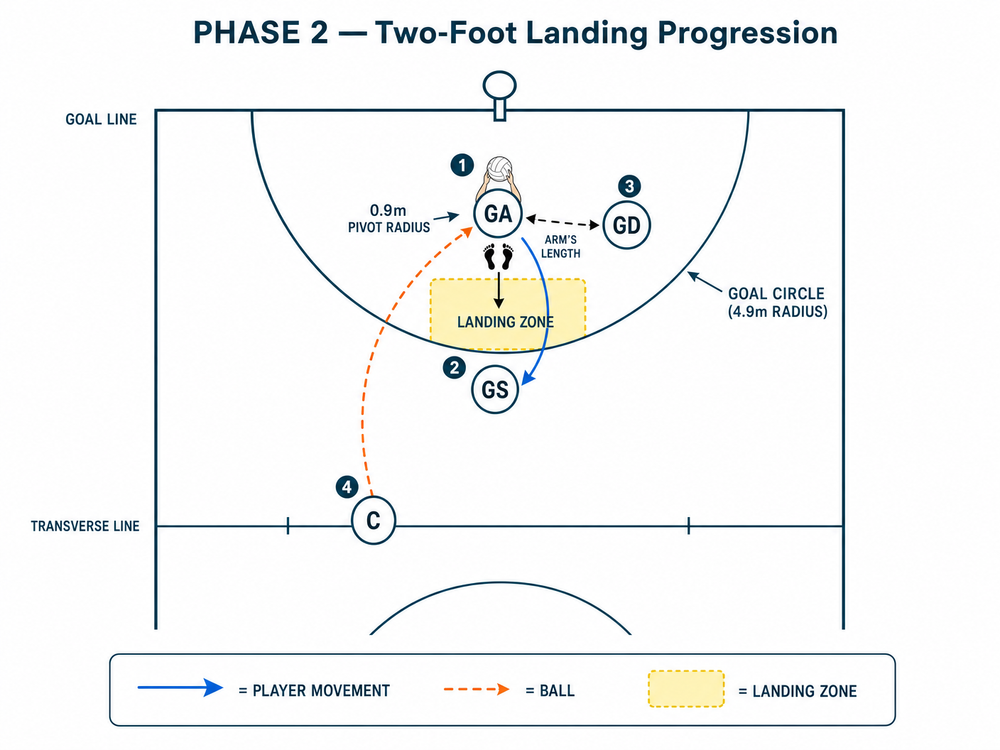
- Player Positions: Minimum 5 players required (can be scaled up). Set up a Centre (C) in the centre circle, a Wing Attack (WA) driving from the side, a Goal Attack (GA) at the edge of the goal circle, and a Goal Shooter (GS) inside the circle. Add a defender (e.g., WD or GD) to increase difficulty.
3. Step-by-Step Instructions
- The Drive: The WA (Player 4) drives aggressively toward the centre circle to receive a pass from the C (Player 3).
- The Catch and Land: As the WA catches the ball, they must execute a clear two-foot landing. Both feet must hit the ground simultaneously.
- The Pivot: The WA establishes their preferred pivot foot and turns to face down the court toward the GA (Player 2).
- The Second Phase: The WA passes to the GA, who is driving toward the top of the goal circle. The GA must also execute a strong two-foot landing upon receiving the ball.
- The Final Feed: The GA pivots and delivers a crisp pass to the GS (Player 1) holding space in the goal circle.
- Rotation: Players follow their pass to rotate positions (C moves to WA, WA to GA, GA to GS, GS jogs back to C).
4. Key Coaching Points
- Simultaneous Impact: Emphasize that both feet must strike the court at exactly the same time. Listen for a single 'thud' rather than a 'tap-tap'.
- Knees Bent: Players should land with their knees slightly bent to absorb the impact and lower their center of gravity for better balance.
- Eyes Up: Ensure players keep their eyes up and looking down the court as they land, ready to spot the next pass.
- Strong Core: A tight core prevents the upper body from swaying forward upon landing, which can cause stepping calls.
5. Common Mistakes
- The 'Tap-Tap' Landing: Landing one foot slightly before the other (a 1-2 landing) limits the player's pivot options to only the first foot that landed.
- Stiff Legs: Landing with straight legs causes jarring through the joints and poor balance, making it difficult to pivot quickly.
- Looking at the Ball: Players staring at the ball as they land lose court vision and delay the next pass.
6. Variations & Progressions
- Add Defenders: Introduce passive, then active defenders on the WA and GA to force them to land strongly under physical pressure.
- Change the Feed: The C can vary the height and speed of the initial pass (e.g., a high lob or a fast chest pass) to challenge the WA's aerial control and landing.
- Full Court Circuit: Expand the drill to utilize the full court, adding more players and passes to test endurance and consistency.
7. Age Adaptations
- Under 8 / Under 10: Remove the ball initially. Have players practice running and stopping on a whistle with a two-foot landing. Introduce the ball slowly.
- Under 12 / Under 14: Focus heavily on the correct pivot foot after the two-foot landing. Ensure they aren't dragging their pivot foot.
- Under 16 / Open: Run the drill at high speed with active defenders. Focus on the speed of the transition from landing to the next pass.
