

Netball
V-Cut, Catch & Stick: Footwork and Landing Technique Drill
A practical Netball footwork progression that teaches players to create space, receive at speed and land in a strong legal position before the next pass.
What you need
2 Netballs, 8 flat marker cones, Bibs for defenders, Whistle or visible timer
Overview
V-Cut, Catch & Stick gives coaches a repeatable way to teach the movement sequence that often decides whether an attacking possession continues: drive, plant, re-offer, catch, and land under control. The drill is deliberately built from unopposed technique into a defender-led decision. Players learn to create separation with a sharp V-cut, attack the ball rather than wait for it, and finish every catch in a stable legal landing position. It is especially useful at the start of a skills block, before centre-pass work, or whenever your side is conceding possession through rushed footwork calls.
Run it in a 16–18 minute block. The first 6 minutes are quality-focused and unopposed; the next 6 minutes add pace and a passing target; the final 4–6 minutes introduce live defensive pressure. Use the full Netball court dimensions of 30.5 m x 15.25 m as the reference, but operate each lane across the centre third and the near edge of a goal third. The working lane is approximately 8 m long and 5 m wide, so every player has space to accelerate and decelerate safely.
Setup
| Item | Coach instruction |
|---|---|
| Players | Use groups of 5–6 per lane: (1) C as Feeder, (2) WA as left-side Worker, (3) WA as right-side Worker/next player, (4) WD as Defender for the progression, and (5) GA as Target. Rotate positions every 90 seconds. |
| Equipment | 2 Netballs, 8 flat cones, bibs for defenders and a whistle or visible timer. |
| Court | Mark two mirror-image lanes from the centre-third line toward the goal third. Place the Feeder 2 m inside the centre third, the Worker’s start cone 4 m in front and 3 m wide of the Feeder, and a landing cone 3–4 m beyond the Worker’s first drive line. |
| Timing | Work for 35 seconds, rest/reset for 20 seconds. Complete three rounds on the right and three on the left before progressing. |
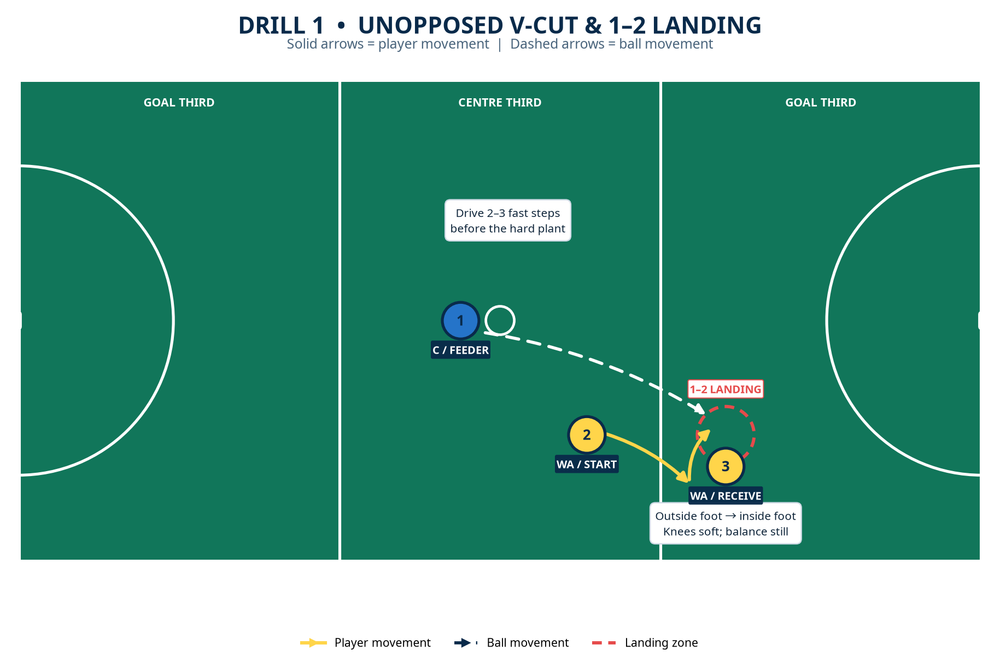
Place the C/Feeder with a ball, side-on so they can see both the Worker and the passing lane. The WA/Worker begins in a neutral athletic stance: knees soft, feet under hips, eyes on the Feeder. Keep the landing cone clear of other players. The GA/Target begins 4–5 m ahead of the landing zone, providing a realistic immediate release option.
Coach’s non-negotiable: Do not progress a player who cannot arrive under control. A fast catch followed by a footwork penalty is not successful repetition.
Step-by-Step Instructions
Demonstrate the finish first. Before players run, show both acceptable receiving finishes: a controlled 1–2 landing and a simultaneous two-foot landing. In the 1–2 option, the outside foot lands first, the inside foot stabilises second, and the player comes to balance before pivoting. In the two-foot option, both feet arrive together with soft knees and hips behind the ball.
Set the starting picture. Player 1 (C) holds the ball at chest height. Player 2 (WA) starts 3–4 m away with hands free, weight on the balls of the feet and chest facing the likely pass. Player 3 (WA) waits behind the next cone, ready to replace the Worker after the repetition.
Drive to sell the first line. On the Feeder’s call of “go,” the Worker drives for two to three purposeful steps at roughly 45 degrees away from the Feeder. Demand a genuine acceleration, not a jog. The first drive has one purpose: make a defender believe the player is continuing in that direction.
Plant and V-cut. At the outside cone, the Worker plants the outside foot under the hip, drops the hips slightly and pushes strongly back into the open lane. The torso stays tall enough to see the ball. The re-offer should be sharp rather than rounded; the player is drawing a V shape, not a large curve.
Lead to the ball. As the Worker exits the cut, Player 1 sends a firm chest pass to the space in front of the Worker. The Worker presents both hands early and steps through the ball. Coach the Feeder to pass to the runner’s new line, not where the runner was standing.
Catch and stick. The Worker receives near the landing cone, absorbs the ball with soft elbows, and lands in the selected 1–2 or two-foot pattern. Ask for a one-second “stick” after the landing. The player should finish upright, knees flexed, hips stable, head up and visibly balanced.
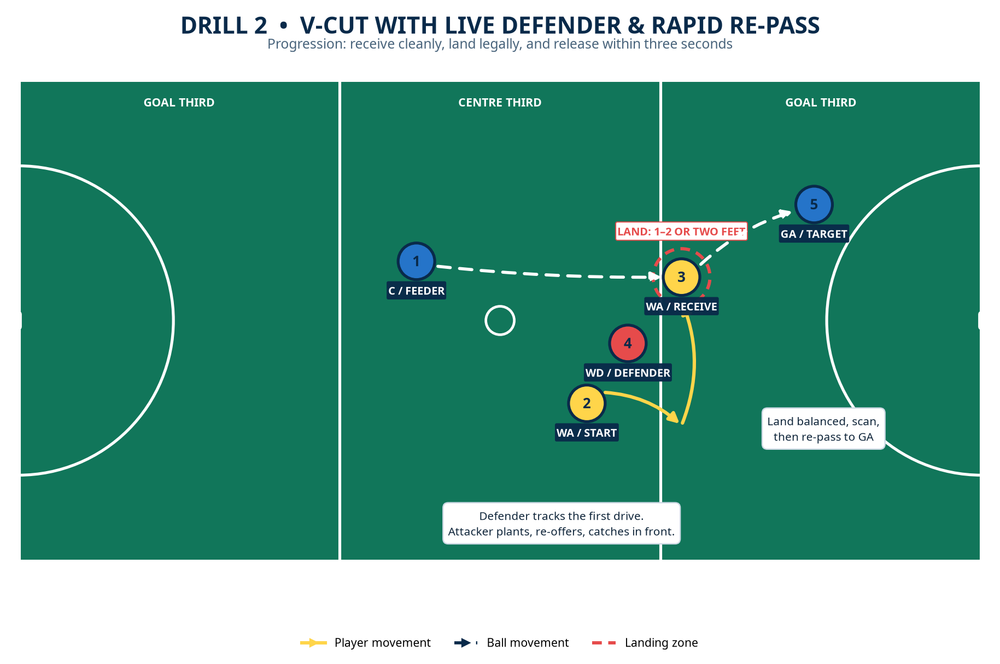
Scan and release. Once balanced, the Worker turns or pivots legally, looks to Player 5 (GA), and makes a clean pass within the three-second possession window. The GA returns the ball to the C/Feeder, while the Worker joins the opposite queue. Keep the repetition moving but never let speed erase the landing check.
Change the side. After three 35-second rounds, reverse the lane. Right-foot and left-foot plant exposure must be balanced; do not let players always cut onto their preferred side.
Key Coaching Points
- Create space before you ask for the ball. The first three steps must be decisive. If the drive does not threaten the defender, the V-cut has no bite.
- Plant beneath the body, not ahead of it. An overreaching plant makes the player lean and slows the push-off. Cue: “hip over foot, then explode away.”
- Separate catching from passing. Secure the ball first, then scan. Younger players especially rush the next pass before their feet and body are settled.
- Land quietly and flex through the hips and knees. Soft, balanced landings reduce unnecessary sway and make the next pivot or pass more reliable.
- Show hands early and take the ball in front. A player who waits for the ball invites interception and tends to land late or off balance.
- Use the eyes intelligently. Read the ball through the catch, then lift the eyes to the next option after balance is established.
Common Mistakes and Corrections
| Mistake to watch | What it usually means | Immediate coaching correction |
|---|---|---|
| Rounded cut | The player is drifting instead of changing direction. | Place a flat cone at the plant point and cue “plant, push, re-offer.” |
| Straight-legged or noisy landing | The athlete is bracing late or arriving too fast for their control. | Reduce the pass distance by 1 m and ask for a one-second stick before any pass. |
| Catching behind the body | Hands are late or the player has stopped tracking the ball. | Cue “hands early, ball in front, step through.” |
| Extra steps after the catch | The player has not decided their landing pattern before receiving. | Rehearse the pattern without a ball, then reintroduce a slower feed. |
| Passing before balance | The player is trying to solve the next action before owning the catch. | Require a visible chin-up scan after the stick, then release. |
Variations & Progressions
1. Easier: Stationary Catch and Landing Map
For new or younger players, remove the V-cut. Have the WA step forward from 2–3 m, take a gentle feed, and land inside a marked 1 m landing box. Alternate 1–2 and two-foot landings. The coach should use this variation for 4–6 quality repetitions before adding speed.
2. Harder: Live WD Shadow
Add Player 4 as a WD. Start the defender half a metre behind the WA, initially at 50% pressure. The defender tracks the first drive but must release the attacker on the cut. Once the WA can land cleanly in three consecutive reps, allow the WD to contest the pass legally. This makes timing and lead angle matter without losing the landing focus.
3. Game Transfer: Three-Second Re-Pass
Keep the live defender and add the GA target. The receiving WA must land, pivot, scan and pass to GA within three seconds. Award one point for a legal clean catch-and-stick, one point for a successful re-pass, and reset the score to zero after a footwork call. The scoring makes players value technical quality under pressure.
Age Adaptations
| Group | How to adapt the session | Success measure |
|---|---|---|
| Under 8 | Use a 2–3 m feed, one clear forward lead and a two-foot landing only. Keep the language simple: “run, catch, freeze.” | Five quiet balanced catches each side. |
| Under 10 | Introduce a small V-cut without a defender. Mark a wide 1 m landing zone and alternate plant feet. | Four clean 1–2 landings and four two-foot landings. |
| Under 12 | Use the full unopposed pattern at a controlled speed. Ask players to identify their landing foot and pivot option aloud. | Eight of ten catches stuck for one second. |
| Under 14 | Add a passive WD and a GA re-pass target. Increase the drive to 3–4 m while preserving balanced landings. | Three consecutive legal reps under pressure. |
| Under 16 / Open | Make the WD live, use both sides, and impose the re-pass decision within three seconds. Review video or partner feedback between rounds. | Clean catch, legal landing and purposeful next pass at match pace. |
Finish with one minute of player reflection: ask each athlete which landing pattern felt most stable and whether they could still see the next pass after contact with the floor. That answer tells you whether to progress speed, add pressure or return to the landing map next session.
