Pressure Cooker: Free Throw Routine & Rebound Rotation Drill
Build consistent free throw mechanics under pressure while reinforcing critical box-out habits for your rebounders.
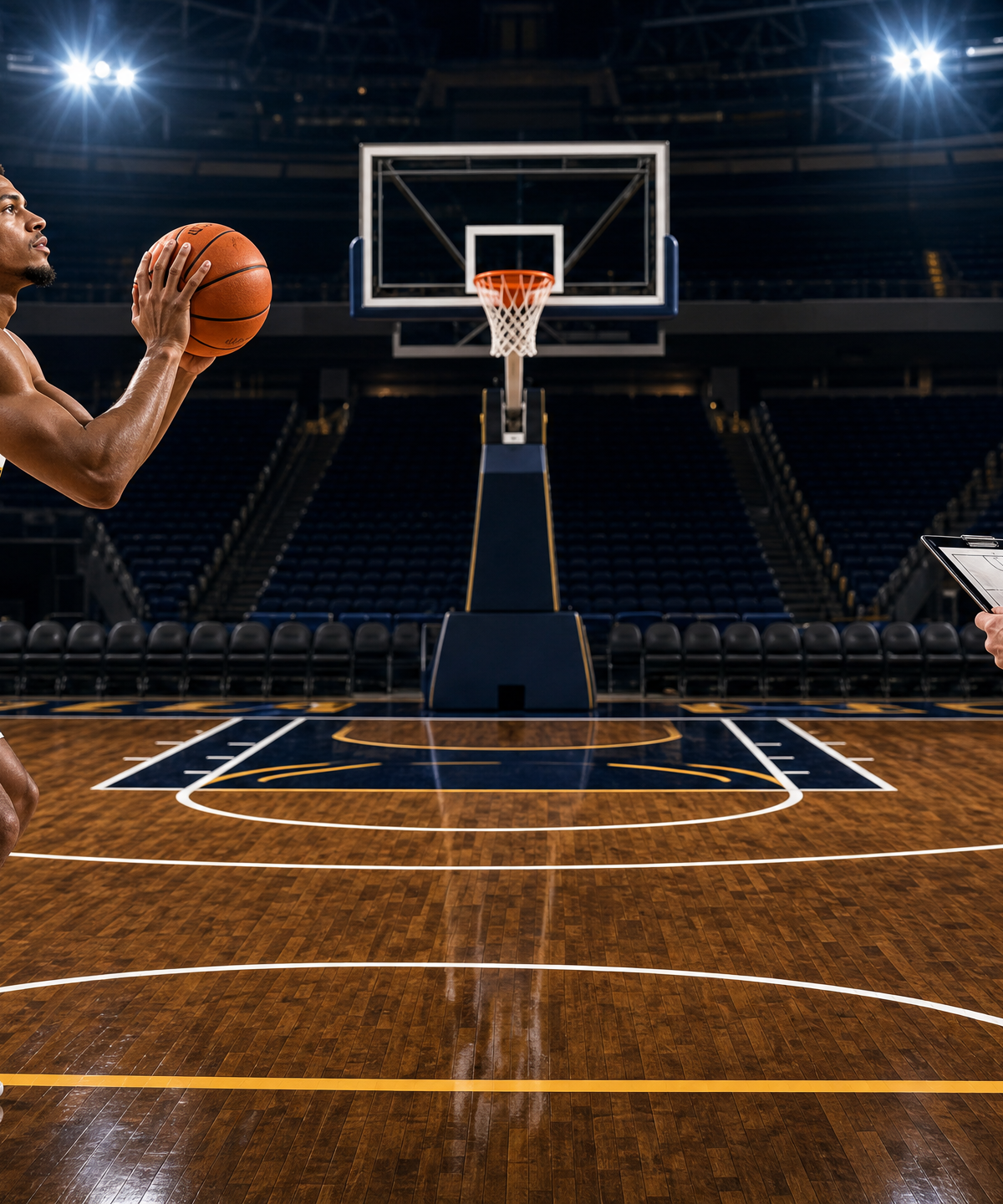
Equipment Needed
1. Overview
The free throw line is often where tight games are won or lost. However, players frequently practice free throws in relaxed, unstructured environments that fail to simulate game conditions. The Pressure Cooker Free Throw Routine drill is designed to bridge that gap.
This drill achieves two critical objectives simultaneously: it forces the shooter to execute their established pre-shot routine with game-like pacing, and it provides live, physical box-out repetitions for the rebounders. By integrating rebounding into shooting practice, coaches can maximize court time and ensure that players maintain focus on the fundamental details of securing possession after a missed shot.
Use this drill toward the end of practice when players are fatigued, simulating the physical and mental state they will experience late in the fourth quarter.
2. Setup
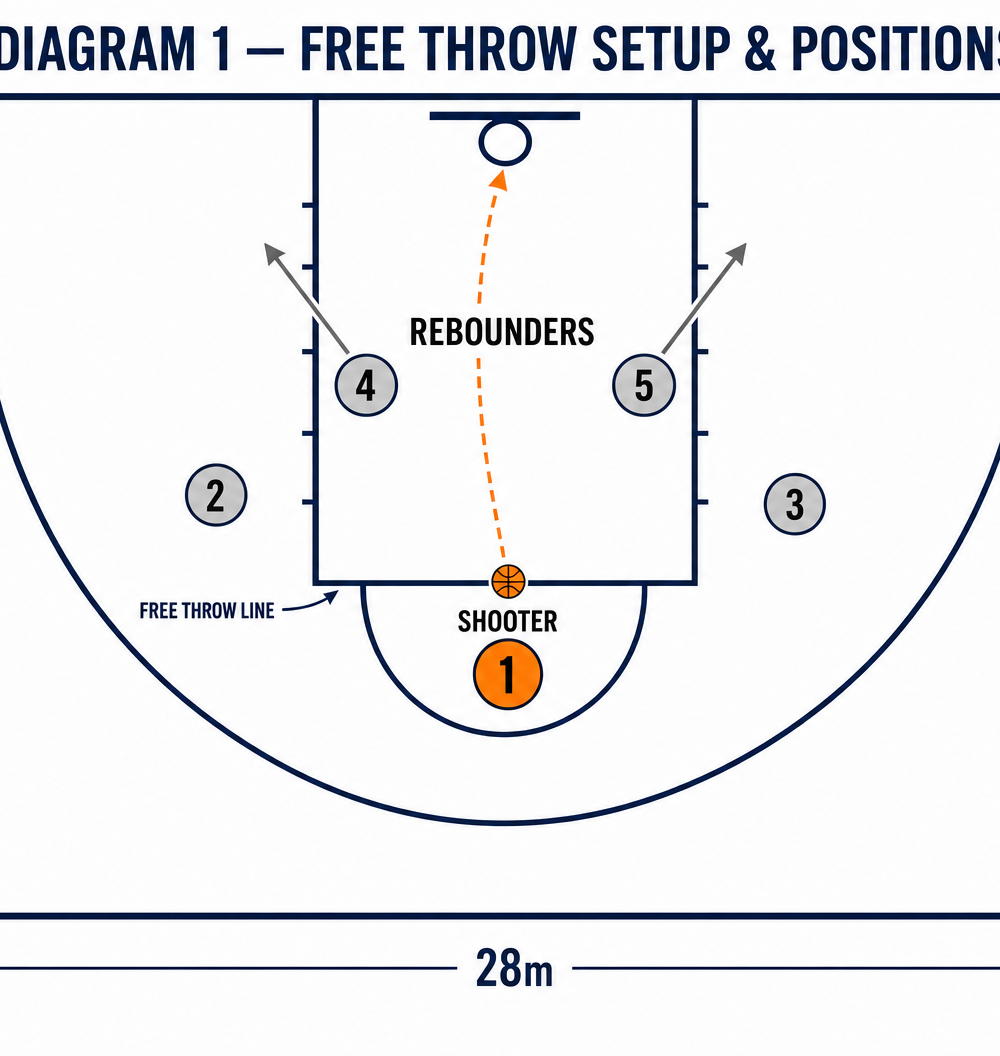
To run this drill effectively, you will need a standard FIBA basketball half-court (28m x 15m), one basketball per group, and a minimum of 5 players.
Court Setup & Player Positions
- Shooter (Position 1): Stands at the free throw line with the basketball.
- Rebounders (Positions 4 & 5): Positioned on the left and right low-post blocks, just outside the lane lines.
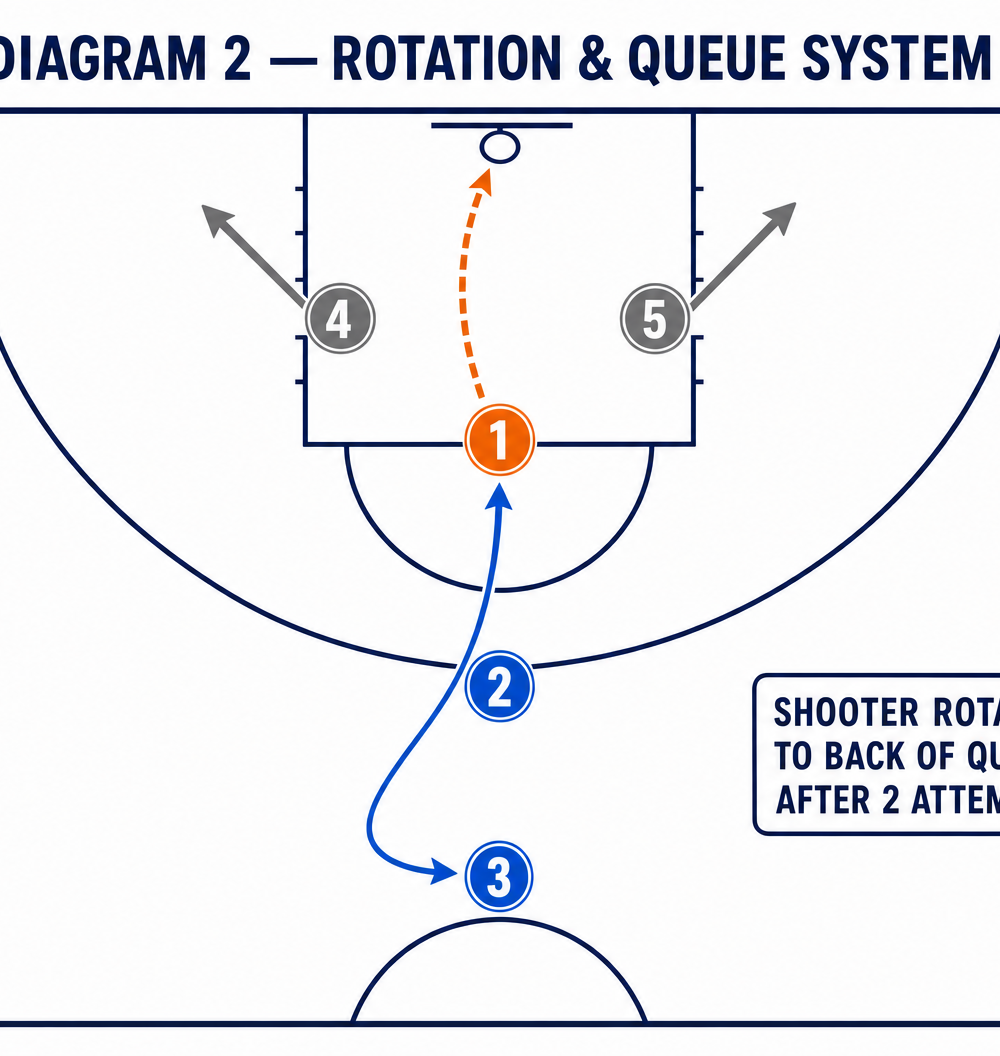
- Queue (Positions 2 & 3): Position 2 stands at the top of the key, waiting to rotate in. Position 3 stands near half-court.
3. Step-by-Step Instructions
Follow these steps to execute the drill with precision:
- Initiate the Routine: The coach blows the whistle. The shooter (Player 1) steps to the line and executes their personal pre-shot routine (e.g., two dribbles, deep breath, spin the ball).
- The Shot: The shooter releases the free throw. They must hold their follow-through until the ball hits the rim or passes through the net.
- The Box-Out: As soon as the ball leaves the shooter's hands, the two rebounders (Players 4 and 5) step into the lane, make physical contact with an imaginary offensive player (or a coach holding a pad), and secure inside rebounding position.
- Secure the Rebound: If the shot is missed, Players 4 and 5 compete for the rebound. If the shot is made, the ball is quickly retrieved and passed to the next player in the queue.
- Rotation: After the shooter attempts exactly two free throws, they rotate to the back of the queue (near half-court). Player 2 steps up to the free throw line to become the new shooter. Player 3 moves to the top of the key.
- Rebounder Swap: After every 5 rotations (10 total free throws), swap the rebounders with players from the shooting queue to ensure everyone gets practice in both roles.
4. Key Coaching Points
To get the most out of this drill, focus your coaching on these critical elements:
- Routine Consistency: Demand that players use the exact same pre-shot routine on every single attempt. Consistency breeds confidence.
- Hold the Follow-Through: The shooter's shooting hand should remain in the "gooseneck" position until the ball completes its flight.
- Early Box-Out Movement: Rebounders must initiate their box-out movement the moment the ball is released, not after it hits the rim.
- Vocalize: Encourage players in the queue to create a game-like, noisy environment to test the shooter's focus.
5. Common Mistakes
Watch for and immediately correct these common errors:
- Rushing the Shot: Players often speed up their routine when they know others are waiting. Force them to slow down and breathe.
- Watching the Flight: Rebounders getting caught "ball-watching" instead of finding a body to box out.
- Stepping Over the Line: Shooters crossing the free throw line before the ball hits the rim (a violation).
6. Variations & Progressions
Keep the drill fresh and challenging with these modifications:
- Consequence Free Throws: If a player misses both free throws, the entire team runs a baseline sprint.
- Live Rebounding: Add two offensive players to the perimeter who crash the boards on the release, creating a live 2-on-2 rebounding situation.
- Fatigue Factor: Require the shooter to complete a full-court sprint before stepping to the line for their attempts.
7. Age Adaptations
Adjust the drill based on the developmental level of your team:
- Under 10 / Under 12: Allow players to shoot from a closer distance (e.g., 1 meter inside the standard free throw line). Focus heavily on basic form rather than the box-out.
- Under 14 / Under 16: Introduce the live rebounding variation to increase physical toughness and game realism.
- Open / Advanced: Incorporate the fatigue factor and consequence variations to maximize mental pressure.