

Rugby
Attacking Backs Move Off First Phase: The Flat Line Strike
Master this essential first-phase backs move to manipulate the defensive line, create space out wide, and unleash your fullback as a lethal strike runner.
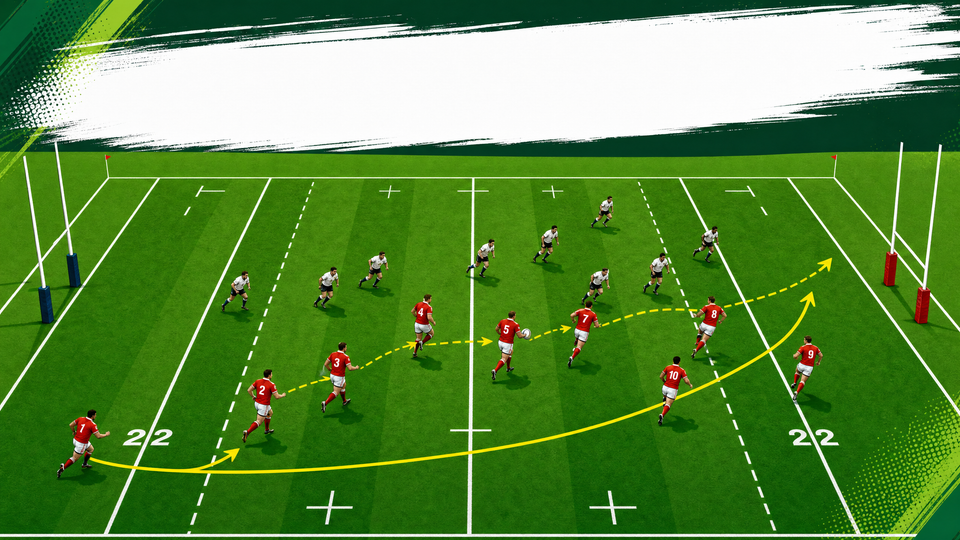
What you need
1 Rugby Ball, Cones, Bibs
1. Overview
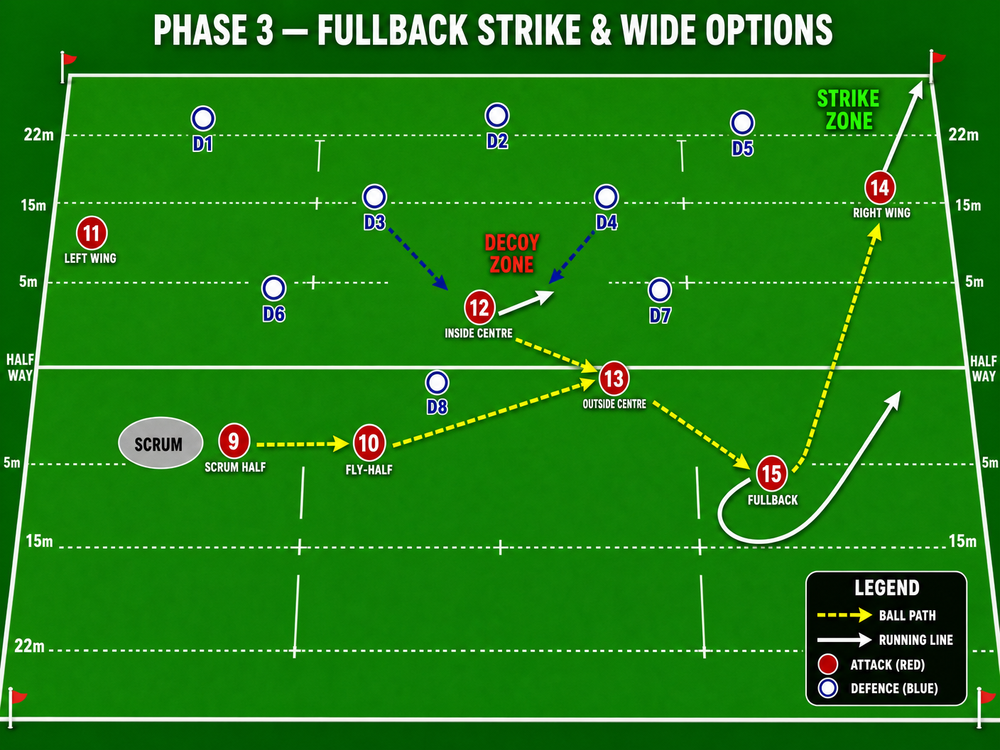
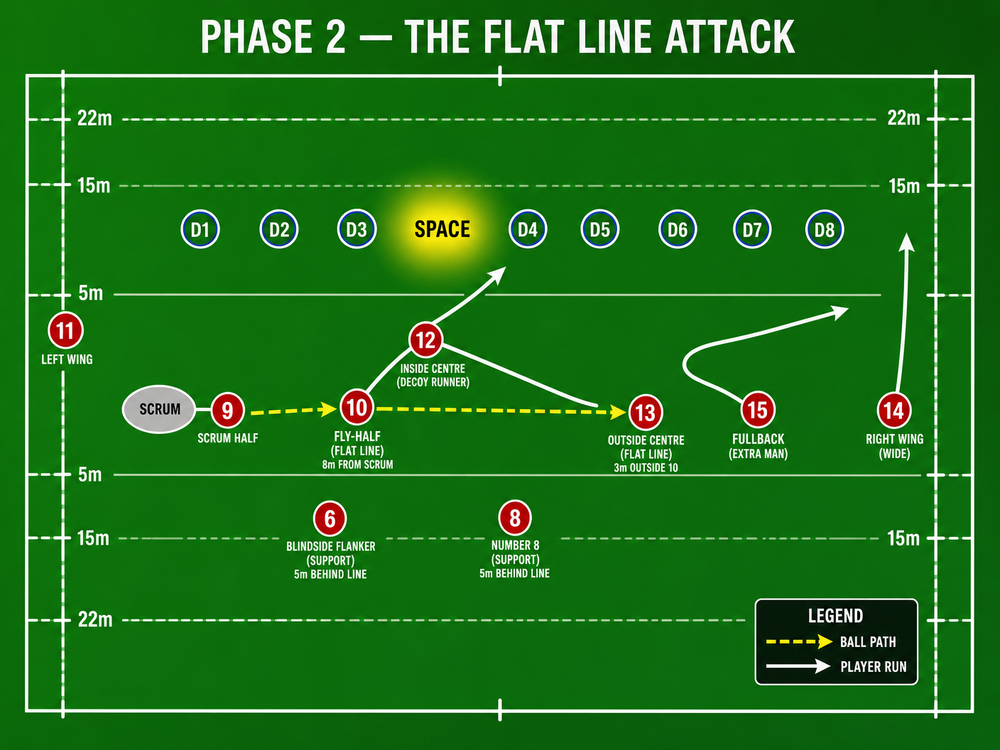
The "Flat Line Strike" is a highly effective first-phase attacking move designed to break down organized defenses directly from a set-piece, typically a scrum. By utilizing flat, aggressive running lines from the Fly-half (10) and Outside Centre (13), combined with a hard decoy line from the Inside Centre (12), this play forces defenders to commit early. The ultimate goal is to create a numerical advantage out wide, allowing the Fullback (15) to enter the line at pace and release the winger into space.
This move is particularly useful when the opposition defense employs a drift system or when you have a dynamic, pacey fullback who can exploit gaps in the wider channels.
2. Setup
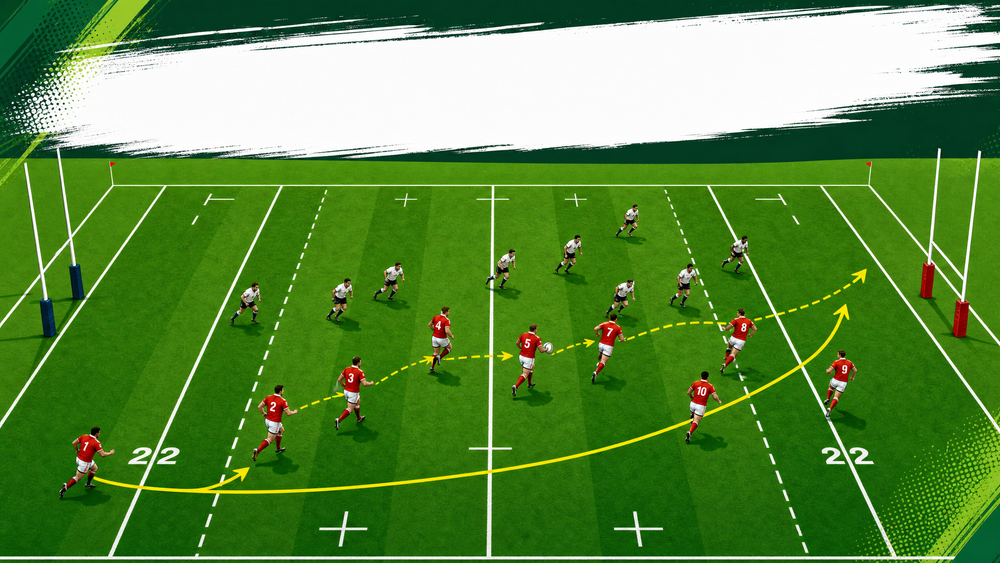
Equipment Needed:
- 1 Rugby Ball
- Cones (to mark starting positions and defensive alignment if running unopposed)
- Bibs (for opposed training)
Pitch Setup:
- Standard 100m x 70m pitch.
- Set up a scrum (or a simulated breakdown point) in the center-left of the pitch, approximately 15 meters in from the touchline.
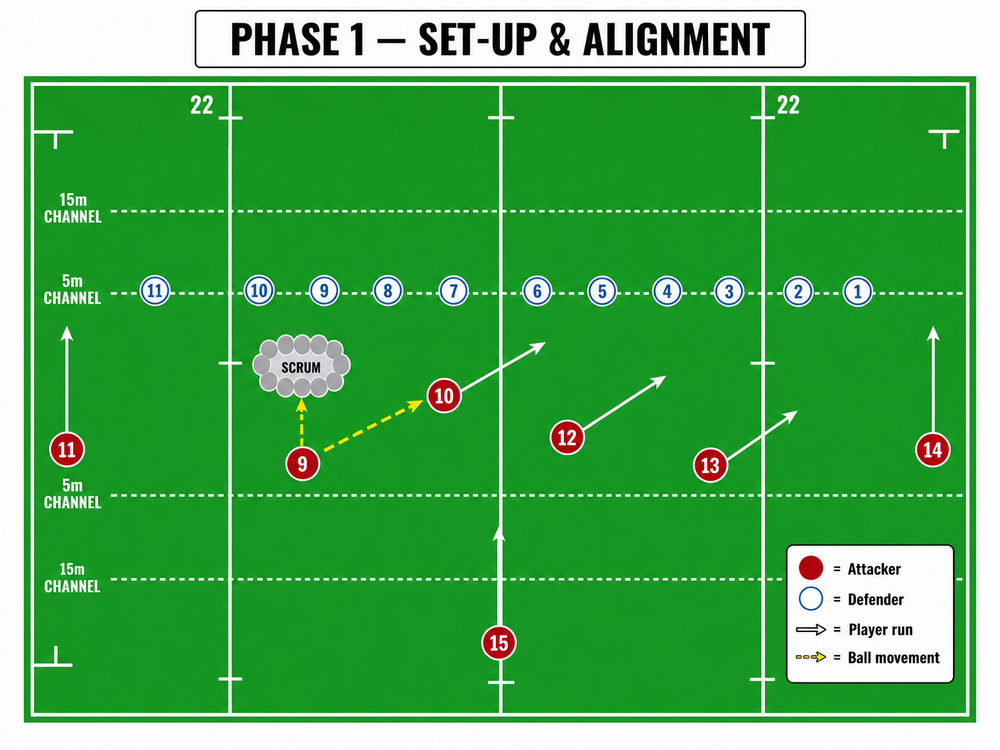
Player Positions:
- 9 (Scrum-half): Base of the scrum.
- 10 (Fly-half): Positioned flat, about 8-10 meters deep and 5 meters to the right of the scrum.
- 12 (Inside Centre): Positioned slightly deeper than 10, ready to run a hard inside line.
- 13 (Outside Centre): Positioned wide, about 10-12 meters outside 10, maintaining a flat alignment.
- 11 (Left Wing): Holding width on the left touchline.
- 14 (Right Wing): Holding width on the right touchline, ready to accelerate.
- 15 (Fullback): Positioned deep (15-20 meters back), tracking the play and timing the run to join the line outside 13.
3. Step-by-Step Instructions
- The Delivery: The Scrum-half (9) clears the ball quickly and accurately from the base of the scrum to the Fly-half (10).
- The Threat: The Fly-half (10) catches the ball on the move, attacking the defensive line flat and hard to fix the opposing 10 and inside defenders.
- The Decoy: As 10 receives the ball, the Inside Centre (12) runs a sharp, aggressive inside-to-outside line (a "hard unders" line), cutting across the face of the defense to draw the attention of the defending 12 and 13.
- The Pass: The Fly-half (10) throws a crisp, flat pass across the face of the decoy (12) to the Outside Centre (13), who is running a flat line into the space created.
- The Extra Man: The Fullback (15), having timed their run from deep, injects pace and loops around outside the 13. The Outside Centre (13) draws the final defender and passes to the Fullback (15).
- The Strike: The Fullback (15) now has a 2-on-1 advantage against the opposing winger. They draw the defender and deliver the final pass to the Right Wing (14), who accelerates down the touchline to score.
4. Key Coaching Points
- Depth and Pace: The Fly-half (10) must start with enough depth to catch the ball at full pace, but run flat enough to engage the defensive line before passing.
- Selling the Decoy: The Inside Centre (12) must be convincing. They must call for the ball, run hard, and genuinely look like they are expecting the pass. If the decoy is lazy, the defense will drift.
- Timing of the Fullback: The Fullback (15) must not arrive too early. The run should be timed so they hit the line at maximum velocity just as the 13 receives the ball.
- Communication: Clear, concise calls are essential. The 10 needs to know the 13 and 15 are in position, and the 15 must communicate their arrival to the 13.
- Catch and Pass under Pressure: The 10 and 13 must execute accurate passes while moving at speed and dealing with oncoming defenders.
5. Common Mistakes
- Passing Too Early: If the 10 or 13 passes before fixing their defender, the defense will simply drift and cover the overlap.
- Lateral Running: Attackers running sideways rather than attacking the gain line will allow the defense to easily slide and shut down the space.
- Fullback Arriving Too Early: If the 15 gets flat too soon, they lose their momentum and become an easy target for the defense.
- Poor Decoy Line: A weak decoy run by the 12 fails to hold the inside defenders, allowing them to drift out and neutralize the attack.
6. Variations & Progressions
- Progression 1: Opposed (Touch): Introduce a passive defensive line that drifts. The attack must execute the play at speed to beat the drift.
- Progression 2: Opposed (Live): Introduce a live defensive line that can choose to blitz or drift. The attack must read the defense and execute the appropriate option (e.g., if the defense blitzes, the 10 might take the tackle or play a short ball to the 12).
- Variation 1: The Inside Ball: If the defense begins to over-read the wide pass, the 10 can hit the 12 on the hard inside line (the decoy becomes the primary option).
- Variation 2: The Kick Pass: If the defense rushes up flat, the 10 or 13 can execute a cross-field kick to the winger (14) in space behind the defensive line.
7. Age Adaptations
- Under 10/12: Focus heavily on the basics: catching, passing, and running straight. Simplify the move by removing the decoy runner initially. Emphasize the 10 fixing their defender before passing.
- Under 14/16: Introduce the decoy runner (12) and focus on timing and communication. Start practicing against a passive defense to build confidence.
- Open (Senior): Full execution at match intensity. Emphasize reading the defense, adjusting depth, and executing variations based on defensive alignment.
