

Rugby
The Decoy Crash: Creating Second-Phase Space
Learn how to use flat and wide decoy runners to isolate a defender, crash the gain line, and create disorganization for devastating second-phase attacks.

What you need
1 Rugby Ball, 6-8 Cones, Training Bibs (2 colors)
Overview
The 'Decoy Crash' is a fundamental attacking set play designed to manipulate the defensive line, guarantee gain-line success, and create highly exploitable space on the second phase. By utilizing a flat decoy runner (usually the Fly-half or a forward) and a wide looping decoy, the defense is forced to hesitate or commit early. This hesitation isolates a specific defender, allowing your primary ball carrier (typically a powerful Inside Centre) to crash over the gain line on their own terms. The ultimate goal is not necessarily to score on the first phase, but to generate quick ruck ball against a scrambling, disorganized defensive line.
Setup
- Equipment Needed: 1 rugby ball, 6-8 cones (to mark the defensive line and ruck area), and bibs for defenders.
- Pitch Setup: Utilize a 40m x 70m area of the pitch. Mark a clear gain line and a starting ruck/breakdown point approximately 15 meters in from the touchline.
- Player Positions:
- Attack (Blue): Scrum-half (9), Fly-half (10), Inside Centre (12), Outside Centre (13), Blindside Flanker (6), Number 8 (8), Left Wing (11), Fullback (15).
- Defense (Red): A standard defensive pod of 6-7 players aligned opposite the ruck.
Step-by-Step Instructions
Phase 1: The Setup and Crash
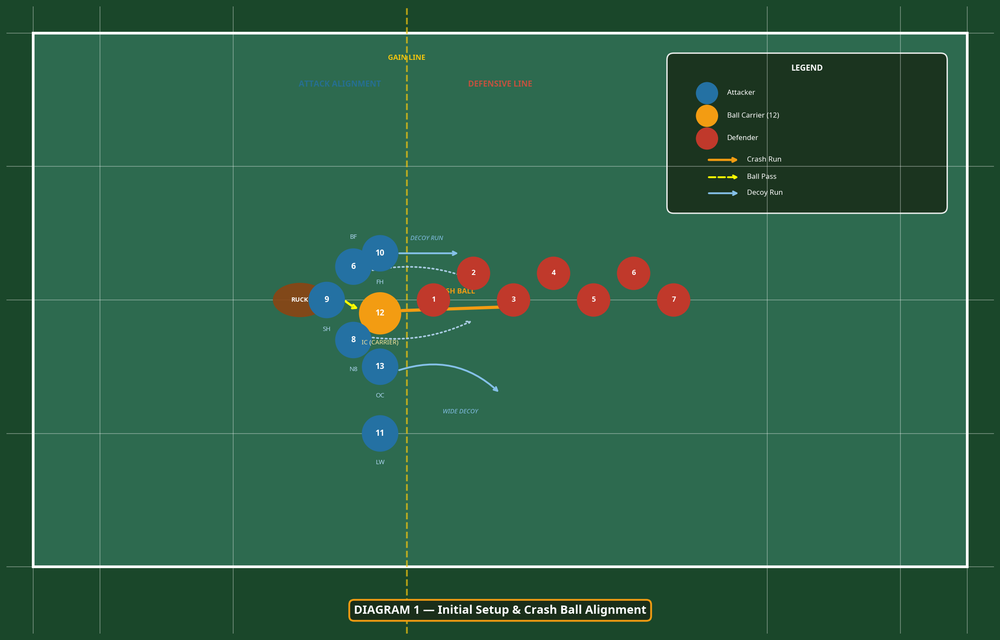
- The Alignment: The attacking backline aligns with depth. The Fly-half (10) stands relatively flat, while the Inside Centre (12) starts deeper, running a hard, direct angle. The Outside Centre (13) aligns wide to run a looping decoy line.
- The Delivery: The Scrum-half (9) clears the ball from the ruck. As the ball is in the air, the Fly-half (10) runs a hard, flat decoy line directly at the inside shoulder of the targeted defender, drawing their attention and fixing them in place.
- The Pass: The Scrum-half bypasses the Fly-half, throwing a crisp, flat pass directly to the Inside Centre (12) who is accelerating onto the ball at pace.
- The Wide Decoy: Simultaneously, the Outside Centre (13) runs a wide, sweeping decoy line behind the Inside Centre, pulling the wider defenders outward and preventing them from folding in to help make the tackle.
- The Contact: The Inside Centre (12) receives the ball at top speed, targeting the outside shoulder of the isolated defender. The carrier must fight through the contact, pump their legs, and ensure they cross the gain line before going to ground.

Phase 2: Exploiting the Space
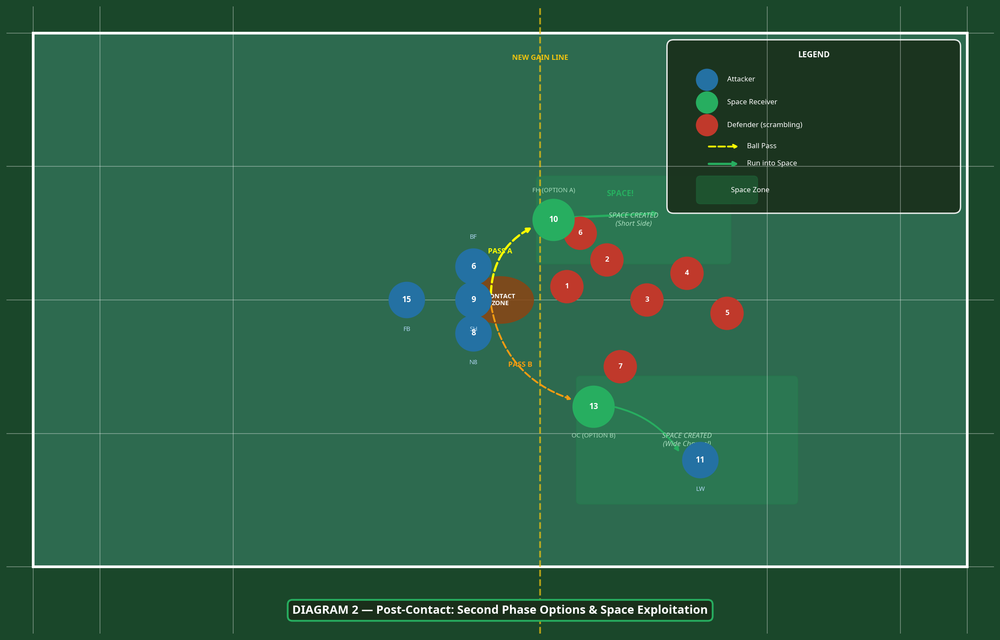
- The Clear-out: The support runners (6 and 8) must track the Inside Centre's run perfectly. As soon as the tackle is made, they must arrive aggressively to clear out any defensive threats and secure lightning-quick ruck ball (under 3 seconds).
- The Realignment: Because the initial crash drew multiple defenders into the tackle zone, significant space has now opened up. The Fly-half (10) wraps around the ruck to the short side, while the Outside Centre (13) and Left Wing (11) hold their width on the open side.
- The Decision: The Scrum-half (9) arrives at the ruck and scans the defense.
- Option A (Short Side): If the defense has folded heavily to the open side, the Scrum-half hits the Fly-half (10) attacking the short-side space.
- Option B (Wide Channel): If the defense has pinched in around the ruck, the Scrum-half fires a long pass to the Outside Centre (13) or Fullback (15) to exploit the numerical advantage out wide.
Key Coaching Points
- Timing is Everything: The decoy runners must sell their lines convincingly. If they run too early, the defense will ignore them; if they run too late, they will obstruct the pass.
- Depth of the Carrier: The Inside Centre (12) must start deep enough to hit the ball at absolute maximum velocity. A static ball carrier will be easily stopped behind the gain line.
- Targeting Shoulders: The ball carrier must not run directly at the defender's chest. They must target the weak shoulder (usually the outside shoulder) to break the tackle or ensure a dominant collision.
- Support Runner Tracking: The forwards (6 and 8) cannot wait to see if a tackle is made. They must anticipate the contact point and arrive simultaneously with the ball carrier going to ground.
- Scrum-half Vision: The 9 must keep their head up as they approach the second-phase ruck. The decision to play short or wide must be made before they touch the ball.
Common Mistakes
- Lazy Decoy Lines: Decoy runners jogging through their lines or not calling for the ball. Defenders will read this instantly and drift onto the actual ball carrier.
- Lateral Running: The Inside Centre drifting sideways before contact, which allows the defense to slide and shuts down the space for the wide attackers.
- Slow Support: Forwards arriving late to the breakdown, resulting in a turnover or slow ball, which allows the defense to realign and negates the advantage of the crash ball.
Variations & Progressions
- The 'Pop' Pass: If the defender commits fully to the Inside Centre (12) before the pass arrives, the 12 can run a hard decoy line, and the Scrum-half can pop the ball short to a forward running an inside line.
- The Pull-Back: The Inside Centre receives the ball but immediately plays a pull-back pass to the Fly-half wrapping around behind them, completely bypassing the blitzing defensive line.
Age Adaptations
- Under 10s / Under 12s: Focus purely on the timing of the pass and the depth of the ball carrier. Simplify the play to just one decoy runner. Emphasize safe contact and strong body position over complex second-phase decisions.
- Under 14s / Under 16s: Introduce the second wide decoy runner. Focus heavily on the speed of the clear-out and the Scrum-half's decision-making on the second phase. Begin demanding quick ball (under 4 seconds).
- Open / Senior: Execute at full game speed with multiple variations. The focus should be on manipulating specific defenders based on pre-game analysis and exploiting micro-spaces on the second phase.
