Connected Defensive Drift Pattern Drill: 5v5 Edge Control
Build a connected, fast-moving defensive line that pressures wide attacks without surrendering the touchline or leaving a soft inside shoulder.

Equipment Needed
Overview
A good drift defence is not five players sprinting sideways. It is a connected line using square body shape, shared line speed and clear communication to make the attack move the ball before it is ready. This 5v5 edge-control drill teaches the chain from scrum-half (9) to wing (14), with the full-back (15) providing cover once the ball reaches the outside. Run it when your side is conceding outside breaks, your 13–14 channel is getting isolated, or you need to rehearse a simple post-ruck call before a conditioned game.
Begin without contact so players own spacing, then introduce controlled tackle-and-reload. Use the maximum 100 m x 70 m pitch as the reference; 22 m, halfway and touch lines are useful landmarks.1 Keep the working area small enough to coach the edge in detail.

Setup
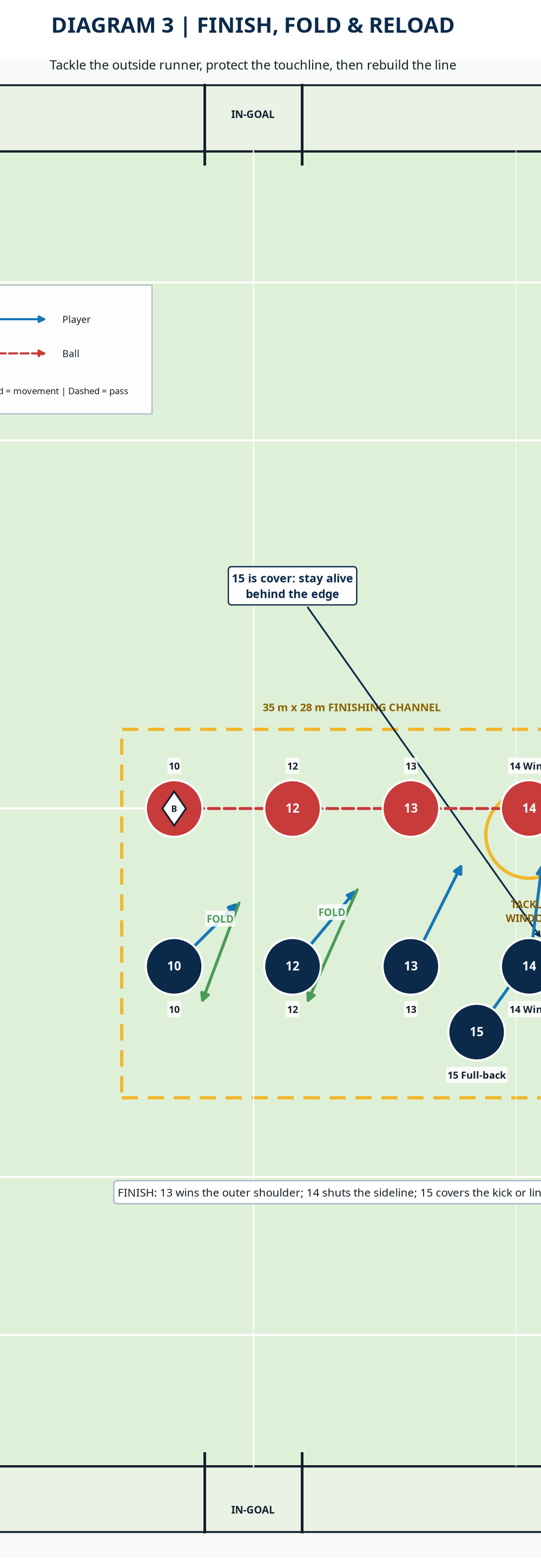
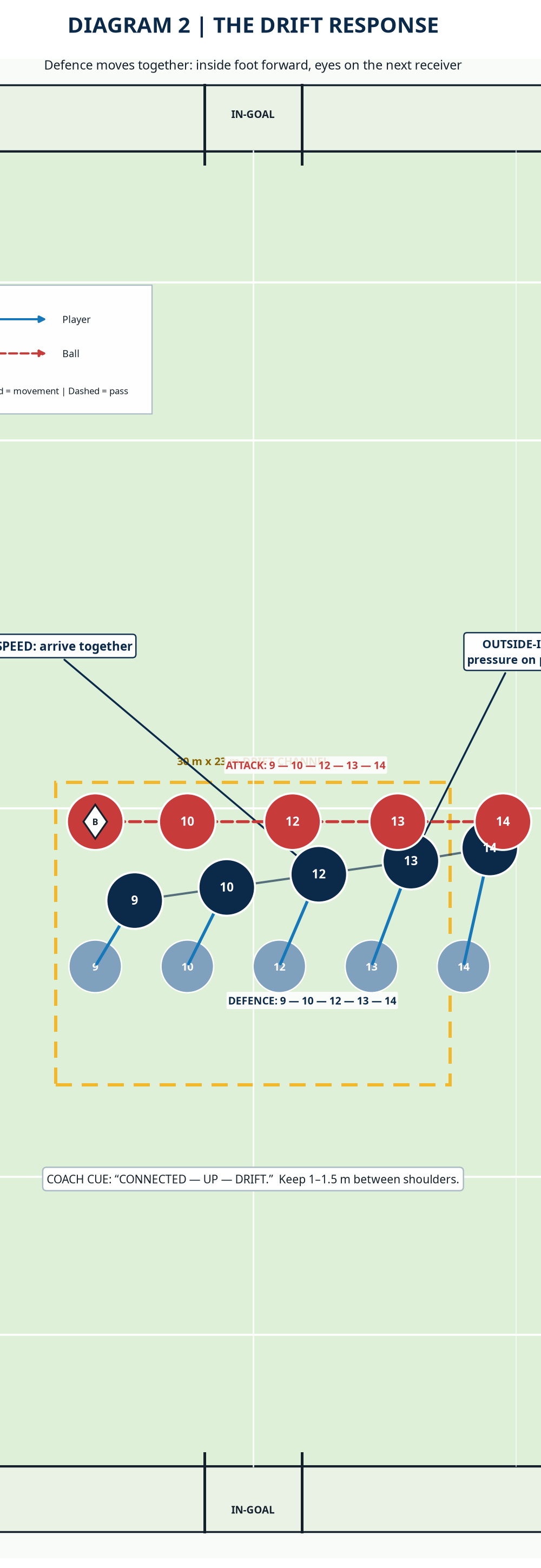
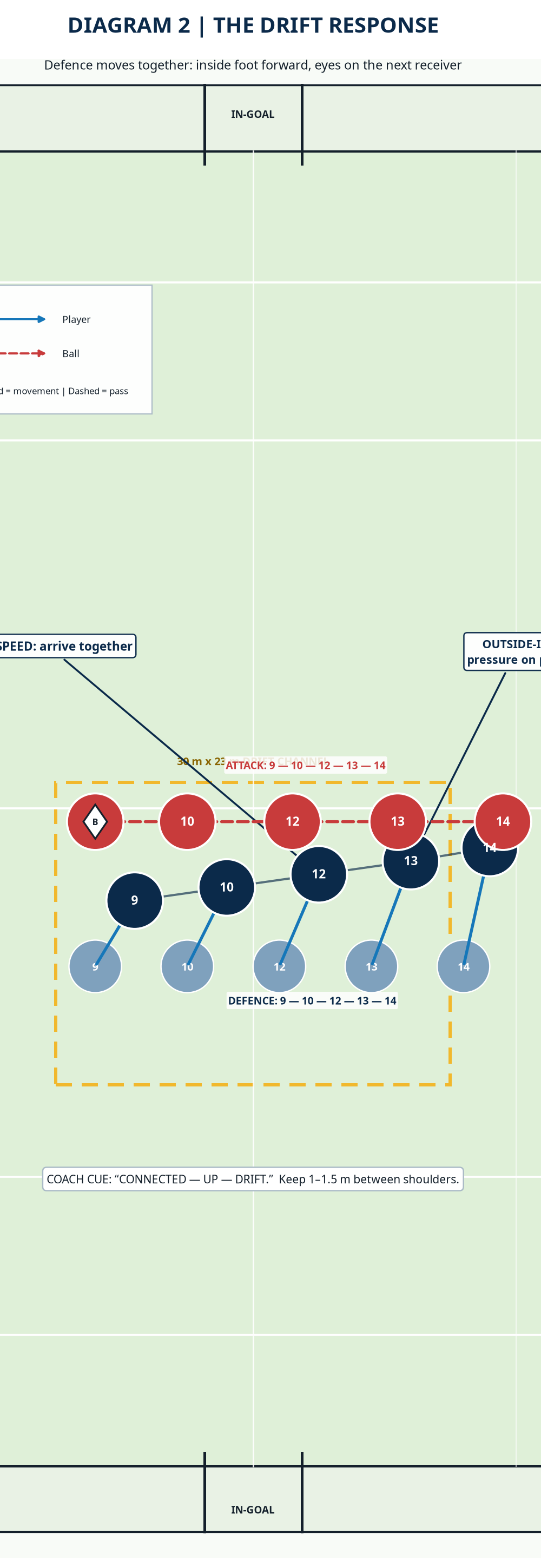
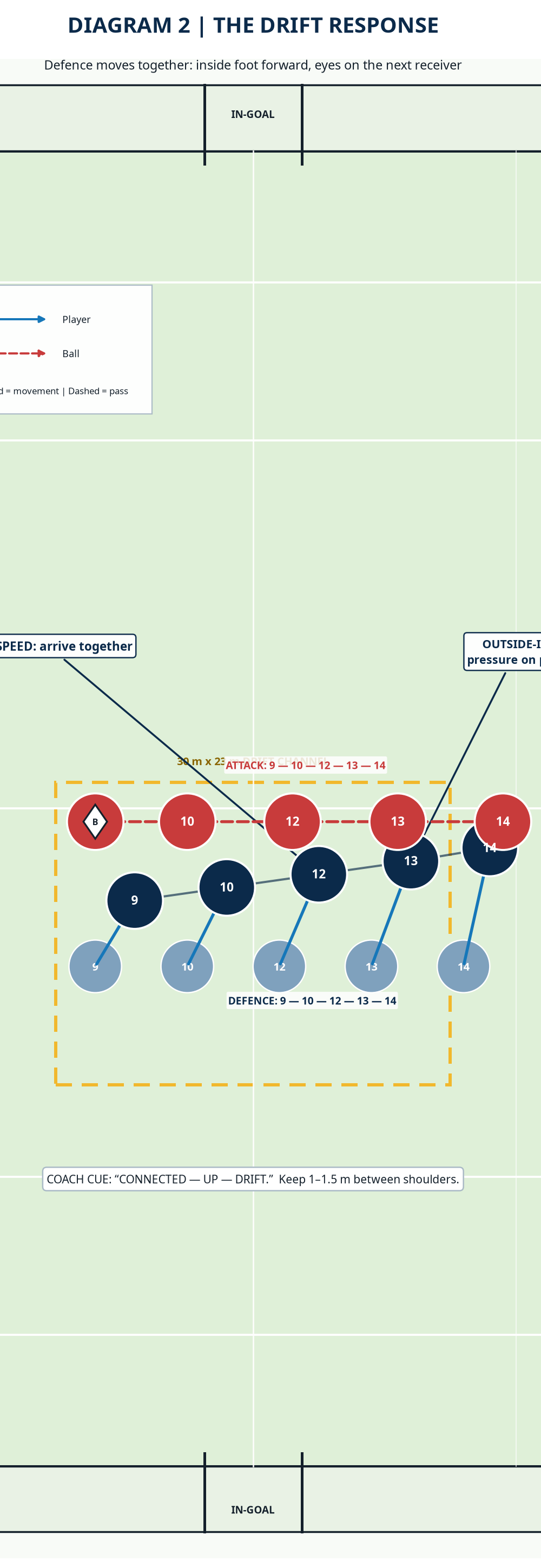
Set the main channel between the 22 m line and halfway line. Mark a 30 m wide x 23 m deep box for the working phase, then use a 20 m x 20 m box for the introductory alignment repetition. Five attackers line up as 9, 10, 12, 13 and 14. Five defenders match them as 9, 10, 12, 13 and 14; add 15 as a live cover player once the basic picture is established. Attack starts from a nominated ruck cone. The defensive 9 owns the first call, the defensive 10 confirms the line, and 13 owns the edge decision with 14.
| Item | Quantity | Coaching use |
|---|---|---|
| Flat cones | 20–24 | Mark the 20 m x 20 m and 30 m x 23 m channels, ruck cone and touchline edge |
| Rugby balls | 3–4 | Keep rapid repetitions; place a spare ball with the coach |
| Coloured bibs | 10–12 | Make attack, defence and the cover 15 instantly visible |
| Tackle shields | 2 | Introduce safe shoulder-contact and finish mechanics in the final phase |
| Whistle and stopwatch | 1 each | Control 8–12 second reps and 25–30 second reset windows |
Start each defender 1–1.5 m shoulder-to-shoulder from the next player and 5 m from the attack line. Success is simple: no outside break, a protected touchline and a connected reload.
Step-by-Step Instructions
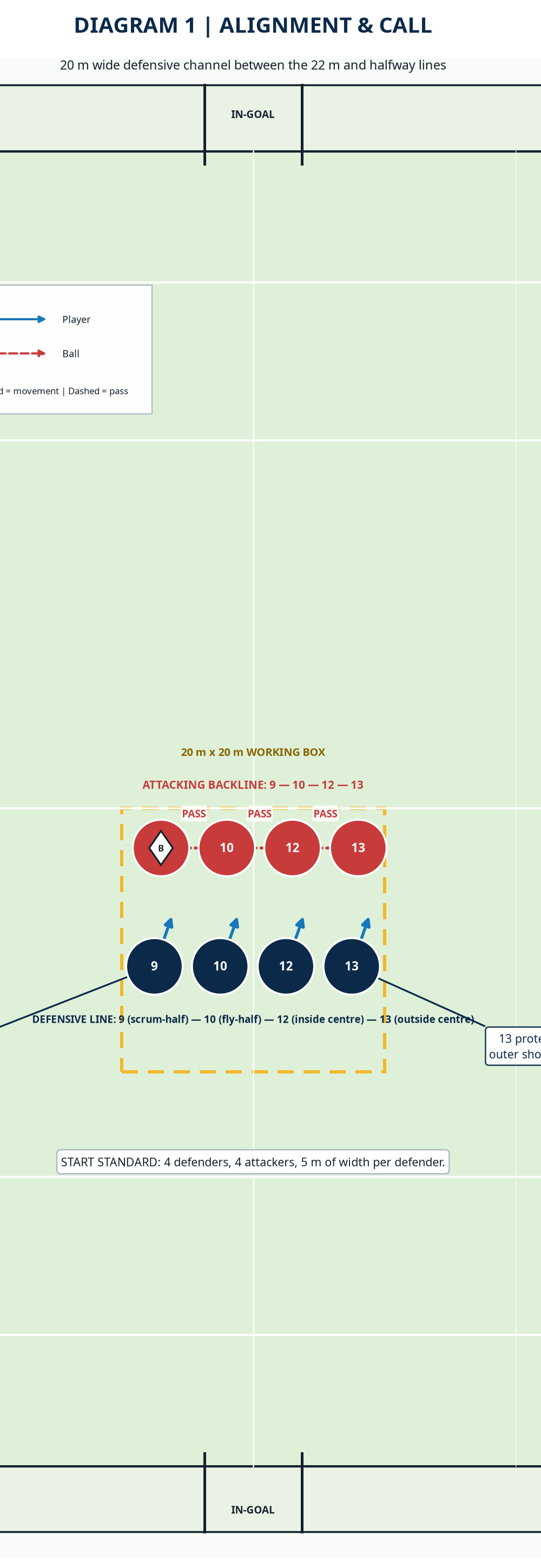
Install the picture (3 minutes). Walk players into the 20 m x 20 m box shown in Diagram 1. Put 9 at the ruck cone, with 10, 12 and 13 outside. Ask 13 to point to the outer shoulder they must own and 14 to name the space they must protect. Freeze the line until every player can see the next receiver, not simply the ball.
Rehearse the call and launch (3 minutes). On the coach’s “ball away”, defensive 9 calls “connected”; 10 echoes it; the line moves up together for two steps. On the second step, 9 calls “drift”. The group advances and slides as one unit, keeping hips and shoulders square enough to tackle. Attacking 9 passes through 10 to 12 or 13 at jogging pace. Reset immediately if a defender runs ahead of the inside shoulder.
Add a live passing decision (5 minutes). Attack has 8–10 seconds to use two or three passes and may straighten any receiver. Defenders must press the receiver in front of them, then drift only when the ball moves. Coach from behind the defence so you can see daylight between shoulders. Award defence one point when 13 and 14 close the edge without crossing or chasing the same attacker.
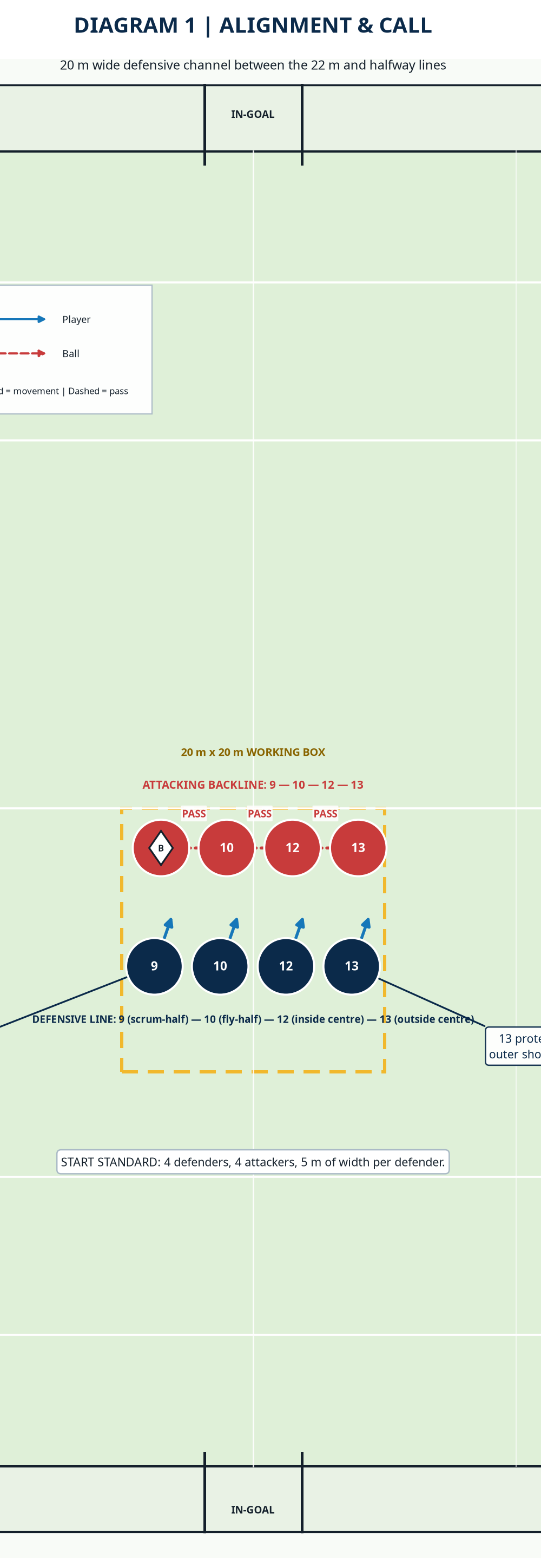
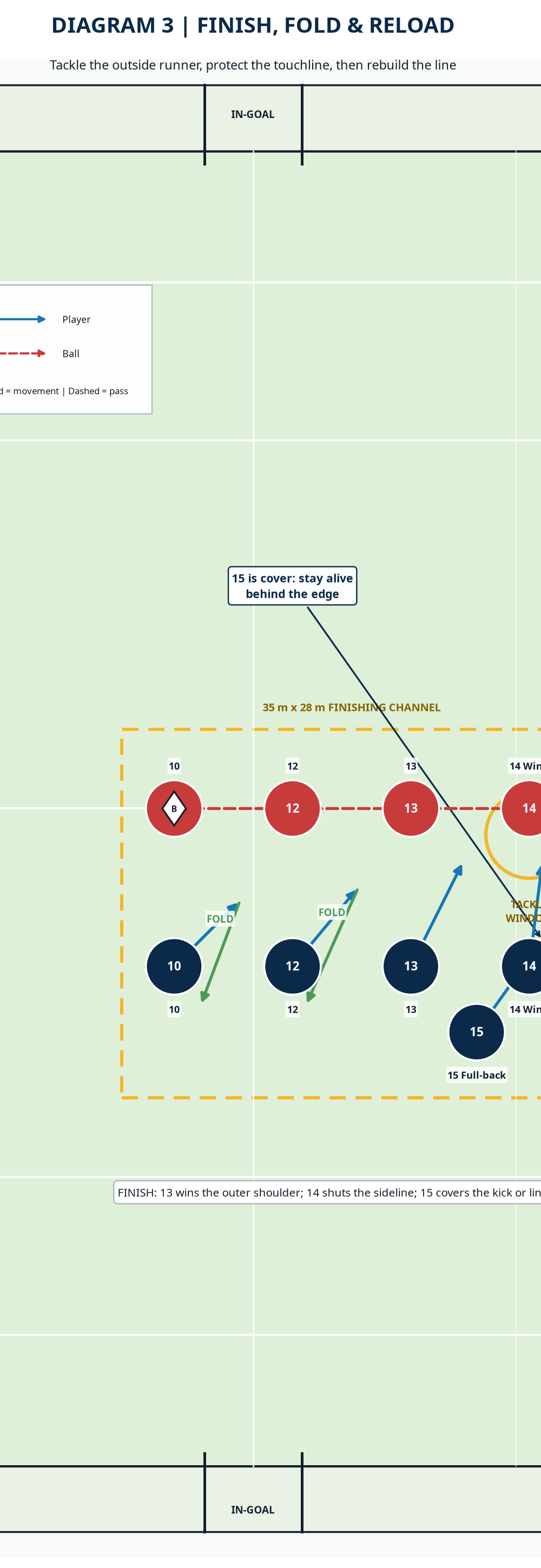
Make the edge accountable (5 minutes). Add the outside channel and nominate 14 as the final line defender. The winger’s first job is to stay connected to 13; their second is to use the touchline as an extra defender. Add 15 five metres behind and inside 14. When the pass leaves 13, 15 tracks behind the edge rather than joining the front line. This gives the team a cover layer for a kick, a late pass or a missed tackle.
Finish with controlled contact (5 minutes). Allow one designated carrier to attack the outside. 13 wins the outer shoulder, 14 closes the sideline and 15 covers inside-out. Use a shield first if your group needs it. In the live version, the first tackler makes a legal, controlled wrap; the nearest defender folds to the next ruck while the others reload on the defensive side. Stop the rep at the tackle or ruck; the learning outcome is the line shape, not a chaotic contest.
Conditioned competition (3 minutes). Play three balls each. Attack scores one point for a line-break or outside break; defence scores one for a dominant edge stop and an extra point if all players are back in a connected line within three seconds of the tackle. Change the defensive 9 and 13 every three reps so communication does not sit with one confident player.
Key Coaching Points
| Coaching focus | What the coach should demand |
|---|---|
| Connection | “See your next defender’s near shoulder.” Maintain 1–1.5 m spacing; do not leave a door for 12 or 13. |
| Line speed | Launch together on the pass, not individually on a hunch. The first two steps are forward; the drift follows the ball. |
| Shoulder ownership | 12 and 13 must win the outside shoulder of their direct threat, forcing the attack toward the touchline rather than opening the seam. |
| Eyes and feet | Eyes track the receiver’s hips and hands; feet stay alive with short square steps. Do not turn and chase too early. |
| Edge and cover | 14 protects the sideline while staying connected to 13. Player 15 stays behind the edge, scans the late pass and calls “cover”. |
| Reload | After contact, the nearest two fold and the remaining line calls a new number order immediately. |
Common Mistakes
| Error you will see | Immediate correction |
|---|---|
| 10 or 12 shoots ahead alone | Put that player back on the starting cone and rerun the two-step launch. Reinforce: “We arrive together, then we drift together.” |
| Defenders turn hips toward touch too soon | Mark a narrow gate facing the attack and require players to travel through it square before they can drift. |
| 13 and 14 chase the same carrier | Freeze the picture. Name 13 as outer-shoulder defender and 14 as sideline defender; make each state their job before restarting. |
| 15 joins the front line | Start 15 deeper, give them a cover cone and reward a clear “cover” call before the pass reaches 13. |
| A tackle ends the drill | Keep a fold cone beside the ruck. The first non-tackler must touch it and reload before the coach releases the next ball. |
Variations & Progressions
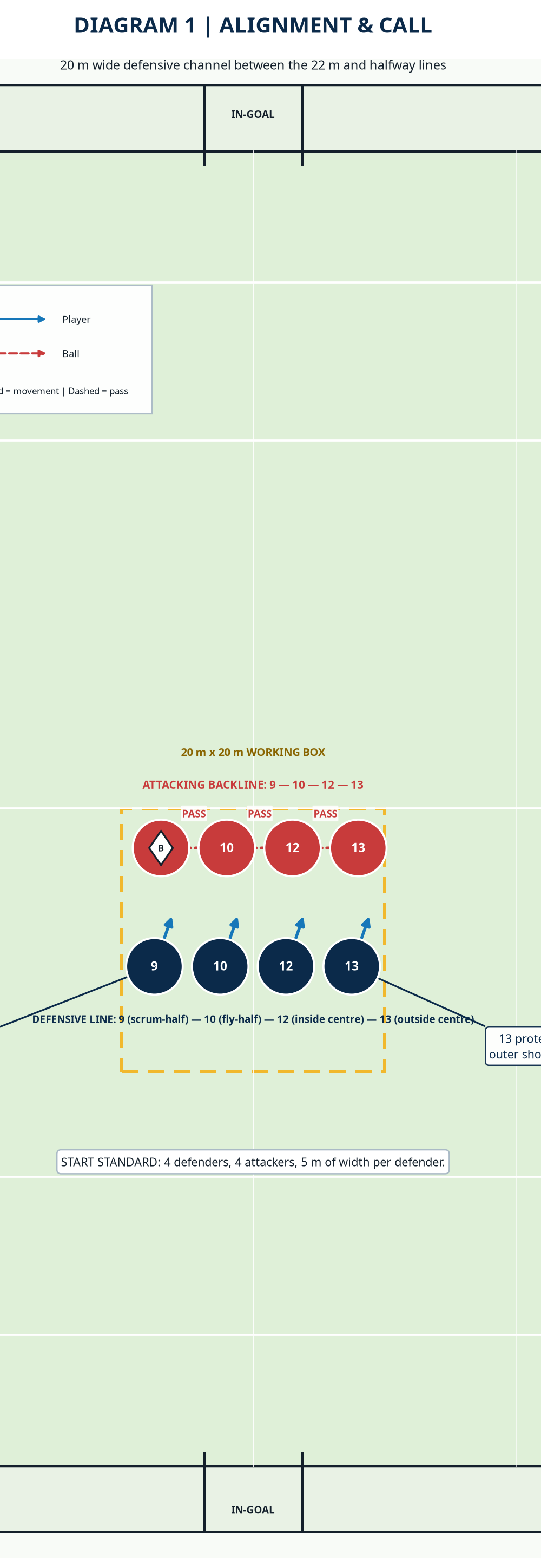
For an easier first session, work 4v4 in a 20 m x 20 m box with touch or two-hand tag only. Slow the pass and insist on visible call-and-response: “connected”, “up”, “drift”. This lets younger or less experienced groups feel the relationship between line speed and spacing without fearing contact.
For the standard progression, use the 5v5 box with 15 as cover and permit the attack one decoy runner. The defensive line must decide whether the ball carrier has genuinely straightened or is merely showing a screen; this is where 10 and 12 must communicate early.
For an advanced progression, play 6v6 plus 15, allow a grubber or cross-field kick after the third pass, and give attack a 12-second shot clock. Defence receives no point unless it stops the edge and either regathers the kick or reforms with six connected players by the next phase.
Age Adaptations
| Age group | Adjustment | Coach emphasis |
|---|---|---|
| Under 8 / Under 10 | Use 3v3 or 4v4, 15 m x 15 m, tag/touch only and no player numbers required. | Run, communicate and stay side-by-side. |
| Under 12 | Use 4v4 in 20 m x 20 m with tackle-shield finishes only. Introduce 9, 10, 12 and 13. | Inside shoulder, drift call and safe tracking. |
| Under 14 / Under 16 | Use the full 5v5 progression with legal tackles and 15 as cover. | Shared launch, outer-shoulder control, edge communication and rapid fold. |
| Open-age | Add 6v6, kicking threats, live ruck entry and a fatigue constraint. | Decision-making under tempo without abandoning connection. |
Finish the session by asking players to state the three non-negotiables: connected launch, square pressure, protected edge. If they can say it, show it in Diagram 2 and execute it under the last conditioned ball, you have built a defensive pattern that will transfer into match play.
References