

Rugby
Exit Strategy Play From Own 22
Master the critical defensive exit strategy with structured kicking, organized chasing, and effective transition play to relieve pressure and gain territory.

What you need
Rugby ball, Cones, Full or half pitch
1. Overview
The "Exit Strategy from Own 22" is a fundamental set play designed to safely clear the ball from your defensive danger zone while maintaining structure and contesting the kick. Exiting the 22 effectively is critical in modern rugby; a poor exit gifts the opposition attacking field position, whereas a well-executed exit relieves pressure and can even lead to an attacking turnover.
This play utilizes a deep, diagonal kick from the fly-half (10) combined with an aggressive, organized chase from the back three, supported by a structured forward pack. The primary goal is to gain territory, force the opposition to play from deep, and apply immediate defensive pressure on the receiver.
2. Setup
Equipment Needed:
- 1 Rugby ball
- Cones to mark the 22m line, 10m line, and halfway line
- Full or half pitch (100m x 70m)
Pitch Setup:
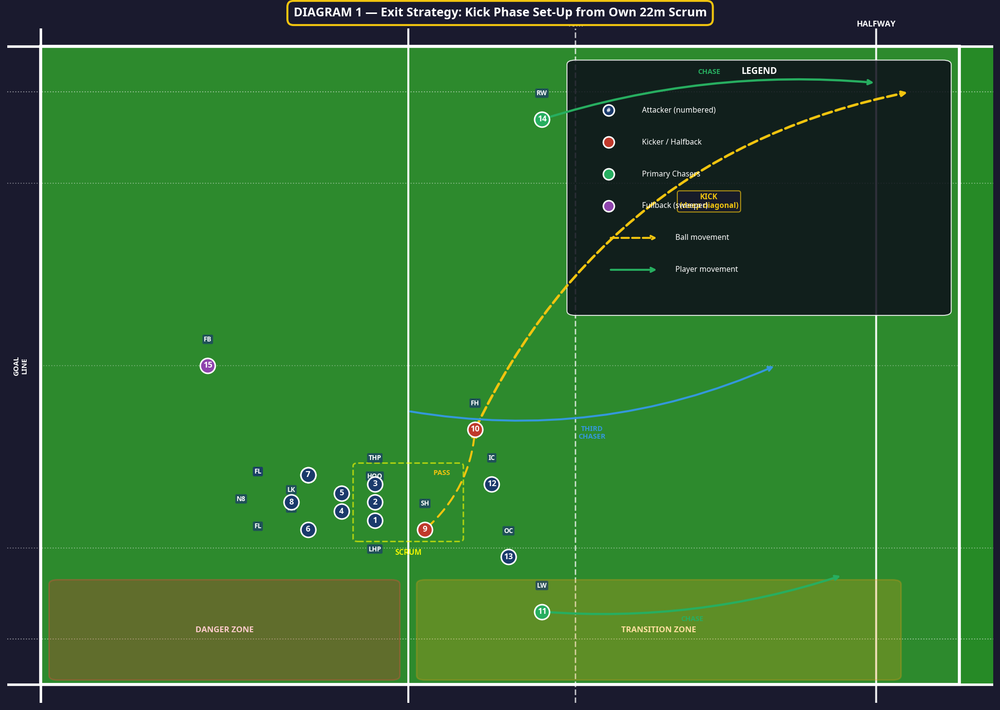
Set up a scrum or lineout on the 22m line, positioned on the right side of the pitch (between the 5m and 15m lines).
Player Positions:
- Forwards (1-8): Bound in the scrum or aligned in the lineout.
- Scrum-half (9): Positioned to feed the scrum or receive the lineout tap down.
- Fly-half (10): Standing deep (approx. 26-28m back from the goal line) to receive the pass and execute the kick.
- Centres (12, 13): Aligned outside the 10, ready to run decoy lines or support the chase.
- Wingers (11, 14): Positioned wide, ready to sprint and chase the kick.
- Fullback (15): Deep safety, covering the backfield in case of a counter-kick.

3. Step-by-Step Instructions
- The Set Piece: The forwards secure possession at the scrum or lineout on the 22m line. Stability here is non-negotiable.
- The Delivery: The scrum-half (9) delivers a swift, accurate pass to the fly-half (10) who is standing deep.
- The Kick: The fly-half (10) receives the ball and immediately executes a deep, diagonal kick aimed towards the far touchline (between the 10m line and halfway). The kick should have enough hang time to allow the chasers to compete.
- The Chase: As soon as the ball is kicked, the wingers (11, 14) sprint up their respective channels. The openside flanker (7) breaks from the scrum to act as the third chaser.
- The Contest: The primary chaser (usually the winger on the side of the kick) competes for the ball in the air or makes an immediate tackle on the receiver.
- The Support: The supporting chasers arrive to secure the ruck if the tackle is made, or to receive an offload if the ball is won back.
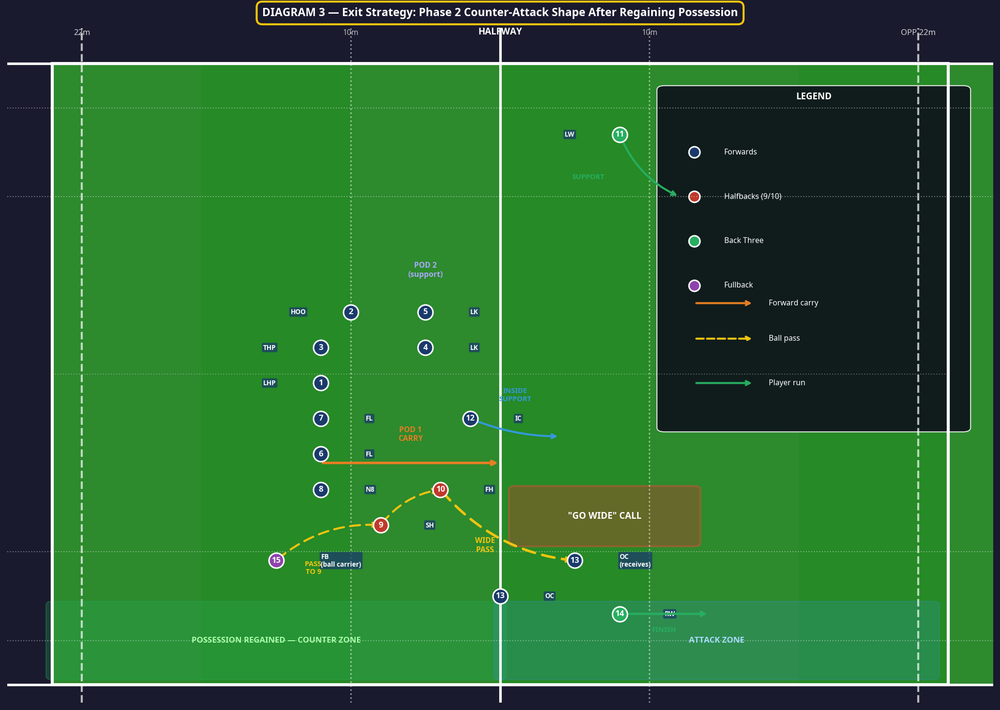
- The Counter (If Won): If possession is regained, the team immediately transitions into an attacking shape, utilizing forward pods and wide runners as called by the fly-half.
4. Key Coaching Points
- Hang Time Over Distance: A kick that goes 40 meters but allows the chasers to arrive simultaneously is infinitely better than a 60-meter kick that isolates the receiver with no pressure.
- The "Wall" Chase: Chasers must stay connected. If one player sprints ahead of the line, it creates doglegs for the counter-attacker to exploit. Maintain a structured defensive wall.
- Scrum-Half Speed: The pass from the base must be rapid. Any delay allows the opposition back row to pressure the kicker.
- Kicker's Protection: The forwards and centres must ensure the fly-half is protected from charge-downs. The inside centre (12) should run a protective decoy line.
- Communication: The fly-half must clearly call the type of exit play before the set piece engages.
5. Common Mistakes
- Kicking Too Flat: A low trajectory kick gives the opposition fullback time to catch and counter-attack before the chasers arrive.
- Disjointed Chase: Wingers setting off too early (offside) or forwards being too slow to support, leading to isolated tackles and potential penalties.
- Poor Set Piece Platform: A retreating scrum or messy lineout disrupts the timing of the play, putting the scrum-half and fly-half under immediate pressure.
- Ignoring the Wind: Failing to adjust the kick depth and angle based on wind conditions.
6. Variations & Progressions
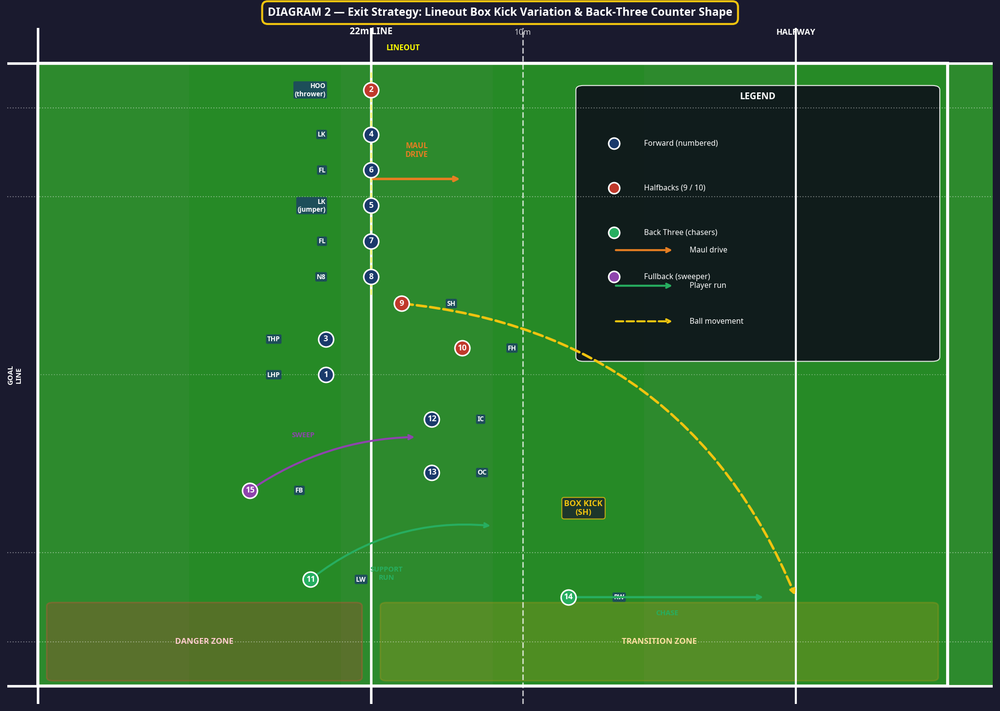
- The Box Kick Exit: Instead of passing to the 10, the scrum-half (9) executes a high box kick directly from the base of the ruck or maul, allowing the winger to compete in the air.
- The Running Exit: If the opposition drops too many players back to cover the kick, the fly-half can call a running play, utilizing the centres to crash over the gain line before kicking on the next phase.
- Progression - Live Defense: Introduce a live opposition back three to actively counter-attack, forcing the chasing team to make real-time defensive decisions.
7. Age Adaptations
- Under 10s/12s: Focus heavily on the technique of the pass from the base and the structure of the chase line. Keep the kick distances shorter and emphasize the tackle.
- Under 14s/16s: Introduce the box kick variation and start working on the hang time of the fly-half's kick. Begin teaching the forwards their roles in the secondary chase.
- Open/Seniors: Full execution with complex calls, multiple variations based on defensive alignment, and high-pressure live scenarios.
