

Rugby
The Falcon Strike: Defensive Lineout Steal and Rapid Counter-Attack
Transform opposition lineouts into your primary attacking platform with this high-pressure steal and wide counter-attack play.

What you need
1 Rugby Ball, Cones (for marking channels), Tackle shields (optional for training)
1. Overview
The 'Falcon Strike' is an aggressive defensive lineout play designed to disrupt the opposition's primary source of possession and immediately launch a wide counter-attack. Instead of merely contesting the throw, this play treats the opposition lineout as a launchpad for your own attack. By anticipating the throw to the middle of the lineout (specifically targeting the second jumper, usually the 4 or 5), the defending team coordinates a rapid lift to steal the ball. Once secured, the ball is recycled at lightning speed to the scrum-half (9), who initiates a wide, expansive attack before the opposition's defensive line can reorganise. This play is highly effective when the opposition hooker has a predictable throwing pattern or when your team desperately needs a momentum shift. It capitalises on the brief moment of disorganisation inherent in a turned-over set piece.
2. Setup

To execute the Falcon Strike effectively, precise positioning and communication are paramount. The play requires a full 15-man pitch (100m x 70m), though the initial action is concentrated within the 5m to 15m channels from the touchline.
Equipment Needed:
- 1 Rugby Ball
- Cones (to mark the 5m and 15m lines if training on an unmarked area)
- Optional: Tackle shields for the opposition to simulate defensive pressure post-steal
Player Positions (Defending/Stealing Team - BLUE):
- 2 (Hooker): Positioned in the 5m channel, ready to defend the front or sweep behind.
- 4 (Lock - Primary Jumper): Positioned opposite the opposition's second jumper. This player must be agile and have excellent aerial skills.
- 3 & 5 (Props/Lifters): Positioned immediately in front of and behind the 4, ready to execute a rapid, dynamic lift.
- 6 & 8 (Back Row - Support): Positioned towards the tail of the lineout, ready to peel around the front as support runners once the steal is secured.
- 9 (Scrum-half): Positioned 2-3 metres behind the lineout, anticipating the tap-down or direct pass from the jumper.
- 10 (Fly-half): Positioned 5-7 metres deep, aligned to receive a swift pass from the 9.
- 13 (Outside Centre): Positioned wide, ready to exploit the space created by the quick turnover.

3. Step-by-Step Instructions
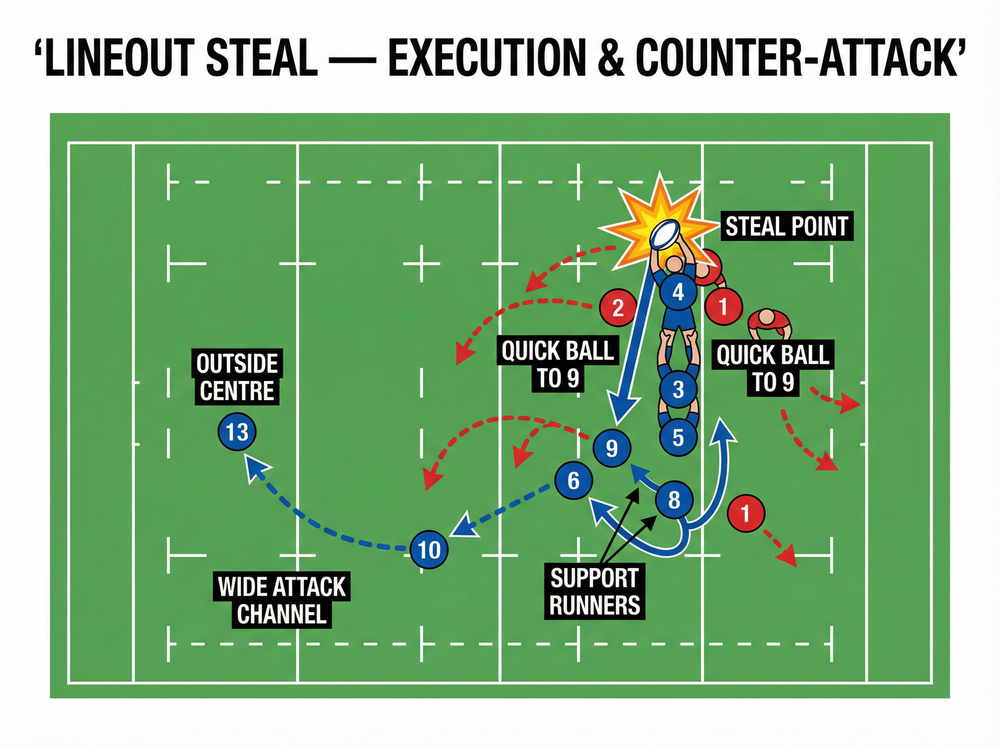
Executing this play requires split-second timing and absolute commitment from the lifting pod.
- The Read: The defensive lineout caller (usually the 4 or 5) reads the opposition's movement and calls the 'Falcon' trigger word, indicating a planned steal on the middle jumper.
- The Trigger: As the opposition hooker begins their throwing motion, the lifters (3 and 5) step aggressively towards the jumper (4).
- The Lift: The jumper (4) explodes upwards, assisted by a powerful, synchronized lift from 3 and 5. The goal is to reach maximum extension before the opposition jumper.
- The Steal: The jumper (4) secures the ball with two hands if possible, or taps it down aggressively to the waiting scrum-half (9) if under heavy pressure.
- The Delivery: Upon securing the ball, the jumper immediately transfers it down to the 9. If the ball was tapped, the 9 must react instantly to secure it.
- The Counter-Attack: The 9 delivers a rapid, flat pass to the 10. The 10 immediately shifts the ball wide to the 13, bypassing the congested midfield.
- The Support: Simultaneously, the 6 and 8 peel aggressively around the front of the lineout to provide inside support for the 10 and 13, offering options for offloads or securing the breakdown if a tackle is made.

4. Key Coaching Points

To ensure the Falcon Strike is effective, coaches must focus on the following critical elements during training:
- Speed of the Lift: The lift must be explosive. The lifters must get under the jumper's hips/thighs quickly and drive upwards with maximum force. A slow lift will result in a lost contest or a penalty.
- Reading the Hooker: The jumper and lifters must study the opposition hooker's body language. Look for 'tells' such as weight shifts or changes in grip that indicate the timing and target of the throw.
- Aggressive Tap-Down: If a clean two-handed catch is impossible, the jumper must tap the ball down aggressively and accurately to the scrum-half's side. A weak tap will result in a messy scramble on the ground.
- Instant Transition: The transition from defence to attack must be instantaneous. The 9, 10, and 13 must anticipate the steal and be in motion before the ball even reaches the ground.
- Support Lines: The peeling back row players (6 and 8) must run hard, aggressive lines. They are not just decoys; they are the primary support for the wide attack and must be prepared to receive an offload or clear the first ruck.
5. Common Mistakes

Watch out for these frequent errors that can derail the play:
- Closing the Gap: Lifters stepping across the line of touch before the ball is thrown, resulting in a free-kick to the opposition.
- Poor Lifting Technique: Lifters using their backs instead of their legs, leading to a weak, unstable lift and potential injury.
- Scrum-half Disconnect: The 9 standing too far away or not anticipating the tap-down, allowing the opposition forwards to disrupt the ball.
- Flat Backline: The 10 and 13 standing too flat, making it easy for the scrambling opposition defence to drift and shut down the wide attack.
- Ignoring the Front: Over-committing to the middle steal and leaving the front of the lineout completely undefended, allowing an easy short throw.
6. Variations & Progressions
Once the basic Falcon Strike is mastered, introduce these variations to keep the opposition guessing:
- The Dummy Steal: The 4 and lifters simulate the Falcon Strike to draw the opposition's attention, but the 9 quickly sweeps around the back of the lineout to attack the blindside if the ball overshoots.
- The Front Peel: Instead of passing wide to the 10, the 9 hits the peeling 6 or 8 on a hard, short line right through the middle of the disorganized opposition lineout.
- The Kick Pass: If the opposition wingers have pushed up aggressively to shut down the wide attack, the 10 can execute a cross-field kick pass to the 14 or 11 in the space behind them.
7. Age Adaptations
This play involves complex lifting and aerial contests, which must be adapted for younger players according to safety regulations.
- Under 14s and Below: Lifting is generally not permitted. Adapt the play to focus on rapid ground-level disruption. The 'jumper' focuses on stepping into the gap and disrupting the catcher on the ground, while the 9 and backline still execute the rapid wide counter-attack off any spilled ball.
- Under 16s: Introduce assisted jumping (supporting the jumper by the shorts, not full lifting) focusing heavily on technique and safety. Emphasise the speed of the jump rather than maximum height.
- Open/Adult: Full lifting is permitted. Focus on explosive power, maximum extension, and complex variations.
