Scrum-Half Passing Accuracy: Ruck-to-Target Drill
Build a dependable No. 9 who can scan, set square and deliver chest-height passes to first receiver under increasing pressure.

Equipment Needed
Overview
This is a scrum-half passing accuracy drill built to make No. 9 dependable when the tempo rises. It develops the repeatable habits that separate a tidy training passer from a game-controller: arriving square to the ball, scanning before the pickup, creating a stable base, and putting the ball into the receiver’s working window without taking their feet away. Use it early in a skills block, immediately after a ruck-speed activity, or as the technical bridge before your attack unit work. The initial version is non-contact and precise; the final progression introduces live line-speed so accuracy survives pressure.
| Session detail | Coach’s prescription |
|---|---|
| Difficulty | Intermediate, with clear regressions for younger players |
| Players | 8: two scrum-halves, two fly-halves (No. 10), two centres (No. 12), two feeders/ball collectors |
| Duration | 25 minutes: 5-minute demo, 12-minute technical block, 8-minute pressure progression |
| Work area | 22 m long × 18 m wide, set over the halfway line on a 100 m × 70 m pitch |
| Success measure | 8 clean catches out of 10 through each target gate before progressing |
Setup
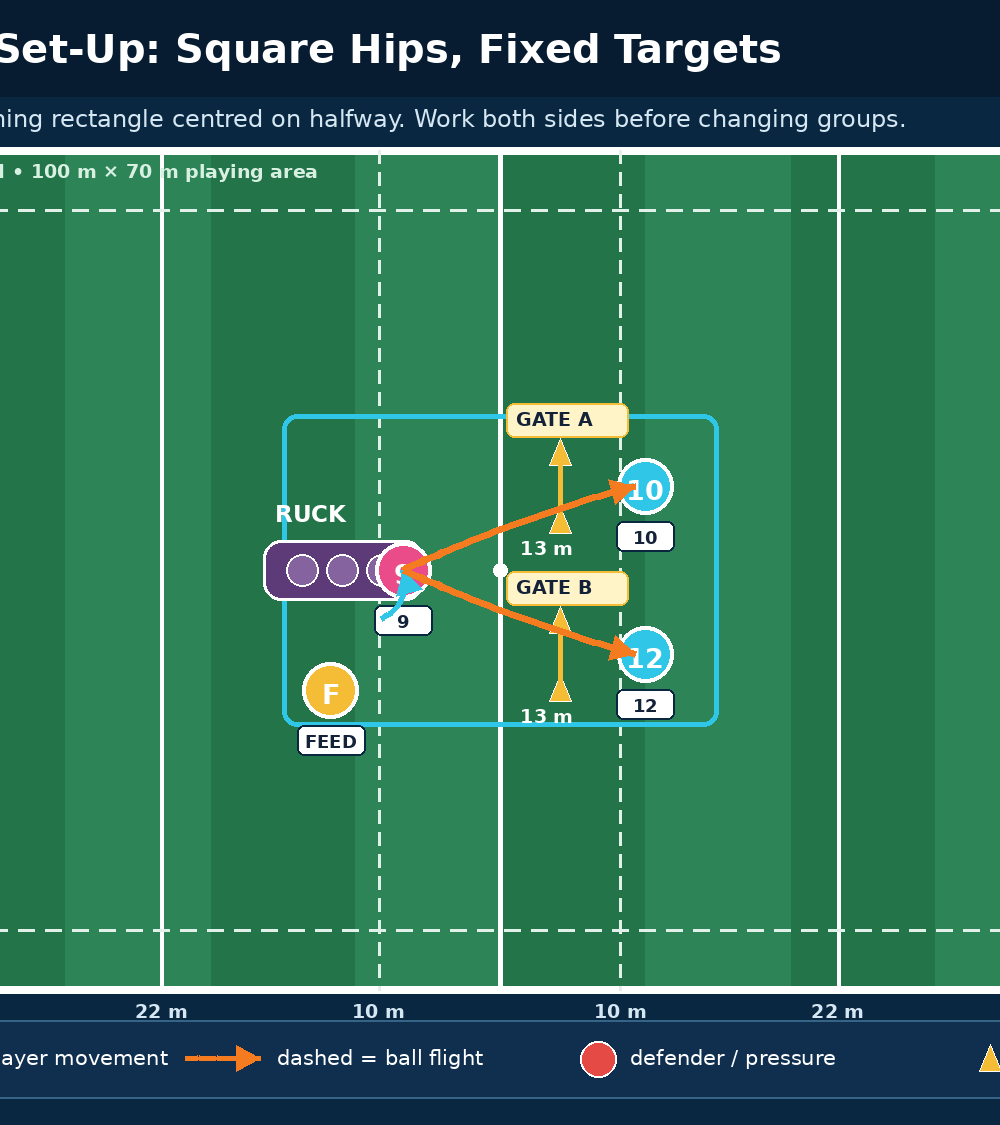
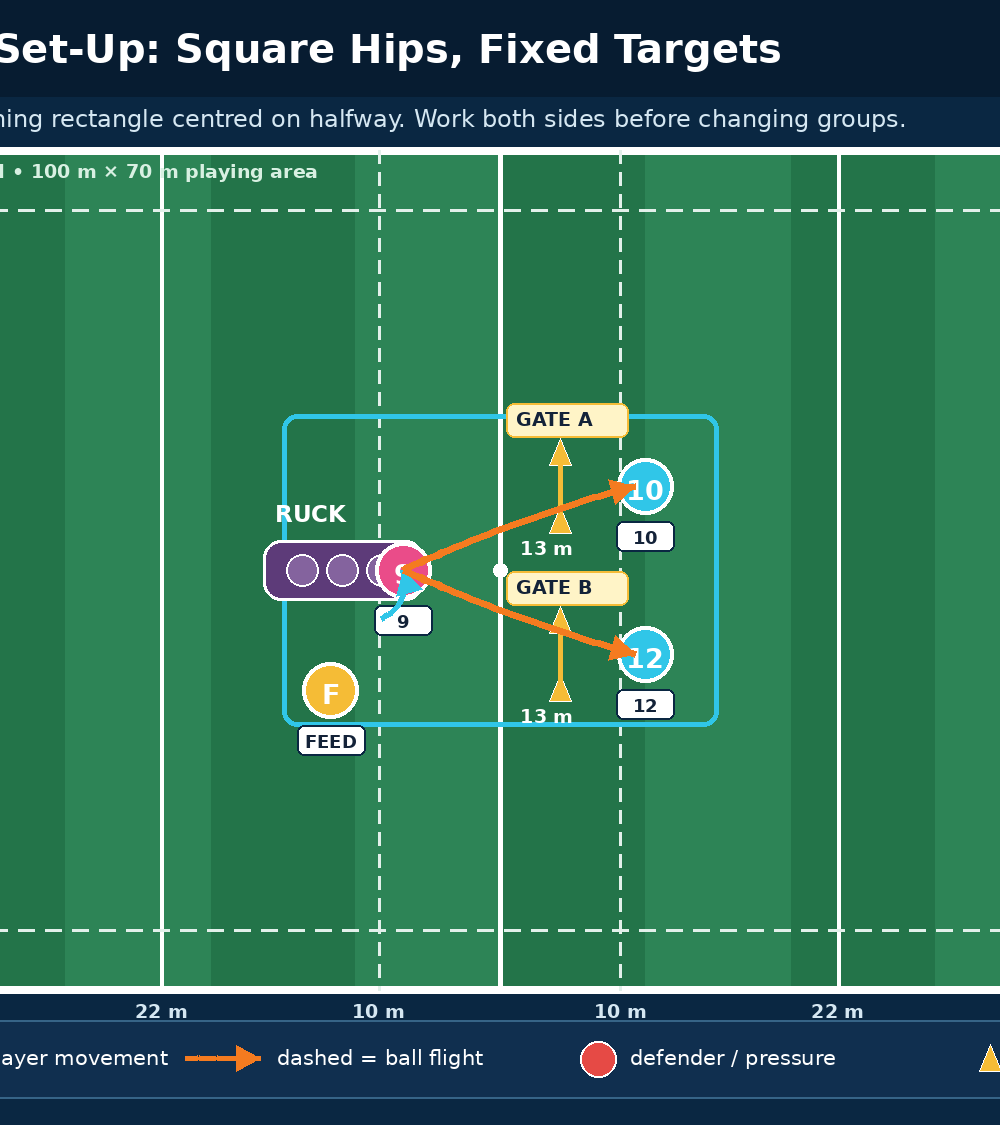
Mark a 22 m × 18 m rectangle with flat discs. Place a low ruck pad, three connected tackle shields, or a clearly marked ball-source cone 5 m inside the left edge of the box. This is the ruck picture. Put the scrum-half, No. 9, 1 m behind and slightly open-side of the ball source. Set two target gates 13 m from No. 9: Gate A is 7 m toward the far side of the box and Gate B is 7 m toward the near side. Each gate is 1.5 m wide, formed with two cones, and has a receiver 2 m beyond it. Use No. 10 (fly-half) beyond Gate A and No. 12 (inside centre) beyond Gate B so the scrum-half learns to deliver both a longer flat pass and a slightly deeper wide pass.
Use six rugby balls so the next feeder can reload the source immediately. One feeder starts 4 m behind the ruck source with balls; the second ball collector works beyond the receivers. Put bibs on the pressure defenders for the final phase. The coach should use a visible scoring card or call the total aloud: a point only counts when the receiver catches cleanly in front of the target line, without stopping or reaching behind their body.

Step-by-Step Instructions
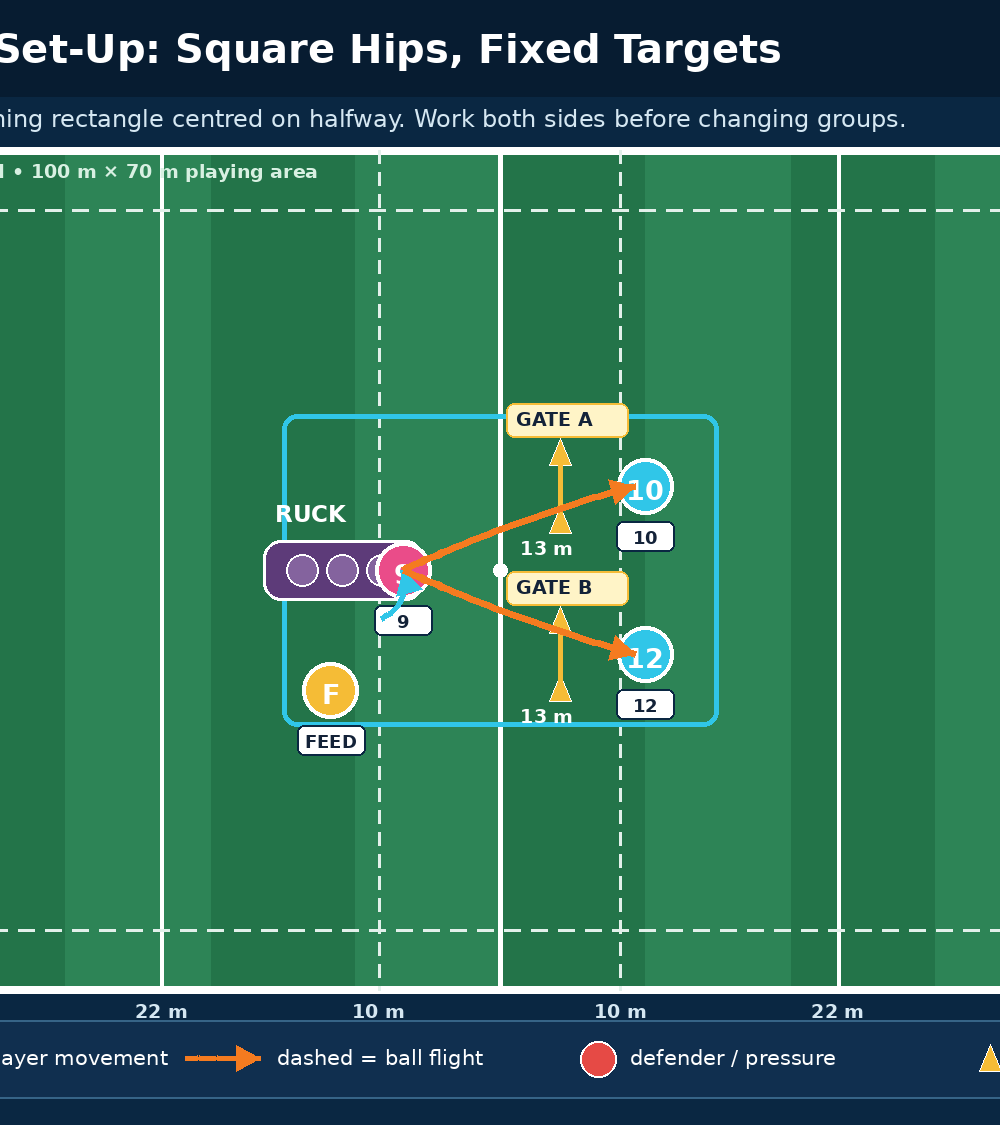
Demonstrate the target first. Put No. 10 beyond Gate A and show the finish: feet set, eyes through the receiver, ball delivered to the front shoulder at chest height. Explain that the gate measures the line of the pass, while the receiver’s catch measures its quality.
Build the base. No. 9 starts with knees flexed, hips low and shoulders square to the target. Their near foot is close enough to the ball source to pick up without reaching. Cue: “Feet to the ball; ball to the target.” The receiver calls their number—“Ten!” or “Twelve!”—before the ball is lifted.
Run the fixed-target block. On the coach’s signal, the feeder places or rolls a ball to the ruck source. No. 9 scans, picks up, takes no more than one adjustment step, and passes through Gate A to No. 10. No. 10 catches, returns the ball to the collector, and joins the opposite target line after five repetitions. Repeat to Gate B and No. 12. Each No. 9 completes two sets of 10 balls: five passes each side.
Score the detail. Award one point for a clean catch in front of the receiver’s sternum, one further point if the ball travels through the gate without touching a cone, and zero if the receiver has to halt, jump, reach behind, or scoop below knee height. Stop after every five balls for a 20-second correction, not a lecture. Give one technical cue, then restart.
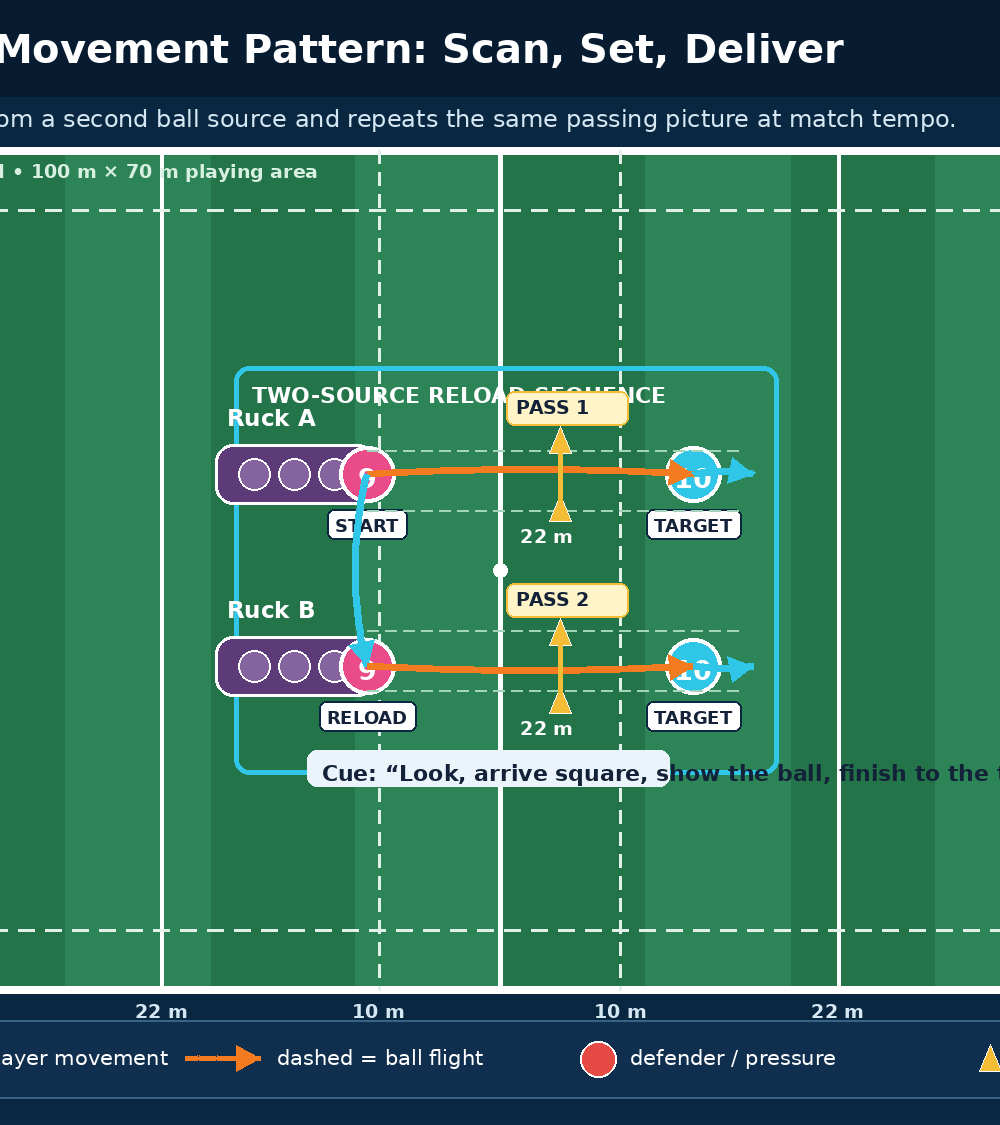
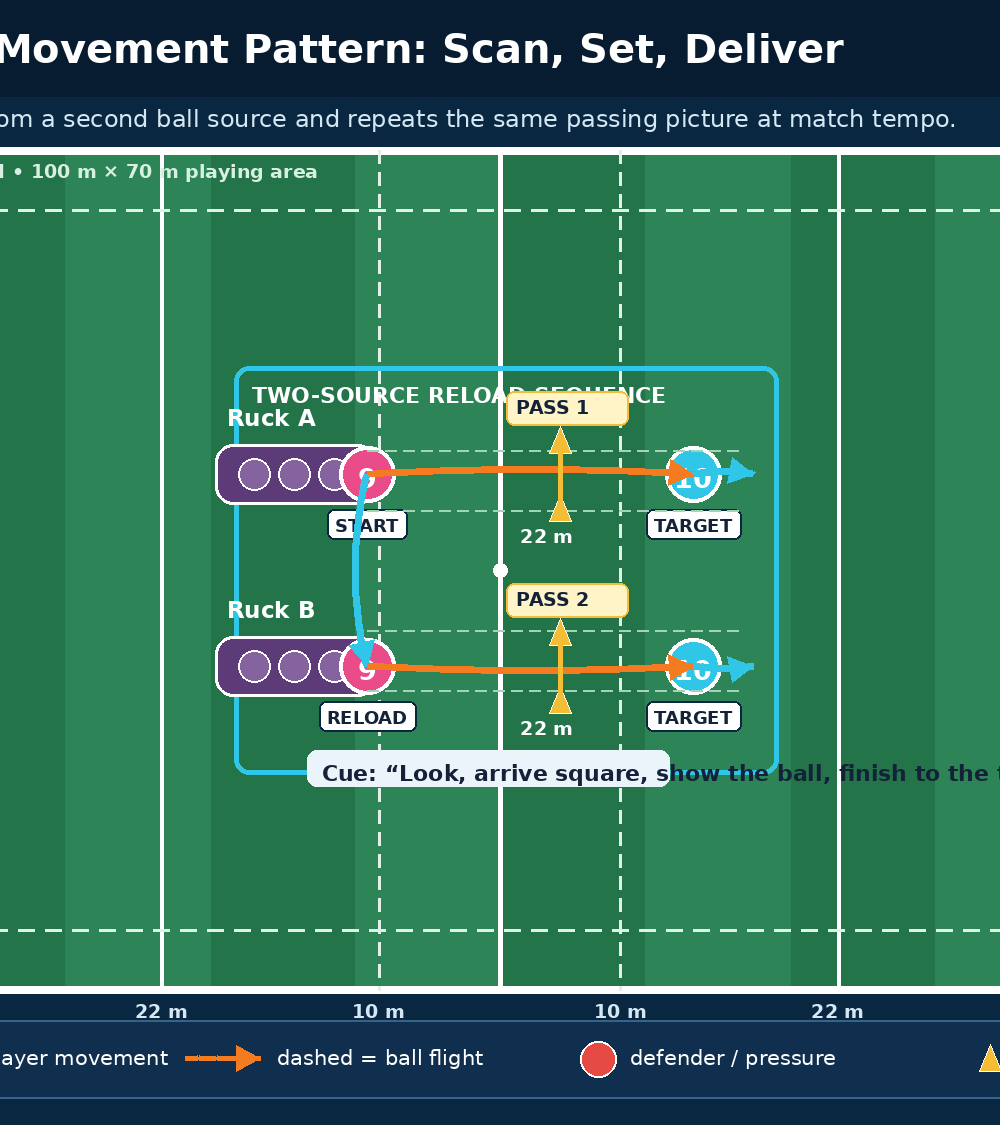
Add the reload movement. Establish a second ruck source 16 m below the first. No. 9 passes from Ruck A, accelerates around the outside cone, reloads at Ruck B, and delivers again. This asks them to regain a square passing picture after movement rather than passing from a comfortable static stance.
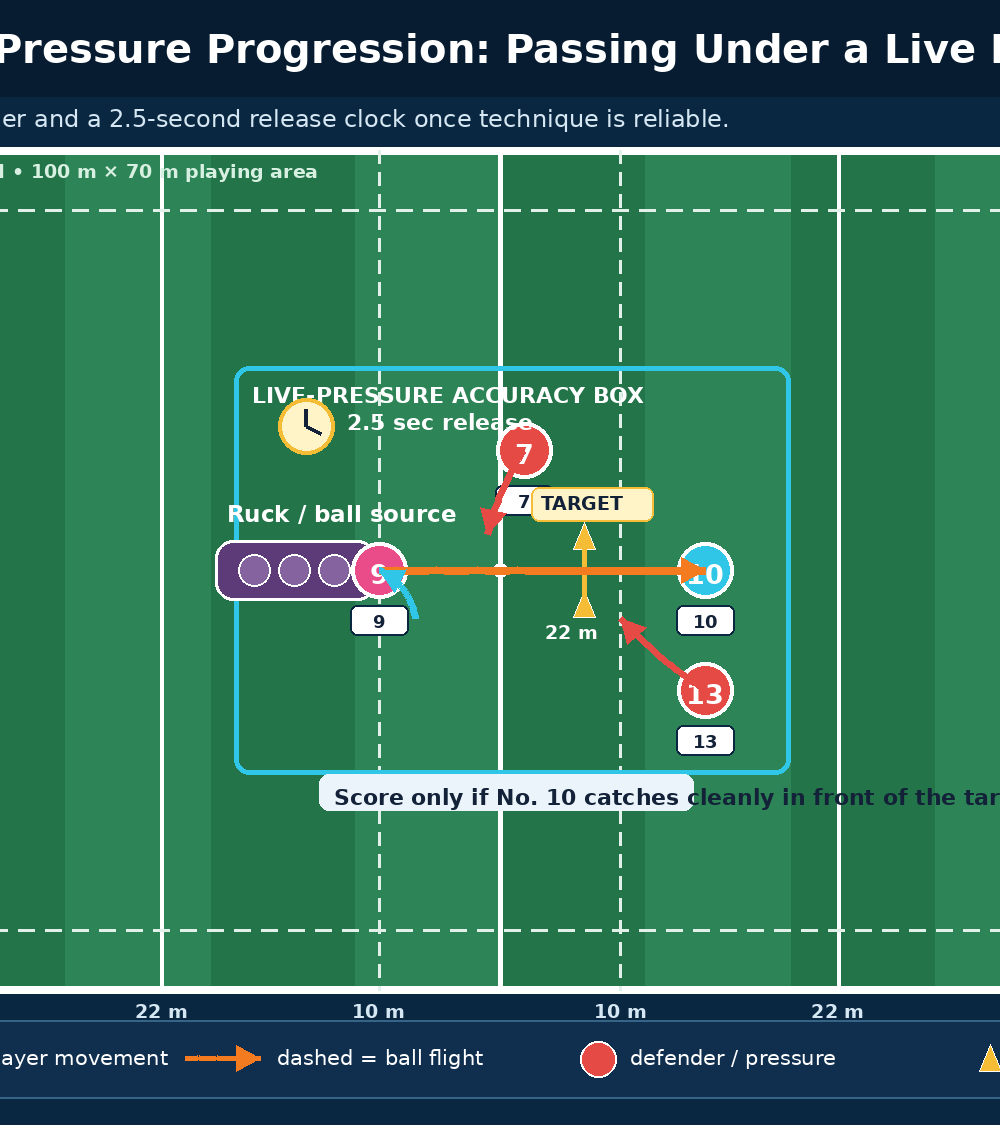
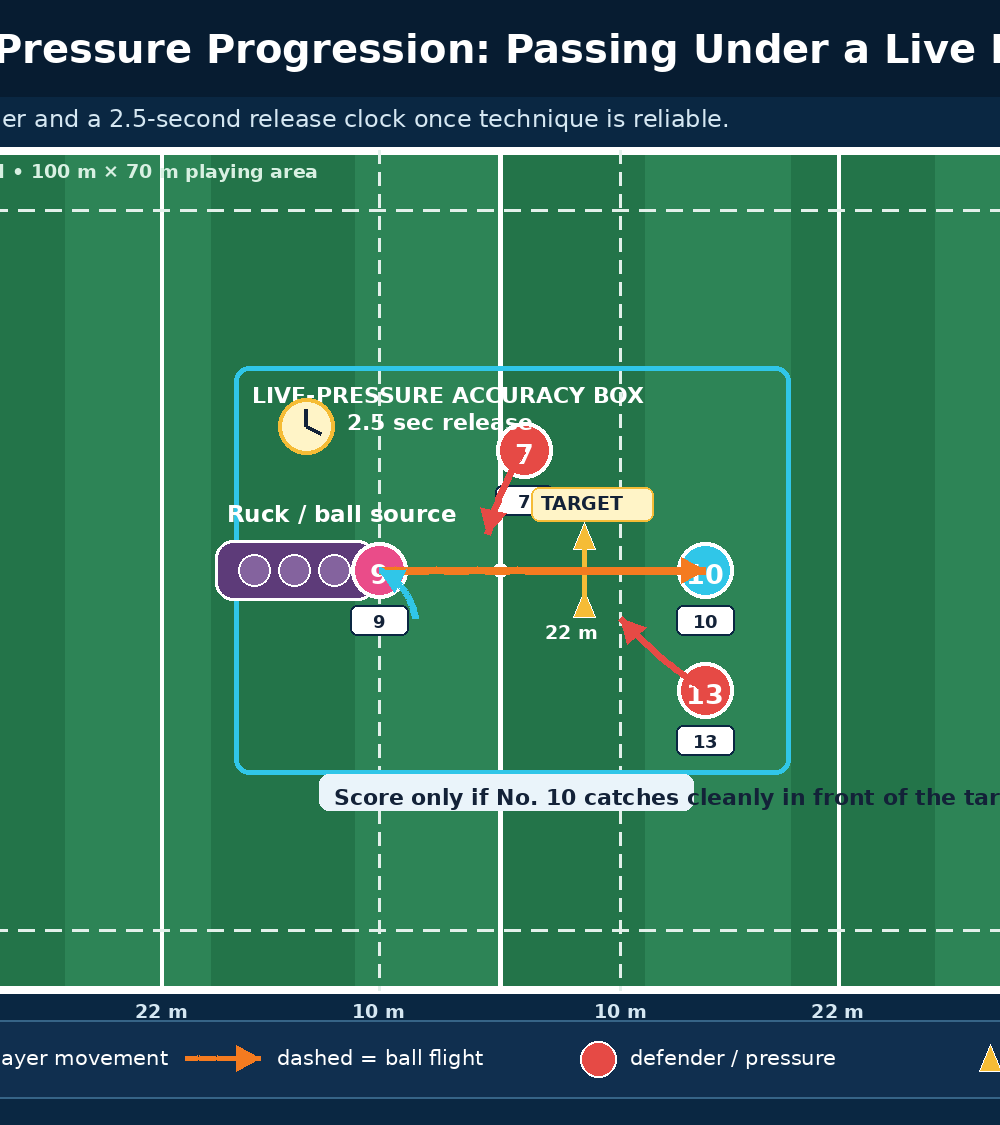
- Progress to live line-speed. Give No. 7 (open-side flanker) a 2 m channel to advance from inside pressure and No. 13 (outside centre) an outside closing line. Both may move on the feeder’s release but must make a touch only; there is no tackle. No. 9 has 2.5 seconds from the ball appearing to release a pass to No. 10. The receiver must still catch in front of the target line. Rotate defenders every 60 seconds.
Key Coaching Points
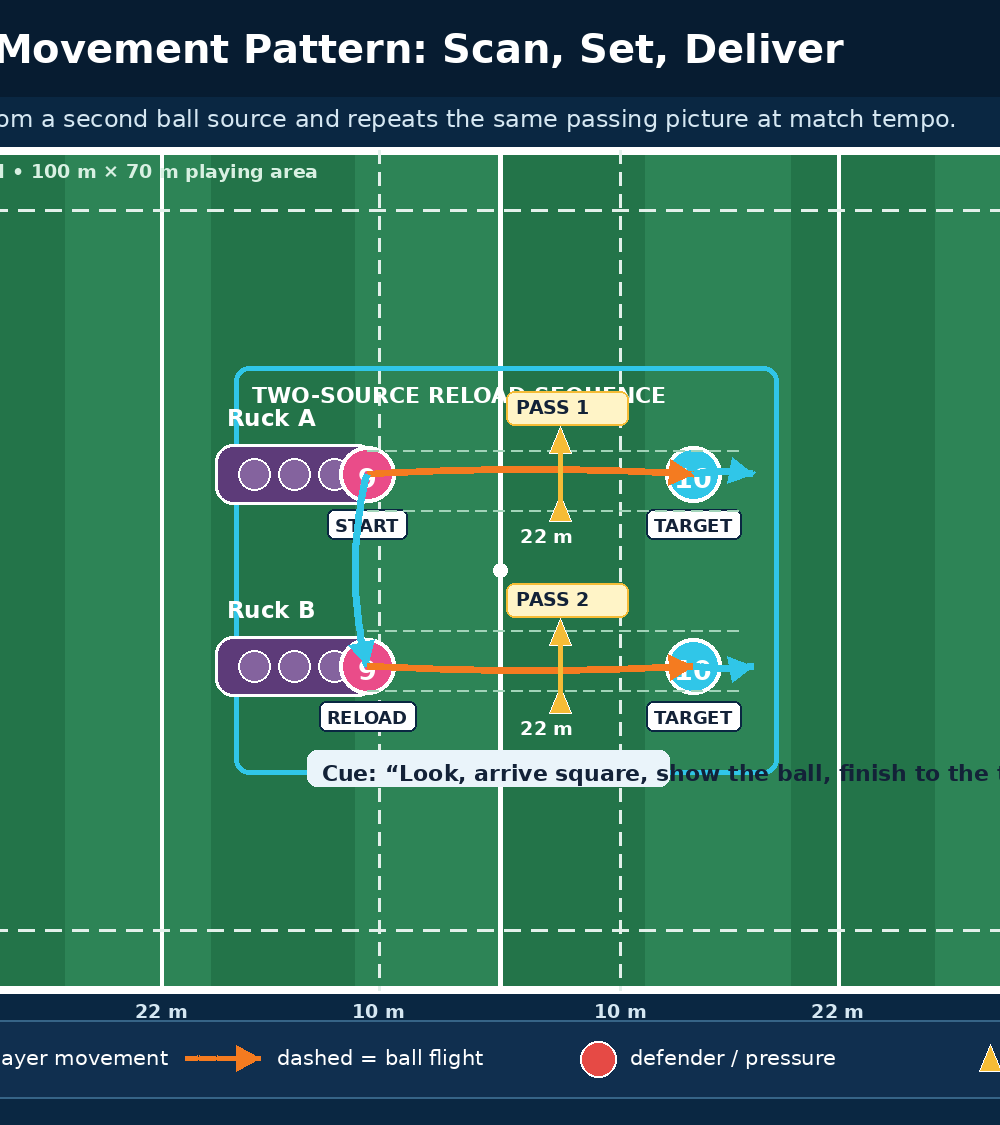
The best coaching is short, specific and repeatable. First, demand an early scan: No. 9 should identify the receiver, the gate and the defender’s first step before their hands reach for the ball. Second, insist that the hips and shoulders arrive square. A scrum-half who opens early loses the ability to pass either way and advertises the target to the defence.
Third, coach the pickup line. The ball should come from close to the body, with hands shaped early and fingers spread around the lower half of the ball. Fourth, finish both hands to the receiver, using the top hand to guide the line and the lower hand to create pace. The wrists should follow through at the receiver’s chest, not sweep across the body. Fifth, hold the pass height. Chest-height ball is the attacking standard because it allows No. 10 or No. 12 to catch and make their next decision in stride. Finally, coach the scrum-half’s recovery: after passing, they should track in behind the ball to be available for the next phase.
Common Mistakes
| Error you will see | Immediate correction |
|---|---|
| No. 9 reaches for the ball and rises before passing | Move the ball source 30 cm closer and cue, “Lower first, then lift.” |
| Passes drift behind the receiver | Freeze the follow-through and point both hands at the receiver’s front shoulder. |
| Ball floats with no pace | Keep the elbows in, drive from the wrists, and demand a firm finish through the gate. |
| No. 9 turns their chest early | Place a cone 1 m in front of the ruck; they must step around it square before delivery. |
| Receiver waits flat-footed | Start the receiver 1 m deeper and require a two-step run-in before the call. |
Variations & Progressions
For an easier regression, widen each gate to 2 m, shorten the pass to 8 m, and allow No. 9 two adjustment steps. Use a static ball on a cone for the first set, then return to a feeder roll once the pickup is stable. For the technical progression, narrow gates to 1 m and make the ball arrive from alternating angles; this forces No. 9 to organise their feet rather than passing from a pre-set stance.
For the match-like progression, retain the 13 m target distance but add the two defenders and 2.5-second release clock shown in Diagram 3. A pass scores double only if No. 10 catches it in stride and can immediately pass to No. 12. If you have 10–12 players, run two mirrored boxes on either side of halfway and compare left-to-right and right-to-left scores. Do not add speed or defensive pressure until your scrum-halves can meet the 8-from-10 standard in the fixed-target block.
Age Adaptations
For Under-8 and Under-10, use five to seven players, a 10 m × 12 m box, 5–7 m passes, and 2 m gates. Replace the ruck pad with a floor cone, remove live defenders, and celebrate a simple clean catch rather than pass speed. Keep work bouts to 30 seconds and use one cue only: “Point the ball at your friend.”
For Under-12 and Under-14, use the full basic layout but retain 10–11 m passes before moving to the 13 m target. Introduce position names—No. 9, No. 10 and No. 12—and ask players to call before receiving. Use shadow defenders who may move but cannot touch.
For Under-16 and open-age groups, use the full 22 m × 18 m area, 13 m target distance, directional reload, line-speed, and the 2.5-second release. Hold No. 9 accountable for scanning the defender before pickup and vary the receiver depth between 5 m and 9 m. Finish with a two-minute competitive round: first group to 12 quality passes, with one point deducted for every pass behind the target, wins.
Coach’s finish
End by asking the scrum-half one question: “Where did your pass let the next player play?” If the answer is “in front, at chest height, with time,” the drill has transferred. If not, go back one constraint, restore the clean passing picture, and rebuild the standard before adding pressure again.