

Rugby
Mastering the Gain Line: Dynamic Support Running and Angles
Equip your players with the precise timing, communication, and varied running lines needed to fracture defensive lines and dominate the contact area.

What you need
10-12 cones, 3-4 rugby balls, Training bibs, 2-3 tackle shields
1. Overview
The "Dynamic Support Running and Angles" drill is designed to train players in the critical art of off-the-ball movement. In modern Rugby, the initial ball carrier rarely breaks the line alone; it is the coordinated effort of support runners hitting the line at pace and varied angles that manipulates the defence and creates line breaks. This drill focuses on teaching players how to run inside, flat, and outside support lines relative to the ball carrier, emphasizing timing, depth, and loud, clear communication. Use this drill when your team is struggling to generate quick ball or when attackers are becoming too isolated post-contact.
2. Setup
To run this drill effectively, you will need the following setup:

- Pitch Area: A 30m x 30m grid, divided into three 10m channels (Inside, Flat, and Outside).
- Equipment: 10-12 cones to mark the grid and channels, 3-4 rugby balls, and bibs to differentiate attackers and defenders.
- Player Positions:
- 1 Scrum-half (9) acting as the primary distributor.
- 1 Fly-half (10) acting as the primary ball carrier.
- 3 Support Runners (e.g., 12, 13, 14 or forwards in pods) starting 5-7 metres deep.
- 2-3 Defenders holding tackle shields (optional for progression).
3. Step-by-Step Instructions
Phase 1: Unopposed Angle Recognition
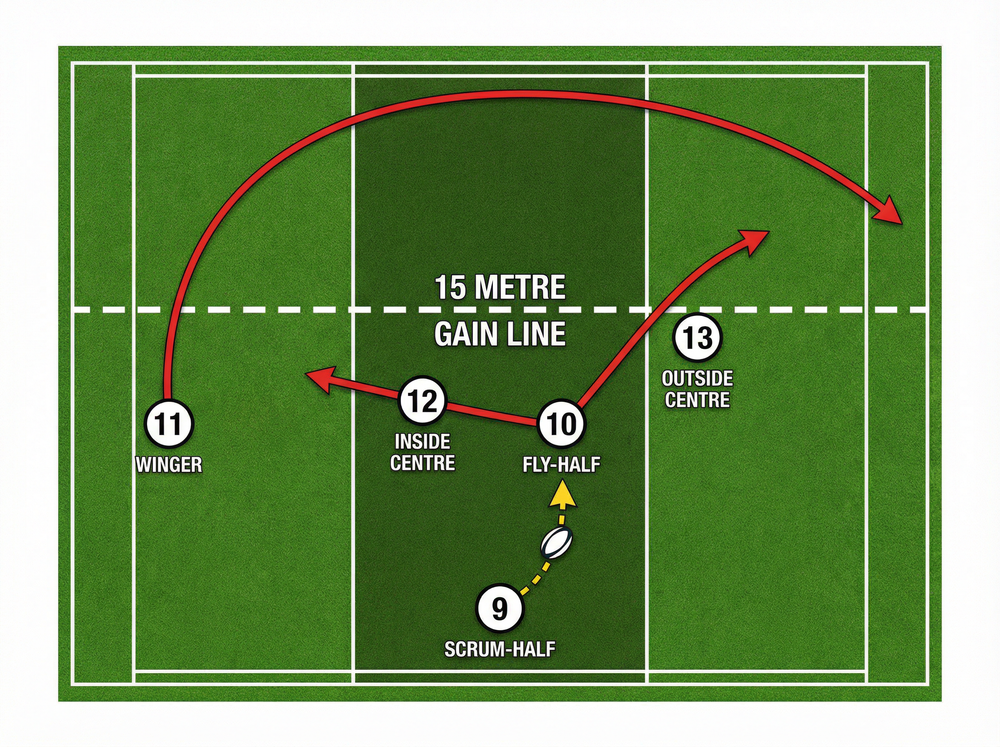
- Starting Positions: The Scrum-half (9) starts with the ball at the base of a simulated ruck. The Fly-half (10) stands flat, ready to receive. The three support runners align in a deep, staggered formation.
- The Trigger: The Scrum-half passes the ball to the Fly-half. As the ball is in the air, the support runners must initiate their movement.
- Running the Lines:
- Runner A (Inside Centre - 12) cuts a sharp, hard angle back towards the source of the pass (Inside Support).
- Runner B (Outside Centre - 13) runs a direct, flat line to preserve forward momentum (Flat Support).
- Runner C (Winger - 14) arcs wide to offer an offload option around the back (Loop/Outside Support).
- The Decision: The Fly-half takes two hard steps forward, reads the simulated defence, and passes to the runner who communicates the best and hits the line with the most pace.

Phase 2: Introducing the Gain Line
5. Setting the Target: Place a line of cones representing the gain line. The objective is for the receiving support runner to catch the ball exactly as they cross this line.
6. Adjusting Depth: If runners are catching the ball before the gain line, they are starting too flat. If they catch it too late, they are too deep. Coaches must pause the drill to correct starting depths.
Phase 3: Opposed Decision Making
7. Adding Defenders: Introduce two defenders with tackle shields.
8. The Read: As the Fly-half receives the ball, the defenders will randomly choose to drift wide or bite in. The Fly-half must read the defenders' shoulders and pass to the support runner exploiting the created gap.
4. Key Coaching Points
- Depth is Dictator: Support runners must start deep enough to allow them to hit the ball at maximum velocity. Running fast while flat leads to forward passes and static collisions.
- Late, Sharp Angles: Runners should run straight initially and cut their angle late. Early angles give the defence too much time to adjust and slide.
- Target the Inside Shoulder: When running a short/inside line, the support runner must aim for the inside shoulder of the defender to isolate them and prevent a dominant double-tackle.
- Demand the Ball: Support runners must not just run the line; they must demand the ball with loud, specific calls (e.g., "Short!", "Flat!", "Wide!").
5. Common Mistakes
- Starting Too Flat: Players often creep up to the gain line, resulting in them catching the ball while stationary. This negates the purpose of the support line.
- Running Away from the Carrier: Outside support runners sometimes drift too far wide, severing the connection with the ball carrier and making the pass impossible.
- Silent Running: Players running excellent lines but failing to communicate, leaving the ball carrier guessing where their support is.
- Catching the Ball Behind the Body: Poor hand positioning leads to dropped balls when hitting the line at pace. Hands must be up and providing a target.
6. Variations & Progressions
- The "Pop" Offload: Instead of a pre-contact pass, the Fly-half takes the ball into the tackle shield, and the support runners must react to execute a late pop pass or offload.
- Continuous Phase Play: After the first line break, the ball carrier goes to ground, and the remaining support runners must immediately secure the ruck, with a new set of runners realigning for the next phase.
- Constraint-Led: Limit the Fly-half to only passing off their non-dominant hand to increase difficulty and force better support positioning.
7. Age Adaptations
- Under 8s - Under 10s: Remove all defenders. Focus purely on running straight and catching the ball while moving forward. Use fun terms like "Rocket" for flat lines and "Boomerang" for loop lines.
- Under 12s - Under 14s: Introduce soft defenders (touch only). Begin focusing heavily on the timing of the run and the specific names of the angles (Inside, Flat, Outside).
- Under 16s - Open: Full contact with tackle shields or live tackling. Focus on micro-communications, reading the defensive shoulders, and executing offloads through contact.
