Rugby Union Scrum Blindside Attack: 6-Peel to Wing Finish
Teach a reliable short-side scrum strike in which the blindside flanker peels off No. 9, reads the inside defender, and either carries through the front door or releases the wing into the 2m channel.

Equipment Needed
Overview
The 6-peel blindside strike turns a narrow scrum-side space into a deliberate attacking lane. Rather than handing the ball to a standing backline, No. 9 takes the ball away quickly, Blindside Flanker 6 peels on the short side, and Wing 11 holds late width. The play gives the defence a two-question problem: if their first defender holds width, 6 attacks the front door; if that defender turns in or jams, 6 draws and releases 11. It is a high-value call when the scrum is within 12–15m of touch, the opposition nine is slow to cover, or your scrum has earned a stable platform.
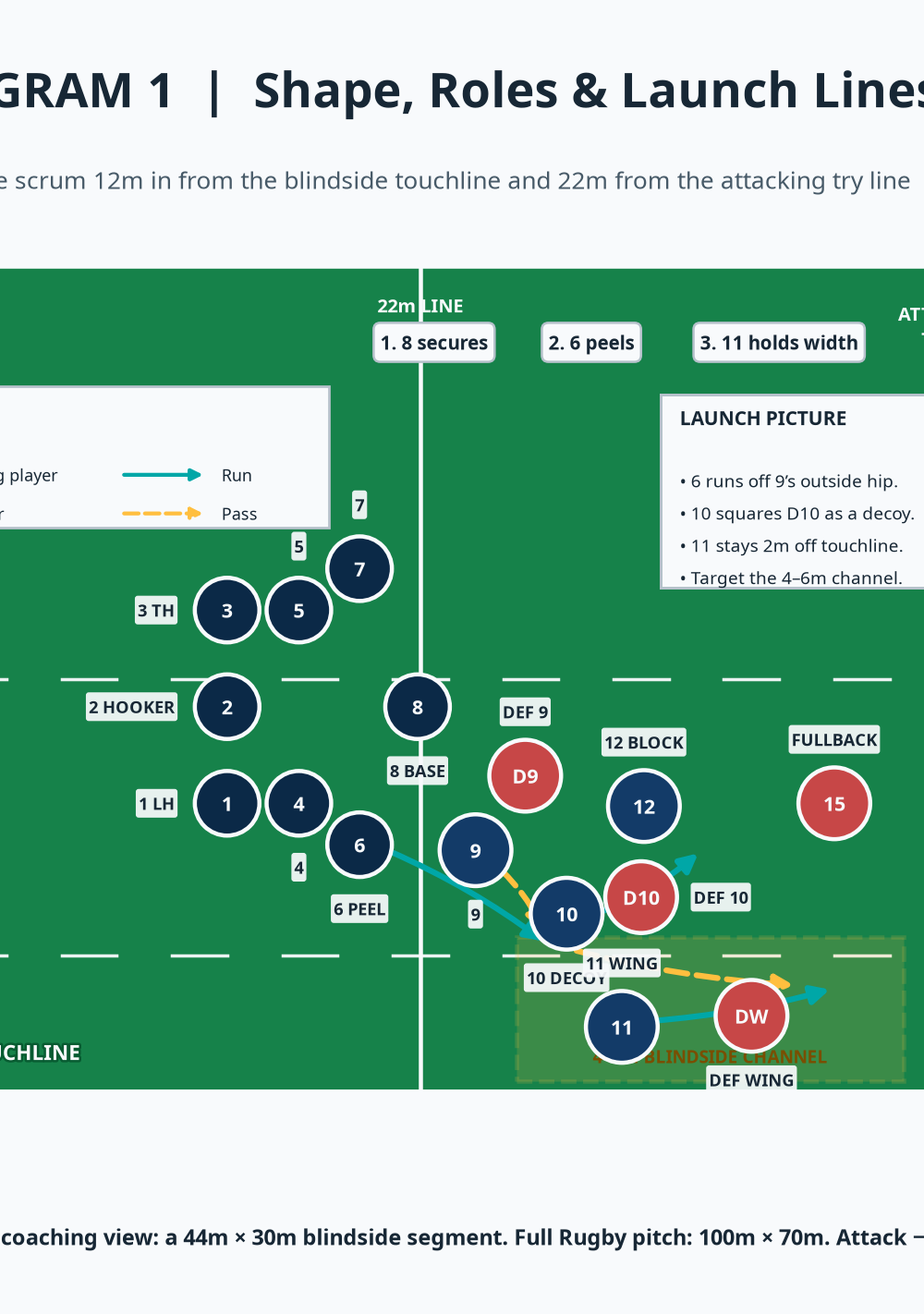
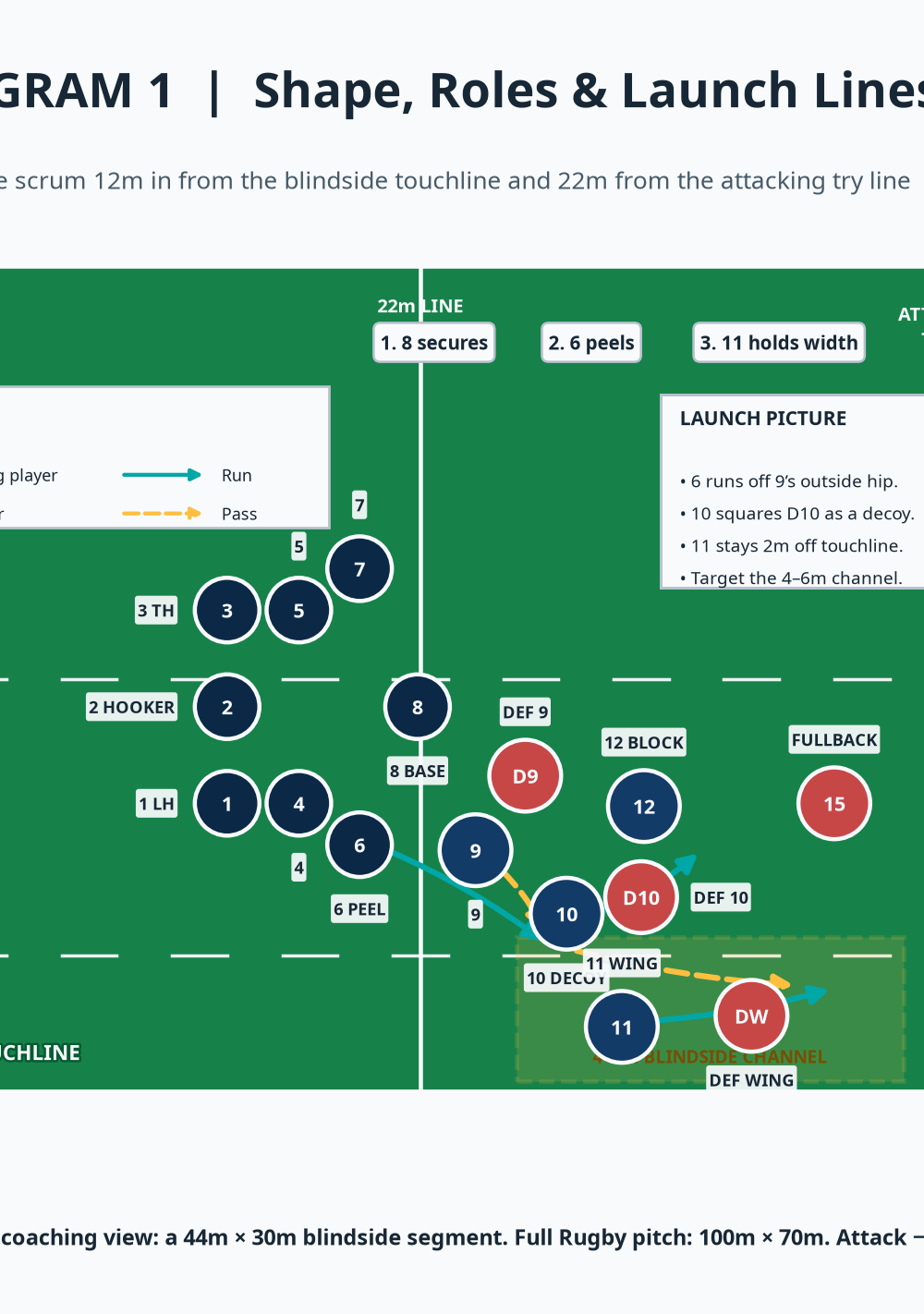
Run it from a scrum set 12m in from the blindside touchline and about 22m from the attacking try line. This preserves enough room for 11 while keeping the defence compressed. A full-size Rugby field may be up to 100m long and 70m wide; use the 5m and 15m dashed lines as visual reference points when laying out the practice area.1 The scrum must be a lawful, stable platform first: with 15-a-side teams, eight players bind in the 3-4-1 formation and the non-participants remain behind the hindmost foot until the scrum ends.2
Setup
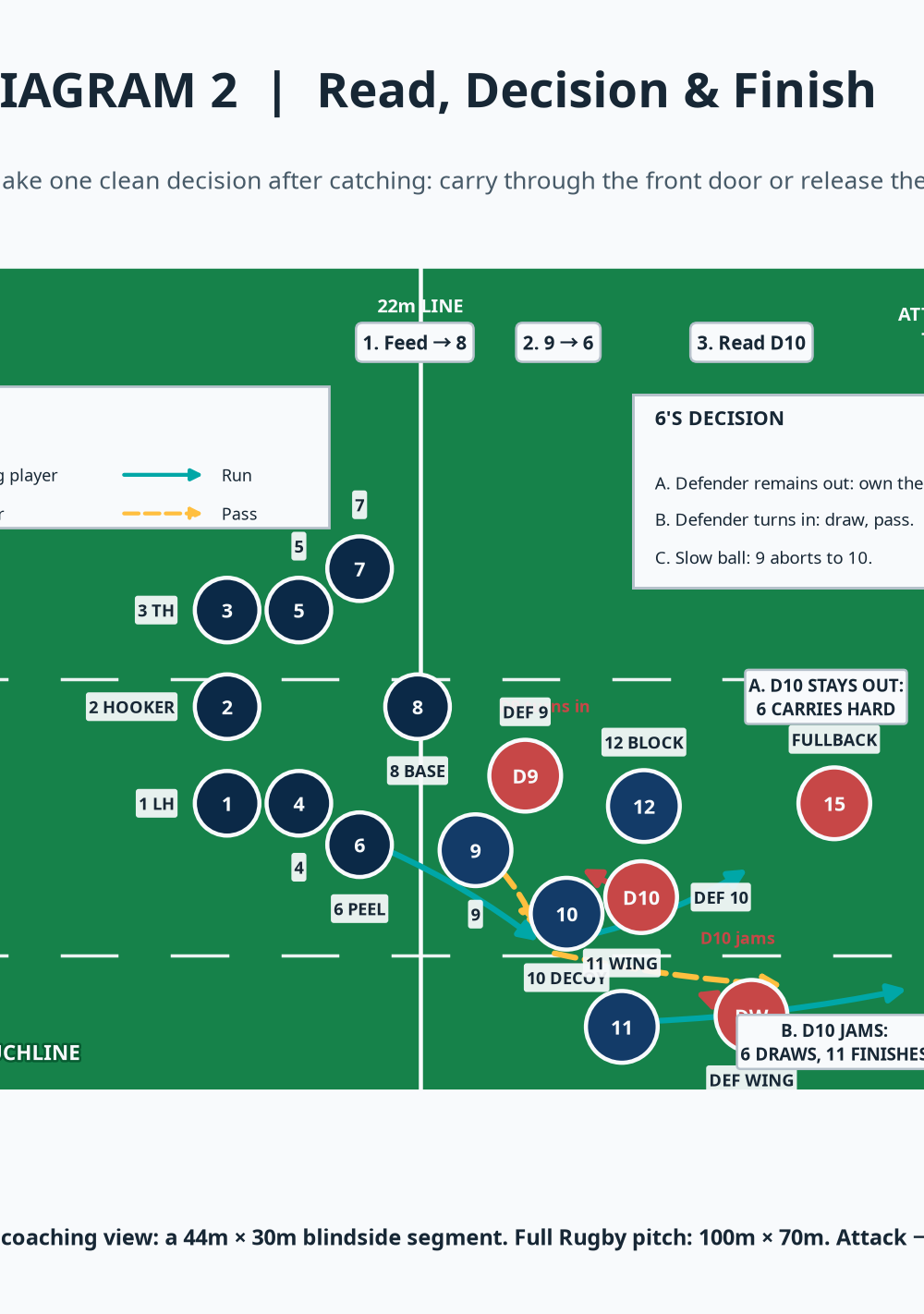
Use a 44m x 30m coaching zone that represents the blindside portion of the 100m x 70m pitch. Mark a touchline, 5m and 15m dashed lines, the 22m line and an attacking try line. Place the scrum mark 12m from touch and 22m from the try line. Start with 15 attackers and 7 defenders; if numbers are limited, keep the attacking pack, 9, 6, 10 and 11 and use four defenders.
| Item | Coach instruction |
|---|---|
| Attacking scrum | Pack in the normal 3-4-1 shape. No. 8 controls the ball at the base; 6 binds legally on the blindside lock and is ready to peel only after the ball is live. |
| No. 9 | Starts on the blindside, one step behind the hindmost foot. Their job is a fast, flat pass to 6 and immediate support inside. |
| No. 10 and 12 | 10 squares up the opposition 10 as a decoy. 12 stays 3m wider and deeper to block the obvious drift line without demanding the ball. |
| No. 11 | Starts 2m from touchline, 5m behind 6’s initial line, and delays the run until 6 has caught the ball. |
| Defence | Opposition 9 sets beside the tunnel or at the back-foot line as appropriate. Set a front-door defender, an edge defender and a fullback cover player. |

Step-by-Step Instructions
Name the call before the scrum forms. Use a short, unambiguous cue such as “Blind 6”. No. 9 confirms the call with 6 and 11; 10 answers with the decoy call.
Win stable ball, then launch. The front five provide a square, stable platform. No. 8 keeps the ball at their feet rather than picking early. The scrum-half feeds straight and stays patient until the ball has reached the base; the scrum begins when the ball leaves the scrum-half’s hands, so do not coach a peel before the ball is live.2
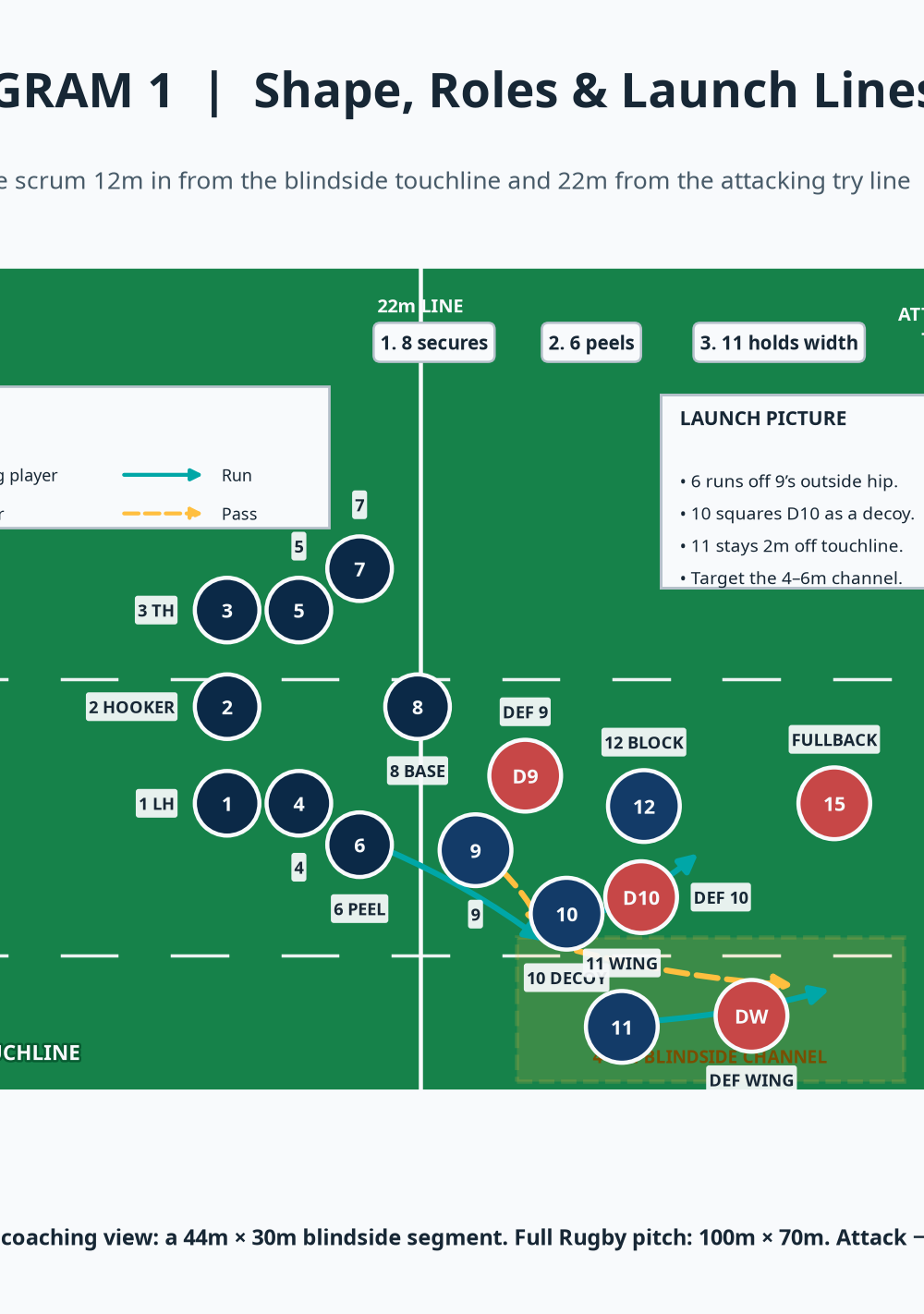
Set the running picture. At the first movement of No. 9, 6 releases from the blindside of the scrum and runs off 9’s outside hip. The target is a line 4–6m in from touch. No. 10 accelerates one hard step on an inside-out decoy line to square D10. No. 11 stays wide, then comes forward late rather than drifting sideways.
Deliver pass one. No. 9 takes two sharp steps away from the base and passes flat, in front of 6’s chest. Coach 9 to show the ball only briefly; a long, floated pass gives the defence time to fold. After passing, 9 trails 2m inside 6 as the cleanout or reload option.
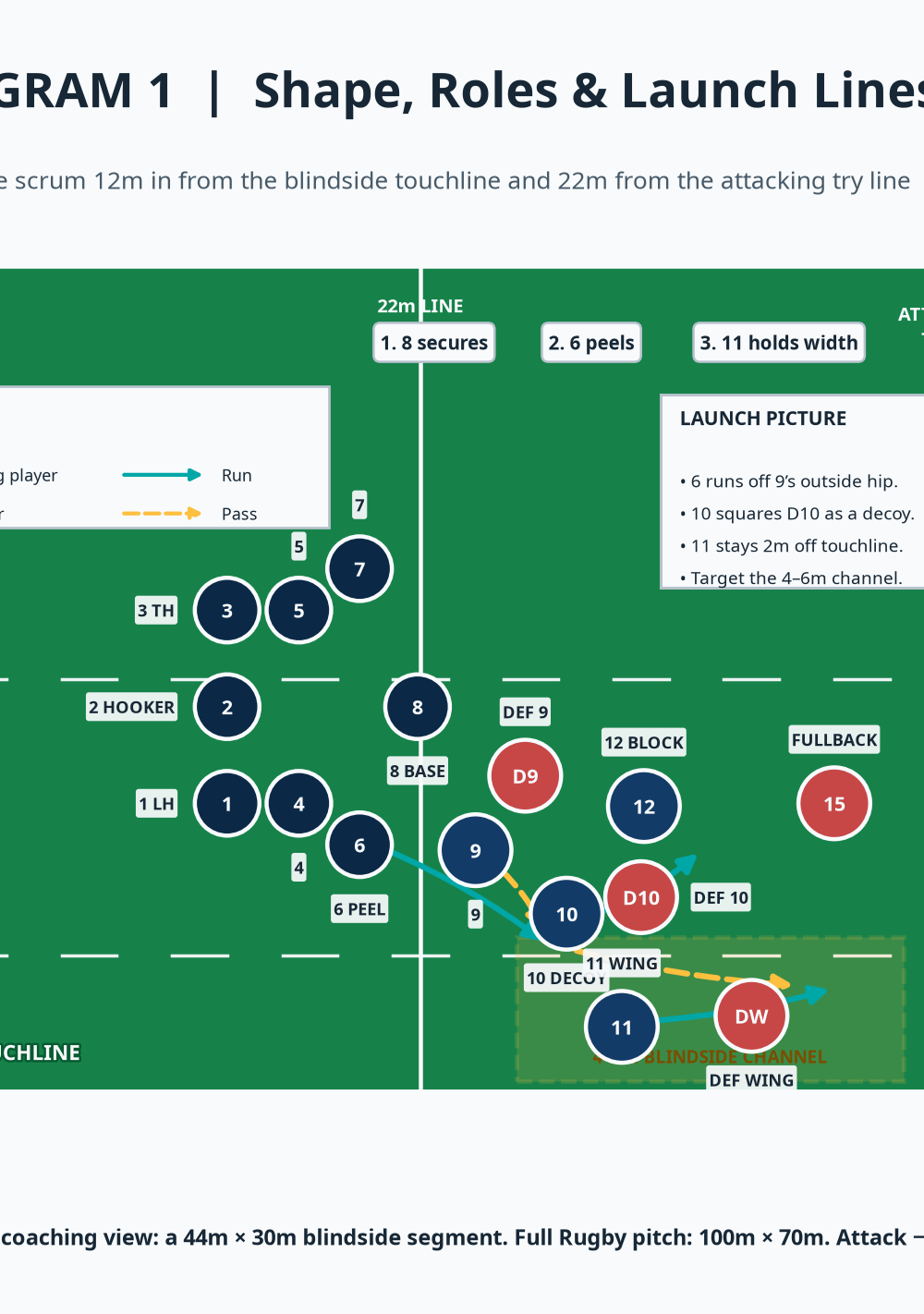
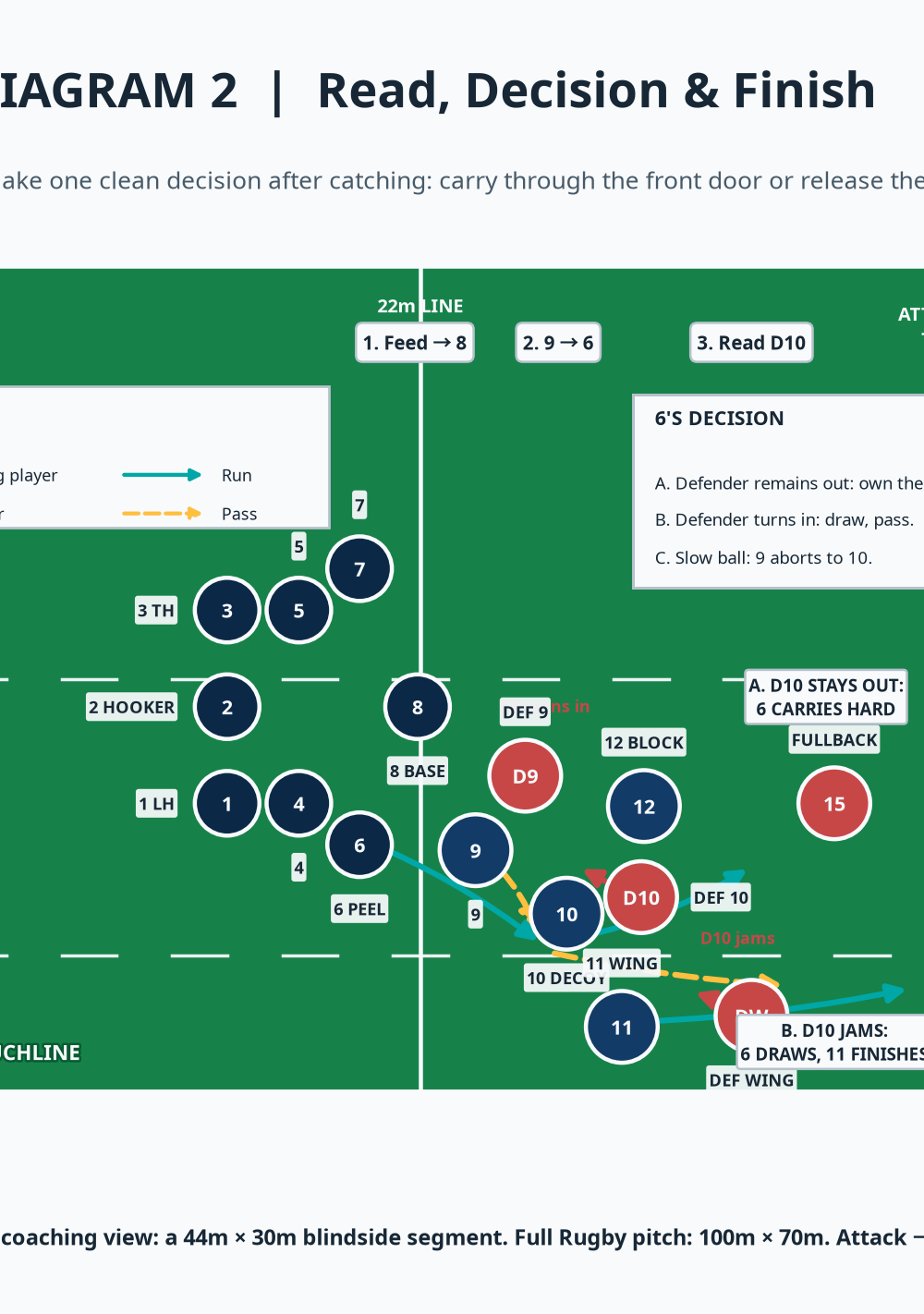
Coach the read, not a pre-planned pass. As 6 receives, their eyes go to the inside shoulder of D10. If D10 stays on 10 or leaves space between themselves and D9, 6 carries hard through that front door. If D10 turns in, jams or plants their feet early, 6 fixes them and passes outside.
Finish accurately. On the pass option, 6 delivers a short, firm pass in front of 11. Wing 11 catches with two hands, stays 2m from the touchline until the ball is secured, then accelerates into the space. The aim is to beat the edge, not to run into touch. If the fullback covers, 11 uses a late inside step and works back toward 9 and 12.
Secure the next phase. If 6 carries, 9 is first arrival inside and 12 is second arrival from the outside. If 11 is tackled, 6 folds behind the ball immediately while 10 clears the first threat. End every rep with a realistic two-player cleanout and a call for the next phase.
Key Coaching Points
| Coaching focus | What to coach on the grass |
|---|---|
| Speed from stable ball | The launch must occur within one second of clean possession, but never at the expense of safety or a legal scrum. |
| 6’s running line | 6 attacks forward and slightly out; do not allow a lateral run that invites the touchline to become another defender. |
| 9’s pass quality | The pass is chest-height, flat and slightly in front. 9 follows their pass rather than admiring it. |
| 11’s patience | The wing waits until 6 has caught. An early run lets the edge defender drift early and closes the channel. |
| Decoy credibility | 10 must run as if they expect the ball. A jog or overrun makes D10’s decision easy. |
| Finish and reload | The play is not finished at the line break. Demand a strong ball presentation, two purposeful arrivals and a loud next-phase call. |
Head-coach message: “We are not throwing the ball blind. We are using 6 to make one defender wrong, then we take the answer that defender gives us.”
Common Mistakes
The first error is 6 peeling too early. This disconnects the pack, telegraphs the play and can create an offside or safety problem. Correct it by making the trigger the first two steps of 9 after the ball is live. The second is a deep or floated pass from 9. Bring the scrum-half closer to the base and insist on a 4–5m flat delivery. The third is 11 crowding the touchline or leaving too soon. Paint a 2m lane with cones and use a freeze-frame check before each live rep.
A fourth common error is 10 drifting rather than fixing D10. Give 10 the task of reaching the defender’s inside shoulder in three steps, then stop and replay if the defender can comfortably slide. Finally, some teams force the pass when the carry is the better answer. Score the drill only when 6 states the read—“stay” or “jam”—after each rep. That builds decision-making instead of choreography.
Variations & Progressions
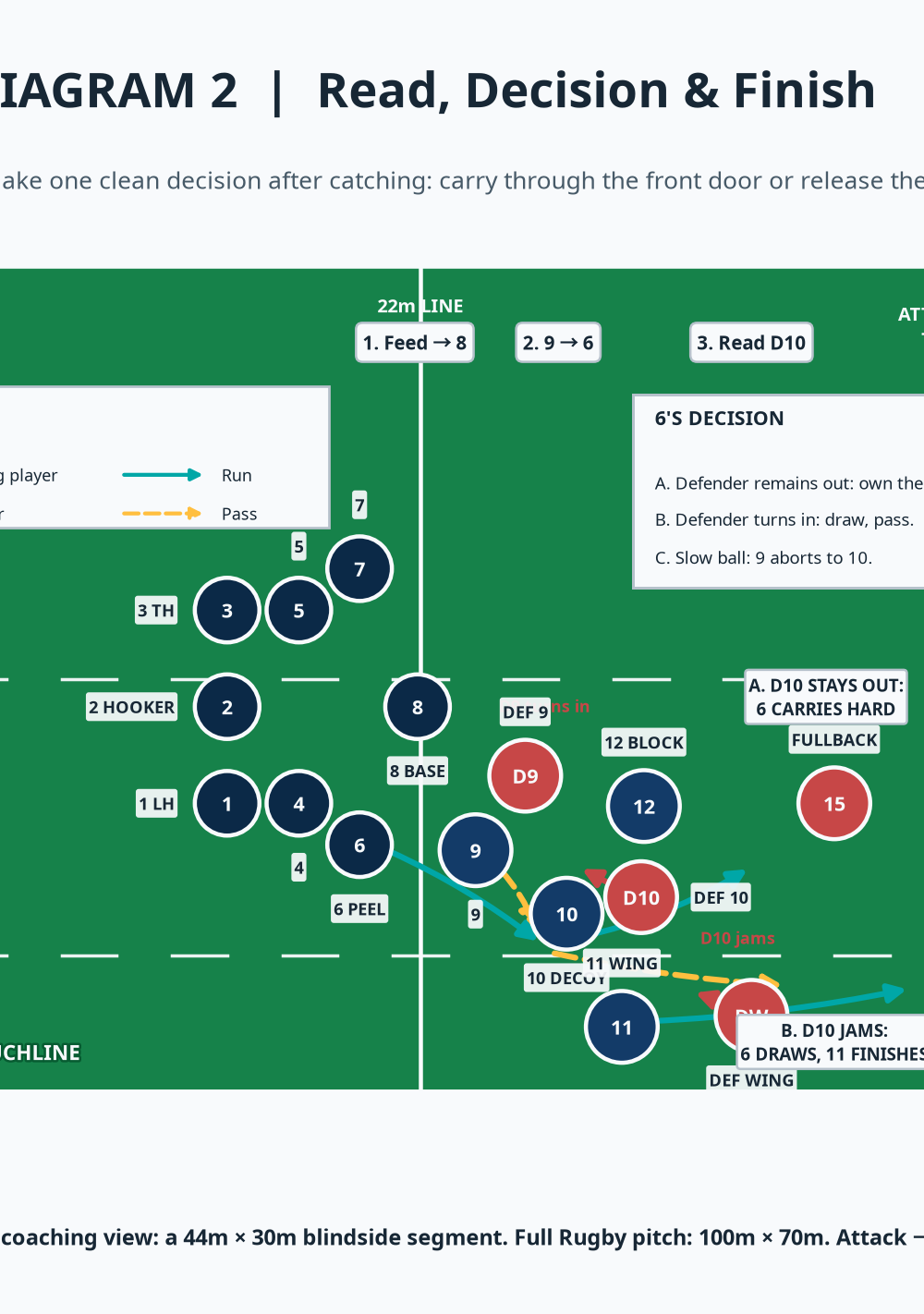
Variation 1: 6 carry plus 9 switch. When D10 stays wide, 6 carries through the front door and gives a short return pass to 9 wrapping underneath. Use this only after the core carry has made defenders bite. Variation 2: 11 unders line. Against a defender who overdrifts, 11 starts wide then cuts underneath 6 for a short ball; keep 12 outside as a safety width option. Variation 3: No. 8 pick bluff. 8 takes one strong step toward the blindside before 9 launches; this can hold the opposing flanker, but it must not delay the clean ball.
Progress from walkthroughs against cones, to a 5v4 edge game with passive defenders, to live defenders who can fold from the far side. The final progression is a 15v15 conditioned game: award two points for a line break created from a blindside scrum, but only if the attack uses the correct read and secures the next ruck.
Age Adaptations
| Age group | Adaptation |
|---|---|
| Under 8 / Under 10 | Use the local modified-game rules and a non-contested restart rather than a live scrum. Practise 9-to-6-to-11 passing and the 2m touchline lane at walking then jogging speed. |
| Under 12 | Use the permitted local scrum format, remove the decoy initially and give 6 one simple choice: carry if the defender is outside, pass if they jam. |
| Under 14 | Introduce the full 6-peel shape only after players can form and exit a safe, stable scrum. Add 10’s decoy and a controlled fullback cover player. |
| Under 16 / Open | Run the complete read with live fold defence, a realistic cleanout and the 9-switch or 11-unders variation. Confirm the competition’s under-19 scrum variations before coaching contested work.2 |