

Basketball
Sideline Inbound: The 'Box' Screen Series vs Man-to-Man
A highly effective sideline out-of-bounds (SLOB) play utilizing a box formation to create multiple scoring options through simultaneous screens against man-to-man pressure.
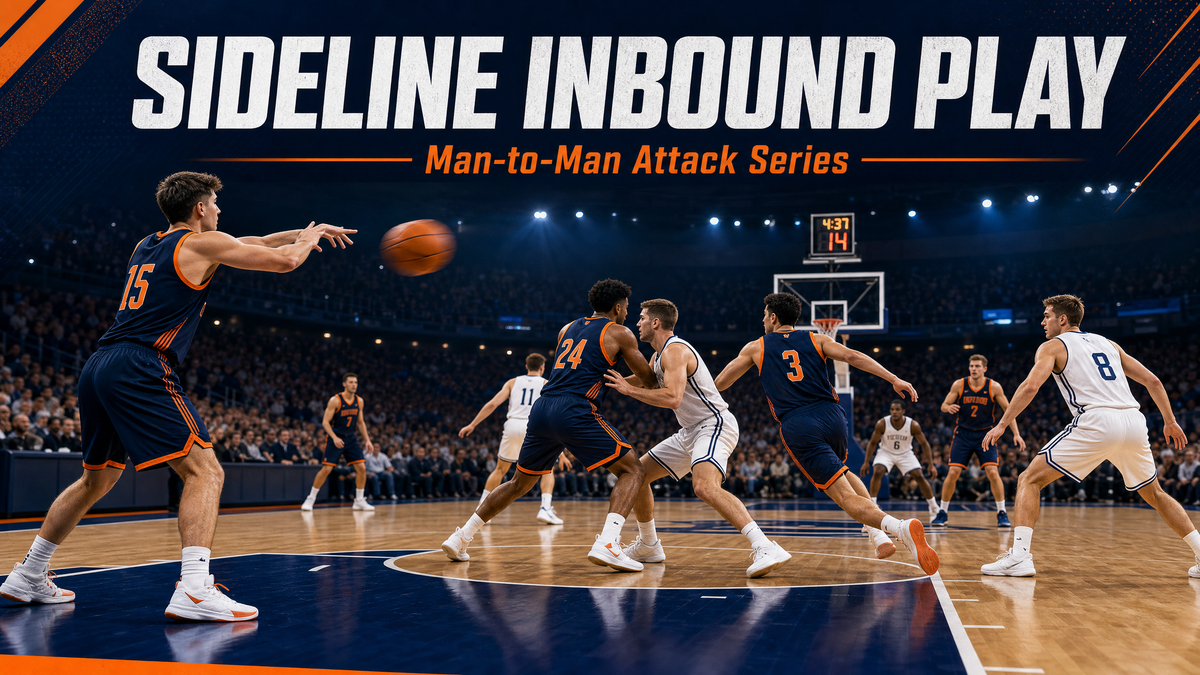
What you need
Basketball, Half-court with FIBA markings
1. Overview
Executing efficiently from sideline out-of-bounds (SLOB) situations is critical for maintaining offensive momentum. The 'Box' Screen Series is a versatile set play designed specifically to attack aggressive man-to-man defense. By utilizing a compact initial formation, this play forces defenders to navigate through traffic, creating immediate advantages.
This play is particularly effective when you need a high-percentage shot late in the shot clock or coming out of a timeout. It leverages simultaneous screening actions—a down screen and a back screen—to force the defense into difficult communication and switching decisions, ultimately yielding either a quick jump shot, a dive to the rim, or an isolation opportunity for your primary ball handler.
2. Setup
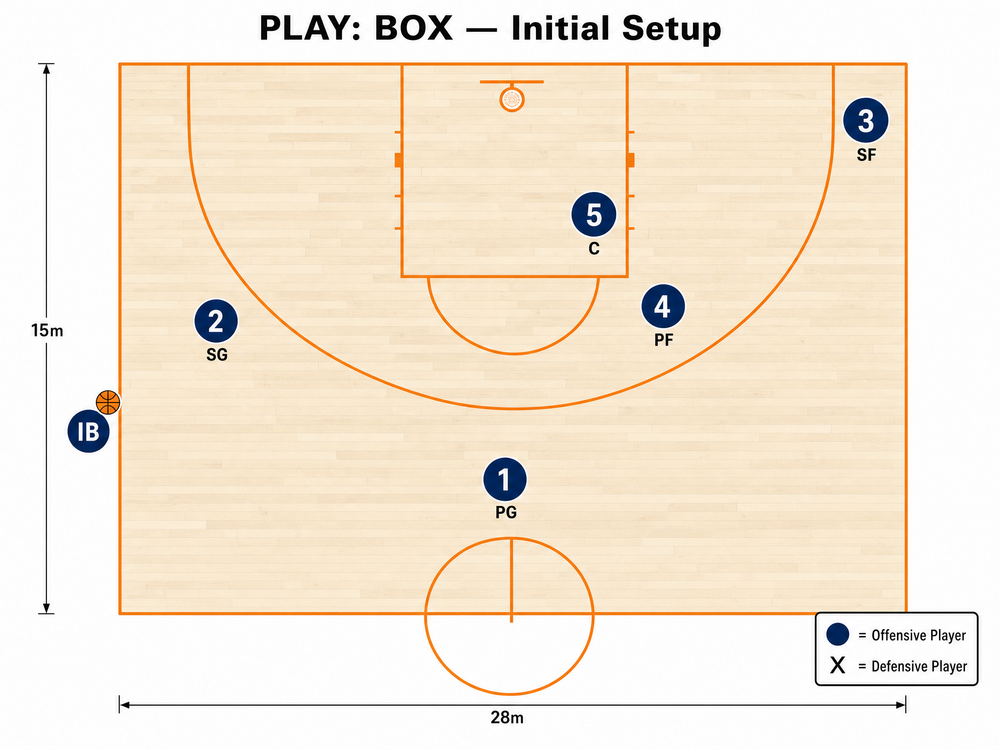
Proper spacing and timing are the foundational elements of this set. The play requires a standard FIBA regulation half-court (28m x 15m).
Player Roles and Initial Positions:
- Inbounder (IB): Usually the 3-man (Small Forward) or a highly capable passer, positioned out of bounds on the sideline at the mid-court extended line.
- Player 1 (PG): Positioned near the mid-court logo area, serving as the safety valve and secondary initiator.
- Player 2 (SG): Positioned on the weak-side wing, just outside the three-point arc.
- Player 3 (SF): Positioned deep in the strong-side corner.
- Player 4 (PF): Positioned at the strong-side elbow (high post).
- Player 5 (C): Positioned at the strong-side low block.
3. Step-by-Step Instructions
This play develops in two distinct phases: the initial screening action to trigger the inbound pass, followed by the secondary continuation if the primary options are covered.
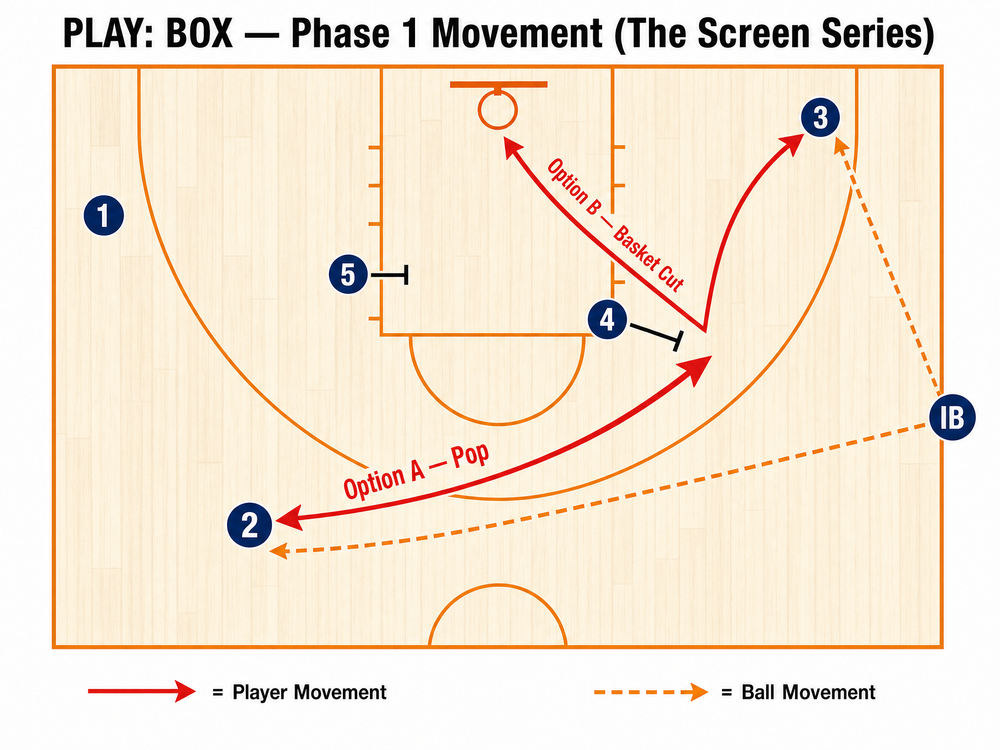
Phase 1: The Screen Series
- The Trigger: The inbounder slaps the ball to initiate the movement. Timing is crucial; the screens must happen simultaneously.
- The Down Screen: Player 5 (C) steps up from the low block to set a hard, legal down screen for Player 2 (SG). Player 2 must wait for the screen, set up their defender with a jab step away, and then cut hard off Player 5's shoulder toward the strong-side corner or wing area. This is the 'Pop' option.
- The Back Screen: Simultaneously, Player 4 (PF) at the elbow turns and sets a back screen for Player 3 (SF) cutting from the strong-side corner. Player 3 cuts aggressively toward the basket. This is the 'Basket Cut' option.
- The Read: The inbounder reads the defense. If Player 2 is open off the down screen, they deliver a crisp chest pass for an immediate jump shot. If the defense cheats or switches poorly on the back screen, the inbounder lofts a lead pass to Player 3 diving to the rim.
Phase 2: Continuation (Secondary Action)
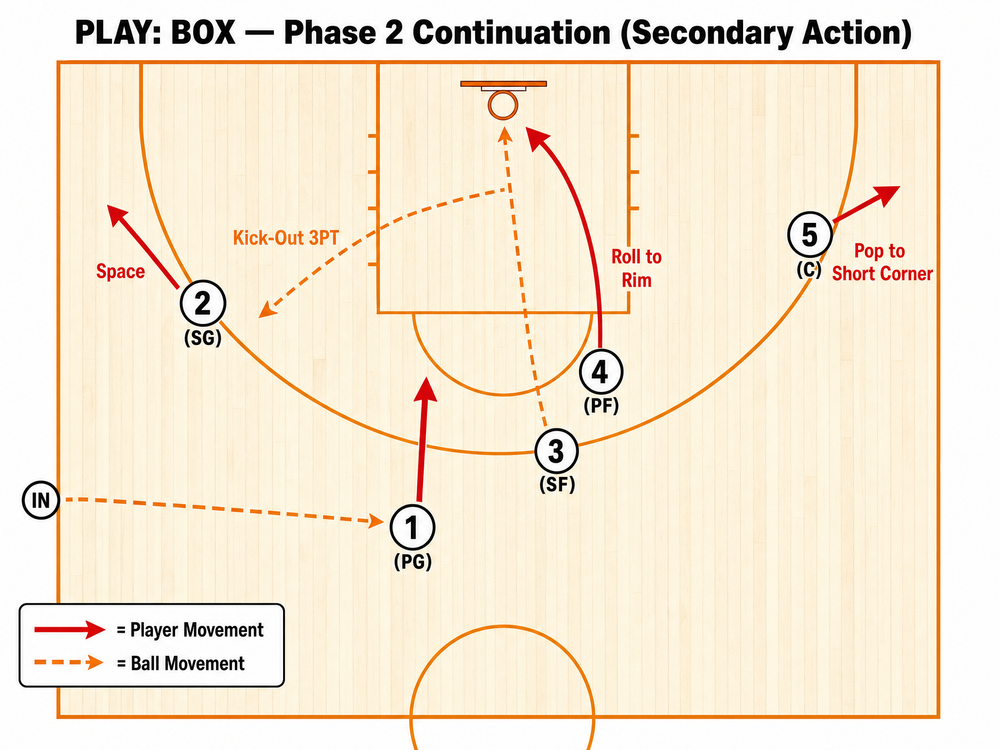
If both primary options (Player 2 popping and Player 3 cutting) are heavily contested, the play flows seamlessly into a secondary action.
- The Safety Valve: The inbounder passes safely to Player 1 (PG) near mid-court.
- The Roll: Immediately after setting the back screen, Player 4 (PF) rolls hard to the front of the rim, sealing their defender.
- The Pop: Player 5 (C), after setting the down screen, pops out to the short corner or mid-post area to clear the lane.
- The Drive and Kick: Player 1 catches the ball and immediately attacks the top of the key off the dribble. Player 1 looks to feed Player 4 on the roll. If the defense collapses, Player 1 kicks the ball out to Player 2 (who has spaced to the weak-side three-point line) or Player 3 (who has relocated after their initial cut).
4. Key Coaching Points
- Screening Angles: The effectiveness of this play hinges on the angles of the screens. Player 5 must ensure their back is facing the sideline to allow Player 2 a clean look at the basket. Player 4 must set the back screen blindly on Player 3's defender, requiring excellent communication.
- Patience on the Cut: Cutters (Player 2 and Player 3) must wait for the screens to be fully set before moving. Premature cuts will lead to offensive fouls or easily navigated screens by the defense.
- Inbounder Vision: The inbounder must not pre-determine their pass. They need to read the defense's reaction to the screens. A fake pass to the 'Pop' option can often open up the 'Basket Cut' option.
- Spacing the Floor: In the continuation phase, Player 2 and Player 5 must quickly space the floor to prevent the defense from clogging the paint against Player 1's drive and Player 4's roll.
5. Common Mistakes
- Moving Screens: Big men (Players 4 and 5) often lean or shift their feet while setting screens, resulting in offensive fouls. Emphasize a wide base and stationary position upon contact.
- Telegraphing the Pass: The inbounder staring down their primary target allows the defense to anticipate and intercept the pass. Use eye fakes and pass fakes.
- Curving the Cut: Player 3 often rounds their cut to the basket instead of making a sharp, straight-line dive. A rounded cut gives the defender time to recover.
- Lack of a Safety Option: Forgetting about Player 1. If the primary options are covered, the inbounder risks a five-second violation if they don't immediately look to the safety valve.
6. Variations & Progressions
- Slip the Screen: If the defense begins aggressively switching the screens, instruct Player 4 or Player 5 to 'slip' the screen (fake the screen and dive immediately to the basket) before contact is made.
- Dribble Handoff (DHO) Entry: Instead of a direct pass to Player 2, the inbounder passes to Player 5 popping to the high post, who immediately executes a dribble handoff with Player 2 wrapping around.
- Elevator Doors: Modify the down screen. Instead of Player 5 screening alone, Player 4 and Player 5 set a double screen (elevator doors) for Player 2 to shoot through.
7. Age Adaptations
- Under 10s / Under 12s: Simplify the play. Remove the back screen entirely. Focus solely on the down screen action (Player 5 screening for Player 2) and emphasize the fundamental skill of waiting for the screen and making a strong chest pass from the sideline.
- Under 14s / Under 16s: Introduce the simultaneous screens, but focus heavily on the 'read and react' element for the inbounder. Emphasize the importance of the safety pass to Player 1 if the primary options are covered to avoid turnovers.
- Open / Advanced: Implement the full play with all variations. Focus on the nuances of screening angles, slipping screens against switches, and the secondary pick-and-roll action between Player 1 and Player 4 in the continuation phase.
