

Football
Slalom Dribble and Finish: Elite Close Control & Striking
Master tight-space dribbling and clinical finishing with this essential slalom drill designed to improve agility and composure in the final third.
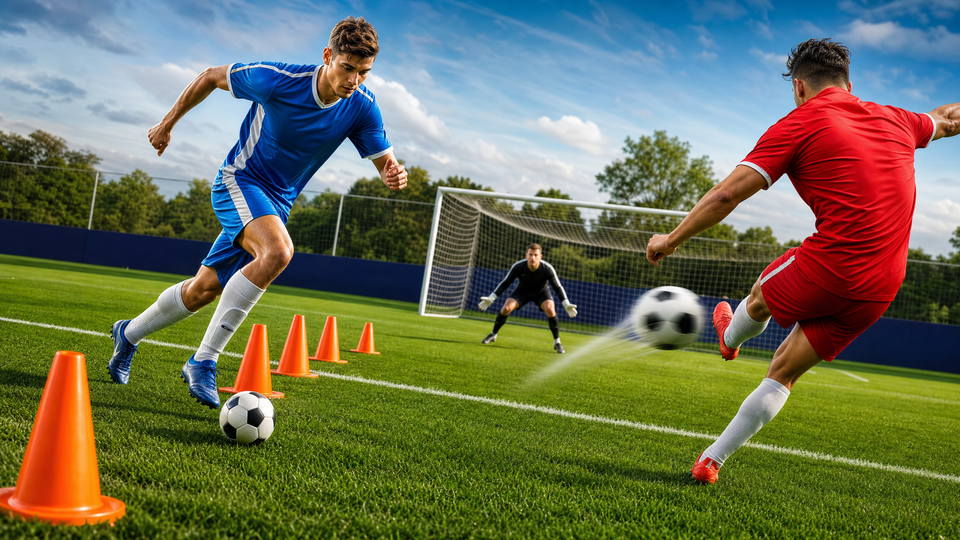
What you need
6-8 Training Cones, 6-10 Footballs, 1 Full-size Goal
1. Overview
The Slalom Dribble and Finish drill is a fundamental attacking exercise designed to improve a player's close ball control, agility, and finishing capability under match-like pressure. This drill simulates the scenario of a forward or winger navigating through a tight defensive block before executing a quick shot on goal. It is highly effective for developing a player's ability to keep their head up while dribbling, allowing them to assess the goalkeeper's position and choose the appropriate finishing technique. Coaches should use this drill during the technical phase of a session or as a precursor to more complex attacking phases of play.
2. Setup
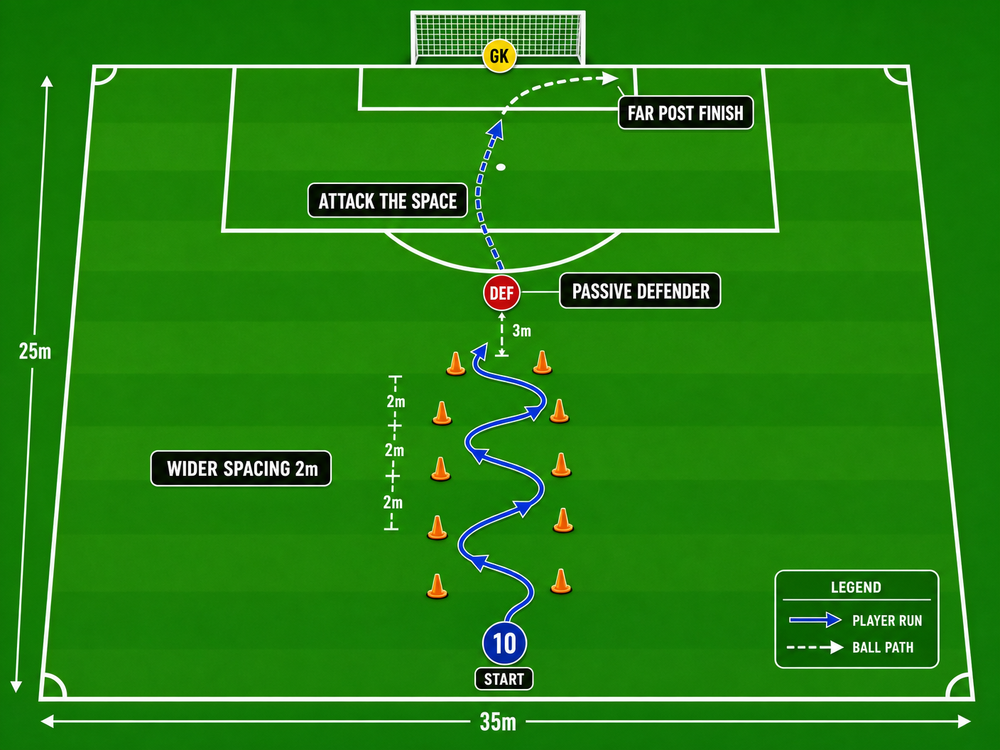
To set up this drill, you will need a standard pitch area of approximately 30m x 20m, focusing on the attacking third leading into the penalty area.
Equipment Needed:
- 6-8 training cones (preferably orange for high visibility)
- An adequate supply of footballs (at least 6-10 to maintain flow)
- 1 full-size goal
- Bibs (optional, for variations)
Pitch Setup:
- Position a starting marker approximately 25-30m from the goal line, centrally aligned with the goal.
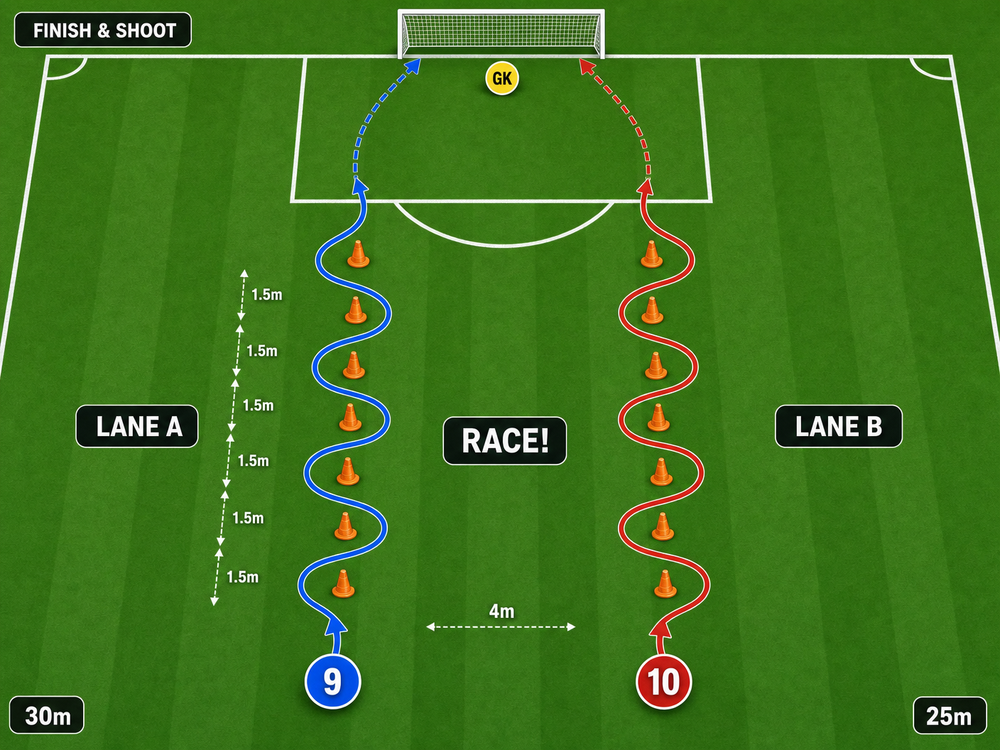
- Arrange 6 cones in a straight vertical line, spacing them exactly 1.5m apart. This creates the slalom course.
- Ensure the final cone is positioned just outside the penalty arc, giving the player enough space to take a touch and shoot.
- Station a goalkeeper in the goal.
Player Positions:
- Attacker (e.g., No. 9, No. 10, No. 7, No. 11): Forms a queue at the starting marker with a ball each.
- Goalkeeper (GK): Starts on the goal line, ready to react to the shot.
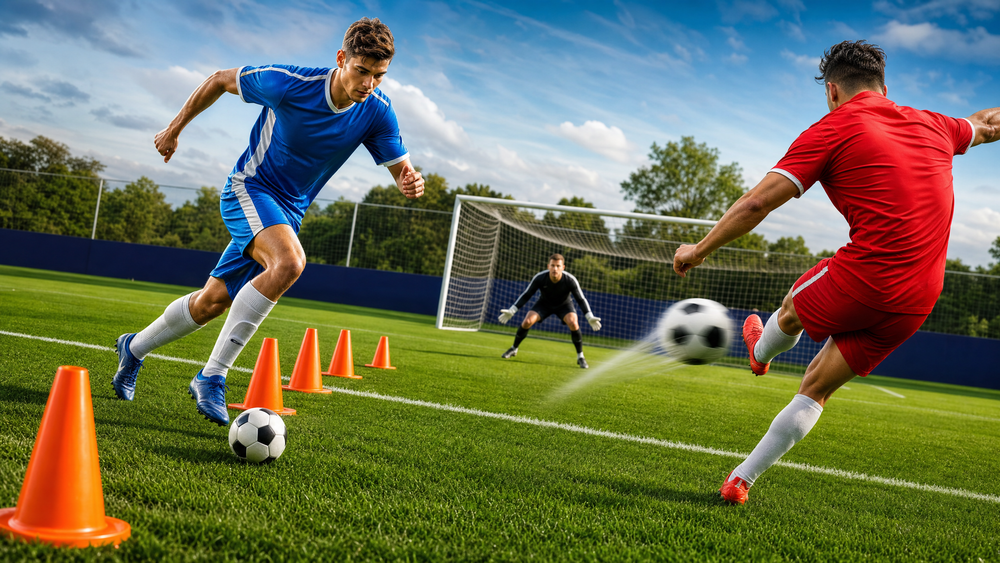
3. Step-by-Step Instructions
- The Approach: The first player in the queue begins by dribbling the ball toward the first cone at a controlled, moderate pace.
- The Slalom: The player weaves in and out of the cones, using quick, small touches. They should alternate between the inside and outside of both feet to navigate the tight spaces efficiently.
- The Exit: Upon passing the final cone, the player must take a slightly heavier touch out of their feet and into the designated "Shooting Zone" (the space just outside the penalty area).
- The Assessment: As the player takes that heavier touch, they must quickly glance up to observe the goalkeeper's positioning.
- The Finish: Without breaking stride, the player strikes the ball firmly, aiming for either the bottom corners or the top corners, depending on the goalkeeper's stance.
- The Reset: After the shot, the player retrieves their ball (if missed) or jogs back to the start of the queue. The next player begins their run as soon as the previous player takes their shot.
4. Key Coaching Points
- Close Control: Emphasize keeping the ball within playing distance (no more than half a meter away) during the slalom phase. Small, rapid touches are crucial.
- Use of Both Feet: Encourage players to use the inside and outside of both feet, rather than relying solely on their dominant foot. This promotes unpredictability and better balance.
- Head Up: Players must learn to scan their surroundings even while dribbling. They should peek up between touches to assess the goal and the goalkeeper.
- The Setup Touch: The touch exiting the final cone must be purposeful. It should push the ball out of the feet just enough to allow for a clean, powerful strike without needing to break stride.
- Finishing Technique: Focus on accuracy over raw power. Instruct players to use the inside of the foot for placed shots into the corners, or the laces for power if the goalkeeper is caught off guard.
5. Common Mistakes
- Looking Down: Players often stare exclusively at the ball while dribbling, leading to a rushed or blind shot at the end of the slalom.
- Heavy Touches in Slalom: Taking touches that are too large will cause the player to lose control and disrupt the rhythm of the dribble, making it difficult to set up the shot.
- Slowing Down to Shoot: A common error is stopping or significantly decelerating before taking the shot. The transition from dribbling to shooting should be fluid and dynamic.
- Leaning Back: When striking the ball, players sometimes lean back, causing the shot to sail over the crossbar. Remind them to keep their chest and knee over the ball.
6. Variations & Progressions
Variation 1: The Dual Lane Race
To introduce a competitive element, set up two identical slalom courses side-by-side (about 4m apart). Two players start simultaneously and race through the cones. The first player to finish their shot scores a bonus point, encouraging speed under pressure.
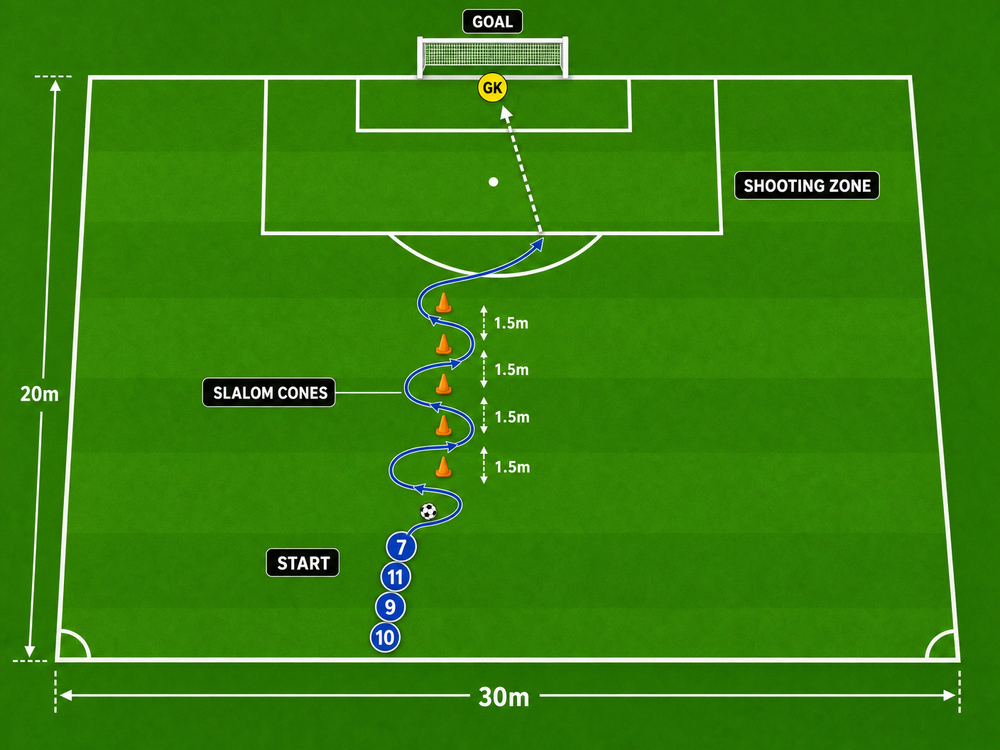
Progression 1: The Passive Defender
Increase the difficulty by adding a passive defender just after the final cone. The attacker must now perform a specific skill move (e.g., a step-over or a feint) to beat the defender before taking the shot.
7. Age Adaptations
- Under-8 to Under-10: Widen the gap between the cones to 2m or 2.5m to allow for larger touches. Focus purely on the mechanics of dribbling and making contact with the ball for the shot, rather than accuracy.
- Under-12 to Under-14: Keep the 1.5m cone spacing but introduce time limits. Require players to complete the slalom and shoot within a specific number of seconds.
- Under-16 to Open: Implement the progressions, such as adding an active defender who can tackle after the final cone, simulating a high-pressure match scenario.
