

Cricket
Slip Catching & Reaction Drill: Building the Ultimate Cordon
Master the art of slip fielding with this comprehensive drill focused on stance, reaction time, and soft hands for taking crucial edges.
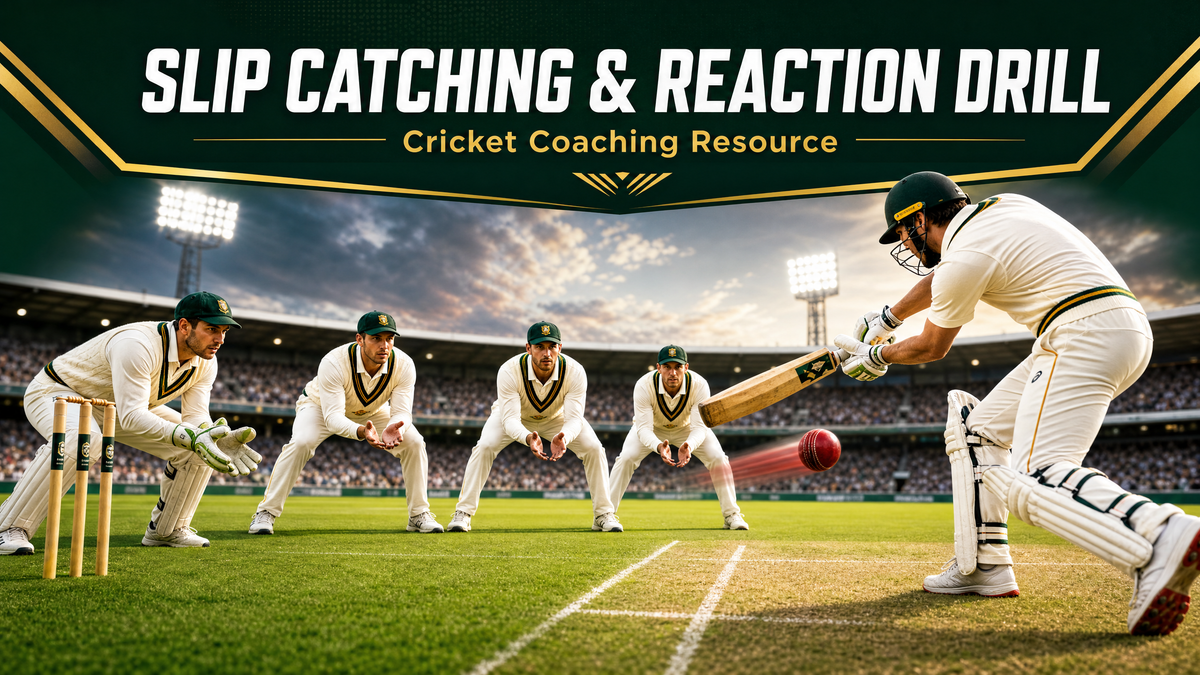
What you need
6-8 high-quality cricket balls, 1 Cricket bat or slip-catching ramp/cradle, Marker cones, Wicketkeeping gloves
Slip Catching & Reaction Drill: Building the Ultimate Cordon
Slip catching is arguably the most specialized fielding position in cricket. A single dropped catch in the cordon can change the entire trajectory of a match. This drill is designed to sharpen the reflexes, improve lateral movement, and build the soft hands required to take sharp edges consistently.
1. Overview
The Slip Catching & Reaction Drill focuses on the crucial elements of slip fielding: stance, anticipation, lateral movement, and hand-eye coordination. It simulates the high-speed, unpredictable nature of edges off the bat.
When to use it: This drill is perfect for the middle or end of a fielding session. It serves as an excellent warm-up before a match or as a focused skill-development block during weekly training.
2. Setup
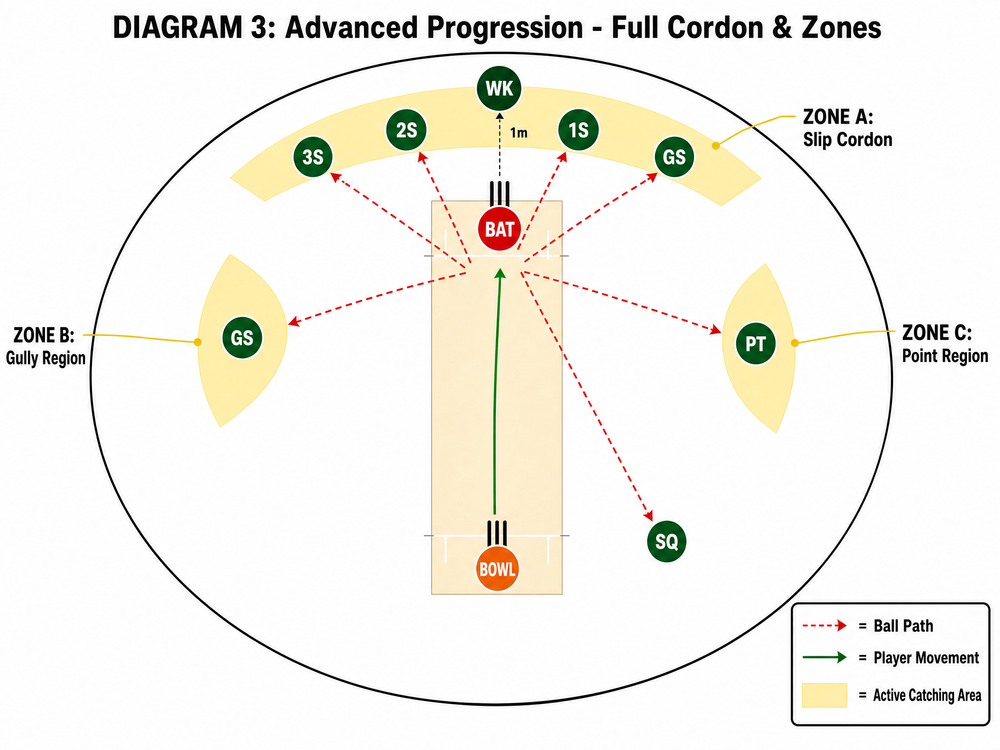
Proper setup is essential to replicate match conditions. The distances must be accurate to ensure players have the correct reaction time.
Equipment Needed:
- 6-8 high-quality cricket balls (a mix of new and slightly used)
- 1 Cricket bat or a specialized slip-catching ramp/cradle
- Marker cones (optional, for setting distances)
- Wicketkeeping gloves (for the WK)
Pitch & Field Setup:
Set up on a flat, grassy surface, ideally on the edge of the square or in the outfield.
- Place a set of stumps (or a single stump) to act as the focal point.
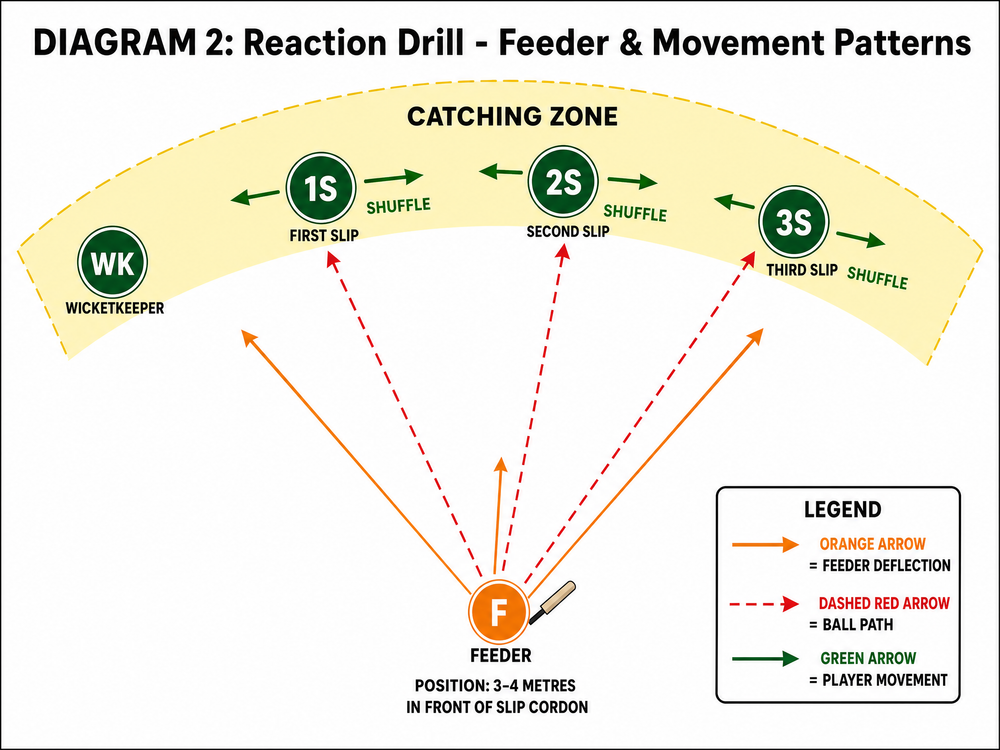
- The Feeder (F) stands approximately 3 to 4 metres in front of the slip cordon, simulating the position of the batsman.
- The Wicketkeeper (WK) crouches approximately 1 metre behind the stumps.
- First Slip (1S) sets up 1.5 metres to the right of the WK (for a right-handed batsman).
- Second Slip (2S) sets up 1.5 metres to the right of 1S.
- Third Slip (3S) sets up 1.5 metres to the right of 2S.
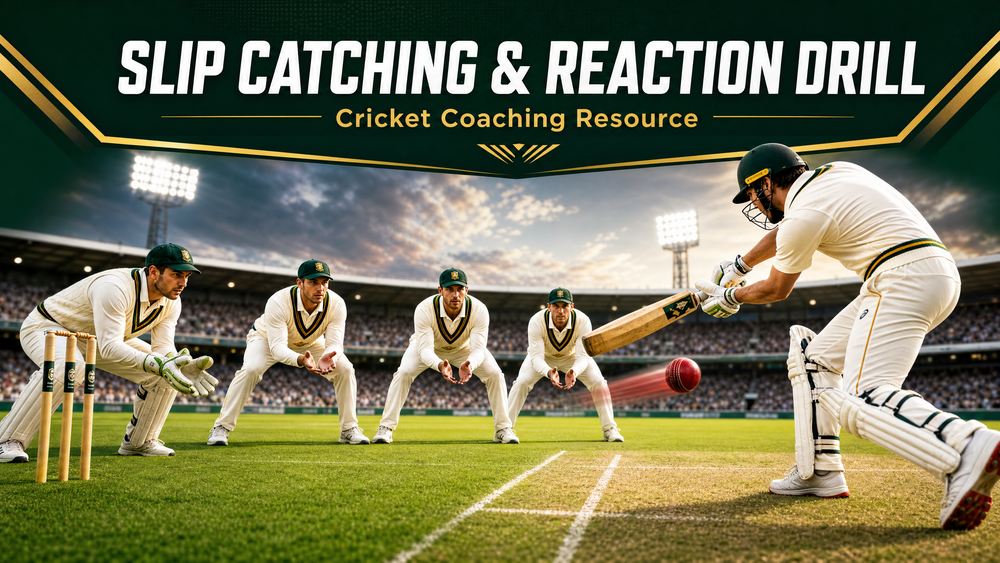
The diagram above illustrates the precise spacing required for a standard slip cordon.
3. Step-by-Step Instructions
Follow these steps to execute the drill effectively. Start slowly to ensure technique is correct before increasing the speed of the deliveries.
- Assume the Stance: All fielders in the cordon must adopt an athletic 'ready' position. Knees bent, weight slightly forward on the balls of the feet, hands out in front, and eyes focused on the feeder's bat or hand.
- The Trigger Movement: As the feeder prepares to strike or throw the ball, the fielders should execute a small, synchronized 'trigger' movement (usually a slight dip or a small step forward) to ensure their weight is moving towards the ball.
- The Feed: The feeder strikes the ball firmly, aiming to create 'edges' that fly towards the cordon. The feeder should vary the pace, height, and direction of the catches.
- Reaction and Catch: The designated fielder tracks the ball, moving their head towards the line of the ball. They must catch the ball with 'soft hands', giving with the impact to prevent the ball from bouncing out.
- The Return: The fielder cleanly returns the ball to the feeder or a designated bucket, immediately resetting their stance for the next delivery.
- Rotation: After a set number of catches (e.g., 6-10), rotate the players through the positions (WK -> 1S -> 2S -> 3S) to ensure everyone experiences different angles.
Notice the lateral shuffle movement required to cover the gaps between fielders.
4. Key Coaching Points
As a coach, focus your feedback on these critical technical aspects:
- Low and Stable Base: Players must stay low. It is always easier to move up to catch a high ball than to drop down quickly for a low catch. The head must remain steady.
- Soft Hands: The hands should 'give' with the ball upon impact. Instruct players to imagine catching a water balloon; snatching at the ball will cause it to pop out.
- Weight Forward: The weight must be on the balls of the feet. If a player is back on their heels, they will not be able to react quickly enough to diving catches.
- Watch the Ball into the Hands: Players must keep their eyes on the ball until it is securely in their hands. A common error is looking up too early to see what happens next.
- Fingers Pointing Down: For catches below waist height, the fingers must point towards the ground. This creates a larger surface area and prevents the ball from bursting through the hands.
5. Common Mistakes
Watch out for these frequent errors and correct them immediately:
- Standing Too Upright: This reduces reaction time and makes low catches incredibly difficult. Correction: Reinforce the 'knees bent, chest over toes' posture.
- Snatching at the Ball: Pushing the hands out aggressively towards the ball. Correction: Emphasize 'giving' with the ball and catching it close to the body.
- Drifting: Fielders slowly moving out of position or losing their spacing between deliveries. Correction: Use marker cones initially to enforce the 1.5m spacing.
- Taking the Eye Off the Ball: Looking away just before the ball enters the hands. Correction: Drill the mantra "watch it all the way in".
6. Variations & Progressions
Once the basic drill is mastered, introduce these variations to increase the challenge:
- The Deflection Ramp: Use a slip-catching cradle or a ramp instead of a bat. The unpredictable bounce off the uneven surface perfectly simulates thick and thin edges.
- Rapid Fire: The feeder hits balls in quick succession, forcing the fielders to react, catch, drop the ball, and reset almost instantly.
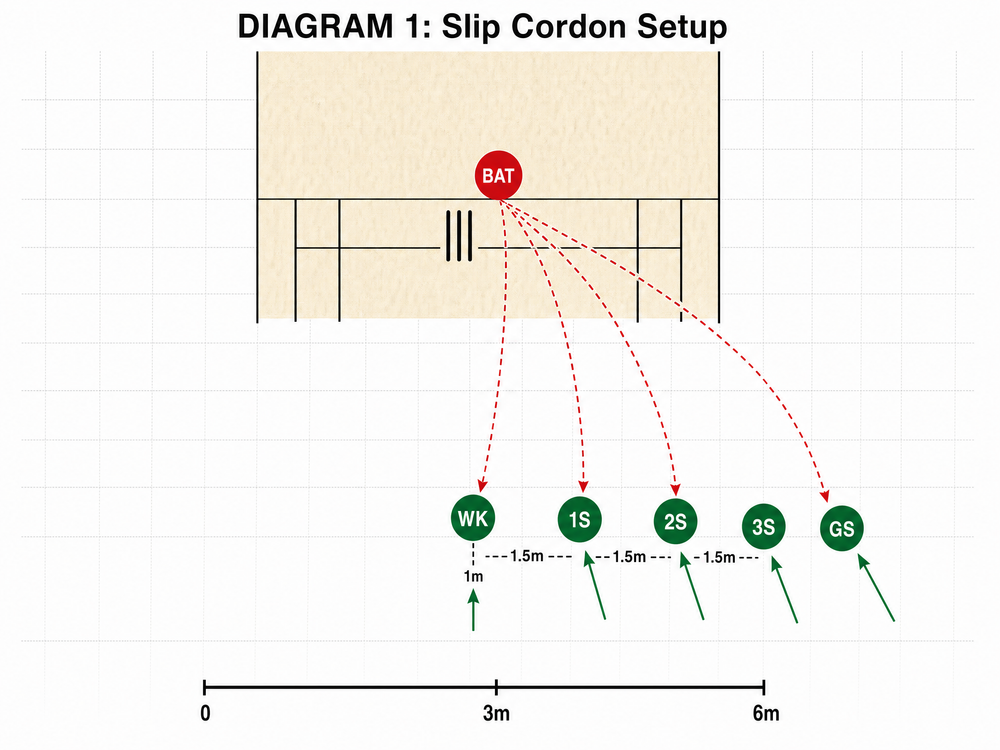
- Live Edge Catching (Advanced): Move the drill to the middle. Have a bowler bowl to a batsman who is instructed to intentionally edge the ball. This provides the most realistic match simulation.
The advanced progression integrates the cordon into a full-field scenario.
7. Age Adaptations
Tailor the drill to suit the developmental stage of your players:
- Under 10s: Use softer incrediballs or tennis balls. Focus heavily on the basic catching technique (cup shape) and standing in the correct position. Keep the feed slow and predictable.
- Under 14s: Introduce harder practice balls (like a 'Kookaburra Super Coach'). Focus on the trigger movement and staying low. Begin to introduce slight lateral movement.
- Under 16s & Open: Use match-quality leather balls. The feed should be fast and unpredictable. Emphasize diving catches and rapid reaction times. Introduce the deflection ramp.
