

Rugby
The 'Strike' Play: Attacking Backs Move Off First Phase
A highly effective first-phase attacking move designed to manipulate the defensive line, isolate a defender, and unleash your outside backs into open space.

What you need
Rugby balls, Cones (for marking defensive alignments in practice), Bibs (for differentiating attack and defense)
1. Overview
The 'Strike' Play is a dynamic first-phase attacking move designed to be launched from a solid scrum or lineout platform. Its primary objective is to create a numerical advantage or a favorable one-on-one mismatch in the wider channels. By utilizing a hard decoy line from the Inside Centre (12) and a delayed insertion from the Fullback (15), this play aims to freeze the drift defense, forcing defending players to commit inwards and opening up crucial space on the outside for the Outside Centre (13) or Wingers.
This move is particularly effective when the opposition's defensive line is aggressive but lacks lateral connection, or when you have a dominant ball-carrying 12 who naturally draws multiple defenders.
2. Setup
Pitch Location: Best utilized between the two 15-metre lines, ideally just outside your own 22-metre line or in the middle third of the pitch where there is ample space on the open side.
Player Positions:
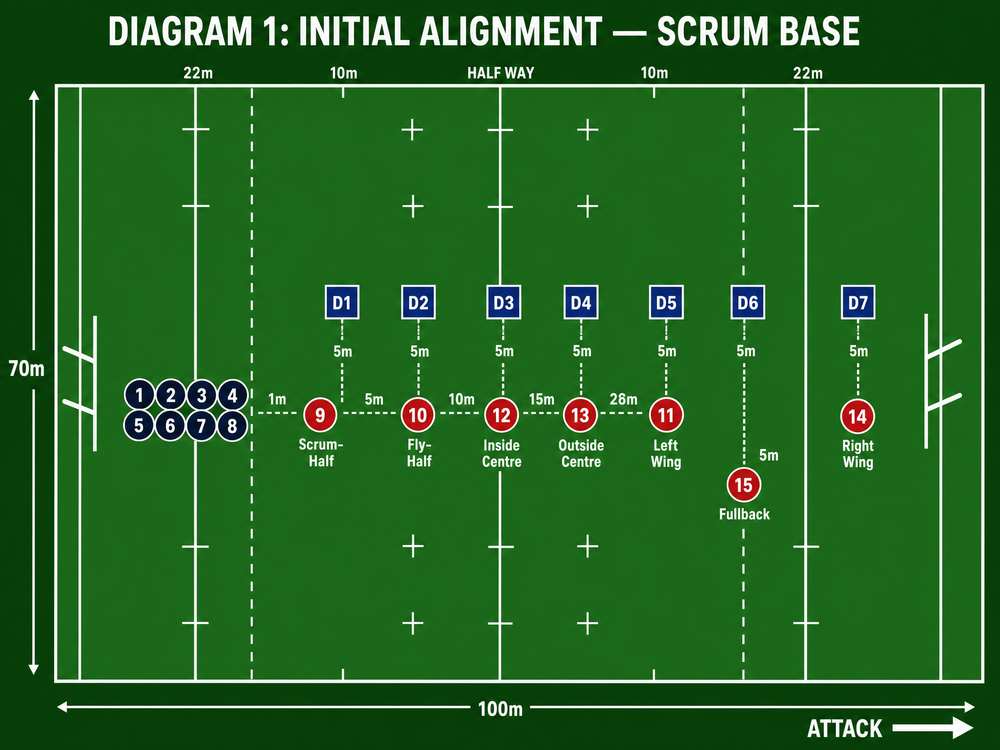
- Scrum-Half (9): Positioned at the base of the scrum, ready to deliver a fast, flat pass.
- Fly-Half (10): Standing 5-7 metres deep, aligned slightly wider than usual to encourage the defense to spread.
- Inside Centre (12): Positioned relatively flat, ready to hit a hard, aggressive line back towards the gain line.
- Outside Centre (13): Starting slightly deeper and wider than the 12, ready to run a sweeping arc.
- Fullback (15): Positioned deep and hidden behind the 10-12 channel, ready to inject pace into the line.
- Wingers (11 & 14): Holding width to stretch the defensive line.
3. Step-by-Step Instructions
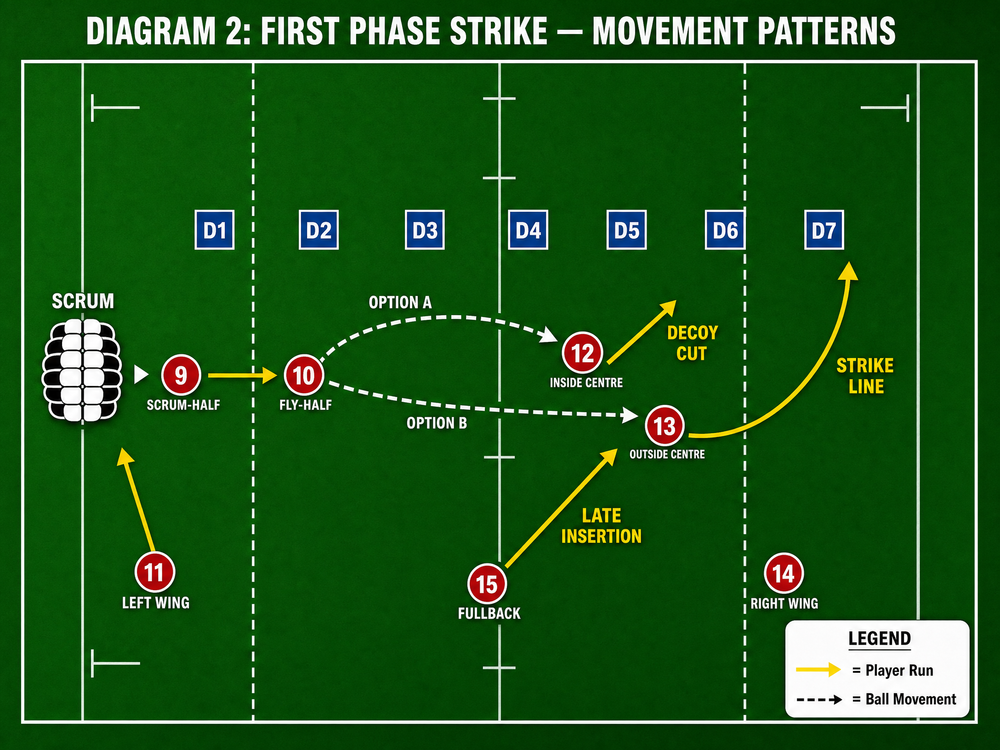
- The Platform: The forwards secure clean, quick ball from the scrum. The Scrum-Half (9) clears the ball rapidly to the Fly-Half (10).
- The Threat: The Fly-Half (10) catches the ball moving forward, immediately squaring up the opposing defender (D2) to fix them in place.
- The Decoy: The Inside Centre (12) runs a hard, convincing 'cut' line at a 45-degree angle back towards the breakdown, targeting the inside shoulder of their opposite number (D3). They must call for the ball loudly and run as if they are receiving it.
- The Decision: The Fly-Half (10) reads the defense. If D3 bites hard on the decoy run of 12, the space opens out wide.
- The Strike: The Fly-Half (10) throws a crisp skip pass across the face of the decoy (12) directly to the Outside Centre (13).
- The Arc: The Outside Centre (13) receives the ball on the move, running a wide, sweeping arc to get on the outside shoulder of their defender (D4), looking to break the line or draw the next defender (D5).
- Support: The Wingers and Fullback track the play, ready to receive an offload or secure the subsequent breakdown.
4. Key Coaching Points
- Conviction in the Decoy: The success of this play hinges entirely on the Inside Centre (12). If they do not run their line with 100% conviction, the defense will simply drift past them. They must demand the ball and brace for contact.
- Squaring Up: The Fly-Half (10) must attack the line before passing. Drifting sideways before passing allows the defense to slide easily and neutralizes the threat.
- Pass Accuracy: The skip pass from 10 to 13 must be flat, fast, and hit the receiver in stride. A looping or inaccurate pass gives the defense time to recover.
- Timing of the Run: The Outside Centre (13) must time their run perfectly. If they are too early, they overrun the pass; if they are too late, they receive the ball static.
5. Common Mistakes
- Telegraphing the Pass: The Fly-Half looking directly at the Outside Centre before throwing the skip pass, allowing the defense to read the play early.
- Shallow Alignment: The backline starting too flat, giving themselves no time or space to execute the complex movements before the defense closes them down.
- Poor Decoy Execution: The Inside Centre jogging their line or looking away from the ball carrier, failing to commit the defender.
- Lateral Running: The Outside Centre running sideways rather than aggressively attacking the outside shoulder of their defender.
6. Variations & Progressions
Variation 1: The Inside Pop
If the defense begins to read the skip pass and drifts early, the Fly-Half (10) can simply pop the ball short to the Inside Centre (12) hitting the hard line. This keeps the defense honest.
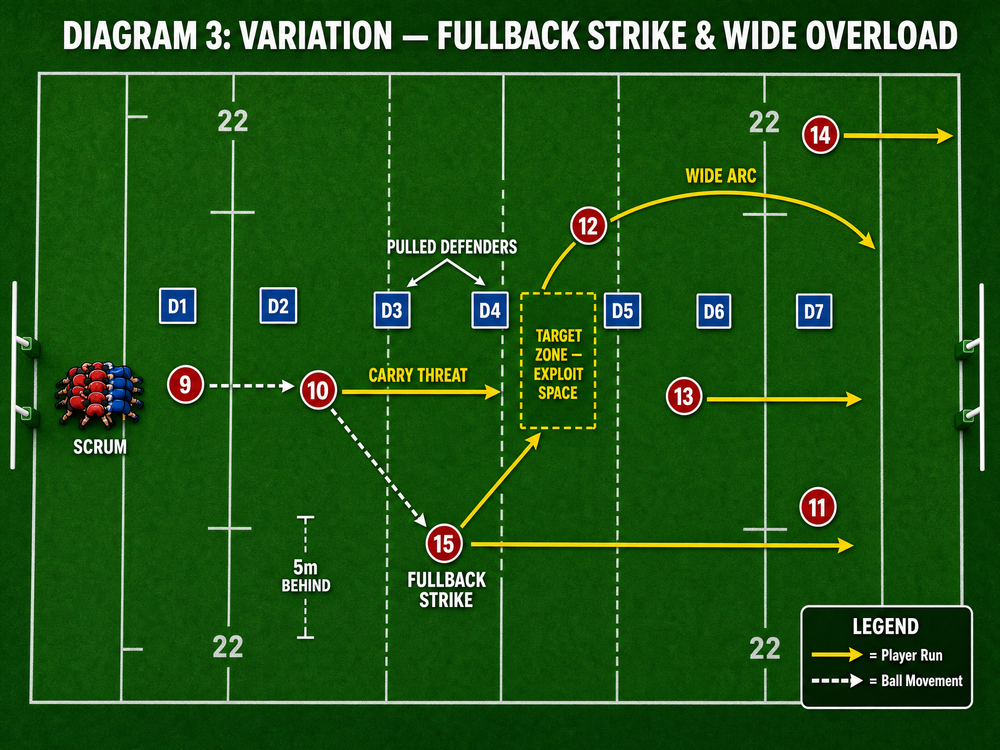
Variation 2: Fullback Insertion (The 'Overload')
Instead of a skip pass to 13, the Fullback (15) injects themselves into the line between 10 and 12 at pace. The Fly-Half passes to the Fullback, creating a sudden 3-on-2 overload in the midfield.
7. Age Adaptations
- Under 10s / Under 12s: Simplify the move. Focus on the basic hands and straight running. Remove the skip pass and have the 10 pass to 12, who passes to 13. Emphasize catching and passing on the move.
- Under 14s / Under 16s: Introduce the decoy runner. Spend significant time ensuring the 12 understands how to run a convincing dummy line. Practice the skip pass under minimal pressure before introducing live defenders.
- Open / Senior: Execute the full play at game speed. Introduce the variations based on defensive reads. Focus on the micro-skills: the speed of the 9's pass, the squaring up of the 10, and the precise timing of the 15's insertion.
